

 Free Consultation
 PCI-DSS Compliant
 GDPR Ready
 ISO 27001
 NDA Protected
 AI Services
 AI App Development
 Generative AI Development
 AI Chatbot Development
 AI Integration Services
 AI Consulting Services
 AI For Fintech
 AI Financial Assistant Solution
 AI Insurance Agent Development
 Tech Stack
 OpenAI / GPT-4
 Claude / Anthropic
 Gemini / Google AI
 Llama / Open Source
 LangChain / LlamaIndex
 Pinecone / Pgvector
 AWS / Azure AI


 Fintech Solution
 Core Fintech
 App Development
 Neobank Solutions
 eWallet Solutions
 Lending Software
 Banking Solutions
 BNPL Solutions
 BNPL Solutions
 Insurance App
 Wealth Management
 Crypto & DeFi
 Blockchain Development
  Payroll Software
 DeFi Solutions
 Crypto Wallet
 Crypto On/Off Ramp
 Crypto Exchange
 Trading Platform
 Payments
 Compliance
 Regulations & Compliance
 Fraud Detection
 Lending Ecosystem
 P2P Lending Platform
 Mortgage Software
 Engagement
 Fintech Outsourcing

 Mobile Development
 Mobile App Dev
 iOS App Development
 Android App Development
 React Native
 Flutter Development
 Web Solution
 Node.js Development
 React.js Development
 Angular Development
 App Services
 UI/UX Design
 App Maintenance
 By Stage
 MVP Development
 Industry Solutions
 Healthcare App Dev
 Education App Dev
 Travel App Dev
 Real Estate App Dev
 Logistics Software
 Social Media App

 Hire Mobile Developers
 Hire iPhone Developers
 Hire Android Developers
 Hire React Native Devs
 Hire Flutter Developers
 Hire Web Developers
 Hire Node.js Developers
 Hire Angular Developers
 Hire PHP Developers
 Hire Laravel Developers
 How It Works
 Pre-Vetted Developers
 Ready In 48 Hours
 NDA From Day One
 Replace Guarantee
 Company
 About Us
 Our Work Process
 Portfolio
 Case Studies
 Blog / Insights
 Careers
 Contact Us
 Awards
 Recognition


 Offices


TL;DR
- In well-built wallets, the biometrics check the device and unlock a cryptographic key. The app never receives the fingerprint or face data.
- Passkeys (FIDO2) are the standard way to combine biometrics with phishing-resistant sign-in. FIDO reports more than 5 billion passkeys in use globally.
- The biggest new threats are deepfakes and injection attacks, mainly in remote face verification during onboarding.
- Biometric data is legally sensitive. BIPA, GDPR, and PSD2 each add duties.
- Biometrics prove who is holding the phone, not that the payment is genuine. Scams still need separate controls.
- Nimble AppGenie helps businesses build secure digital wallets with biometric authentication, passkey integration, risk-based payment approval, and recovery workflows tailored to their users and target markets.
Biometric authentication in wallets allows users to unlock the app, sign transactions, and approve payments with a fingerprint or face scan instead of a password. If done well, it is faster and harder to phish, and if done badly, it creates privacy exposure, deepfake gaps, and recovery problems. This guide explains how it works, where the risks lie, which rules apply, and how to build it properly.
What Is Biometric Authentication in a Wallet?
Biometric authentication in a wallet confirms a user’s identity through a behavioral or physical trait before the wallet unlocks, approves a payment, or signs a transaction. It generally replaces or supplements a password or PIN.
Key Terms to Know
| Term | Plain-English meaning |
| Biometric template | The mathematical representation of a fingerprint or face, not the raw image. |
| Secure enclave / keystore | Protected hardware area on the phone where keys and biometric matching are handled. |
| Passkey (FIDO2 / WebAuthn) | A phishing-resistant credential. A biometric or PIN unlocks a private key that never leaves the device or credential manager. |
| Liveness detection | A check that the biometric sample comes from a live person, not a photo, video, or mask. |
| Presentation attack | Spoofing a sensor with a fake face, print, or replay. |
| Injection attack | Feeding fake video or data directly into the software, bypassing the camera. |
| Strong customer authentication (SCA) | The EU/UK PSD2 requirement for two independent factors on many payments. |
| MPC / smart-account wallet | Wallet designs that split or program key control, often unlocked by a passkey or biometric. |
Common Biometric Types in Wallets
| Type | Typical use | Main weakness |
| Fingerprint | App unlock, payment approval | Sensor quality varies; some devices lack it |
| Face recognition | App unlock, onboarding selfie checks | Deepfakes and injection attacks if liveness is weak |
| Voice | Support and call-center verification | Easy to clone with AI; weak as a sole factor |
| Behavioral signals | Background risk scoring (typing, swipe patterns) | Probabilistic, can create false positives |
How Does Biometric Authentication Work Inside a Wallet?
The device checks the biometric locally, then releases a stored cryptographic key to sign a login or transaction. The wallet backend verifies the signature, so the biometric itself is not sent or stored by the app provider.
On-Device vs Server-Side Biometrics
| Factor | On-device (passkey, OS biometrics) | Server-side (remote verification) |
| Where matching happens | Phone secure hardware | Vendor or your servers |
| Data you hold | None; a public key only | Templates or images (high-risk data) |
| Best for | Daily login and payment approval | Onboarding identity proofing against an ID document |
| Privacy and legal load | Lower | Higher (consent, retention, breach duties) |
Most wallets should use on-device biometrics for everyday actions and reserve server-side face matching for onboarding, where it should match to an ID document.
Passkey adoption is now mainstream: FIDO’s 2026 report puts passkeys above 5 billion globally, with around 90% of consumers familiar with them and around three-quarters having enabled them for at least some accounts. It also notes that hardware-bound passkeys can reach NIST’s highest authenticator assurance level, AAL3.
In crypto wallets, the same pattern unlocks keys held in secure hardware, or approves actions in smart-account and MPC designs. For how account abstraction is changing wallet design, see our guide to wallet interoperability and fragmentation.
What Are the Risks of Biometric Authentication in Wallets?
The main risks are deepfake and injection attacks, privacy exposure from stored biometric data, lockout and recovery failures, and false confidence. Biometrics prove who holds the device, not that the payment is legitimate.
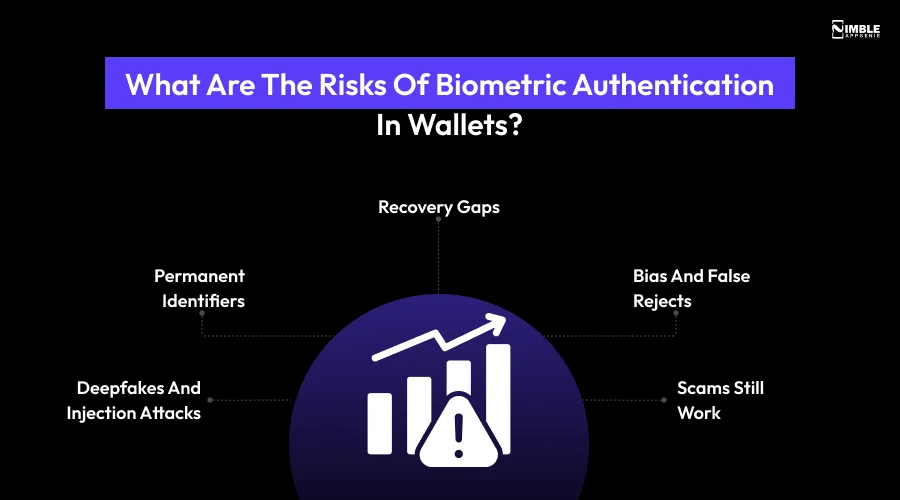
- Deepfakes and Injection Attacks: Security researchers and vendors describe injection attacks, where fake video is injected into the software, as increasing the threat to remote face verification. One vendor-cited industry report says around one in five biometric fraud attempts involves deepfake manipulation. Treat that as a directional figure, not an audited statistic.
- Permanent Identifiers: You can reset a password, not a face. A breach of stored templates has long-lasting impact. That’s why you should avoid holding them.
- Recovery Gaps: Biometrics do not restore a lost phone. Wallets need a tested recovery path, such as social recovery, cloud-synced passkeys, or MPC backup.
- Bias and False Rejects: Face recognition systems can perform unevenly across devices, lighting conditions, and demographic groups. Provide a PIN or alternative method.
- Scams Still Work: If a victim is tricked into approving a payment, the biometric passes. See our article on CFPB oversight rollback and fraud liability for why these authorized scams are the hardest fraud classes to resolve.
Which Laws and Standards Apply to Biometric Wallets?
It depends on where your users are. Common frameworks include Illinois BIPA, PSD2 SCA, GDPR, NIST authentication guidelines, and the EU digital identity wallet rules. Biometric data is treated as sensitive almost everywhere.
| Framework | Region | What it means for wallets |
| BIPA | Illinois, US | Written consent, public retention policy, statutory damages for violations. A 2024 amendment limits recovery to one per person, but exposure remains significant. |
| GDPR Article 9 | EU / UK-style regimes | Biometric data used to identify a person is special-category data, needing a strong legal basis and safeguards. |
| PSD2 SCA | EU / UK | Two independent factors for many payments; biometrics count as an “inherence” factor. |
| NIST SP 800-63B | US guidance | Authenticator assurance levels (AAL) and rules for using biometrics as part of multi-factor authentication. |
| ISO/IEC 30107-3 | International standard | Test method for presentation attack detection, often cited when choosing liveness vendors. |
| eIDAS 2.0 (EUDI wallets) | EU | Member states are required to offer digital identity wallets, with biometric and credential use under user control. Check current implementation dates. |
Laws and thresholds change, so confirm with counsel before launch. Our fintech regulations guide gives wider context, and the GENIUS Act wallet guide covers stablecoin-specific duties.
How Do You Implement Biometric Authentication in a Wallet?
By default, use on-device biometrics and passkeys; add certified liveness only when you identify remotely, and design recovery, consent, and fallback from the start.
Biometric Wallet Implementation Checklist
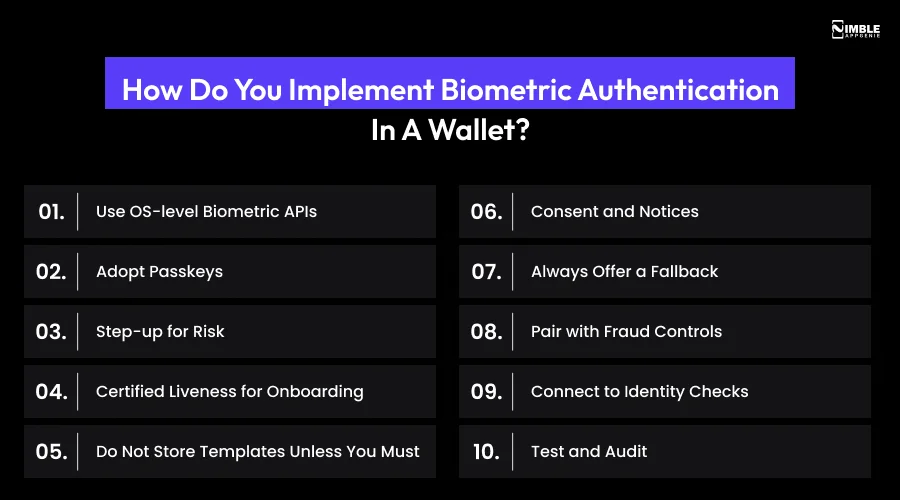
- Use OS-level Biometric APIs: Rely on Android and Apple’s secure hardware so the app never touches raw biometric data.
- Adopt Passkeys (FIDO2/WebAuthn): Bind login to device keys and drop SMS codes where you can.
- Step-up for Risk: Need a fresh biometric for new payees, large amounts, key export, and security-setting changes.
- Certified Liveness for Onboarding: Choose passive liveness detection with presentation attack detection and injection-attack defenses, and test with your own users.
- Do Not Store Templates Unless You Must: If you do, encrypt, minimize, and set deletion schedules.
- Consent and Notices: Collect clear consent where laws require it and publish a retention policy.
- Always Offer a Fallback: PIN or alternative factor, plus a rate-limited, secure recovery flow.
- Pair with Fraud Controls: Add scam warnings, device-risk signals, and payee checks, following our fintech security guidance.
- Connect to Identity Checks: Link selfie matching to document verification as part of KYC and AML compliance.
- Test and Audit: Run penetration tests, device-matrix testing, and periodic liveness evaluations.
If you are building the wallet itself, explore eWallet app development or crypto wallet development. Third-party liveness and identity services connected through fintech API integration and a focused MVP allow you to test authentication friction before scaling. For budgeting, see our fintech app development cost guide.
How Nimble AppGenie Helps You Build Secure Wallet Authentication
Nimble AppGenie designs wallet sign-in and payment approval flows that keep biometric data on the device, add step-up checks for risky actions, and include a tested recovery path.
For wallet teams, our work typically covers:
- Integration with Android and Apple biometric APIs and passkey (FIDO2) sign-in.
- Wallet builds across crypto and fiat, including eWallet app development and crypto wallet development.
- Identity verification and selfie-matching connections for onboarding, tied to KYC and AML checks.
- Security reviews and testing as part of our fintech security approach.
We have built wallets for multi-region users, including Swap Africa, which serves 14 Francophone African countries. Biometric and privacy requirements differ by market, so we plan to align on authentication with your legal team from the start. Book a free consultation to scope your wallet’s security model.
Final Thoughts
Biometrics make wallets easier to use and harder to phish, but only when the design keeps sensitive data on the device, tests for deepfakes, and includes recovery plans. Treat them as one layer in a wider fraud and compliance stack, and review the legal position in every market you serve.
FAQs
It involves the use of a fingerprint, face scan, or similar trait to confirm identity before a wallet unlocks or approves a payment. In most modern wallets, the match happens on the device, and the app never sees the biometric.
Usually, when they unlock a device-bound key as passkeys do, they need liveness checks, device security, and a fallback, and they cannot stop scams the user approves.
They can defeat weak remote face checks. Strong passive liveness, certified presentation attack detection, and injection-attack defenses reduce the risk.
Well-built wallets do not. The phone’s secure hardware stores the template and only confirms a match. Remote onboarding checks may process face images on a vendor’s servers.
Yes. BIPA, GDPR, and PSD2 all apply in different places, covering consent, retention, special-category status, and authentication strength.

Niketan Sharma, CTO, Nimble AppGenie, is a tech enthusiast with more than a decade of experience in delivering high-value solutions that allow a brand to penetrate the market easily. With a strong hold on mobile app development, he is actively working to help businesses identify the potential of digital transformation by sharing insightful statistics, guides & blogs.
Table of Contents




No Comments
Comments are closed.