

 Free Consultation
 PCI-DSS Compliant
 GDPR Ready
 ISO 27001
 NDA Protected
 AI Services
 AI App Development
 Generative AI Development
 AI Chatbot Development
 AI Integration Services
 AI Consulting Services
 AI For Fintech
 AI Financial Assistant Solution
 AI Insurance Agent Development
 Tech Stack
 OpenAI / GPT-4
 Claude / Anthropic
 Gemini / Google AI
 Llama / Open Source
 LangChain / LlamaIndex
 Pinecone / Pgvector
 AWS / Azure AI


 Fintech Solution
 Core Fintech
 App Development
 Neobank Solutions
 eWallet Solutions
 Lending Software
 Banking Solutions
 BNPL Solutions
 BNPL Solutions
 Insurance App
 Wealth Management
 Crypto & DeFi
 Blockchain Development
  Payroll Software
 DeFi Solutions
 Crypto Wallet
 Crypto On/Off Ramp
 Crypto Exchange
 Trading Platform
 Payments
 Compliance
 Regulations & Compliance
 Fraud Detection
 Lending Ecosystem
 P2P Lending Platform
 Mortgage Software
 Engagement
 Fintech Outsourcing

 Mobile Development
 Mobile App Dev
 iOS App Development
 Android App Development
 React Native
 Flutter Development
 Web Solution
 Node.js Development
 React.js Development
 Angular Development
 App Services
 UI/UX Design
 App Maintenance
 By Stage
 MVP Development
 Industry Solutions
 Healthcare App Dev
 Education App Dev
 Travel App Dev
 Real Estate App Dev
 Logistics Software
 Social Media App

 Hire Mobile Developers
 Hire iPhone Developers
 Hire Android Developers
 Hire React Native Devs
 Hire Flutter Developers
 Hire Web Developers
 Hire Node.js Developers
 Hire Angular Developers
 Hire PHP Developers
 Hire Laravel Developers
 How It Works
 Pre-Vetted Developers
 Ready In 48 Hours
 NDA From Day One
 Replace Guarantee
 Company
 About Us
 Our Work Process
 Portfolio
 Case Studies
 Blog / Insights
 Careers
 Contact Us
 Awards
 Recognition


 Offices



Key Takeaways:
- Building a payment orchestration layer is all about understanding the requirements, mapping the PSPs, designing the routing, handing the end-to-end payment cycle, and enabling the configuration.
- The payment orchestration acts as a single layer and platform that sits between a business’s checkout system, processors, and with financial service providers in a single platform.
- One should create this layer because it helps in smart routing, lowers the development cost, offers advanced security, and improves fraud detection.
- The overall cost to build a payment orchestration layer can vary from $50,000 to $3,00,000, depending on different factors.
- Key challenges include complex payment flows, regulatory challenges, and cost related issues.
- Connecting with the right developer such as Nimble AppGenie, can help you in adopting payment orchestration layer.
Want to build a payment orchestration layer but don’t know how?
Well, to create a payment orchestration layer, you need to identify what your software is all about, is it required a layer or not. And what type of API integration you will be required, what design is needed, and how to handle an end-to-end payment cycle.
Additionally, the global payment orchestration platform market size was estimated at USD 2.8 billion in 2025, and is further projected to reach USD 9.7 billion by 2035.
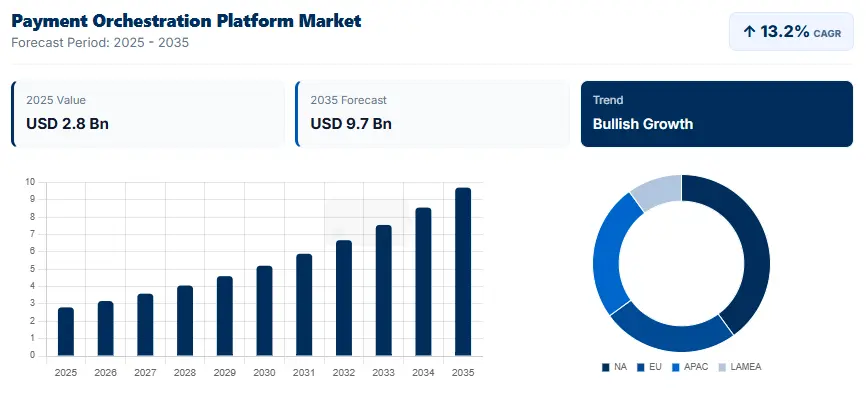
You can be the one contributing maximum to this market, by building one.
Hence, in this guide to building a payment orchestration layer, we will walk you through how to build a payment orchestration layer, need of the layer, financial impacts it lays, compliances, and even cost structure.
Without further ado, lets begin.
What is a Payment Orchestration Layer?
A payment orchestration layer is a centralized software platform that sits between a business’s checkout system, processors, acquirers, and other financial service providers in a single platform.
The payment orchestration layer doesn’t replace the gateways or processors; rather, it connects them. It can also save businesses and customers money. Unlike traditional payment gateways, an orchestration evaluates each transaction in real time and then decides how to best handle it.
It can choose the best, most reliable, and cost-effective provider based on different important factors such as currency, location, and historical success rates.
The core functions of the payment orchestration layer include:
- Smart routing
- Failover handling
- Unified reporting
- Fraud prevention
The AI technology for automated mobile app development helps the users and businesses to make transaactions faster, safer and easier.
Many of the fintech startups and engineers also ask, how does a payment orchestration layer work in the next section.
Now, let’s get ahead with the working process of how a payment orchestration layer works.
How Does a Payment Orchestration Layer Work?
A payment orchestration layer is a single software platform that sits between a business and multiple payment service providers, and connects different gateways with one network.
Here’s how a payment orchestration layer works:
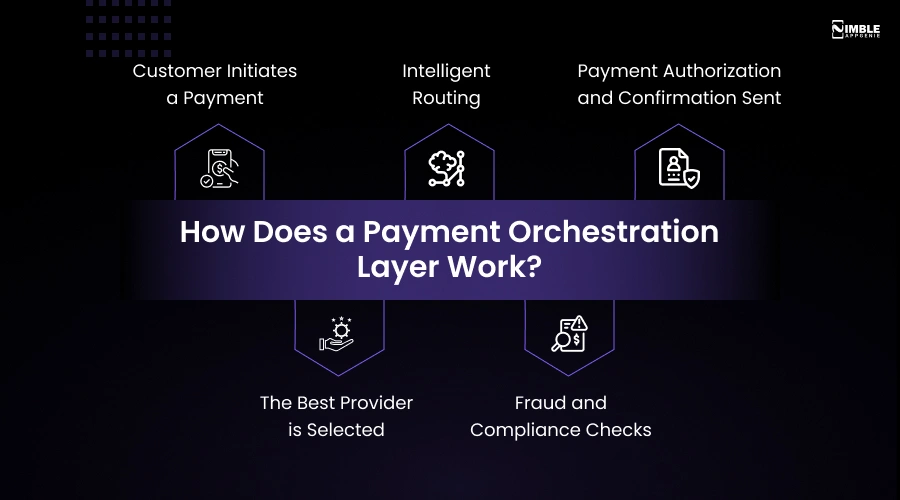
1. Customer Initiates a Payment
This is the first step, where the user generates the payment on any platform, which can be a retail or any other. Here, the request is sent to the orchestrator, where this layer acts as a brain and routes the payload to the internal payment orchestration layer.
2. The Best Provider is Selected
Now, the orchestrator decides which payment request is sent to which payment network based on the payment request. Here, the orchestrator uses the smart routing channel and the rules engine to evaluate the incoming transaction attributes in milliseconds.
3. Intelligent Routing
This is the third step, where intelligent routing is used that acts as a brain and uses real-time data as well as rules for directing each transaction to the payment gateway that has the highest chance of approval at the lowest cost.
4. Fraud and Compliance Checks
The fraud and compliance checks are created at the gateway, and if any request fails at the payment gateway, a failover is automatically sent to the user. When all routes fail, the transaction is marked as declined and can result in a fallback workflow.
5. Payment Authorization and Confirmation Sent
At this stage, the payment authorization is passed where the payment process connects to the bank for authorization. Here, confirmation is sent to the user if payment is processed successfully, and if not, the confirmation is sent related to the failed payment.
Bonus Read: “Payment Gateway vs Payment Processor Guide”
With the relevant steps, let’s get ahead with why the fintech founders need a payment orchestration layer for fintech in the following section.
What’s the Need For a Payment Orchestration Layer For Fintech?
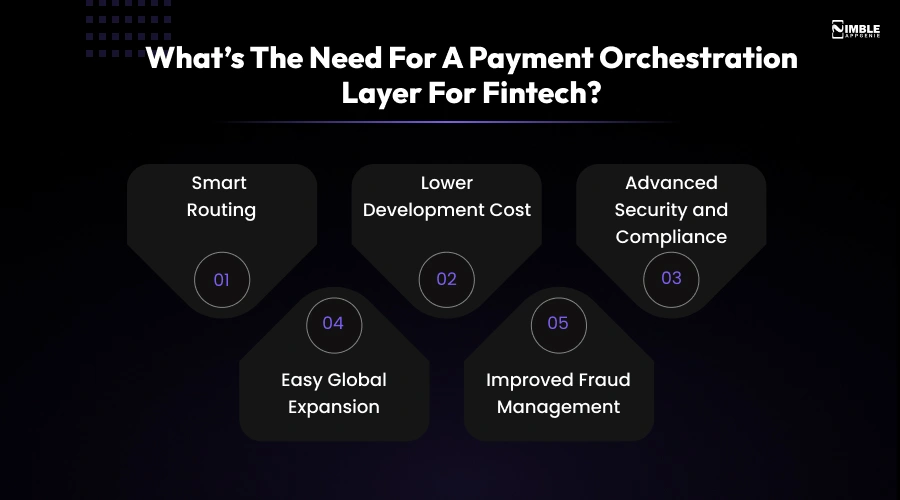
There is a diversified need for a payment orchestration layer when it comes to fintech. Here, the needs consist of smart routing, lower development cost, advanced security and compliance, easy global expansion, and further enhanced fraud management.
Let’s learn all of them below:
► Smart Routing
A payment orchestration layer helps fintech platforms build payments via smart routing, acting as an intelligent central hub that analyses each transaction in real time.
It is also an important feature of building a payment orchestration layer where, through smart routing, you automatically select the best payment provider for each transaction.
► Lower Development Cost
With the help of a payment orchestration layer, development cost is reduced from months of custom API integration to a single and unified API.
It assists businesses in reducing their payment processing fees through intelligently routing the transactions.
► Advanced Security and Compliance
A payment orchestration layer assists businesses in operating in compliance with global payment regulations and then provides tools for compliance with local laws and security features.
These security and comply with the local laws and standards for minimizing the risk of penalties and legal issues.
► Easy Global Expansion
With the help of a payment orchestration layer, fintech firms will be able to offer a single, unified API integration that commonly connects the business to multiple regional payment service providers.
The simple way of orchestration drives global expansion through a single API integration and by adopting local payment methods.
► Improved Fraud Management
The payment orchestration layer is one of the important results of implementing fraud management, acting as a centralized control plane that consolidates different third-party fraud detection tools.
The core fraud management benefits consist of multi-vendor layering and often come with advanced fraud detection along with security features.
Now, let’s get ahead with the financial impacts of payment orchestration in the following section.
Financial Impacts of Payment Orchestration
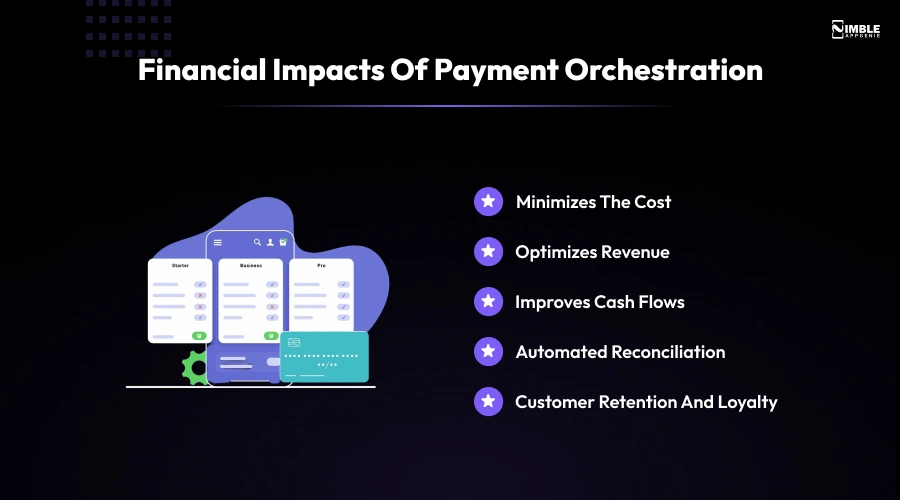
The key financial impacts of payment orchestration are minimizing the transaction costs that is through minimizing the transaction costs via smart routing and enhancing the complete cash flow.
Here is the list of the financial impacts of payment orchestration:
♦ Minimizes the Cost
One of the important impacts that the payment orchestration layer offers is saving money by using the most cost-effective PSPs, decreasing the failed transactions, and even minimizing chargeback costs.
♦ Optimizes Revenue
The payment orchestration optimizes revenue through boosting conversion rates and supporting multiple payment methods and currencies for attracting a wider customer base.
♦ Improves Cash Flows
Building the payment orchestration layer enhances cash flows through accelerating transaction settlements and even reducing failed payments via smart routing. It even helps in automating retries and directing the routing.
♦ Automated Reconciliation
The payment orchestration helps to transform the automated reconciliation process through centralizing the fragmented data from the diversified payment service providers within a single, standardized data model.
♦ Customer Retention and Loyalty
The payment orchestration layer systems even boost financial management by deploying advanced fraud detection mechanisms. This creates a smooth and reliable shopping experience that creates customer trust and even keeps buyers coming back.
Now, the question is “how to build a payment orchestration layer?”
How to Build a Payment Orchestration Layer?
Fintech developers can create a payment orchestration layer by conducting market research, including all essential factors, examining business requests, and then conducting robust testing before deployment.
If you are a fintech startup or an enterprise, you should be well aware of the key steps to take to build a payment orchestration layer in case you create your own payment gateway.
Building a payment orchestration layer is not a small feat. Here’s how to build a complete payment orchestration layer:
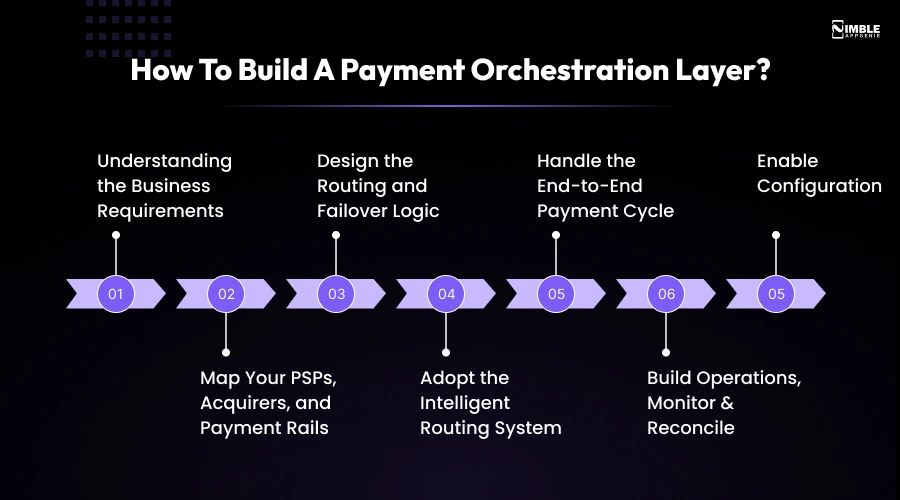
1. Understanding the Business Requirements
This is one of the most important steps while building a payment orchestration layer; here you should know and well understand the business requirements.
Here’s what one should consider:
- Interpret business requirements for your software.
- Is it valid to proceed with the payment orchestration now?
- Identify the project scope and the functional needs.
2. Map Your PSPs, Acquirers, and Payment Rails
This is the second step, where you map your PSPs, which are integration endpoints through which your platform connects. While the acquirers can refer to the financial institutions that process the card payments on behalf of the customers.
Here’s what one should consider:
- Routing logic and failover, transaction cost, and interchange optimization.
- Consider the technology and compliance while selecting the acquirers.
- While consider the payment rails, which are the underlying factors that move money.
3. Design the Routing and Failover Logic
Now, you should design the complete routing and failover logic by building a payment orchestration layer. For designing a highly available and resilient system, your routing and failover logic should handle the failovers automatically.
You should consider:
- Establish a primary and secondary infrastructure.
- Develop the canonical routing and standardized data models.
- Normalize the request and standard codes and statutes across providers.
4. Adopt the Intelligent Routing System
Under the intelligent routing system, you should collect real-time and historical data, analyze user intent via AI or natural language processing, and then apply the strategic business rules to connect.
Here’s what you should do:
- Support routing strategies such as priority routing, cost optimization, load balancing, failover, and retries.
- Enable dynamic routing based on real-time performance and availability.
- Opt for continuous routing decisions to fine-tune the complete performance.
5. Handle the End-to-End Payment Cycle
This is the fifth step where you handle the end-to-end payment cycle, through managing the transactions from initiation to final reconciliation with the help of a unified system. Here, you should design a unified architecture that manages transaction routing and even ledger updates.
Here’s what you need to consider:
- Build a unified API abstraction, intelligent router, and reliable state-machine engine.
- Route, process, and settle transactions when building a payment orchestration layer.
- Opt for processing and authorization for tokenization, protocol translation, and response handling.
6. Build Operations, Monitor & Reconcile
While building a payment orchestration layer requires setting up real-time monitoring for transaction health, automated reconciliation, and robust operations for financial accuracy.
Here’s what to consider:
- Connecting with experts can help you to build complete operations.
- Monitor the operations, and then reconcile.
- Implement centralized transaction logging and real-time alerting for payment failures.
7. Enable Configuration
For enabling the configuration layer, you should build a payment orchestration layer, transition decision logic, and credentials out of hardcoded sources. You should decouple business logic from hardcoded code.
Here’s what you need to do:
- Separate core routing and execution code from business rules.
- Store the dynamic rules, provider credentials, and conditional workflows in an external database.
- You should implement the complete payment orchestration layer successfully.
Following these steps for building a payment orchestration layer, there are certain compliances securities that you should follow for creating a payment orchestration layer.
Compliance and Security Checklist for Payment Orchestration
A payment orchestration compliance and security checklist requires validating the level 1 PCI DSS compliance, implementing tokenization to reduce audit scope, and then opting for the anti-money laundering (AML) compliance.
Different types of compliance and security checklists for payment orchestration:
| Compliance / Standard | Why It Matters |
| PCI DSS v4.0 | Secures card data across all connected PSPs; tokenization reduces scope |
| PSD2 / SCA | Enforces strong authentication on EU/UK transactions |
| 3-D Secure 2.x | Must be applied consistently across every routed PSP |
| GDPR | Protects EU customer data centralized across providers |
| CCPA/CPRA | Covers US (California) consumer data rights |
| KYC/AML | Identity checks & monitoring must stay consistent across PSPs |
| BSA (US) | AML program & recordkeeping for US money movement |
| SOC 2 Type II | Security audit often required by PSP partners |
| ISO 27001 | Info-security certification enterprise merchants expect |
| Local regulator rules (RBI, MAS, CBUAE, etc.) | Determines legal operation & data localization by market |
| Open Banking (UK/FDX) | Needed if routing extends to bank rails, not just cards |
| AES-256 / TLS 1.2+ | Baseline encryption for data in transit and at rest |
For ensuring the fintech security, its important to comply with the latest compliances and regulations standards.
Now, with the compliance and security, let’s get ahead with how much it costs to build a payment orchestration layer in the next section.
How Much Does it Cost to Build a Payment Orchestration Layer?
The overall cost to build a payment orchestration layer can vary from $50,000 to $3,00,000. Different factors impacting the complete cost are PSP integrations, smart routing, fallback logic, compliance and security landscape, infrastructure and operations, and others.
These factors can vary when it comes to considering fintech app development cost. However, as we are discussing the payment orchestration, lets look at the cost breakdown for building this layer:
| Tier | Cost Range | What’s Included |
| MVP / Startup | $50,000 – $90,000 | Single-region routing engine, 2–3 PSP connectors, basic tokenization, simple dashboard. |
| Growth | $90,000 – $180,000 | Smart routing/failover, 5+ PSP integrations, fraud engine, reconciliation, multi-currency support. |
| Scale / Multi-Region | $180,000 – $250,000 | Advanced rule-based routing, cross-border rails, compliance automation (KYC/AML), analytics suite. |
| Enterprise | $250,000 – $300,000 | Full high-availability architecture, custom fraud/ML models, dedicated compliance & audit tooling, 24/7 monitoring. |
Now, proceeding with the cost and its related factors, let’s get ahead with the complete list of challenges that are associated with payment orchestration in the following section.
Challenges Associated With Payment Orchestration
Different challenges and common mistakes that fintech founders often make while building a payment orchestration layer include treating the orchestrator as a new single point of failure without any redundancy.
Here is the list of challenges associated with payment orchestration:
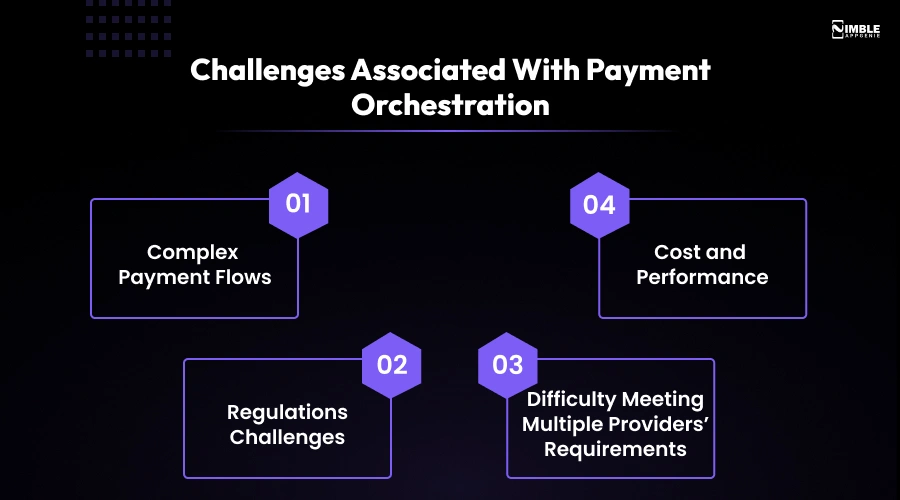
➤ Complex Payment Flows
The complex payment flows act as a primary challenge of payment orchestration because coordinating the entire lifecycle creates massive architectural and operational hurdles. It even leads to smart routing logic, cascading and failover retries.
➤ Regulations Challenges
Regulatory hurdles are the primary challenge in payment orchestration because platforms must continuously comply with diversified regulations. For instance, your online payments must comply with the EU’s regulations on online payments such as strong customer authentication (SCA), and even with the PSD2.
➤ Difficulty Meeting Multiple Providers’ Requirements
Here, each payment provider has its own APIs, authentication methods, and compliance requirements. And maintaining the multiple provider-specific integrations also increases development effort and ongoing maintenance as providers update their platforms.
➤ Cost and Performance
Routing the payments through multiple providers while building a payment orchestration layer can increase the operational costs due to integration, infrastructure, and transaction fees if not managed effectively. Additionally, maintaining low latency and high transaction success rates across different providers requires intelligent routing and even continuous performance monitoring.
Now, moving on to the challenges, one of the key aspects is the future of the payment orchestration layer.
Future of Payment Orchestration Layer
The future of the payment orchestration layer is agentic commerce integration, transition to data orchestration, and modular ecosystems.
Here is the list of the future of the payment orchestration layer:
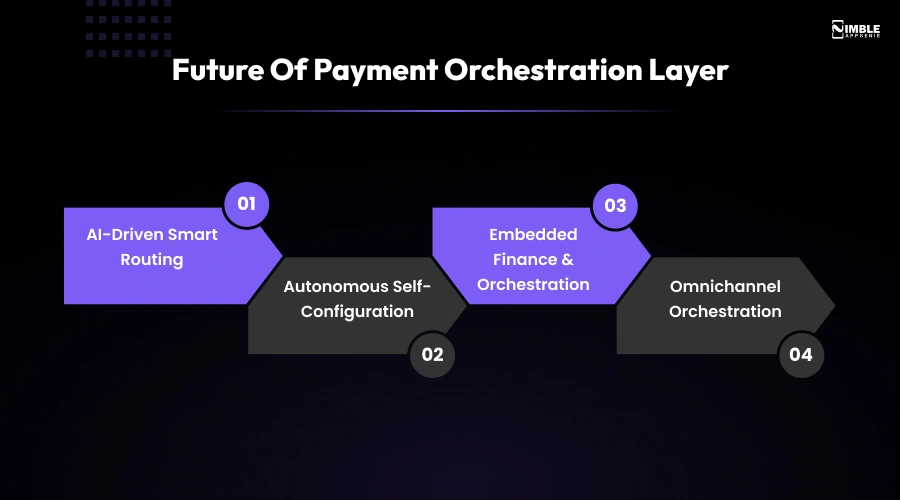
► AI-Driven Smart Routing
AI-driven smart routing helps to shift the payment orchestration from rigid, static rulebooks to autonomous, real-time decision-making. AI in fintech offers a shift from a basic transaction router to an AI-native operating infrastructure.
► Autonomous Self-Configuration
Autonomous self-configuration represents the next evolution of payment orchestration platforms. It even replaces rigid rules with dynamic artificial intelligence systems that will help in the future to adapt to transaction conditions in real time.
► Embedded Finance & Orchestration
The payment orchestration layer becomes the core infrastructure that enables payments inside the non-financial app. Orchestration platforms expand beyond the basic routing into a comprehensive layer from the e-commerce portals to the ERP platforms and industry marketplaces.
► Omnichannel Orchestration
Through implementing and unifing the POS terminal, into a single plane, the omnichannel orchestration bridges the historical gap between online and in-store transactions. It is the future of payment orchestration as it eliminates the channel silos.
You need to connect with the right company to ensure you build a payment orchestration layer tha matches and complements your software requirements.
Which is the Best Company to Connect For Building a Payment Orchestration Layer?
Nimble AppGenie is the best fintech software development company to connect with for building a payment orchestration layer. The engineers of Nimble AppGenie works as a helper for the fintech founders, assisting them to identify the right routing, and even API integration frameworks for implementing or building a payment orchestration layer.
The company’s key strengths are:
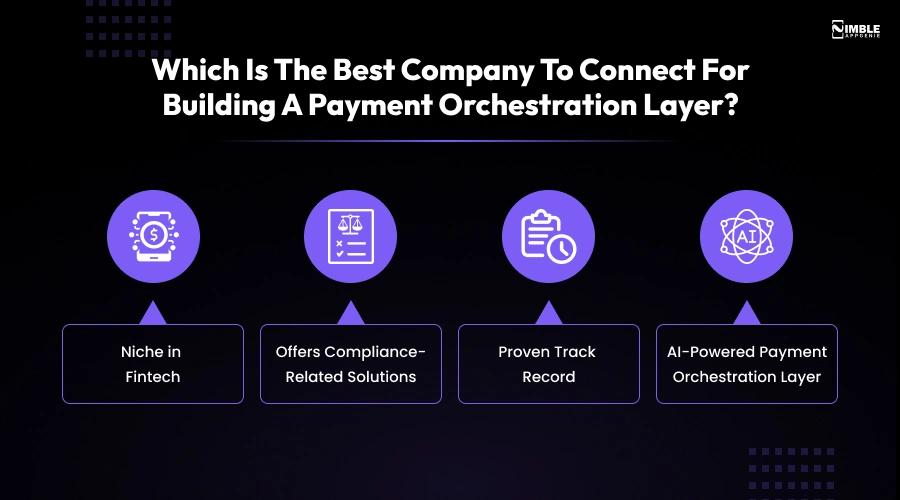
1. Niche in Fintech
Nimble AppGenie is the top fintech app development company that has a niche in offering fintech and banking software solutions for fintech founders. Here, our developers offer an end-to-end solution for startups, banks, fintechs, and enterprises.
2. Offers Compliance-Related Solutions
The experts of Nimble AppGenie helps in driving insurance platform solutions, RegTech solutions, fraud detection solutions, and credit scoring software solutions. We offer compliance mapping practices, that enable you to comply with the region specific guidelines.
3. Proven Track Record
The experts at Nimble AppGenie has helped the fintech firms and founders in implementing and building a strong layer of payment orchestration as we offer core integration solutions, compliance frameworks, and scalable infrastructure.
4. AI-Powered Payment Orchestration Layer
Nimble AppGenie offers AI-powered payment orchestration layer that mitigates the risk of manual errors and even offers an extra layer of security where the fraud transactions are identified at the earlier stage.
Conclusion
Building the payment orchestration layer comprises of crucial steps that begins with identifying the requirements of the app, mapping the PSPs, acquirers, and payment rails, designing the routing, adopting the intelligent routing and then enabling configuration.
The key compliance and security checklist that is followed during building the payment orchestration layer comprises of PCI DSS, PSD2, GDPR, CCPA, KYC, or even BSA or ISO. The cost to create the payment orchestration layer can vary depending on the complexity of features, regulatory requirements, and even cost structures.
The future of payment orchestration layer is shifting from a simple layer to routing into the AI structure framework. Here, the future includes autonomous self-confidence, embedded finance, and omnichannel orchestration.
FAQs

Niketan Sharma, CTO, Nimble AppGenie, is a tech enthusiast with more than a decade of experience in delivering high-value solutions that allow a brand to penetrate the market easily. With a strong hold on mobile app development, he is actively working to help businesses identify the potential of digital transformation by sharing insightful statistics, guides & blogs.
Table of Contents




No Comments
Comments are closed.