

 Free Consultation
 PCI-DSS Compliant
 GDPR Ready
 ISO 27001
 NDA Protected
 AI Services
 AI App Development
 Generative AI Development
 AI Chatbot Development
 AI Integration Services
 AI Consulting Services
 AI For Fintech
 AI Financial Assistant Solution
 AI Insurance Agent Development
 Tech Stack
 OpenAI / GPT-4
 Claude / Anthropic
 Gemini / Google AI
 Llama / Open Source
 LangChain / LlamaIndex
 Pinecone / Pgvector
 AWS / Azure AI


 Fintech Solution
 Core Fintech
 App Development
 Neobank Solutions
 eWallet Solutions
 Lending Software
 Banking Solutions
 BNPL Solutions
 BNPL Solutions
 Insurance App
 Wealth Management
 Crypto & DeFi
 Blockchain Development
  Payroll Software
 DeFi Solutions
 Crypto Wallet
 Crypto On/Off Ramp
 Crypto Exchange
 Trading Platform
 Payments
 Compliance
 Regulations & Compliance
 Fraud Detection
 Lending Ecosystem
 P2P Lending Platform
 Mortgage Software
 Engagement
 Fintech Outsourcing

 Mobile Development
 Mobile App Dev
 iOS App Development
 Android App Development
 React Native
 Flutter Development
 Web Solution
 Node.js Development
 React.js Development
 Angular Development
 App Services
 UI/UX Design
 App Maintenance
 By Stage
 MVP Development
 Industry Solutions
 Healthcare App Dev
 Education App Dev
 Travel App Dev
 Real Estate App Dev
 Logistics Software
 Social Media App

 Hire Mobile Developers
 Hire iPhone Developers
 Hire Android Developers
 Hire React Native Devs
 Hire Flutter Developers
 Hire Web Developers
 Hire Node.js Developers
 Hire Angular Developers
 Hire PHP Developers
 Hire Laravel Developers
 How It Works
 Pre-Vetted Developers
 Ready In 48 Hours
 NDA From Day One
 Replace Guarantee
 Company
 About Us
 Our Work Process
 Portfolio
 Case Studies
 Blog / Insights
 Careers
 Contact Us
 Awards
 Recognition


 Offices


![How to Build Freight Payment Automation Software: Features, Cost & Integration Guide [2026]](https://www.nimbleappgenie.com/blogs/wp-content/uploads/2026/08/How-to-Build-Freight-Payment-Automation-Software_Hero-768x249.webp)
TL;DR
- Freight payment automation software captures, matches, approves, and pays freight invoices automatically – cutting a days-long manual process down to hours.
- Must-have features: automated invoice capture, rate/contract matching engine, multi-carrier support, exception workflows, audit-ready reporting, and TMS/ERP integration.
- Realistic 2026 cost: $35K–$70K for an MVP, $80K–$160K for a mid-market build, and $180K–$350K+ for an enterprise platform with AI-based auditing.
- Integration with your TMS, ERP, and carrier EDI feeds – not the payment logic itself is usually what drives both cost and timeline.
- Best-in-class AP teams process invoices in under 3 days at a fraction of the cost of manual teams, which is the gap automation is built to close.
- Nimble AppGenie builds custom freight payment and fintech automation software with integration-first architecture, so it plugs into the TMS and ERP stack you already run instead of forcing you to rebuild around it.
“How much does it cost to build freight payment automation software and what should it actually include?” That’s one of the most common questions logistics and fintech teams ask on Google, and increasingly on Perplexity and ChatGPT too, as more buyers research software projects through AI assistants before they ever talk to a vendor.
Freight payment automation software is a system that audits, matches, and pays freight invoices without requiring a team to manually rekey carrier bills into a spreadsheet.
If you are a freight forwarder, 3PL, broker, or fintech company planning to build one, instead of buying a subscription that doesn’t fit your workflow, this guide written by experts at Nimble AppGenie will help you with what to build, what it costs in 2026, and how to connect it to the systems you run already.
We will walk you through a realistic step-by-step build process, must-have features, integration requirements, and genuine cost ranges based on scope.
What Is Freight Payment Automation Software?
Freight payment automation software is a system that automatically captures, audits, matches, approves, and pays freight invoices by checking each charge against the shipment record and the carrier contract before money moves.
It replaces manual invoice entry and line-by-line rate checking with rules-based and AI-driven matching, so errors are caught before payment instead of surfacing months later in a dispute.
At a minimum, it needs to do four things:
- Capture the Invoice, from EDI, email, PDF, or a carrier portal, without manual data entry.
- Match it against the load, contracted rate, and any accessorial charges.
- Flag exceptions; anything that doesn’t match goes to a human reviewer, not straight to payment.
- Pay and report; approved invoices are paid on schedule, and every step is logged for audit.
Freight Payment Automation vs. Freight Audit Software: What’s the Difference?
People usually use these terms interchangeably, but they are not the same system, and mixing them up is the fastest way to under-scope a build.
Freight audit software focuses on catching errors; it compares an invoice against a contract and flags discrepancies. It stops at “here’s what’s wrong.”
Freight payment automation software includes audit as the first step, then carries the process all the way through approval, payment, and execution (ACH, virtual card, wire, or carrier-preferred rail), and reconciliation back into your general ledger.
If you are also building out payment execution and disbursement logic, it’s worth looking at how that layer is typically architected in fintech app development more broadly, since the payment rails themselves are not freight-specific.
If your only goal is diminishing overbilling, an audit module may be enough. If you want to eliminate manual work from the entire invoice-to-pay cycle, you need the full automation layer, and that changes what you build, not just what you buy.
Why Freight Teams Are Automating Payments Now
Freight is a line item that’s big enough to intensify small inefficiencies fast. The American Trucking Associations projects that trucking revenue will grow from $906 billion in 2024 to approximately $1.46 trillion by 2035, underscoring the need for scalable digital freight and payment infrastructure. At that scale, even a small percentage of processing inefficiency becomes a real budget line.
Organizations that invest in AP automation significantly reduce invoice cycle times and processing costs. Ardent Partners reports that Best-in-Class AP teams process invoices 79% faster while spending 79% less per invoice than average organizations, demonstrating the measurable ROI of automation.
That gap, days versus hours, full cost versus a fraction of it, is why freight forwarders, shippers, and brokers are moving from “audit later” to automating the whole payment cycle.
Must-Have Features in Freight Payment Automation Software
These are the features worth planning for from day one, not bolting on later once the architecture is already set.
| Feature | Description |
| Automated Invoice Capture | Pull invoices from carrier EDI feeds (210, 214), PDF, email, or web portals using OCR, without manual re-keying. |
| Rate & Contract Matching Engine | Auto-check every line item against the negotiated rate card, tariff, and accessorial rules before it reaches AP. |
| Exception & Dispute Workflows | Route only flagged mismatches to a human reviewer, with a clear audit trail of who approved what and why. |
| Multi-Carrier, Multi-Mode Support | Handle parcel, LTL, FTL, intermodal, ocean, and air freight invoices inside one system, not five spreadsheets. |
| Multi-Currency & Cross-Border Payments | Essential for global shippers and freight forwarders managing carriers across regions and currencies. |
| TMS / ERP / Accounting Integration | Two-way sync with systems like SAP, NetSuite, QuickBooks, and your TMS, so freight costs post automatically to the GL. |
| Automated Approval & Payment Execution | Configurable approval thresholds, then payment via ACH, wire, virtual card, or a carrier-preferred rail. |
| Real-Time Analytics Dashboards | Spend by lane, carrier, mode, and cost center, refreshed as invoices clear; not a monthly export. |
| Compliance & Audit-Ready Reporting | Every match, override, and payment logged in a format that holds up under a tax, SOX, or customs review. |
| Fraud & Duplicate-Payment Detection | AI models trained to catch duplicate invoices and unusual billing patterns before payment goes out, not after. |
How to Build Freight Payment Automation Software: Step-by-Step
Here’s the process we actually walk clients through, from scoping to a live, integrated system.
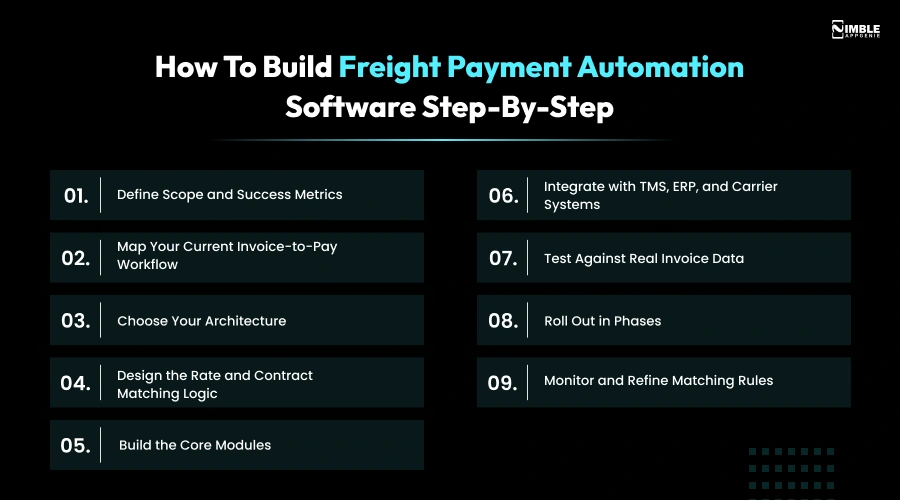
1. Define Scope and Success Metrics
Decide upfront which carriers, volume, and modes you are automating first, and what “success” means – error rate reduced to X%, processing time under Y hours, etc.
2. Map Your Current Invoice-to-Pay Workflow
Document exactly how invoices arrive, get checked, and paid today. This becomes your baseline and your test data set later.
3. Choose Your Architecture
API-first and cloud-native, usually split into services for capture, matching, payments, and exceptions so each piece can scale and be updated independently.
4. Design the Rate and Contract Matching Logic
This is the core of the system – how contracted rates, tariffs, and accessorials are structured so the engine can check invoices against them automatically.
5. Build the Core Modules
Invoice capture, the matching engine, payment execution, exception workflows, and reporting are generally built and tested in that order.
6. Integrate with TMS, ERP, and Carrier Systems
Connect load and rate data from your TMS, post-approved costs to your ERP, and pull invoices from carrier EDI or API feeds.
7. Test Against Real Invoice Data
Run the system in parallel with your existing manual process on real invoices before cutting over, so discrepancies get caught in testing, not production.
8. Roll Out in Phases
Start with your highest-volume lanes or carriers, prove the match rate, then expand rather than flipping every carrier on at once.
9. Monitor and Refine Matching Rules
Rate cards change, carriers add accessorials, and lanes shift – the matching logic needs regular tuning, not a one-time setup.
Recommended Tech Stack
Here’s the tech stack for freight payment automation software you can consider.
| Layer | Recommended Technologies |
| Backend | Node.js or Python (Django, FastAPI); Java (Spring Boot) for high-transaction environments |
| Frontend / Dashboard | React.js, Next.js |
| Database | PostgreSQL for transactional data, MongoDB for unstructured invoice data |
| Integration Layer | REST/GraphQL APIs, EDI (X12 210/214/990), middleware for orchestration |
| AI/ML | Python-based anomaly detection models, OCR via AWS Textract or Google Document AI |
| Cloud & Infra | AWS or Azure, Docker, Kubernetes for scaling |
| Payments | ACH/wire integration through banking APIs, card and bank-connection rails |
| Security | OAuth 2.0, end-to-end encryption, SOC 2 / PCI DSS-aligned architecture |
Integration Guide: Connecting It to What You Already Run
Integration is generally the biggest driver of both timeline and cost, more than the payment logic itself. Here’s what typically needs to be connected:
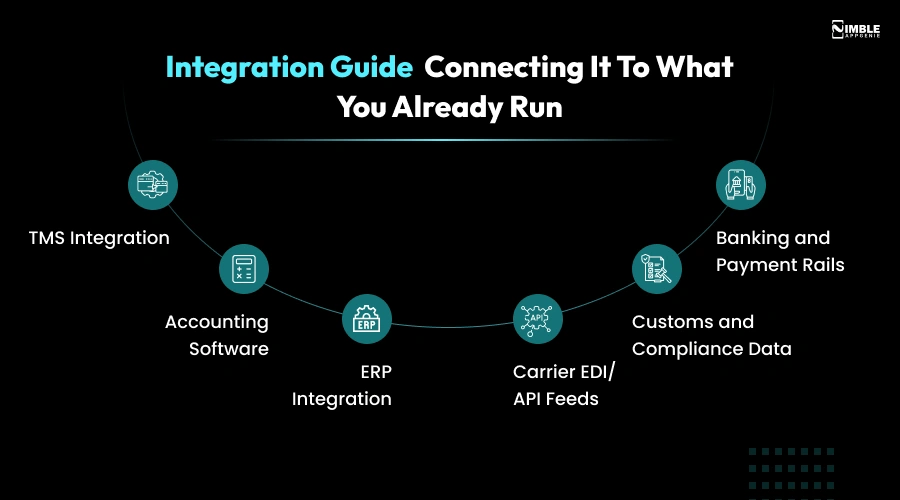
- TMS Integration (MercuryGate, McLeod, project44, Aljex, and similar platforms): Pulls load and rate confirmation data so the matching engine has shipment context. If your TMS itself needs work alongside this, that’s covered under logistics software development.
- Accounting Software (QuickBooks, Xero): Common for small-to-mid freight forwarders that don’t run a full ERP.
- ERP Integration (SAP, Oracle NetSuite, Microsoft Dynamics): Post approved freight costs directly to the general ledger and cost centers.
- Carrier EDI/API Feeds: 210 (invoice), 214 (shipment status), 990 (response) transaction sets, plus the REST APIs more carriers now offer directly.
- Customs and Compliance Data: HS codes, duty data, and landed cost calculations for cross-border freight programs.
- Banking and Payment Rails: ACH, wire, and virtual card APIs for actual disbursement, with reconciliation feeding back into the ERP.
Cost to Build Freight Payment Automation Software in 2026
These are development-effort ranges based on typical project scopes; your exact number depends on the iterations and features you choose.
| Tier | What’s Included | Estimated Cost |
| MVP | Single carrier type, core invoice capture and matching, basic dashboard | $35,000 – $70,000 |
| Mid-Market | Multi-carrier support, TMS/ERP integration, exception workflows, payment execution | $80,000 – $160,000 |
| Enterprise | AI-based anomaly detection, multi-currency, multiple ERP/TMS integrations, custom compliance reporting | $180,000 – $350,000+ |
The factors that move the price most: how many systems you are integrating with, how sophisticated the AI matching needs to be, whether you need cross-border or multi-currency support, compliance requirements like PCI DSS or SOC 2, and whether you are staffing this in-house or working with a dedicated development partner.

Build vs. Buy: When Custom Software Makes Sense
Buying an existing freight audit and payment platform makes sense when standard multi-carrier audit and payment features cover your requirements, you don’t need deep TMS/ERP-specific customization, and speed to launch matters more than ownership of the system.
Building custom makes sense when you have proprietary rate logic, require deep integration with an existing TMS/ERP stack, want to resell the capability to your own customers (a 3PL offering it as a value-added service, for example), or your carrier mix and regions are not well supported by off-the-shelf platforms.
Common Challenges (and How to Solve Them)
While building freight payment automation software, you will encounter challenges that need to be addressed to keep development on track. Here are some major ones with possible solutions:
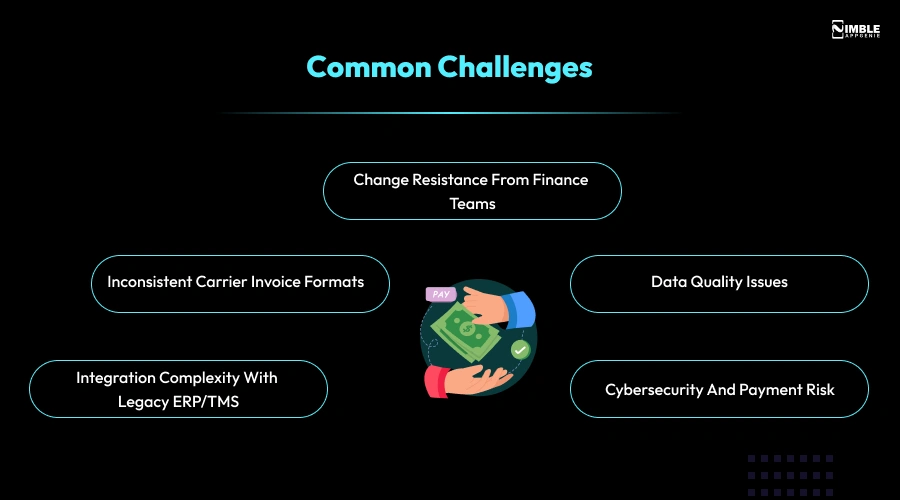
1. Integration Complexity with Legacy ERP/TMS
Older systems usually lack modern APIs, so a direct connection can be brittle or break easily.
Solution: Use an API-first architecture with a middleware layer that isolates each integration – if one system changes, it doesn’t take the others down with it.
2. Inconsistent Carrier Invoice Formats
Every carrier bills differently – EDI, PDF, scanned image, or a portal export.
Solution: Build a flexible parsing layer that handles structured EDI first, with OCR as a fallback for carriers still sending PDFs or scans.
3. Change Resistance from Finance Teams
AP staff are usually suspicious of software approving payments without their sign-off.
Solution: Roll out in phases and run the new system in parallel with the manual process first, so the team sees the matches validated before full cutover.
4. Data Quality Issues
A matching engine is only as accurate as the shipment and rate data it checks against.
Solution: Clean and standardize shipment data, contract data, and rate before go-live – treat this as a prerequisite step, not a post-launch fix.
5. Cybersecurity and Payment Risk
The system is now moving real money, which raises the security bar significantly.
Solution: Build to SOC 2 / PCI DSS-aligned standards from day one – encryption, role-based access, and audit logging, not bolted on after an incident.
Why Build with Nimble AppGenie?
Freight payment automation sits right at the intersection of two things we build regularly: logistics software and fintech systems that move real money.
That combination matters more than it looks – a team that only knows TMS platforms will underbuild the payment and compliance layer, and a team that only knows fintech will underbuild the freight-specific matching logic (accessorials, tariffs, lane-level rate structures).
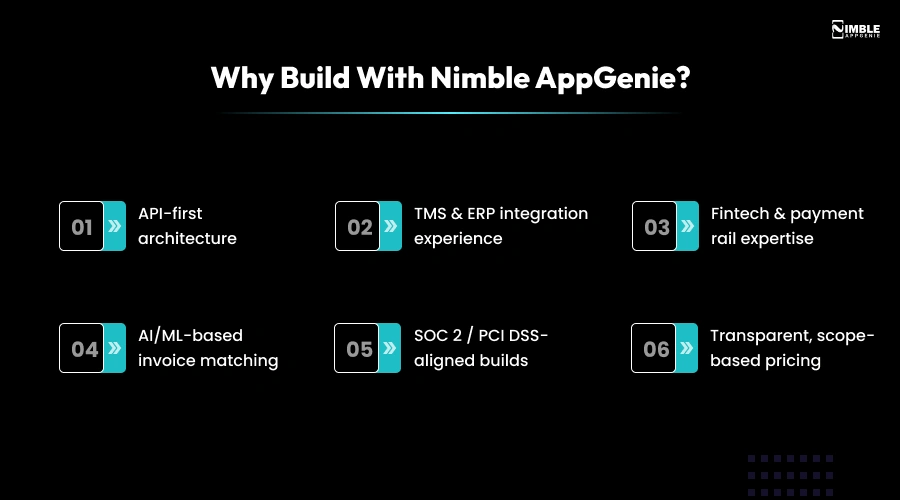
Here’s how we approach a freight payment automation build:
- API-first architecture
- TMS & ERP integration experience
- Fintech & payment rail expertise
- AI/ML-based invoice matching
- SOC 2 / PCI DSS-aligned builds
- Transparent, scope-based pricing
We also work on the broader systems that freight payment automation usually needs to talk to, from logistics and TMS software development to fintech app development for the payment execution layer.
If you are also exploring how payment rails are built themselves, our guide on how to develop a merchant payment solution covers that side in more depth, and our piece on transportation software development is a useful read if you are scoping on the TMS side alongside this.

Conclusion
Freight payment automation software is not a nice-to-have anymore – it’s the difference between a finance team drowning in carrier invoices and one that processes them in hours with a clean audit trail.
The features matter, but what actually determines whether the project succeeds is the integration work: getting your TMS, ERP, and carrier data feeding the matching engine cleanly, and getting payments flowing back into your books without manual reconciliation.
If you are scoping a build, start with the workflow you have today, be honest about which integrations are non-negotiable, and size the budget against the tier that matches your actual carrier volume and complexity – not the biggest platform on the market.
FAQs
A focused MVP with core invoice matching typically costs $35,000 to $70,000. A mid-market build with TMS/ERP integration and payment execution runs $80,000 to $160,000. Enterprise builds with AI-based auditing, multi-currency support, and multiple integrations run $180,000 to $350,000 or more, depending on scope.
Freight audit software checks invoices against contracts and flags errors. Freight payment automation software includes that audit step and carries the process through approval, payment execution, and reconciliation back into your accounting system.
An MVP typically takes 3 to 5 months. A mid-market build with multiple integrations takes 6 to 9 months. Enterprise-grade platforms with AI matching and multi-region support can take 10 to 14 months.
Yes. It’s typically built with an API-first architecture so it can connect to TMS platforms, ERP systems like SAP or NetSuite, accounting tools like QuickBooks, and carrier EDI feeds without replacing systems you already rely on.
Buying makes sense if standard multi-carrier audit and payment features cover your needs. Building makes sense if you have proprietary rate logic, need deep integration with your existing TMS or ERP, or plan to offer the capability to your own customers.
A common stack includes Node.js or Python for the backend, React for the dashboard, PostgreSQL for transactional data, REST or GraphQL APIs plus EDI support for integrations, and cloud infrastructure on AWS or Azure with Docker and Kubernetes for scaling.
Yes, when it’s designed for it from the start. Multi-carrier support and multi-currency, cross-border payment handling need to be built into the architecture early; they are difficult to retrofit into a system designed for a single carrier or region.

Niketan Sharma, CTO, Nimble AppGenie, is a tech enthusiast with more than a decade of experience in delivering high-value solutions that allow a brand to penetrate the market easily. With a strong hold on mobile app development, he is actively working to help businesses identify the potential of digital transformation by sharing insightful statistics, guides & blogs.
Table of Contents




No Comments
Comments are closed.