

 Free Consultation
 PCI-DSS Compliant
 GDPR Ready
 ISO 27001
 NDA Protected
 AI Services
 AI App Development
 Generative AI Development
 AI Chatbot Development
 AI Integration Services
 AI Consulting Services
 AI For Fintech
 AI Financial Assistant Solution
 AI Insurance Agent Development
 Tech Stack
 OpenAI / GPT-4
 Claude / Anthropic
 Gemini / Google AI
 Llama / Open Source
 LangChain / LlamaIndex
 Pinecone / Pgvector
 AWS / Azure AI


 Fintech Solution
 Core Fintech
 App Development
 Neobank Solutions
 eWallet Solutions
 Lending Software
 Banking Solutions
 BNPL Solutions
 BNPL Solutions
 Insurance App
 Wealth Management
 Crypto & DeFi
 Blockchain Development
  Payroll Software
 DeFi Solutions
 Crypto Wallet
 Crypto On/Off Ramp
 Crypto Exchange
 Trading Platform
 Payments
 Compliance
 Regulations & Compliance
 Fraud Detection
 Lending Ecosystem
 P2P Lending Platform
 Mortgage Software
 Engagement
 Fintech Outsourcing

 Mobile Development
 Mobile App Dev
 iOS App Development
 Android App Development
 React Native
 Flutter Development
 Web Solution
 Node.js Development
 React.js Development
 Angular Development
 App Services
 UI/UX Design
 App Maintenance
 By Stage
 MVP Development
 Industry Solutions
 Healthcare App Dev
 Education App Dev
 Travel App Dev
 Real Estate App Dev
 Logistics Software
 Social Media App

 Hire Mobile Developers
 Hire iPhone Developers
 Hire Android Developers
 Hire React Native Devs
 Hire Flutter Developers
 Hire Web Developers
 Hire Node.js Developers
 Hire Angular Developers
 Hire PHP Developers
 Hire Laravel Developers
 How It Works
 Pre-Vetted Developers
 Ready In 48 Hours
 NDA From Day One
 Replace Guarantee
 Company
 About Us
 Our Work Process
 Portfolio
 Case Studies
 Blog / Insights
 Careers
 Contact Us
 Awards
 Recognition


 Offices


In a Nutshell:
- Podcast app development is growing fast because more people listen to audio content daily, which makes it the best opportunity for startups.
- To create a podcast app, you need three main parts: a mobile or web app, audio storage and streaming infrastructure, and creator publishing tools.
- The must-have features of a podcast app are audio streaming, search, subscriptions, offline listening, creator upload tools, and user profiles.
- The tech stack to build a podcast app usually includes Flutter or React Native for mobile apps, Node.js or Django for backend, cloud storage, CDN for streaming, and databases like PostgreSQL.
- The cost to develop a podcast app typically ranges between $25,000 and $200,000 depending on features, streaming infrastructure, and scalability.
- Podcast app monetization can come from subscriptions, in-app ads, creator monetization tools, and exclusive content partnerships.
- Nimble AppGenie delivers podcast app development services to build a custom podcast app from idea to launch.
Podcasts are no longer a niche content format. They have become a mainstream way for people to learn, stay informed, and entertain themselves. Today, users listen to podcasts while driving, working out, cooking, or even working.
For businesses, this creates a huge opportunity. Audio platforms build long-term user engagement because listeners often return daily or weekly for new content. That kind of user retention is valuable for any digital product.
Brands like Spotify, Apple, and Amazon have already invested heavily in podcast platforms. At the same time, smaller startups are building niche podcast apps focused on specific industries, languages, or communities.
So if you are planning to create a podcast app, the real questions are:
- What features should you build?
- What technology is required?
- How much will development cost?
- How do podcast apps make money?
This guide answers those questions step by step from a product-building perspective.
What is a Podcast App?
A podcast app is essentially an audio streaming platform focused on episodic content. It allows listeners to discover podcasts, stream episodes, follow shows, download audio, and receive updates.
At the same time, it allows creators to publish and manage their content. A podcast app like Pocket Casts usually connects three systems:
- Mobile app or web app
- Audio hosting and streaming system
- Creator Publishing Tools
When a creator uploads an episode, the podcast app stores the audio file in cloud storage. When a user presses play, the app streams the audio from the server.
To make this work smoothly, developers build:
- Audio delivery systems
- Metadata indexing
- Search functionality
- Recommendation logic
- User account systems
This combination of content platform + streaming infrastructure + mobile app is what makes podcast app development different from building a simple mobile app.
Why Build a Podcast App in 2026?
From a business standpoint, podcast applications sit at the intersection of media streaming, creator economy, and subscription platforms. The podcasting industry has grown steadily over the last few years and continues to expand globally.
The podcast mobile app market statistics below show you why you should create a podcast app in 2026.
- The number of podcast listeners worldwide is projected to hit 600 million users by 2026. This steady growth shows that podcast consumption is becoming part of everyday digital behavior.
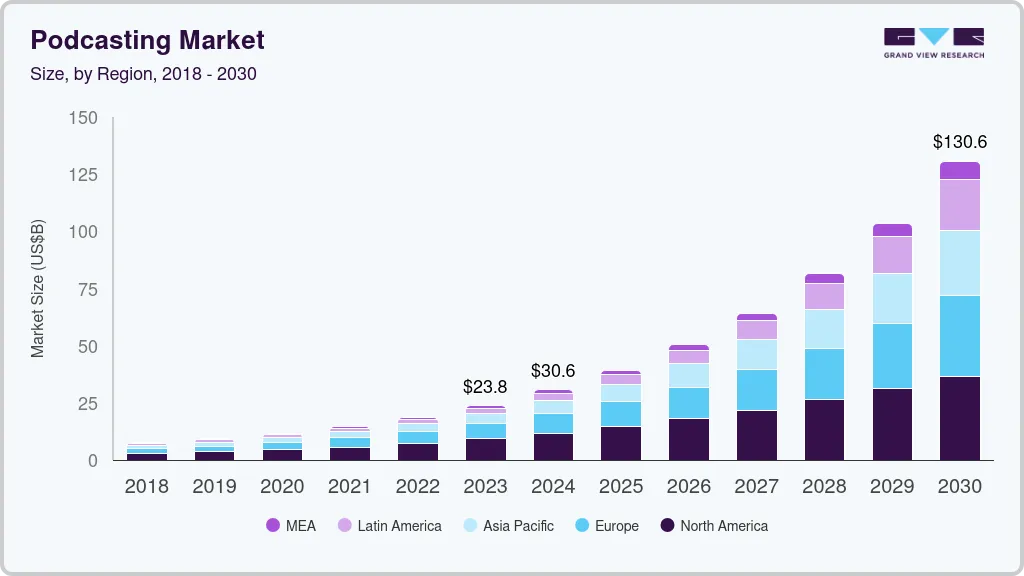
- Grand View Research estimates the global podcast market will reach $131.13 billion by 2030, driven by mobile usage, creator platforms, and digital advertising.
- Podcast advertising is also increasing quickly. The podcast ad revenue crossed $2 billion annually in the U.S., showing strong monetization potential for platforms.
- The total number of registered podcasts is 4.5 billion globally. 50% of US people listen to podcasts once every week.
- Another important factor is the creator economy. More independent creators and businesses are launching podcasts to build audiences and communities. These creators need reliable platforms to host and distribute content.
From a product strategy perspective, podcast apps have several advantages:
- Lower infrastructure cost than video streaming apps.
- Strong user retention behavior.
- Multiple monetization models.
- Growing creator ecosystem.
- Global audience reach.
Due to these factors, podcast app development is becoming an attractive opportunity for startups like yours to enter the media or creator-economy space.
Must-Have Features of a Podcast App Development
When you develop a podcast app, features should be planned around three groups. They are listeners, creators, and admins.
Here is a must-have podcast app features table showing what to build and why it matters.
| Features | Why it matters |
| User Registration & Profiles | Allows users to save subscriptions, playlists, and listening history across devices. |
| Podcast Streaming Player | This is the core experience of the app. Smooth playback keeps users engaged. |
| Podcast Search & Discovery | Users must be able to quickly find shows, episodes, and categories. |
| Podcast Categories & Filters | Helps users explore content easily and improves content discovery. |
| Offline Listening | Users often listen while traveling or without internet access. |
| Podcast Subscription System | Let users follow shows and return for new episodes regularly. |
| Playlist Creation | Allows users to organize episodes and increases listening time. |
| Listening History | Helps users continue where they left off. |
| Personalized Recommendations | Improves engagement by suggesting relevant content. |
| Push Notifications | Alerts users when new episodes are released. |
| Podcast Upload System | Enables creators to publish episodes directly on the platform. |
| Episode Management Dashboard | Helps creators edit titles, descriptions, and metadata. |
| Creator Analytics Dashboard | Shows creators’ listener behavior and engagement metrics. |
| Reporting & Analytics System | Helps track platform growth and performance. |
| Admin Dashboard | Helps manage users, content, and platform activity. |
These features form the core foundation of podcast app development. Most startups begin with a smaller MVP feature set, then expand as users grow.
For example:
- MVP podcast app → streaming, search, subscriptions, upload.
- Scalable platform → recommendations, analytics, moderation tools.
This approach keeps the cost to develop a podcast app within budget while still building a usable product.
How to Create a Podcast App: Step-by-Step Process
You can develop a podcast app by following a structured approach and roadmap if you do not want to make costly development mistakes.
Here is the step-by-step process you can follow to create a custom podcast application.
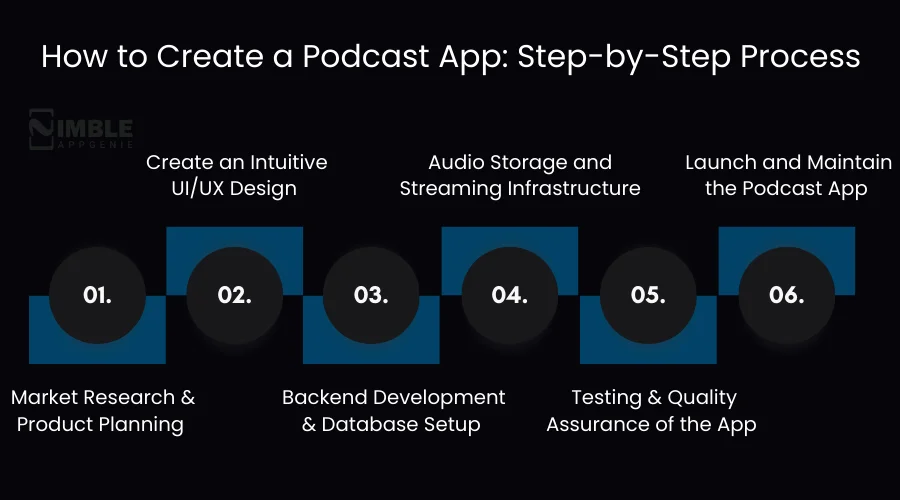
1. Market Research and Product Planning
Before you start to create an app, just identify what your podcast app will do. You don’t need to copy an app like Spotify. Some applications focus only on streaming podcasts from RSS feeds.
RSS feeds automatically deliver new podcasts or website content to apps, so users get updates without manually checking each time. However, other apps help creators upload and manage content.
Additionally, think about your target audience and why they would use it instead of so many existing apps. You also have to decide on the basic version, which is the MVP of the application.
Basically, proper market research and product planning will help you avoid wasting time and budget on features you really do not require.
2. Create an Intuitive UI/UX Design
As you know, podcast applications are utilized really differently from many mobile apps. Users generally open the app just to continue listening to a podcast or to find something new. That is the reason the player screen, episode list, and search must be easy to use.
You can begin by creating a wireframe that has the main screens like home, search, library, and player. Then turn those into small, visually appealing, and intuitive designs. If listening feels seamless and effortless, your target audience will likely continue to regularly use the podcast app.
3. Backend Development and Database Setup
Now, it is time to build the backend where your actual podcast app begins working. The dedicated development team writes the code to store podcast shows, episode information, user accounts, subscriptions, and listening history.
They set up a backend system that handles creator profiles and uploaded content. You have to organize the database so users do not get frustrated while finding episodes. A strong backend ensures that the podcast app does not slow down when more users use the app.
4. Audio Storage and Streaming Infrastructure
Podcast applications mainly have audio files, and those files need to play smoothly. You can simply store podcast audio in cloud storage and stream it using a CDN, so playback instantly begins.
Instead of downloading the whole episode at once, your podcast app should stream small parts of the audio as the user listens. This can minimize the buffering issue, and users can continuously listen to it.
However, it is really essential to build this part correctly. Otherwise, users will stop using your podcast app if the episodes take too long to play.
5. Testing and Quality Assurance of the App
Before you launch the app, it is vital to carefully do the mobile app testing. You can check whether the podcast stream is without any interruptions, is saved correctly, and notifications arrive on time. All this testing is very necessary for smooth app performance.
Additionally, you should check whether your podcast mobile app is working on all devices and internet speeds. Since podcast apps are mainly used for long listening sessions. So, stability matters more than anything else.
Lastly, you can fix the bugs like playback issues that now prevent bad ratings and reviews later. It also assists your target audience in trusting your podcast platform.
6. Launch and Maintain the Podcast App
Once you have thoroughly tested the podcast app, it is time to launch it on the app stores. The backend is deployed to cloud servers. After launch, real users start listening and uploading content, which helps you understand what needs improvement.
Most podcast apps improve search, recommendations, and create tools after release. So, it is advisable to regularly check and update the podcast application for smooth performance, better user retention, and engagement.
Tech Stack Required to Develop a Podcast App
You need to include a top-notch mobile app tech stack for a high-performing podcast solution.
The table below shows technologies and tools for creating a custom podcast app to stand out.
| Layer | Technology Stack |
| Mobile app development | Flutter, React Native, Swift, Kotlin |
| Backend development | Node.js, Django, Ruby on Rails |
| Database | PostgreSQL, MongoDB |
| Cloud storage | AWS S3, Google Cloud Storage |
| Audio streaming delivery | CloudFront, Cloudflare CDN |
| Authentication | Firebase Auth, OAuth |
| Search Engine | Elasticsearch, Algolia |
| Push Notifications | Firebase Cloud Messaging |
| DevOps and hosting | AWS, Google Cloud, Docker |
| Audio processing | FFmpeg |
| Analytics | Google Analytics, Mixpanel |
| Payments | Stripe, Razorpay |
How Much Does it Cost to Create a Podcast App?
The cost to create a podcast app can range from $25,000 to $200,000 or more, depending on the type of platform you want to create. Podcast app development cost is mostly affected by streaming infrastructure, feature complexity, and scalability requirements.
The major difference in cost happens because not all podcast apps are developed the same way. The cost mainly depends on what type of podcast app you want to build. If your budget is higher, you can build a platform that includes both podcast and music streaming in one app.
In that case, the cost to develop a music streaming app will also become part of the total development investment. This makes the project more complex and expensive.
To understand this, let’s check out the breakdown of the cost to develop a podcast app in the table given below.
| App Complexity | Cost Estimation |
| Basic Podcast App | $25,000 – $60,000 |
| Standard Podcast App | $70,000 – $130,000 |
| AI-Powered Podcast App | $130,000 – $200,000+ |
Factors affecting the podcast app development cost.
- Audio streaming infrastructure
- Feature integration
- Technology stack
- Cloud storage for podcast files
- Creator upload system
- Recommendation engine
- Number of platforms
Unlike many other apps, podcast platforms need strong streaming and storage systems. This makes your backend development more costly. Because of this, you can first build an MVP app and improve it after launch instead of building everything at once.
Monetization Strategies For a Podcast Application
One question that every founder has in their mind while developing a podcast app: how a podcast or music app makes money. It is vital to plan in advance for monetization that affects features, user experience, and platform design.
Here are the most popular monetization strategies that you can take into consideration.
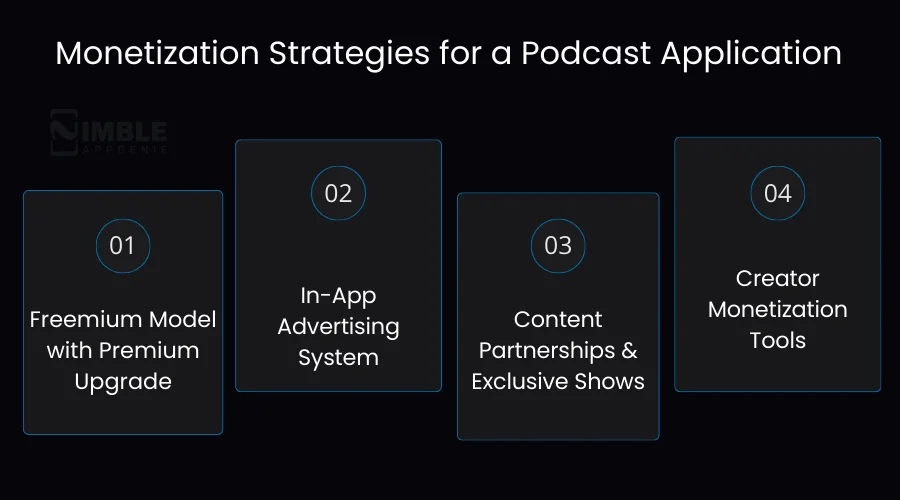
♦ Freemium Model With Premium Upgrade
Many podcast applications like Podbean start with free listening to attract users, then provide paid upgrades for premium features. This model is the best because it minimizes the entry barriers while still creating recurring revenue later.
If you are creating a podcast app, this model will help you grow the user base and monetize after engagement boosts.
♦ In-App Advertising System
Don’t just depend on external advertising; you can build your own ad system where creators and advertisers can connect. You can insert ads dynamically into podcast episodes and charge advertisers per impression or per campaign.
This approach can turn your podcast application solution into an advertising marketplace rather than just a streaming app.
♦ Content Partnerships and Exclusive Shows
Some podcast platforms invest in exclusive content partnerships to attract users. If you provide exclusive podcasts, it encourages downloads and increases subscription conversions.
This app monetization strategy is commonly used by large streaming platforms to grow faster. You can also partner with niche creators to help you differentiate the app in the early stage.
♦ Creator Monetization Tools
Another great way to monetize your podcast app is through creator monetization tools. You can allow creators to earn directly through the app. Also, you can encourage creators to publish more content with features like paid episodes, fan subscriptions, or tipping systems.
This way, your app can earn a commission from each transaction, which creates huge money without requiring creators to produce the podcast itself.
What are the Challenges in Podcast App Development and Possible Solutions?
Buffering-less audio streaming, huge podcast libraries, and developing a creator ecosystem from the beginning are the challenges you might face while building a podcast app. But don’t worry! Here are some possible solutions for each challenge you may come across while creating a podcast app.
Let’s take a look:
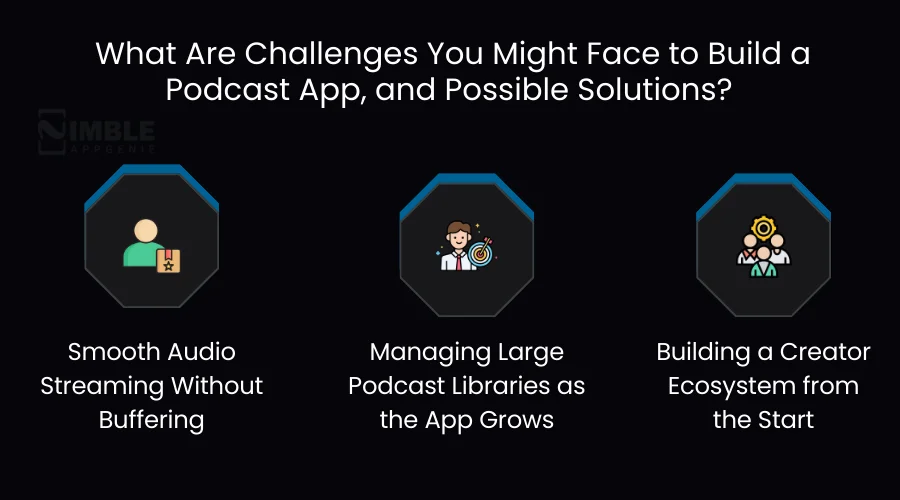
➤ Smooth Audio Streaming Without Buffering
Podcast applications rely completely on audio playback. If episodes take time to load or stop in the middle, users can lose interest. This is similar to challenges in music app development, where streaming performance directly affects the user experience.
How to solve it :
You can store audio files in cloud storage and deliver them with CDN. Additionally, if you compress audio files properly, playback starts faster. It is vital to test podcast streaming on slow internet networks before launch. This will help ensure a better listening experience.
➤ Managing Large Podcast Libraries as the App Grows
As more creators post podcast episodes, your app must handle thousands of audio files and metadata records. Without proper structure, search results can slow down, and episode pages may take longer to load.
How to solve it :
For that, you can utilise a structured database for podcast metadata and implement a search indexing system. Also, caching frequently played podcasts and organizing content by categories keeps your app fast even when you add more content.
➤ Building a Creator Ecosystem From the Start
A podcast app requires content to attract listeners, but creators usually join platforms that already have an audience. This makes early growth difficult for new podcast platforms.
How to solve it :
You can allow creators to import podcasts with RSS feeds. This can make posting episodes really easy. You can add basic analytics so creators can see listener activity. Also, it is vital to focus on a niche category of podcasts that can help build content faster.
Why Choose Nimble AppGenie to Make a Podcast App?
If you already have an idea for a podcast app, the next step is turning that idea into a product without wasting time and budget.
Nimble AppGenie helps you plan podcast applications from a product perspective, to deciding which listener features and streaming systems should be built first.
Instead of starting directly with coding, our expert team helps define the app structure, audio delivery approach, and content flow so the platform can handle real podcast usage after launch.
Additionally, we also support you in creating a podcast MVP that can later expand into subscription models, analytics dashboards, and larger content libraries. So, what are you waiting for? Book a free consultation now for a bespoke podcast app solution!
How Nimble AppGenie stand out?
- Hands-on experience in building a podcast app for global clients.
- Clear project planning with fixed milestones and predictable development timelines.
- Prototype-first approach to test ideas before full app development begins.
- Easy integration with payments, chat, APIs, and cloud services.
- Long-term support like updates, scaling help, and performance monitoring.
Conclusion
Podcast platforms continue to grow as more users prefer on-demand audio content and creators look for new distribution channels. For your business, it is best to start with a clear product idea and build only the essential features first.
Once the platform gains users, you can expand into creator tools, subscriptions, and advanced streaming capabilities. You do not have to start from scratch; we just showed you how to build a podcast app with essential features to stand out.
You can partner with a music streaming app development company that can help ensure your podcast app is scalable and ready to grow with increasing content and listeners over time.
FAQs

Niketan Sharma, CTO, Nimble AppGenie, is a tech enthusiast with more than a decade of experience in delivering high-value solutions that allow a brand to penetrate the market easily. With a strong hold on mobile app development, he is actively working to help businesses identify the potential of digital transformation by sharing insightful statistics, guides & blogs.
Table of Contents




No Comments
Comments are closed.