

 Free Consultation
 PCI-DSS Compliant
 GDPR Ready
 ISO 27001
 NDA Protected
 AI Services
 AI App Development
 Generative AI Development
 AI Chatbot Development
 AI Integration Services
 AI Consulting Services
 AI For Fintech
 AI Financial Assistant Solution
 AI Insurance Agent Development
 Tech Stack
 OpenAI / GPT-4
 Claude / Anthropic
 Gemini / Google AI
 Llama / Open Source
 LangChain / LlamaIndex
 Pinecone / Pgvector
 AWS / Azure AI


 Fintech Solution
 Core Fintech
 App Development
 Neobank Solutions
 eWallet Solutions
 Lending Software
 Banking Solutions
 BNPL Solutions
 BNPL Solutions
 Insurance App
 Wealth Management
 Crypto & DeFi
 Blockchain Development
  Payroll Software
 DeFi Solutions
 Crypto Wallet
 Crypto On/Off Ramp
 Crypto Exchange
 Trading Platform
 Payments
 Compliance
 Regulations & Compliance
 Fraud Detection
 Lending Ecosystem
 P2P Lending Platform
 Mortgage Software
 Engagement
 Fintech Outsourcing

 Mobile Development
 Mobile App Dev
 iOS App Development
 Android App Development
 React Native
 Flutter Development
 Web Solution
 Node.js Development
 React.js Development
 Angular Development
 App Services
 UI/UX Design
 App Maintenance
 By Stage
 MVP Development
 Industry Solutions
 Healthcare App Dev
 Education App Dev
 Travel App Dev
 Real Estate App Dev
 Logistics Software
 Social Media App

 Hire Mobile Developers
 Hire iPhone Developers
 Hire Android Developers
 Hire React Native Devs
 Hire Flutter Developers
 Hire Web Developers
 Hire Node.js Developers
 Hire Angular Developers
 Hire PHP Developers
 Hire Laravel Developers
 How It Works
 Pre-Vetted Developers
 Ready In 48 Hours
 NDA From Day One
 Replace Guarantee
 Company
 About Us
 Our Work Process
 Portfolio
 Case Studies
 Blog / Insights
 Careers
 Contact Us
 Awards
 Recognition


 Offices



In a Nutshell:
- AI Insurance Agents are intelligent digital assistants powered by AI, ML, NLP, and automation that support human insurance professionals by managing tasks like customer interaction and data interpretation more effectively than basic chatbots.
- Primary use cases include autonomous underwriting, claim automation, hyper-personalized sales, and fraud detection, all of which simplify processes and boost accuracy.
- The cost to build an insurance AI agent usually starts from $20,000 for basic ones and $150,000 for the advanced ones, based on several aspects.
- Implementation steps involve architecture selection (choosing AI/LLM and tools), data modernization, tool integration into existing systems or new apps, and a Human-in-the-Loop (HITL) design to supervise AI decisions.
- Benefits of adopting agentic AI include reduced costs, improved operational efficiency, 24/7 availability, and higher precision in decision-making across insurance workflows.
- Challenges you can encounter while building AI insurance agents are regulatory compliance, legacy system compatibility, AI hallucination risks, and data privacy concerns, which demand careful planning and expert support.
With time, almost every industry is becoming smart, leading to speedy and satisfactory operations. The insurance industry has also awakened.
Yes, with AI agent development for insurance, insurers can meet their expectations for accuracy, speed, and scalability.
Traditional automation is a bygone story; an agentic AI insurance agent is the advent of a new era. They can act autonomously, reason, and even constantly learn across complex workflows.
What is an AI insurance agent?
For your information, an AI insurance agent is a smart, autonomous system powered by agentic AI, NLP, and machine learning. These autonomous AI agents can thoroughly analyze data, execute insurance workflows, and make decisions without continuous human intervention.
How to build AI agent for insurance?
This post talks about insurance AI agent development, AI agent architecture, key use cases, benefits of AI agent development, challenges you can encounter, and the technology stack for a successful AI agent development for insurance.
What Is an AI Agent in Insurance?
AI insurance agents, or AI agents for insurance, refer to a smart, digital, and diligent partner who has only one job: assisting the human professional.
You see, AI and machine learning, combined with Natural Language Processing and automation, bring to life a digital agent that never sleeps.
The combination of AI and ML allows this digital agent to learn from the user behaviour, along with the preferences of the users.
The automations help in simplifying the process at all hours of the day and NLP helps in understanding user concerns with more depth.
Professionals use agentic AI in insurance to bring these aspects to life. Unlike your basic automation strategies being used through the implementation of artificial intelligence, Agentic AI takes the performance of your digital insurance agent to the next level.
These agents are not the typical chatbots that simply feed you a pre-decided answer.
These agentic AI solutions leverage all the technology to identify what exactly your intention is and only then give you an answer, helping you do things just by guiding it in the right direction.
The use cases of AI agents in insurance or using agentic AI are significant to the industry as they simplify the process and make it highly responsive for the users.
Let’s check out exactly how it achieves this objective in the next section.
Simply put, an AI insurance agent is a smart and self-operating system that leverages advanced technologies, like AI, ML, and NLP, to manage insurance processes.
Such agents autonomously analyze information, take actions, and simplify insurance operations without any human intervention.
How AI Agents Work in the Insurance Industry and Key Use Cases
AI agents in the insurance industry perform by combining reasoning engines, data ingestion, and task execution layers.
These insurance automation AI systems constantly learn, optimize process workflows, and make contextual decisions in real time.
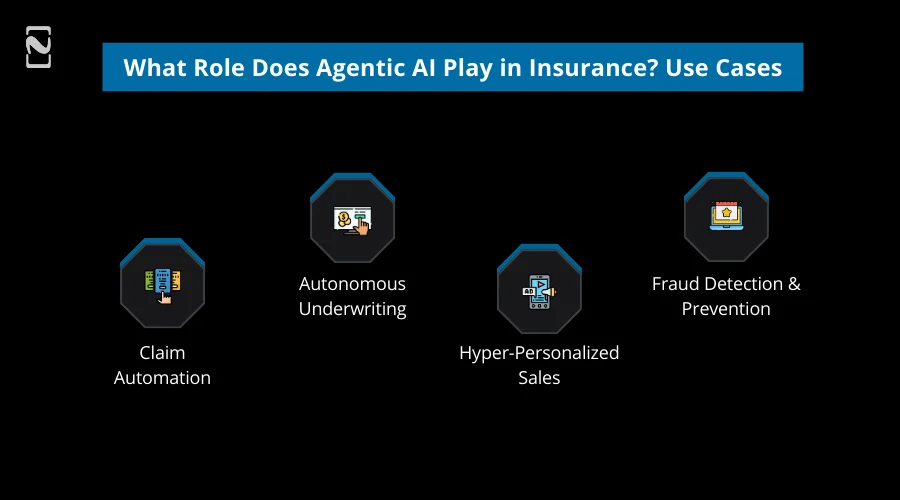
Talking about AI-powered insurance use cases, some common ones are automated claims, intelligent underwriting, fraud detection, customer support, and automated claims processing.
Through AI-driven insurance workflows, insurers can diminish manual effort while boosting speed and accuracy.
Let’s discuss some major use cases of AI agents in insurance.
-
Claim Automation
An AI agent can simplify and automate the claim process for your business and customers. From analyzing the legitimacy to cross-referencing the data for solidifying the claims, the AI agent is capable of doing all of it.
What makes it a great automation tool is that it has NLP integrated, which helps it analyze the submitted documents. The AI agent is well-equipped to check for anomalies in past claims. This helps in identifying potential fraud.
-
Autonomous Underwriting
The underwriting process is a key factor when it comes to insurance services. The AI agent can easily help in autonomous underwriting solutions, as it can go a step further to analyse customer-related data.
The enhanced risk profiling consists of analyzing credit score, lifestyle factors, and other customer details to fetch the best possible prediction.
The agentic AI is capable of creating a complete risk portfolio while accounting for a customer’s claim frequency and severity.
-
Hyper-Personalized Sales
Artificial intelligence is a game-changer when it comes to learning about your customers and offering personalized services. An AI agent can significantly personalize things for the user, making the add-on services more and more desirable for them.
This is achieved through various data points about the customer, for instance their demographics, prior history, online behaviour, and more. It is clearly one of the best personalized sales strategies to deploy an agentic AI agent in insurance services.
-
Fraud Detection & Prevention
An AI agent is smart enough to analyze user patterns that may appear fishy or fraudulent. But did you know that an AI-powered agent can take an inside look to identify potential hardware and machinery failure? Yes, you read that correctly.
Not only does an AI agent in insurance simplify your solution, but it also makes it easier for you to maintain the operations without facing any outages or failures.
An AI solution might even get significantly better than a human when dealing with potential fraud.
The mentioned use cases of agentic AI in insurance are enough to understand the significance of using a digital insurance agent.
With that said, the significance of technology, specifically AI, ML, and NLP, in the industry gets clearer.
How to Implement an AI Agent in Insurance using Agentic AI?
Implementing an AI agent in insurance using agentic AI demands defining business goals, organizing high-quality insurance data analytics, and crafting an autonomous AI agent architecture.
Besides, to deploy secure AI agents for insurance workflows, APIs, models, and human-in-the-loop control integration is essential.
Learn more by delving deeper!
Knowing how you can easily carry out some of the most complex operations with the help of an AI agent powered by agentic AI, you may be wondering,
“How can I leverage this technology?”
How do you implement the solution for your business? Well, an agentic AI solution is not just any application or service that you can directly buy from the internet. Implementing the solution requires a series of steps and solid expertise in AI and NLP.
To give you better insights into the same, we have discussed the steps involved in chronological order to give you a perspective of what AI agent development for insurance means. Check it out!
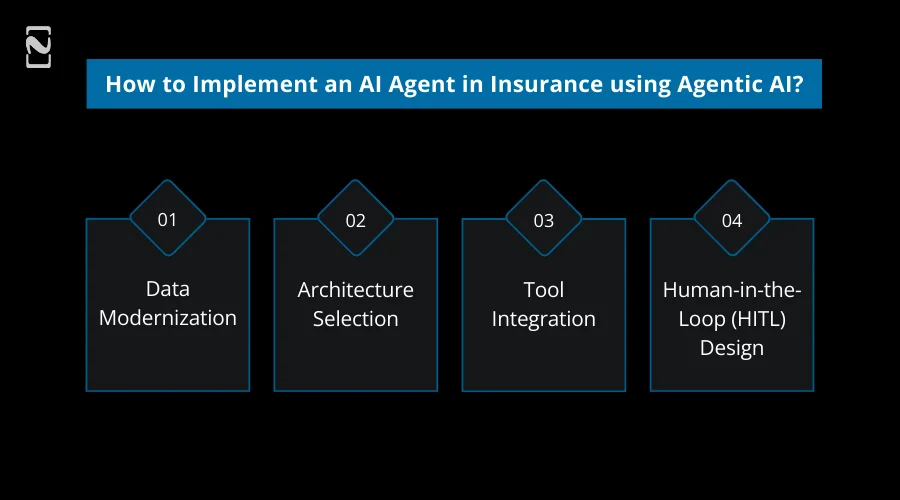
Phase 1: Data Modernization
The first thing you need to do is collect all the data and modernize it. You see, irrespective of whether you have been using a digital or a physical data collection, the LLM and NLP learning models use a significantly different way of interpreting the data.
Hence, you need to check your current data landscape and ensure that the data is in the necessary modern format and meets all the requirements.
It is necessary to have clean, integrated, and well-governed data to yield the best results from agentic AI in insurance apps.
Phase 2: Architecture Selection
This is a crucial step, as this is where you select your architecture for building an AI agent. From choosing the LLM model to creating a combination of solutions that get the job done for you, this is the step where your entire agentic AI solution is configured.
Deciding if you want to go with LLaMA by Meta, GPT by OpenAI, or PaLM by Google depends on your requirements. All of them play their roles quite well.
Next comes your AI-Agent building platforms like AutoGen by Microsoft, which makes your agent capable of dealing with multi-turn conversations easily.
If the preferences are for a no-code solution, CrewAI is also a good choice.
Phase 3: Tool Integration
This is the step where you go through the entire app development process. You have the data to feed, and you have the architecture of the AI agent.
Now all you need to do is integrate the tool with your application. If you already have an app, you can ask the expert to guide you with the integration.
However, if you are in the process of building the application from scratch, you need to hire the development team and go through the course of development and integration process, which includes the following steps:
- Data collection and curation
- Designing an AI agent’s architecture
- Augmenting comprehension capabilities
- Involving data from external sources
- Boosting reasoning and analytical capabilities
- Designing output generation
- Taking care of ethical considerations
- Creating UI
- Testing and validation
- Deployment and scaling
After you have reached deployment, you need to keep upgrading your application regularly for better results.
Phase 4: Human-in-the-Loop (HITL) Design
Lastly, when you have a dedicated solution with you, you need to have a human in the loop.
This means that your current employees must be in charge of overseeing the tasks that your agentic AI performs.
You see, regardless of how accurately you have developed the solution, the technology still requires a human in the loop in order to take care of ambiguity that may appear.
Human oversight ensures safety, accuracy, and accountability by leveraging the respective strengths of both humans and machines.
The implementation steps may have provided clarity on the role agentic AI plays and the responsibilities of a human in this automated operation.
Converting your older data into newer formats that your agentic AI can process to yield better insights and investing in a completely new system can certainly feel like a lot to do.
So what’s in it for you? Well, check out the next section, where we have discussed some of the key benefits of using Agentic AI in the insurance business.
Benefits of AI Agent Development for Insurance Companies
The benefits of AI in insurance embrace mitigated operational costs, improved decision precision, and rapid processing.
By activating AI-driven insurance operations, companies catch up with transparency, scalability, and a competitive edge.
An AI agent is not just any gimmick or a chatbot that feeds simple pre-decided answers to the user.
Instead, it is like an insurance agent who has insights into your services and can easily answer customer queries based on the same.
The applications go beyond answering queries, as we saw in the previous sections, too.
With an AI insurance agent working to simplify the journey of both your users and your employees, the benefits that it brings are truly valuable.
Here are some of the benefits you can expect when planning to implement agentic AI in insurance.
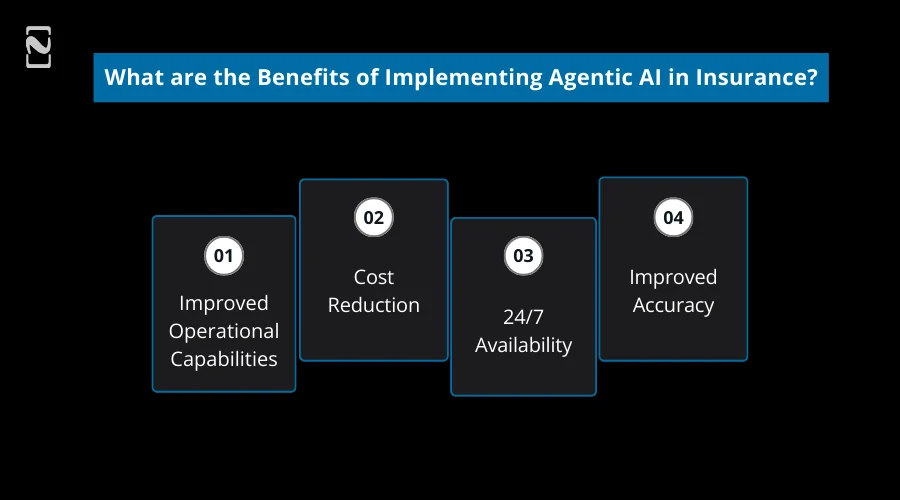
1] Improved Operational Capabilities
The first benefit of implementing an AI agent in insurance is the operational efficiency that comes with it.
The ability to create, execute, and adapt new strategies is significantly improved when you have an automated agentic AI working to simplify the job for you.
2] Cost Reduction
When you have built an AI agent to manage your everyday tasks, the cost of your human resources can be significantly reduced.
You can even use the resources in a more optimized way to get things done better, which helps in reducing the overall operational costs.
3] 24/7 Availability
An AI agent is available 24×7, making your services more efficient. Any user can visit your platform for answers, and the Agentic AI is implemented to give the necessary solution.
With an online presence, being able to connect with your clients and potential customers at any hour of the day puts you significantly ahead of the competition.
4] Improved Accuracy
When managing an insurance business, accuracy is a tool that you must have. From identifying the claim requirements to checking the details and managing underwriting, you need to be accurate, or else things can go south.
Agentic AI solutions can make it easier for you to manage highly accurate solutions.
Other than this, an agentic AI solution in the insurance industry can help you simplify the user experience to a great extent by breaking down the services according to their preferences.
With the help of AI recommendations and a one-of-a-kind natural language processing algorithm, the solution is nothing less than a humanoid working for you.
AI Insurance Agent Development Cost: What to Expect
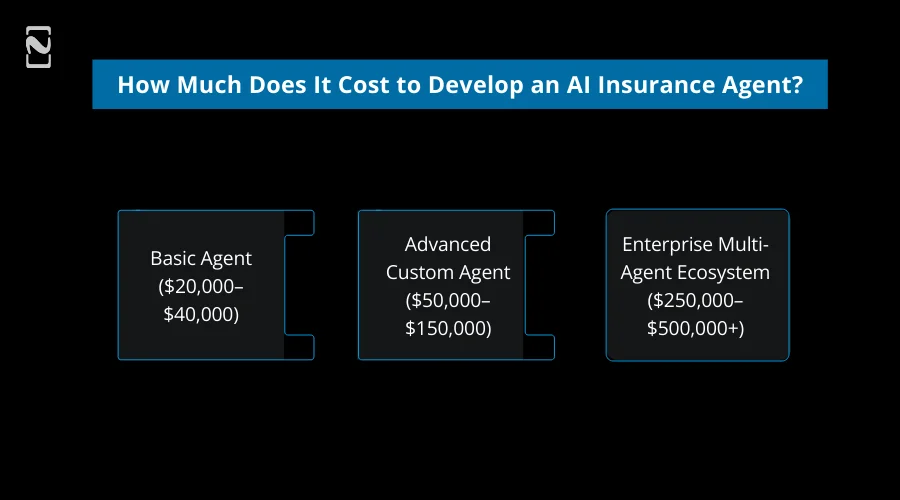
The cost to develop an AI insurance agent ranges between $20,000 and $150,000, depending on factors like AI model sophistication, feature complexity, data integration, and platform choice.
Developing custom AI agents demands enterprise-level investments, with scalability, security, and compliance influencing overall pricing.
The benefits bring a lot of excitement to the table, as these are some of the most prestigious and cutting-edge advancements that can take your insurance business to the next level.
However, with this excitement comes an important question: how much does it cost?
You see, all types of tech are available for grabs today. It is the budget constraints and value for money that keep Agentic AI solutions away from small and medium businesses.
Here’s a cost breakdown of an AI agent for the insurance industry to give you an estimate of how much you need to spend to get your hands on a dedicated agentic AI solution for your insurance business.
-
Basic Agent ($20,000–$40,000)
This is your basic AI Agent that can be considered an advanced version of the chatbot. It can hold context and give answers to the customers; however, it may not be able to perform advanced solutions.
-
Advanced Custom Agent ($50,000–$150,000)
The advanced custom agent is what you can call your automated employee, as it holds significantly better tools to manage operations and generate results that are hyper-personalised for the user.
-
Enterprise Multi-Agent Ecosystem ($250,000–$500,000+)
This is a complete ecosystem of your multiple agentic AI models working together to create a chain of operations that is automated. It is generally used by large-scale insurance companies as they have significantly more things to manage and automate.
Keep in mind that it is just a rough estimate of how much it may cost. Sure, the customizations may vary according to your requirements.
However, this estimate can be considered to be the closest to what it would cost you to finish. There are several recurring costs associated with the solution that you need to consider.
Challenges and Solutions for AI Agents in Insurance Platforms
Successful AI implementation in insurance demands robust governance and human-in-the-loop frameworks.
You can get blocked by common AI challenges, like legacy system integration, regulatory compliance, AI hallucination risks, and data privacy.
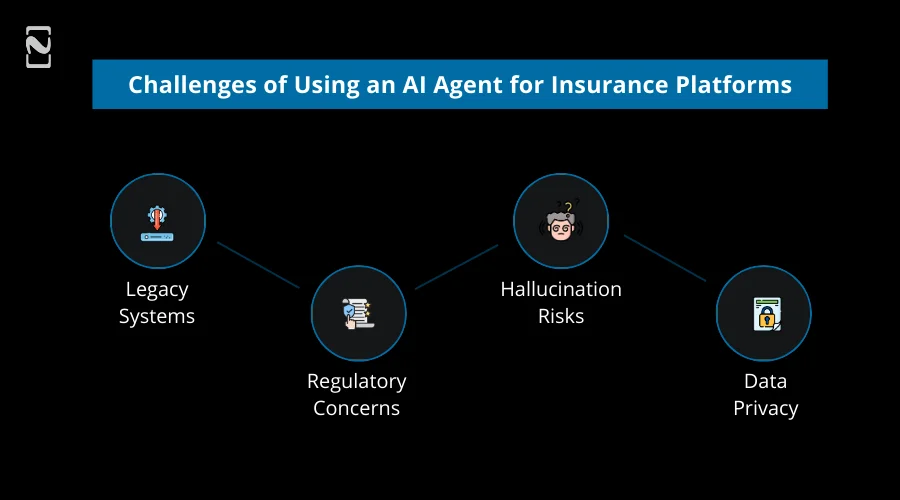
Some of the key challenges to address are:
Challenge #1: Legacy System Integration
Solution: By leveraging API-based integrated or phased deployment, you can bridge AI agents with your existing systems without even disturbing operations.
Challenge #2: AI Decision Accuracy
Solution: For that, combine continuous model training, high-quality datasets, and human-in-the-loop (HITL) review to keep up the reliability.
Challenge #3: Data Privacy and Compliance
Solution: You should implement anonymization, end-to-end encryption, and compliance monitoring to ensure your AI agents are operating within legal frameworks.
Challenge #4: Operational Transparency
Solution: Harness the potential of explainable AI (XAI) tools to document, track, and justify streamlined decisions for regulators and stakeholders.
Challenge #5: Cost and Resource Management Solution:
Begin with pilot projects considering high-impact workflows, then gradually scale for ROI and cost efficiency.
To ensure that these challenges do not hinder your vision, you need a solid AI-enabled insurance app development company to get things done.
If you are wondering who can help with the job, check out the next section, as we have just the right solution for you.
Technology Stack for Insurance AI Agent Development
AI insurance AI technology stack embraces LLMs, data pipelines, APIs, orchestration frameworks, and monitoring tools.
A scalable AI agent architecture ensures compliance, continuous learning, and reliability in production environments.
Technology Stack for AI-Powered Insurance Platform
| Category | Technologies / Tools |
| AI & Machine Learning | TensorFlow, PyTorch, Scikit-learn, Keras |
| Natural Language Processing (NLP) | SpaCy, NLTK, GPT/LLMs, BERT |
| Data Management & Storage | PostgreSQL, MySQL, MongoDB, Apache Hadoop, Snowflake |
| APIs & Integrations | REST APIs, GraphQL, OpenAPI, Insurance platform APIs |
| Cloud & Deployment | AWS, Azure, Google Cloud, Docker, Kubernetes |
| Security & Compliance | HIPAA-compliant frameworks, SSL/TLS, IAM tools |
| Analytics & Monitoring | Power BI, Tableau, Grafana, ELK Stack |
| Automation & Workflow Orchestration | Apache Airflow, Camunda, UiPath |
Why Choose Nimble AppGenie for Insurance AI Agent Development
Well, you should choose the right insurance AI agent development partner to get secure and compliant AI solutions.
Nimble AppGenie is a reliable AI development company delivering scalable AI agent development services.
Our team of AI developers creates custom insurance AI solutions tailored to unique enterprise insurance workflows.
Key Reasons to Choose Nimble AppGenie:
- Proven Insurance AI Expertise
- Modern AI & ML Stack
- Custom, Scalable Solutions
- End‑to‑End Support
- Compliance & Security First
Real-Time Case Study: AI Agent for Insurance Claims Automation
Client: Leading Health Insurance Provider (Confidential)
Challenge: The insurer faced lagging claims processing, high operational costs, and uneven risk assessments due to manual workflows.
Solution We Offered: Nimble AppGenie developed a custom AI insurance agent utilizing agentic AI, machine learning, and NLP to streamline validation, claims intake, and settlement.
The solution included:9
- Smooth integration with the client’s legacy insurance platform via APIs.
- Fraud detection and compliance monitoring embedded in workflows.
- Automated document and image analysis for claim verification.
- Human-in-the-loop review for critical claims.
Results Obtained:
- 60% drop in claims processing time.
- 35% lower operational costs.
- 50% reduction in error rates in claim approvals.
- 24/7 customer support facilitated through AI-powered virtual agents.

Conclusion
AI insurance agent development and agentic AI solutions are the future of the insurance industry from now on.
These are best for enhancing decision-making, automating workflows, and improving customer experiences.
You can opt for AI agent development for your insurance company to streamline claims, fraud detection, underwriting, and customer support with speed, accuracy, and scalability.
Expert AI development services can help you address challenges like data privacy, legacy system integration, and compliance issues.
Insurers embracing custom AI agents catch up with a competitive edge, diminish operational costs, and deliver reliable services to their customers.
Partner with a bespoke AI development company, like Nimble AppGenie, to make sure your AI initiatives are fully aligned with your business objectives.
FAQs

Niketan Sharma, CTO, Nimble AppGenie, is a tech enthusiast with more than a decade of experience in delivering high-value solutions that allow a brand to penetrate the market easily. With a strong hold on mobile app development, he is actively working to help businesses identify the potential of digital transformation by sharing insightful statistics, guides & blogs.
Table of Contents




No Comments
Comments are closed.