

 Free Consultation
 PCI-DSS Compliant
 GDPR Ready
 ISO 27001
 NDA Protected
 AI Services
 AI App Development
 Generative AI Development
 AI Chatbot Development
 AI Integration Services
 AI Consulting Services
 AI For Fintech
 AI Financial Assistant Solution
 AI Insurance Agent Development
 Tech Stack
 OpenAI / GPT-4
 Claude / Anthropic
 Gemini / Google AI
 Llama / Open Source
 LangChain / LlamaIndex
 Pinecone / Pgvector
 AWS / Azure AI


 Fintech Solution
 Core Fintech
 App Development
 Neobank Solutions
 eWallet Solutions
 Lending Software
 Banking Solutions
 BNPL Solutions
 BNPL Solutions
 Insurance App
 Wealth Management
 Crypto & DeFi
 Blockchain Development
  Payroll Software
 DeFi Solutions
 Crypto Wallet
 Crypto On/Off Ramp
 Crypto Exchange
 Trading Platform
 Payments
 Compliance
 Regulations & Compliance
 Fraud Detection
 Lending Ecosystem
 P2P Lending Platform
 Mortgage Software
 Engagement
 Fintech Outsourcing

 Mobile Development
 Mobile App Dev
 iOS App Development
 Android App Development
 React Native
 Flutter Development
 Web Solution
 Node.js Development
 React.js Development
 Angular Development
 App Services
 UI/UX Design
 App Maintenance
 By Stage
 MVP Development
 Industry Solutions
 Healthcare App Dev
 Education App Dev
 Travel App Dev
 Real Estate App Dev
 Logistics Software
 Social Media App

 Hire Mobile Developers
 Hire iPhone Developers
 Hire Android Developers
 Hire React Native Devs
 Hire Flutter Developers
 Hire Web Developers
 Hire Node.js Developers
 Hire Angular Developers
 Hire PHP Developers
 Hire Laravel Developers
 How It Works
 Pre-Vetted Developers
 Ready In 48 Hours
 NDA From Day One
 Replace Guarantee
 Company
 About Us
 Our Work Process
 Portfolio
 Case Studies
 Blog / Insights
 Careers
 Contact Us
 Awards
 Recognition


 Offices


Insurance companies often struggle with slow claims approvals, fraud detection issues, and managing large volumes of policyholder data across digital systems. These operational delays not only increase costs but also create poor customer experiences in mobile platforms.
Due to this, AI in insurance apps is becoming a priority for modern insurers. According to Shift Technology, insurers using AI-driven automation can reduce claims processing time by up to 57% while improving accuracy.
By integrating AI into insurance apps, businesses can automate document verification, risk assessment, and customer support without increasing manual workload. This helps insurance teams focus more on decision-making instead of repetitive processes.
If you are planning to integrate AI into your insurance app to improve efficiency and customer experience, understanding where AI fits and how it delivers value is important.
In this blog, we’ll explore how AI is changing the insurance industry and how you can successfully integrate AI into insurance apps.
So, let’s begin!
What is AI in Insurance?
AI in insurance is used to make things faster and better for both insurance companies and the customer.
For example, in the past, if someone had a car accident, they had to fill out the forms and talk to agents, and also wait for days to hear back.
Now, with the advent of AI, the insurance app can help look at photos of the damage and help approve the claim within minutes. AI helps in selecting the right insurance plans.
It looks at things like a user’s age, health, driving habits, and any records. Based on that, AI suggests a plan that fits users the best.
Besides, there are many insurance companies that provide AI chatbots that solve queries of users anytime. Basically, AI helps companies to do their work faster and better.
Why Businesses Invest in AI Insurance Apps – Market Overview?
Businesses are investing in AI because customer expectations and operational pressure are changing. Manual processes in claims handling, underwriting, and customer support slow down service and increase costs. But AI helps them manage huge volumes of data really fast and make more consistent decisions.
Let’s take a deeper look at the insurance industry insights to get a clear understanding of investing in AI insurance app development.
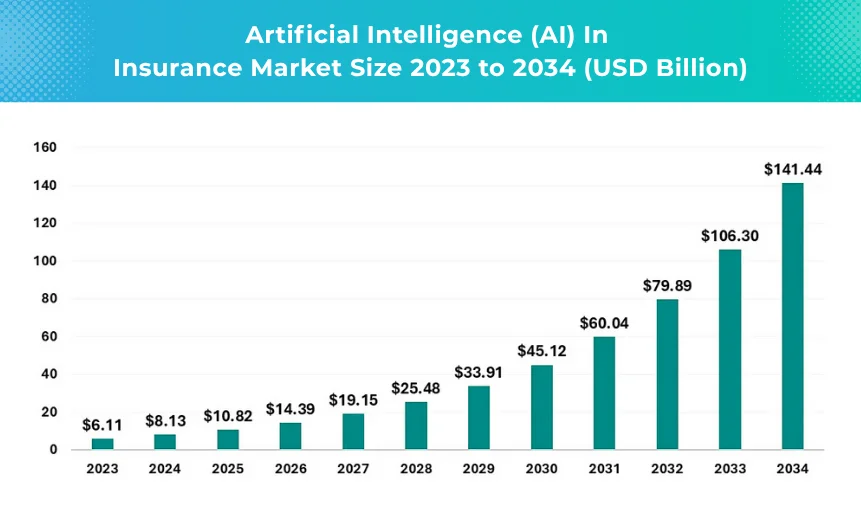
Source: Precedence Research
- The market size of AI in insurance is forecasted to hit $141.44 billion by 2034 with a CAGR of 06%.
- North America is projected to dominate the market during the forecast period.
- The insurance sector will grow $1223.5 by 2030 with a CAGR of 2%.
- A survey says 74% of people have a health insurance app, and 69% use it monthly.
- Another study shows 78% of young people want to do things like payments and claims through their phones, showing mobile use is growing fast.
5 Benefits of Using AI in Insurance Apps
Adding AI to insurance apps isn’t always simple. Many companies are still unsure because they worry about things like data safety and whether the AI will always give the right results.
However, as technology grows, it’s becoming clear that AI can really help. It can save time, reduce mistakes, and help insurance teams work smarter.
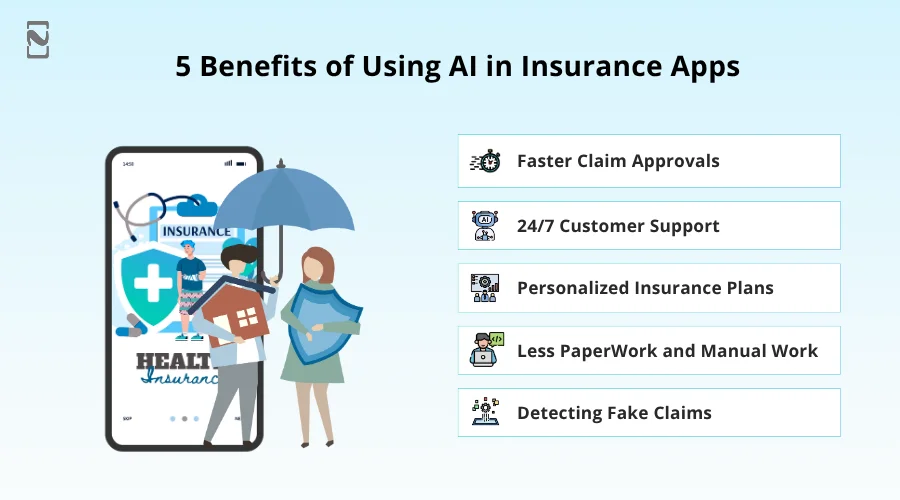
The more it’s used, the more useful it’s proving to be. So, let’s check out some benefits of using AI in insurance apps.
1. Faster Claim Approvals
We all know how stressful it is to file a claim after an accident or emergency. You had to fill out forms, collect documents, talk to different agents, and so on. Am I correct? Well, with AI in insurance apps, this process becomes much easier and very fast.
The app can read photos, check documents, and decide if the claim is real or not. This can all be done within minutes. It means you can get help or money faster. Also, it minimizes mistakes, since AI can check everything carefully.
2. 24/7 Customer Support
You will often need help outside normal working hours. You may have a question at night or on a weekend. With AI, insurance applications can provide customer support anytime through chatbots.
These chatbots can answer questions, help customers find the right plan, and explain policy details. Unlike human agents who need breaks, an OpenAI Agent can work 24/7 without stopping. This makes customers feel supported at all times and enhances the overall experience.
3. Personalized Insurance Plans
Everyone has multiple needs when it comes to insurance. One person drives carefully every day. Others may have health issues.
When building a health insurance app, AI assists in looking at each person’s habits, past data, and lifestyle to recommend the best insurance plan.
For instance, a safe driver can get a low-cost car insurance policy, or someone who works out daily might get a better health plan.
It helps customers save money and makes them feel like the company knows and values them. It is just no longer a one-size-fits-all; AI can help in making personal offers.
4. Less PaperWork and Manual Work
AI can manage many tiny tasks that used to take more time for humans. For instance, reading forms, checking documents, entering data, or sending updates. All this can be done by AI in seconds. It minimizes paperwork for the customers and also helps the company save time.
In combination with an AI detector & humanizer, the system can further enhance user interactions by adding a personal touch to automated processes. This synergy creates a more engaging and efficient experience, allowing employees to focus on higher-priority tasks.
Besides, employees do not have to waste hours on routine jobs and can focus on helping people with more crucial things. The app also becomes seamless and fast to use, which makes customers happier.
5. Detecting Fake Claims
Some people try to trick insurance companies by providing wrong details. They also make fake claims. It causes money loss for the company and delays for honest people who need assistance.
AI helps stop this by checking for anything that looks unusual. It compares old and new data and sends a warning if something fishy is found. This helps ensure that real claims get managed faster and more fairly for all.
Real-World Use Cases of AI in Insurance
AI is not just a big idea anymore. Insurance companies are using it in real life. From speeding up claims to helping customers through chatbots, these real-world examples show how AI is making insurance faster.
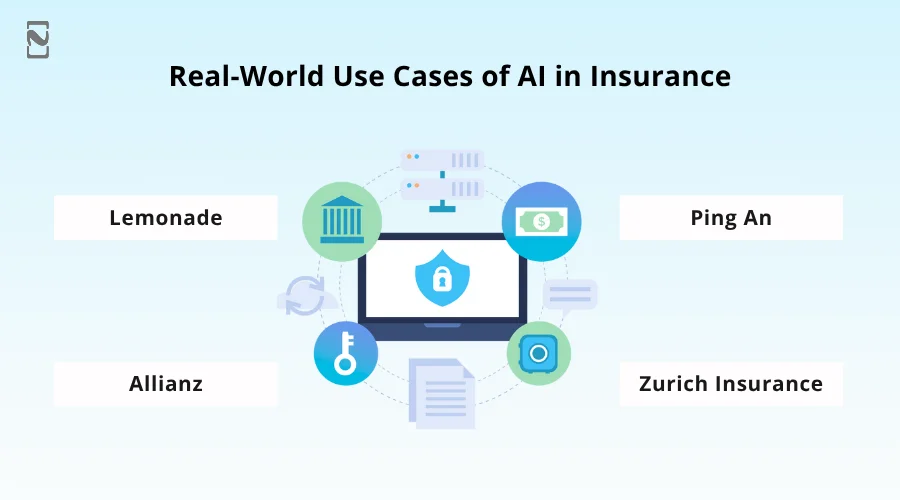
Let’s have a look at the use cases.
-
Lemonade – AI Settles Claims in Seconds
Lemonade is an insurance company in the USA. If something you own gets stolen or damaged, you can file a claim through this app.
Their smart AI system checks your details, reviews your policy, and if everything looks fine, it can approve and send the money in just a few seconds. Also, some people have even been paid in 3 seconds. No paperwork, no waiting.
-
Ping An – AI Checks Car Damage from Photos
Ping An is a China-based insurance company. If your car gets into an accident, you do not need to wait for someone to come and inspect it. You just take a few pictures, upload them to your app, and the system will figure out how bad the damage is. It tells you the repair cost and shows nearby garages.
-
Allianz – AI Reads Claim Documents
When someone files a claim, Allianz often sends many documents. For instance, hospital bills, reports, forms, etc. Instead of making a person read all of it, Allianz uses a smart app to do it. It picks out the essential details quickly so the company can move faster and make fewer errors.
-
Zurich Insurance – AI Detects Fraud
Zurich uses AI to find claims that do not look right. For instance, if someone keeps filing claims that seem suspicious, or the story does not add up, the system notices it. It then alerts a human to double-check. This helps stop cheating and saves the company a lot of money.
What Are the Challenges of Integrating AI in Insurance Apps and Possible Solutions?
Integrating AI into an insurance app can improve claims processing, fraud detection, and customer service, but the process is not always simple.
You might face many challenges when adding AI to existing insurance systems. Here are the challenges and their possible solutions that you must take into consideration.
1. Data Readiness and Organization
AI relies on huge amounts of historical data like claim records, customer profiles, and policy information. This data is stored in different systems or contains missing or inconsistent entries. It can slow down AI integration.
How to fix this:
You can start by cleaning and organizing your essential datasets, like claims or underwriting data. Also, if you start with structured and reliable data, it assists AI models in producing accurate results.
2. Integration with Legacy Systems
You often depend on older core apps that were not designed to support AI tools. If you replace these systems completely, it can really cost you and can be risky.
How to fix this:
You can connect AI services using APIs or middleware layers and do not rebuild the entire system. This enables AI features to work alongside existing apps without any major disruption.
3. Regulatory and Compliance Concerns
Insurance decisions should follow strict rules and regulations. If AI is utilised for underwriting or claims approval, you must be able to explain how decisions are made. Some AI models make this difficult.
How to fix this:
You can use explainable AI models and keep human approval in essential workflows. This maintains compliance while still increasing efficiency from automation.
4. Initial Implementation Cost and Effort
AI integration in insurance applications needs a huge investment in data preparation, testing, and system updates. If you are new to Artificial Intelligence, this can really feel overwhelming.
How to fix this:
You can follow a common method to implement AI. Just begin with smaller AI features like chatbots or document verification. This can slowly expand after seeing the results.
5. Internal Adoption and Trust
Your employees might hesitate to depend on AI systems. It is especially when you take the heavy decision like claims evaluation.
How to fix this:
You can introduce AI as a support or chatbot system rather than a replacement. This can help your employees to adapt. Over time, the consistent outcomes can build confidence in the system.
How Much Does it Cost to Integrate AI in an Insurance App?
The cost to integrate AI in an insurance app can be around $25,000-$250,000. However, it depends on the feature you integrate, the existing system, and the available insurance data. You can begin with small and expand AI integration over time to manage cost and risk.
Below is a rough cost breakdown for integrating an AI in insurance system:
| AI Feature Type | Estimated Integration Cost |
| Basic AI integration | $25,000 – $70,000 |
| Mid-level AI integration | $70,000 – $180,000 |
| Advanced AI integration | $180,000 – $250,000+ |
This is just a rough estimate. Several factors affect the final cost to develop an insurance app with AI functionality. These include the quality of insurance data, integration with legacy insurance systems, compliance requirements, and cloud infrastructure usage.
Therefore, you can start with one high-impact feature like AI claims processing or fraud detection. Once the system proves reliable and valuable, you can expand AI functionality on the insurance app.
This step-by-step approach reduces risk, keeps implementation manageable, and helps businesses see measurable results from AI integration.
Future of AI in the Insurance Industry
The future of AI in insurance looks bright. Many tasks that take time now will become much faster. People will use mobile apps to buy insurance, ask questions, and get help without talking to an agent. AI chatbots will answer most questions right away.
AI will help make smart insurance plans. For instance, if someone drives safely, the app can provide a lower price. Claims will be easier, too. People can upload images, and AI will check the damage and process the claim fast.
Due to this, more companies are now investing in insurance apps with AI features. These apps help customers manage everything from their mobile phones.
In short, AI and mobile apps will work together to make insurance simple yet fast. But companies must keep customer data safe and use AI in fair ways.
How Does Nimble AppGenie Help with AI Integration in Your Insurance App?
If you are planning to integrate AI in an insurance app, but do not know where to begin, Nimble AppGenie is your one-stop destination.
Our team can provide robust insurance app development services for businesses and has the expertise to add AI in a way that works.
Let’s say you have an insurance app. Nimble AppGenie can integrate features like chatbots that talk to users, check documents, or systems that provide users the right insurance plan as per their habits.
We do not just throw in random AI features. First of all, we understand your goals. We plan, develop, and test everything so it runs seamlessly.
Our expert team takes care of the hard stuff, while you focus on running your business.
We also ensure that everything is safe and easy for your users to use. If you want to develop an app that is future-ready, Nimble AppGenie is the team to consult with.
AI in Insurance Apps: Real-World Case Study
Client Type: Digital insurance startup providing motor and health coverage.
Key Challenge: Slow claims verification, fraud risk during claim submission, and heavy manual work in customer support. The client also struggled to give instant policy recommendations inside their mobile app.
AI Solution We Implemented:
- AI-based claims document verification
- Fraud detection using behavior-pattern analysis
- AI chatbot for policy queries and claim status tracking
- Personalized policy recommendation engine
- Risk-scoring model for faster claim approvals
Results (Within 150 Days):
- 41% faster claims processing time
- 28% reduction in suspected fraudulent claims
- 55% drop in customer support workload
- 37% improvement in in-app policy purchases
- Higher customer satisfaction scores
Key Takeaway:
AI helped the insurance app move from manual claim handling to faster, smarter decision-making. This keeps the human review process in place for complex cases.

Conclusion
AI is no longer just an idea in the insurance industry. It is quietly becoming a major part of insurance applications, like faster claims review and smarter fraud detection. For you, the real change is not just replacing people. It helps teams make quick decisions using data.
However, if you integrate AI in insurance application solutions, it will allow your business to automate repetitive tasks and improve customer experience.
Since insurance apps continue to become more digital, AI will play a major role in risk analysis, policy management, and personalized coverage.
Startups that begin to explore AI today will be better prepared to create customer-focused insurance apps like Geico or General in the future. This adoption of AI will shape how insurers innovate, compete, and deliver reliable digital insurance experiences.
FAQs

Niketan Sharma, CTO, Nimble AppGenie, is a tech enthusiast with more than a decade of experience in delivering high-value solutions that allow a brand to penetrate the market easily. With a strong hold on mobile app development, he is actively working to help businesses identify the potential of digital transformation by sharing insightful statistics, guides & blogs.
Table of Contents




No Comments
Comments are closed.