

 Free Consultation
 PCI-DSS Compliant
 GDPR Ready
 ISO 27001
 NDA Protected
 AI Services
 AI App Development
 Generative AI Development
 AI Chatbot Development
 AI Integration Services
 AI Consulting Services
 AI For Fintech
 AI Financial Assistant Solution
 AI Insurance Agent Development
 Tech Stack
 OpenAI / GPT-4
 Claude / Anthropic
 Gemini / Google AI
 Llama / Open Source
 LangChain / LlamaIndex
 Pinecone / Pgvector
 AWS / Azure AI


 Fintech Solution
 Core Fintech
 App Development
 Neobank Solutions
 eWallet Solutions
 Lending Software
 Banking Solutions
 BNPL Solutions
 BNPL Solutions
 Insurance App
 Wealth Management
 Crypto & DeFi
 Blockchain Development
  Payroll Software
 DeFi Solutions
 Crypto Wallet
 Crypto On/Off Ramp
 Crypto Exchange
 Trading Platform
 Payments
 Compliance
 Regulations & Compliance
 Fraud Detection
 Lending Ecosystem
 P2P Lending Platform
 Mortgage Software
 Engagement
 Fintech Outsourcing

 Mobile Development
 Mobile App Dev
 iOS App Development
 Android App Development
 React Native
 Flutter Development
 Web Solution
 Node.js Development
 React.js Development
 Angular Development
 App Services
 UI/UX Design
 App Maintenance
 By Stage
 MVP Development
 Industry Solutions
 Healthcare App Dev
 Education App Dev
 Travel App Dev
 Real Estate App Dev
 Logistics Software
 Social Media App

 Hire Mobile Developers
 Hire iPhone Developers
 Hire Android Developers
 Hire React Native Devs
 Hire Flutter Developers
 Hire Web Developers
 Hire Node.js Developers
 Hire Angular Developers
 Hire PHP Developers
 Hire Laravel Developers
 How It Works
 Pre-Vetted Developers
 Ready In 48 Hours
 NDA From Day One
 Replace Guarantee
 Company
 About Us
 Our Work Process
 Portfolio
 Case Studies
 Blog / Insights
 Careers
 Contact Us
 Awards
 Recognition


 Offices



In a Nutshell:
- The implementation of AR-VR in fantasy sports apps does create an immersive experience through blending virtual elements with the live-game data.
- The role of AR-VR in fantasy sports apps are it provides an immersive experience, offers real-time analytics, helps in deeper intelligence, boosts fan engagement, and helps in strategy simulations.
- Key features of AR-VR in fantasy sports apps are virtual stadium tours, 3D player interactions, virtual tour management, and 3D simulations of matches.
- You can integrate AR-VR in fantasy sports apps by following the steps, such as analyzing the market trends, understanding the use cases, designing the app, developing an integrated AR/VR asset, and testing.
- The challenges in integrations are the cost of implementation, the availability of resources, and content creation.
- Furthermore, partnering with Nimble AppGenie can help you integrate AR/VR effectively in your app.
The market for interactive entertainment has grown multiple-fold in the past decade. One of the prime examples of such applications is fantasy sports apps. People can directly interact with a live game.
The thrill of choosing your team and waiting for their performance makes it super exciting for a user. To take this excitement to the next level, enthusiasts are investing in the latest technologies.
The most popular choice of tech for this has been AR/VR. Augmented Reality and Virtual Reality have found their way into the realm of fantasy sports apps and offer some cutting-edge features.
In this post, let us take a look at what those features are, how they work, and, more importantly, how AR/VR has transformed the fantasy app industry. So without further ado, let’s begin!
What is AR/VR in Fantasy Sports Apps: Market Size and Its Related Stats
AR/VR in fantasy sports apps is all about creating immersive, 3D, and real-time interactive experiences that go beyond 2D screen-based gaming. These technologies do allow users to play fantasy sports and experience a stadium-like atmosphere.
AR/VR in fantasy sports apps offers an immersive experience for users at different stages. You see, fantasy sports apps are all about competitive stats and online contests. There is no direct media involved to engage the user.
Thanks to these technologies, app owners and developers have found a way to gamify the entire app experience by integrating different immersive features that can be brought to life with the implementation of AR/VR in fantasy sports.
The market has shown great acceptance of AR/VR as it has shown great adaptability. If we talk about the market for AR/VR, it is a growing one as it is expected to grow from $727.44 million to a whopping $5,897.53 million between the years 2024-2032 with a CAGR of 29.90%.
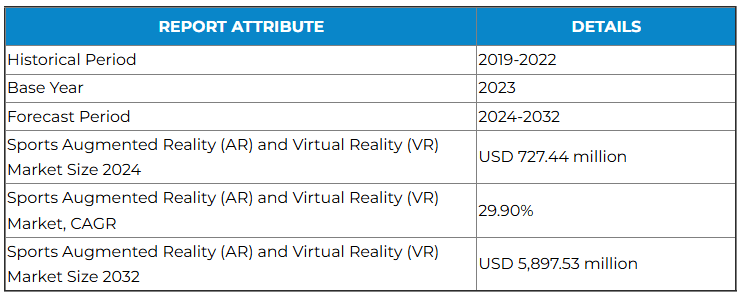
The numbers clearly state that the use of AR/VR is one of the most popular fantasy sports app trends. Hence, if you are planning to step into the AR/VR fantasy sports market, then integrating AR/VR can be a great way to attract new users.
What are the Key Features of AR/VR in Fantasy Sports Apps?
The key features of AR-VR in fantasy sports apps are virtual stadium tours, real-time overlays, community & social features, advertising tools, virtual design tools, and 3D simulations of matches.
There are different fantasy sports app features that AR/VR brings along when implemented. In case you are worried about making things work in your app, here are some features that you can consider integrating.
If we talk about the categories of features, there are three types that you can find in an AR/VR-enabled fantasy sports application, i.e., User. Admin, & Advanced users.
Let’s explore all the features you might find in an AR/VR integrated fantasy sports app :
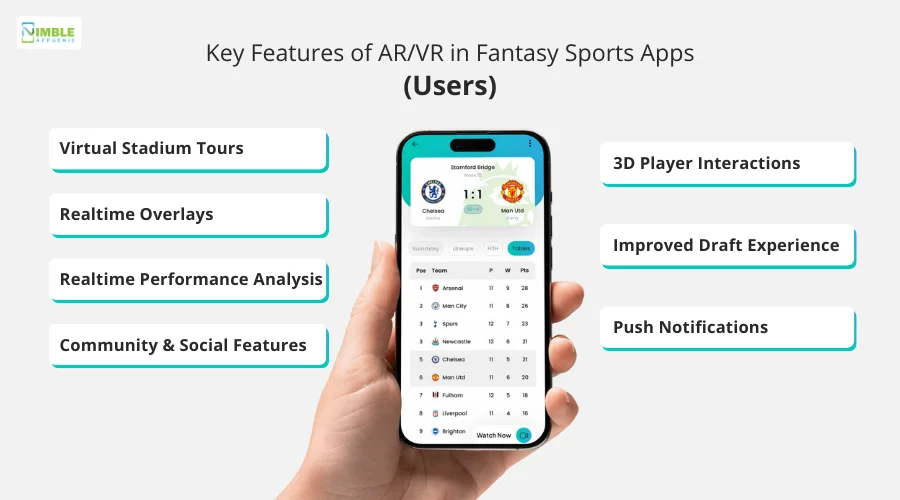
► Users Panel Features in AR/VR Fantasy Sports App
- Virtual Stadium Tours
- 3D Player Interactions
- Realtime Overlays
- Improved Draft Experience
- Realtime Performance Analysis
- Push Notifications
- Community & Social Features
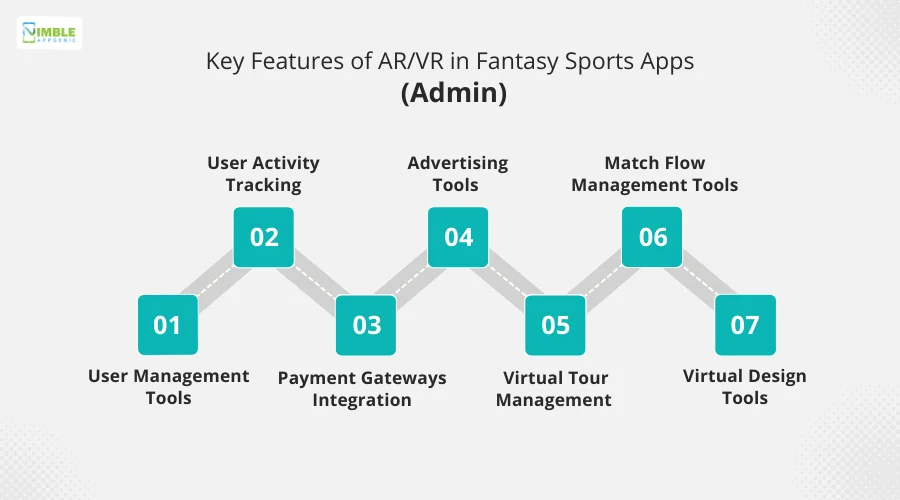
► Admin Panel Features in AR/VR Fantasy Sports App
- User Management Tools
- User Activity Tracking
- Payment Gateways Integration
- Advertising Tools
- Virtual Tour Management
- Match Flow Management Tools
- Virtual Design Tools
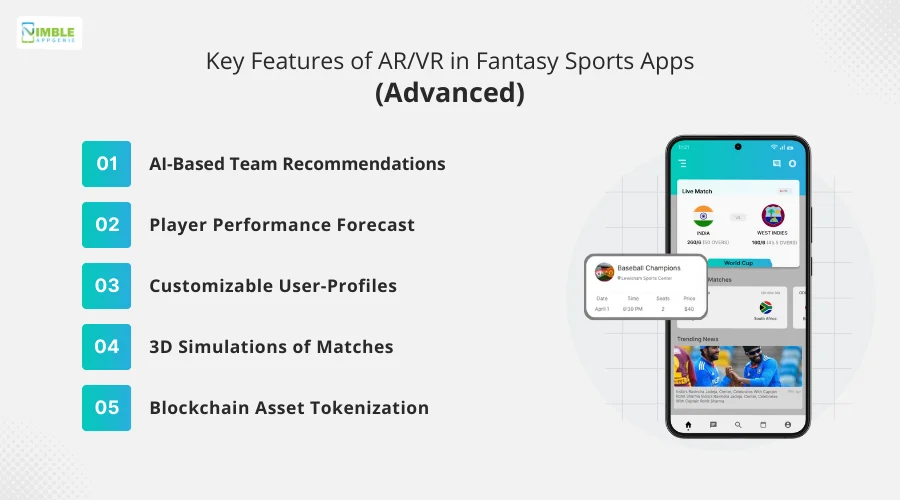
► Advanced Features in AR/VR Fantasy Sports App
- AI-Based Team Recommendations
- Player Performance Forecast
- Customizable User-Profiles
- 3D Simulations of Matches
- Blockchain Asset Tokenization
The possibilities with technologies like augmented reality and virtual reality are endless as you can always innovate new features. Making things interactive is the ultimate goal of integrating these features.
How to Integrate AR/VR in Fantasy Sports Apps?
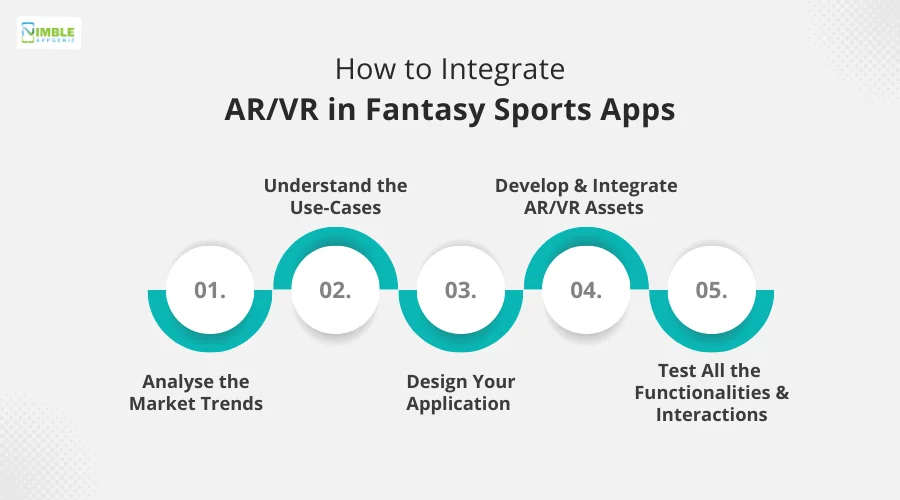
You need to follow the steps given below to integrate AR/VR in fantasy sports apps:
- Analyse the Market Trends
- Understand the use-cases
- Design your application
- Develop & integrate AR/VR assets
- Test all the functionalities & interactions
With these steps, you can develop a fantasy sports app through integrating AR-VR.
Let’s discuss them all in detail below:
1. Analyse the Market Trends
You research the market, understand the gap, and then introduce a solution. However, the key factor here is to find the user of AR/VR and integrate it intelligently.
Before you start building an AR/VR-enabled sports fantasy application, you need to understand the market trends. These market trends refer to current market practices and what are the features being offered.
This research gives you an idea of how the market perceives the use of Augmented Reality and Virtual Reality in fantasy sports.
2. Understand the Use-Cases
This step allows you to understand the requirements of the app, and accordingly, you can opt for the features based on your understanding of use cases.
You see, the majority of the apps integrate these technologies as a gimmick and do not offer a highly useful feature. If you plan to build an app with AR/VR, you would want the user to use the features you offer, and hence, understanding the use case is crucial.
3. Design Your Application
Having a dedicated place for AR/VR features in your fantasy sports application is crucial in terms of fantasy sports app design and development.
In this step, you need to design your application in such a way that people can easily interact with the app, without having to go through complex steps. The navigation, choice of core features, and placement of these features.
4. Develop & Integrate AR/VR Assets
Now that you have a design, a bunch of features, and an understanding of the market, you should start developing the application.
This is the step where you start building your AR/VR assets that you integrate along with the fantasy sports app tech stack. Build functionalities and start integrating them one by one to ensure that the application works fine.
5. Test All the Functionalities & Interactions
Once you are done developing the functionalities, it is time to check them all and ensure that they are working fine.
Especially when you have AR/VR services integrated, you must check all the interactions and experience the AR/VR features to check that they work as intended.
After you are done testing all the test cases and are 100% satisfied with the outcome, it is time to launch the application. Keep in mind that this launch can go either way, as you have tested the app in a certain environment and not every user will be able to replicate the same.
Hence, you should continuously monitor the performance of your application while paying attention to the feedback you receive.
What’s the Role of AR-VR in Fantasy Sports Apps?
AR-VR in Fantasy sports apps transforms the passive stats into immersive experiences. With the help of VR headsets, users can experience live matches from a first-person perspective.
AR creates an interactive 3D visualization for drafting players and tracking the team performance in real time.
Let’s evaluate the complete role of AR-VR in Fantasy Sports Apps:
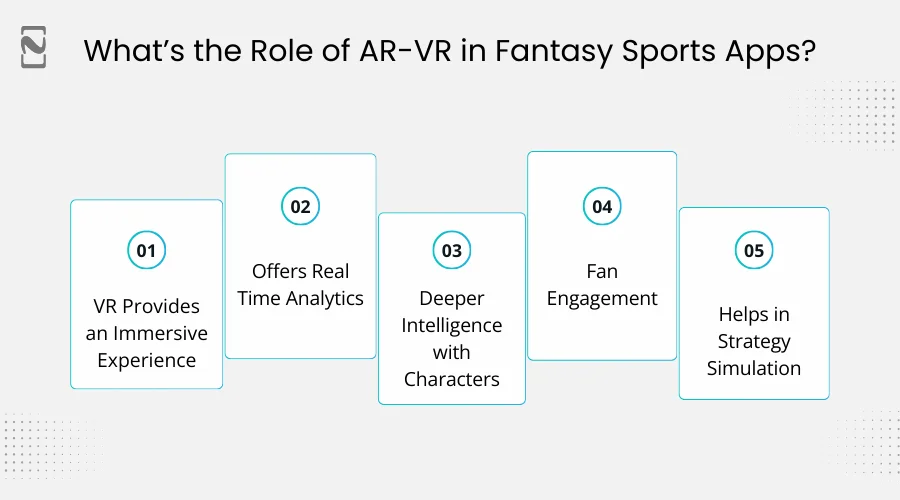
➤ VR Provides an Immersive Experience
When it comes to integrating VR in a fantasy sports app, this will help you to create a more reliable fantasy experience.
With the help of headsets, you can use stereoscopic displays to build a 3D effect that offers a wide field of view that tricks the brain into perceiving depth. This enables users to understand the complex concepts of fantasy sports and explore the virtual world.
➤ Offers Real-Time Analytics
AR-VR offers real-time analytics through transforming the raw, complex data into an immersive experience, 3D visualizations that help users to interact with and analyze information instantly.
AR can display live player stats and the fantasy points directly on the screen during the match. It transforms abstract, complex datasets into an interactive 3D visualization that helps to identify patterns and monitor KPIs.
➤ Deeper Intelligence with Characters
With the help of AR-VR integration in the fantasy sports apps, you can gain a deeper intelligence with characters. To make users engaged in the app, it is essential to opt for AR and VR, it creates an immersive experience with the characters, goals, and so on, that too quite smoothly.
Additionally, for the metaverse gameplay, you can blend 3D visualization with the real-time analytics.
➤ Fan Engagement
Through AR-VR, you can help the users to have social interaction, that allows the users to team up with friends in the fantasy sports tournaments, and explore fantastical landscapes together.
With social interaction, you can have word-of-mouth advertising and promotion of your fantasy sports app. This is one of the important roles of AR-VR in fantasy sports apps that helps to enhance decision-making while playing games.
➤ Helps in Strategy Simulation
With the help of AR-VR, the users can form prompt strategies to test different lineups and strategies. This helps to simulate match scenarios.
Further, it is effective to analyze player combinations, and it is even useful to make decisions based on the precision models. This even helps in interactive viewing experiences where users can analyze data and can share it on social media platforms.
What are the Challenges to integrating AR-VR in Fantasy Sports?
While integrating AR/VR is a great solution for your fantasy sports app business, there are a few challenges that you might come across.
Usually, managing the cost to develop a fantasy sports app is the biggest challenge. For the majority of app owners and developers, these challenges become the dealbreaker.
Check them out and decide for yourself if they bother you :
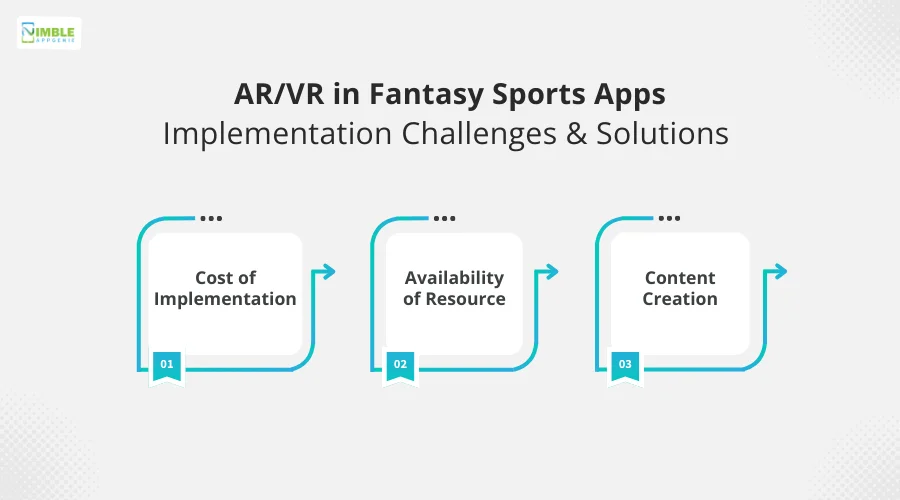
► Cost of Implementation
The very first issue that usually bothers a fantasy app developer is the budget constraint.
Augmented reality and virtual reality are two technologies that require you to spend more than usual on fantasy development, which is often an issue for people starting their business with a cap on their budget.
Solution :
The ideal way to handle your implementation cost is to identify the key features you want to integrate into your fantasy sports app and accordingly allocate the budget. The more you plan, the better your cost of implementation.
► Availability of Resource
You need high-performance computing resources, a larger team of developers and AR/VR specialists, more time, and many other resources. These resources are high in cost and limited in terms of availability when compared to basic fantasy app development.
The availability-to-cost ratio also varies with the type of team you hire and their location. Finding the right resources under a budget is certainly a challenge many face.
Solution :
It might take you some time to fix the final team, but you should consider checking multiple resources before finalising one.
Digital resources are surely something that you cannot compromise on; however, you can always make the best decision while choosing the team from a third-party provider to whom you can easily outsource.
► Content Creation
While integrating AR/VR into your application, you need to understand that there will be additional content that you will have to generate purely for AR/VR functionalities.
Generally, fantasy sports apps use a straightforward approach when it comes to sharing content on the app; however, when there is AR/VR integrated, content has to be built as per the use. It is not easy for a user to create content for AR/VR, and hence it poses a significant challenge.
Solution :
Content for AR/VR is specially designed for an immersive experience. There are several libraries that offer templates to get started with your application.
You can reduce your complications by getting inspired and getting hold of ways to build AR/VR-friendly content. Other than these challenges, one of the most common challenges that people come across is the challenge of education.
You see, there’s no point in introducing new features and tech if the users you are targeting are not equipped to use them. Hence, you have to educate your users about ways to use these.
If all these challenges are too much to handle, you should start looking for a development partner to guide you and help you identify fantasy sports app development mistakes to avoid at any cost.
These challenges can be managed with the right approach by the development team and the experts you hire.
Successful Examples of AR/VR in Fantasy Sports Apps
It is not necessary that these challenges make it difficult to survive and thrive in the industry. Several active apps have achieved immense success with the implementation of AR/VR in the fantasy sports app business.
Let’s take a look at some of the best fantasy sports apps that have already made it big in the fantasy sports realm by integrating AR/VR.
♦ FanDuel
One of the most popular fantasy sports apps, FanDuel offers real-time player stats with AR overlays and VR-based game simulation. The app has certainly set the standard for fantasy sports applications as it has millions of users across the world.
Read Also: How To Develop An App Like Fanduel
♦ DraftKings
Another popular app like DraftKings fantasy sports that has left a mark in the fantasy world, DraftKings has started integrating AR/VR in the form of overlays and draft experiences.
♦ ESPN Fantasy Football
Integrating AR/VR with a pinch of AI & ML, ESPN fantasy football offers the best of both worlds with an immersive experience using Virtual Reality and personalized stats and projections based on AI algorithms.
While these apps today focus mainly on traditional fantasy sports, all of them have started integrating the future trends of AR/VR into their apps in one way or another. You can find glimpses in the form of overlays, stadium views, and more.
Releted Blog: How To Develop An App Like ESPN Fantasy Sports
What are the Future trends in AR/VR in Fantasy Sports Apps?
The use of AR/VR itself emerged as a trend in the growth of fantasy sports applications. If we go further deep into how the use of AR/VR will change over the coming years, there are significant trends that will drastically improve the experience of users.
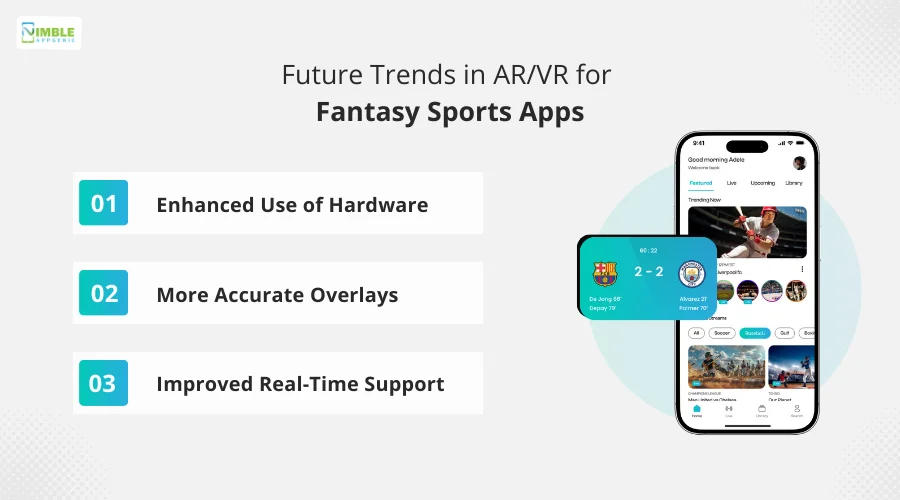
Here are some future AR/VR Trends :
➤ Enhanced Use of Hardware
With virtual reality and augmented reality taking over the experience of a user, there will be a lot of dedicated hardware that will be required. AR/VR devices such as glasses, headsets, etc., will start making their way into fantasy sports app interactions.
➤ More Accurate Overlays
Today if we take a look at virtual overlays, they often seem laggy and inaccurate. There is a lag in updating from player to player.
In the upcoming years, these overlays will become more stable with the use of AI and ML in fantasy sports apps, which help in improving virtual reality implementation along with optimized technologies.
➤ Improved Real-Time Support
One of the core reasons why people are hesitant to integrate AR/VR into the application is the lack of real-time support when things go south. However, with the improvement in technology and implementation of AR/VR in fantasy sports apps, these can certainly improve real-time support.
These trends make the future of AR-VR in fantasy sports apps promising. If you plan to integrate augmented reality and virtual reality into your business, you must focus on these trends as they will define the upcoming generation of fantasy sports applications.
Why Connect With Nimble AppGenie to Leverage AR-VR for Transforming Fantasy Sports Apps?
The idea of integrating AR and VR into a fantasy sports app emerged as a way to make data and statistics-oriented games more and more engaging.
At the end of the day, AR/VR are technologies that are used to enhance the experience of users to leverage these features and transform them into a game-changing factor for your fantasy sports app. You need an app development partner.
Nimble AppGenie offers the best fantasy sports app development services that not only help you build a unique experience but also help you take your business to the next level with robust solutions.
Let the experts of our team help you design a perfectly balanced fantasy sports application for your next entrepreneurial adventure. Reach out today!
Conclusion
Understanding the role of AR/VR in fantasy sports apps is highly crucial for people who are associated with the field or are planning to penetrate the realm. You must understand that these technologies are highly interactive and can be used to create immersive experiences.
Integrating AR/VR has completely refreshed the way people interact with fantasy sports applications. Improvements in the overall experience of fantasy sports applications mean a widely growing user base and a solid, stable career path.
Hence, you can always rely on fantasy app developer experts to assist you. Hopefully, this post gives you all the necessary insights on the role that AR/VR plays in fantasy sports applications. That will be all for this one.
FAQs

Niketan Sharma, CTO, Nimble AppGenie, is a tech enthusiast with more than a decade of experience in delivering high-value solutions that allow a brand to penetrate the market easily. With a strong hold on mobile app development, he is actively working to help businesses identify the potential of digital transformation by sharing insightful statistics, guides & blogs.
Table of Contents




No Comments
Comments are closed.