

 Free Consultation
 PCI-DSS Compliant
 GDPR Ready
 ISO 27001
 NDA Protected
 AI Services
 AI App Development
 Generative AI Development
 AI Chatbot Development
 AI Integration Services
 AI Consulting Services
 AI For Fintech
 AI Financial Assistant Solution
 AI Insurance Agent Development
 Tech Stack
 OpenAI / GPT-4
 Claude / Anthropic
 Gemini / Google AI
 Llama / Open Source
 LangChain / LlamaIndex
 Pinecone / Pgvector
 AWS / Azure AI


 Fintech Solution
 Core Fintech
 App Development
 Neobank Solutions
 eWallet Solutions
 Lending Software
 Banking Solutions
 BNPL Solutions
 BNPL Solutions
 Insurance App
 Wealth Management
 Crypto & DeFi
 Blockchain Development
  Payroll Software
 DeFi Solutions
 Crypto Wallet
 Crypto On/Off Ramp
 Crypto Exchange
 Trading Platform
 Payments
 Compliance
 Regulations & Compliance
 Fraud Detection
 Lending Ecosystem
 P2P Lending Platform
 Mortgage Software
 Engagement
 Fintech Outsourcing

 Mobile Development
 Mobile App Dev
 iOS App Development
 Android App Development
 React Native
 Flutter Development
 Web Solution
 Node.js Development
 React.js Development
 Angular Development
 App Services
 UI/UX Design
 App Maintenance
 By Stage
 MVP Development
 Industry Solutions
 Healthcare App Dev
 Education App Dev
 Travel App Dev
 Real Estate App Dev
 Logistics Software
 Social Media App

 Hire Mobile Developers
 Hire iPhone Developers
 Hire Android Developers
 Hire React Native Devs
 Hire Flutter Developers
 Hire Web Developers
 Hire Node.js Developers
 Hire Angular Developers
 Hire PHP Developers
 Hire Laravel Developers
 How It Works
 Pre-Vetted Developers
 Ready In 48 Hours
 NDA From Day One
 Replace Guarantee
 Company
 About Us
 Our Work Process
 Portfolio
 Case Studies
 Blog / Insights
 Careers
 Contact Us
 Awards
 Recognition


 Offices



Key Takeaways:
- App store optimization (ASO) is all about improving your app’s visibility and even the conversion rate on the app stores.
- ASO is important because it engages the right users, helps to keep the overall cost low, improves trust, and drives long-term growth.
- The key difference between ASO for Apple App Store and Google Play Store is that Apple relies on 100-word keywords while Google crawls for long descriptions.
- You can opt for an app store optimization process that includes keyword selection, optimizing the meta, selecting the right category, creating visuals, encouraging reviews, updating the app, and even performing A/B testing.
- Key factors that impact the app rankings are ratings and reviews, downloads and velocity, metadata optimization, and technical performance.
- Common ASO mistakes to avoid are keyword stuffing, creative and conversion, technical mistakes, and localization mistakes.
- Connect with Nimble AppGenie, and perform a complete ASO audit.
App store optimization can be defined as the overall procedure to enhance your app’s visibility as well as its conversion on the app stores.
Your app’s presence on the app store defines your business success.
There are millions of apps that compete against each other for attention, and even though there are some that never get discovered by their target audience.
Do you know what the difference is between one app that thrived, and the one that got buried is ASO?
Yes, through ASO, you can make a big difference, but how to perform it, and what it includes.
Well, don’t worry, we have stated it all under this guide to app store optimization.
Hence, without any ado! Let’s get ahead.
What is App Store Optimization (ASO)?
App store optimization is the complete process of enhancing an app’s visibility and its conversion rates on the app stores.
It is a complete process of improving overall elements that influence how an app ranks and performs in app search results.
Small changes in the complete process of ASO can drive effective and meaningful results. The updates to titles, keywords, and even the creative assets of the app prioritize relevance, engagement, quality, and consistent optimization.
Here are some of the stats related to ASO that you should be aware of:
- App Store Page View to Install conversion rate is 33.7%
- The Google Play page view to install conversion rate is viewed as 26.7%
- However, the Google Play App page scroll depth is 10% for 80% of Android app users.
Along with understanding what ASO is, before you invest in a mobile app, learn a guide to ASO for its importance, key factors, and more.
Why is ASO Important?
ASO is critical because it increases an app’s visibility in the crowded app stores that can further drive higher organic downloads and even lead to lower user acquisition costs.
This is an important practice for every app owner because it makes the app more discoverable in the app stores, which leads to more downloads.
Here’s why you need to opt for ASO.
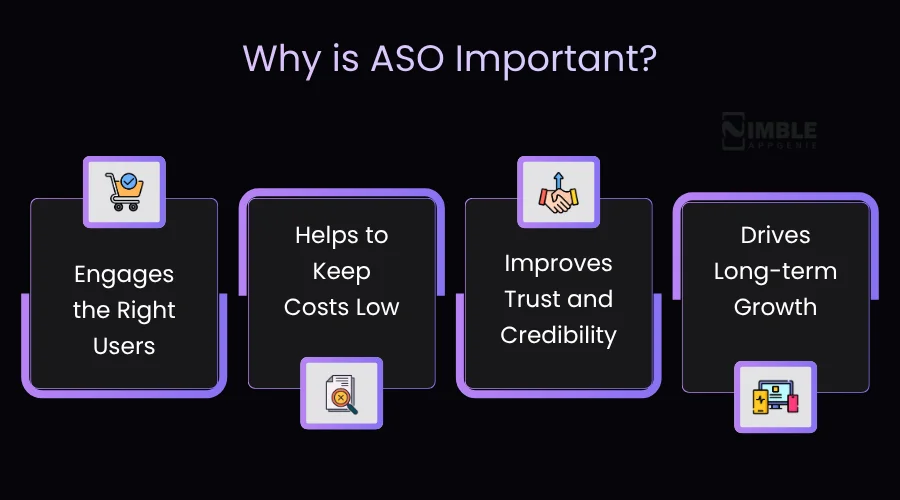
1. Engages the Right Users
ASO engages the right users through aligning an App Store listing with the specific search intent and with the demands of the users. Here, you optimize the keywords relevant to your app to bring the users in who actually want what you offer.
2. Helps to Keep Costs Low
The use of ASO can be effective in keeping the overall costs low, which drives organic downloads rather than relying on paid advertising campaigns. Additionally, by maximizing visibility in the app stores, ASO acts as a sustainable strategy.
3. Improves Trust and Credibility
If you are an entrepreneur with a mobile app, going for ASO will improve your brand visibility. The higher-ranking apps do appear more trustworthy, because the users expect app stores to only rank the quality apps at the top.
4. Drives Long-term Growth
ASO does help in driving the long-term growth through creating a sustainable, self-reinforcing engine for the organic user optimization, instead of relying on one-time, paid marketing campaigns.
Now, in this App Store Optimization guide, let’s proceed to understand the concept across different platforms.
ASO for the Apple App Store Vs Google Play Store
ASO increases an app’s visibility and even boosts overall conversion rates through strategic keyword optimization.
To submit the app to the app store and publish the Android app to the Google Play Store, ASO is critical.
For the Apple App Store and the Google Play Store, it is essential to look for different ASO techniques for each:
| Factor | Apple App Store ASO | Google Play Store ASO | Key Difference |
| App Title | 30 characters, highly keyword-sensitive | 30 characters, keyword-weighted but more contextual | Google uses a broader semantic understanding |
| Keywords Field | Dedicated hidden keyword field (100 chars) | No keyword field | Apple relies on manual keyword input; Google relies on content |
| Description | Not indexed for search ranking | Heavily indexed for keywords | Google SEO-style optimization matters more |
| Subtitle / Short Description | Subtitle (30 chars) impacts ranking | Short description (80 chars) impacts ranking | Both are important, but used differently |
| Long Description | Less impact on ranking | Strong impact on ranking | Google prioritizes content density |
| Visuals (Icons, Screenshots, Video) | Strong impact on conversion rate | Strong impact on conversion rate | Similar importance |
| Ratings & Reviews | Important for ranking & trust | Important for ranking & trust | Similar, but Google weighs volume slightly more |
| Backlinks / External Signals | Minimal impact | Significant impact (SEO influence) | Google uses web signals |
| Update Frequency | Helps but moderate impact | Frequent updates can boost visibility | Google favors freshness more |
| A/B Testing | Limited (via Product Page Optimization) | Built-in and robust (Play Console experiments) | Google has stronger native testing tools |
| Indexing Speed | Slower | Faster | Google updates listings more quickly |
| Localization | Strong impact per region | Strong impact per region | Here, Google auto-indexes more elements |
Now, let’s count the steps on how to perform App Store Optimization in the following section.
How to Do App Store Optimization?
You can do app store optimization beginning from keyword research, optimizing the app’s title, selecting the right category, adding keywords, writing an engaging app description, encouraging reviews, and maximizing downloads.
When you create a complete mobile app and launch it to the app store, one of the next elements to get ahead with is how to perform a complete app store optimization.
Let’s learn it all stepwise in this section:
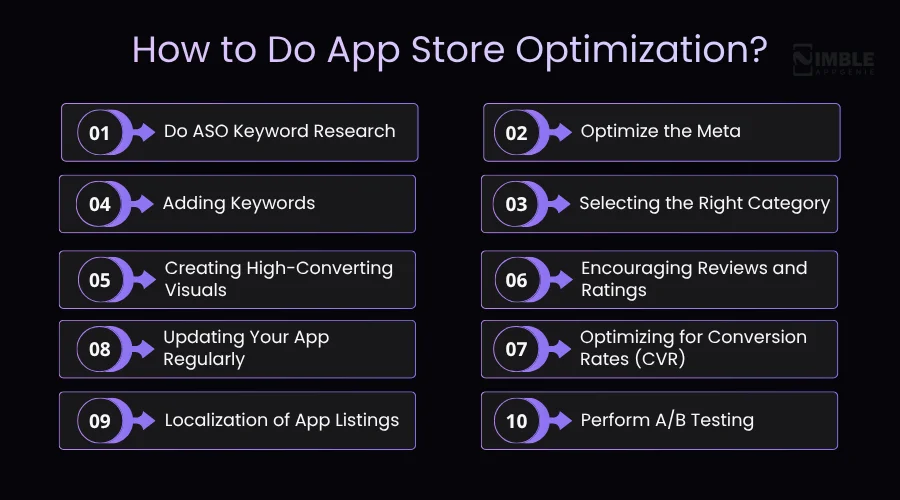
Step 1: Do ASO Keyword Research
ASO keyword research is one of the important steps,whichre it includes brainstorming, analyzing competitors, and opting for the respective tools.
Here’s what you should do in ASO keyword research:
- Begin by creating a seed keyword list
- Use a keyword research tool
- Consider the keyword difficulty metrics
- Opt for identifying search volume
You should note that for Apple, it is significant to prioritize keywords for the hidden keyword field. For Google, prioritize keywords for natural usage and description.
Step 2: Optimize the Meta
This is the second step towards ASO, where you should optimize the metadata that should comprise the app name, subtitle, description, and even the keywords.
Here’s what you should look for while optimizing the meta:
- Identify the core & long-tail keywords
- Focus on relevance over volume
- Create semantic clusters
- Use of ASO tools
You can include the keywords naturally to conduct an ASO for your app. Start by listing keywords related to the app’s functionality, and even for the user demographics.
Step 3: Selecting the Right Category
Selecting the right app store category comprises aligning the app’s primary function with the user search behavior and balancing high-traffic categories.
Here’s how you need to select the right category:
- Evaluate the core functions of your app
- Both stores offer the same variations; the names of the apps can vary.
- Category selection influences the app’s ranking in the competition
- Opt for competition density for the app store optimization
The simple strategies to opt for category selection are prioritizing relevance, analysing competitors’ ranking, balancing competition, and even using effective ASO tools.
Step 4: Adding Keywords
Adding keywords is essential because it directly drives the app’s discoverability, helps to enhance organic downloads, and even helps in targeting specific audiences.
Here’s how to add keywords:
- Research for relevant, high-traffic terms
- Prioritize those with low competition
- Place the title strategically in your app
- Focus on great difficulty keywords
It is important to hire mobile app developers who know the exact implementation and addition of focused keywords.
Step 5: Creating High-Converting Visuals
Opting for high-converting visuals is critical while performing app store optimization because it includes tailored screenshots that engage 15-30 apps visuals.
You should opt to create high-converting visuals via:
- Consider adding text overlays
- The screenshots, videos, and visual elements can impact app ranking.
- Apple App Store allows for 10 screenshots with three app preview videos
- Opt for instant engagement and autoplay
You can even create a prototype and a wireframe for building an ASO for your app.

Step 6: Encouraging Reviews and Ratings
Encourage reviews and ratings, and ensure to optimize your ASO accordingly. It’s important to boost search rankings. It comprises using in-app prompts even after the positive milestones, offering a seamless user experience.
Here’s how reviews and ratings can help:
- Signals quality to algorithms
- Increases overall conversion rate
- Improves visibility
- Search ratings help to build trust that drives organic growth
With high ratings, you can encourage downloads that can result in improving app discoverability.
Step 7: Optimizing for Conversion Rates (CVR)
When you optimize for conversion rates, it does require a shift from a generic listing update to high-precision and intent-based experiences. It’s all about turning store page visitors into installers through crafting a compelling and clear product story.
Here’s how you can optimize for conversion rates (CVR):
- Opt for A/B testing
- Conduct visual optimization
- Metadata optimization
- Localized content
Through user behaviour, you can enhance experience, where the businesses turn more visitors into consumers, which further results in higher ROI and even better actionable insights into customer behaviour.
Step 8: Updating Your App Regularly
For regularly updating, you should focus on refreshing metadata based on prompt search trends, which further results in improving user behavior. Furthermore, it helps in improving your brand’s positioning through updating frequency and localizing content.
Here’s what you need to perform to update the app regularly:
- Visual enhancements
- Increases retention by fixing bugs
- Offers a competitive edge
- Enhanced conversion rates
Through ASO, you can maintain relevance and compliance that helps to make the app compatible with the latest app store guidelines.
Step 9: Localization of App Listings
Localization of app settings is another step for app store optimization. It comprises translating text and functionality for meeting the cultural and technical expectations of the prospective users.
Here’s how to opt for localization in app listings:
- Metadata and app title optimization
- Visual asset localization
- Cultural and contextual refinement
- Avoiding automatic translation
It further increases discoverability, helpful to boost conversion rate and drive international downloads.
Step 10: Perform A/B Testing
Performing A/B testing helps you to experiment with different app store testing algorithms. Here, both the app store optimizes the listings for better conversion rates, which might lead to more downloads and reviews, and enhances the app’s visibility.
Here’s what is included in A/B testing:
- Helps to identify the right version of the app’s store listings
- Use native tools for the app store and Google Play
- Formulate a clear hypothesis
- You can opt for testing methods for custom product pages and third-party tools
Now, let’s get ahead with the key factors for influencing app store rankings in the following section.
Key Factors that Influence App Store Rankings
The key factors that influence the app store rankings are ratings and reviews, downloads and velocity, ratings and reviews, and even app quality performances.
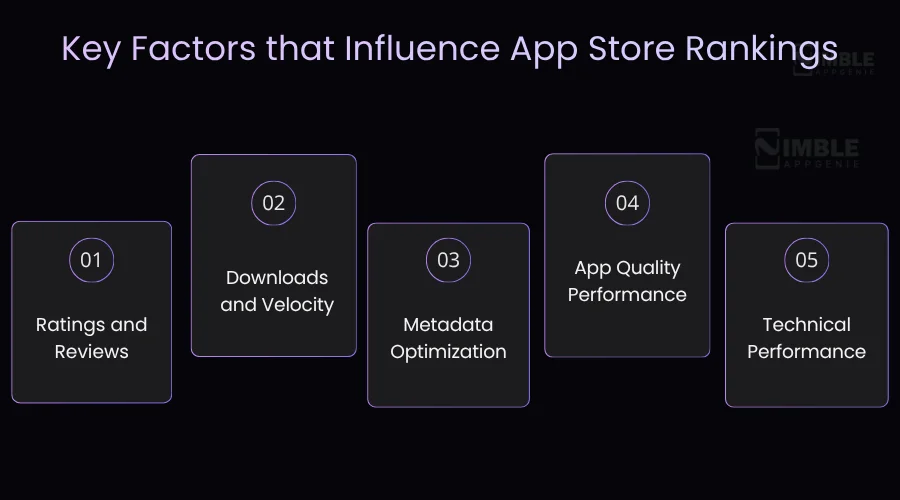
1. Ratings and Reviews
A highly rated app is most likely to rank high on the App Store. It is a critical indicator of user satisfaction and even of popularity for the app store algorithms. These ratings indicate the app related to its overall quality.
2. Downloads and Velocity
The speed at which your app is downloaded on the app store is one of the reasons that it impacts overall rankings. High velocity can lead to high downloads and vice versa.
3. Metadata Optimization
Optimizing the meta title and meta description focuses on boosting the download conversion rates via providing social proof, while the low-rated apps suffered reduced visibility.
4. App Quality Performance
A good-featured and functional app has a strong influence on the user experience, and it further impacts the app rankings. Hence, a good functional app can be effective in engaging and retaining a large number of users.
5. Technical Performance
Another crucial factor impacting the app store ranking is technical performance. Even the lower crash rates and the regular updates signal active maintenance as well as signal stability.
Now, let’s get ahead with the key challenges related to ASO in the following section.
Common ASO Mistakes to Avoid in 2026
The common ASO mistakes to avoid in 2026 are strategic and keyword mistakes, creative and conversion mistakes, technical mistakes, and even localization mistakes.
Avoiding ASO is itself a challenge to build an app; however, there are challenges to ASO. Let’s learn them:
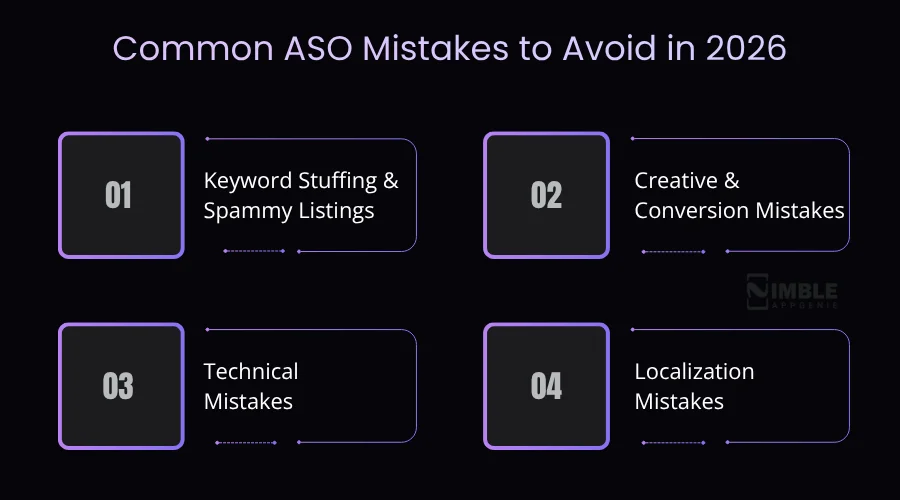
1. Keyword Stuffing and Spammy Listings
Keyword stuffing is an unethical practice when you go for ASO.
This is the search ranking practice that is used for manipulating the search intent.
2. Creative and Conversion Mistakes
These mistakes take place due to ineffective visual presentation of your app.
Additionally, a messy app design and even unclear messaging can result in poor rankings.
3. Technical Mistakes
The core technical mistakes can be treating Android and iSO platforms as the same.
This can impact the overall performance of your mobile app and can even lead to app abandonment.
4. Localization Mistakes
This happens when a mapping service inaccurately identifies an inadequate location, wrong positioning, or results in mapping inaccuracies.
It is an issue that will have a large impact on Google Maps and might happen due to outdated IP addresses.
Well, with the right steps to app store optimization, you can avoid these mistakes. Now, let’s get ahead with how to measure ASO success in the following section.
How to Measure ASO Success?
There are different tools to measure ASO success, such as AppTweak, Sensor Tower, ASOdeck, App Radar, and even data.ai.
Here are key steps to measure ASO success:
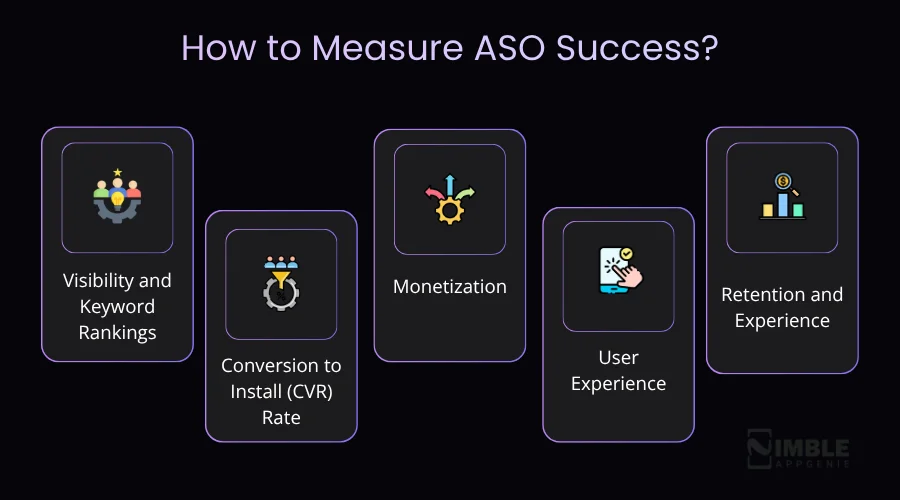
1. Visibility and Keyword Rankings
If your app ranks on the right keywords, then ASO is pure success. You need to track the number of keywords, specifically in the top 3. Here, a higher ranking indicates better visibility.
2. Conversion to Install (CVR) Rate
Measures the percentage of users who install the app after even viewing the store page. The success rate of ASO is defined by converting the store page visitors into users. This helps in indicating better visibility and appeal.
3. Monetization
The ultimate goal of every app is revenue; hence, ASO can drive thousands of installs, but if the strategy doesn’t work well, it should be reconsidered. You check the monetization through ARPU/ARPPU, LTV, and even through the marketing ROI.
4. User Experience
If your app has an effective user experience and people prefer your app, then it’s a success. Hence, ASO efficiency can be measured when a user prefers your app.
5. Retention and Experience
These are considered modern pillars for ASO success because the app store algorithms do prioritize the overall user behavior, including engagement, session length, and even the retention rates.

Why Partner with Nimble AppGenie to Perform ASO?
If you are confused about how you can opt for ASO, then connecting with the right team of developers can be helpful.
You should partner with Nimble AppGenie, a leading mobile app development company. Our team has professional experience of over 8 years and knows every nuance related to app platforms.
From keyword research, selecting the right industry, to updating your app as per guidelines, we can handle it all.
At Nimble AppGenie, we optimize apps as per stores and then help you to visually appear in front of your target audiences. We use AI-driven market strategies for your ASO that enable you to be sustainable as per the current competition.
Conclusion
App Store Optimization is no longer optional; it’s a growth necessity. From keyword research and metadata optimization to visuals, reviews, and localization, every element of ASO works together to make your app more discoverable and more downloadable.
The app stores are crowded, but with the right strategy, your app can rise above the noise and consistently attract high-quality users. Start optimizing today, track your results, and keep refining, because ASO is not a one-time task; it’s an ongoing commitment to growth.
FAQs

Madan is the Backend Solutions Architect at Nimble AppGenie, specializing in the design of secure, high-concurrency systems that power complex mobile ecosystems. With deep expertise in server-side logic and database management, he ensures every platform is built with enterprise-grade security. In his free time, he is an avid researcher of emerging technologies; he spends his time deconstructing the latest backend frameworks and reading technical papers to ensure our solutions remain at the absolute forefront of industry innovation.
Table of Contents




No Comments
Comments are closed.