

 Free Consultation
 PCI-DSS Compliant
 GDPR Ready
 ISO 27001
 NDA Protected
 AI Services
 AI App Development
 Generative AI Development
 AI Chatbot Development
 AI Integration Services
 AI Consulting Services
 AI For Fintech
 AI Financial Assistant Solution
 AI Insurance Agent Development
 Tech Stack
 OpenAI / GPT-4
 Claude / Anthropic
 Gemini / Google AI
 Llama / Open Source
 LangChain / LlamaIndex
 Pinecone / Pgvector
 AWS / Azure AI


 Fintech Solution
 Core Fintech
 Fintech App Development
 Neobank App Development
 eWallet App Development
 Lending Software
 Banking Software Development
 BNPL Solution
 BNPL App Development
 Insurance App
 Wealth Management App
 Blockchain Development
 Payroll Software Development
 DeFi App Development
 Crypto Wallet Dev
 Crypto On Ramp Off Ramp
 Crypto Exchange Dev
 Trading Platform Dev
 Payments
 Compliance
 Fintech & Digital Regulations
 Fraud Detection
 Lending Ecosystem
 P2P Lending Platform
 Mortgage Software
 Engagement
 Outsourcing Dev

 Mobile Development
 Mobile App Dev
 iOS App Development
 Android App Development
 React Native
 Flutter Development
 Web Solution
 Node.js Development
 React.js Development
 Angular Development
 App Services
 UI/UX Design
 App Maintenance
 By Stage
 MVP Development
 Industry Solutions
 Healthcare App Dev
 Education App Dev
 Travel App Dev
 Real Estate App Dev
 Logistics Software
 Social Media App

 Hire Mobile Developers
 Hire iPhone Developers
 Hire Android Developers
 Hire React Native Devs
 Hire Flutter Developers
 Hire Web Developers
 Hire Node.js Developers
 Hire Angular Developers
 Hire PHP Developers
 Hire Laravel Developers
 How It Works
 Pre-Vetted Developers
 Ready In 48 Hours
 NDA From Day One
 Replace Guarantee
 Company
 About Us
 Our Work Process
 Portfolio
 Case Studies
 Blog / Insights
 Careers
 Contact Us
 Awards
 Recognition


 Offices



TL;DR
- Payment splitting– dividing one customer payment among vendors, platform fees, and tax is usually the most underestimated part of building a marketplace.
- The real complexity is not the API call. It’s who is legally on the hook (the Merchant of Record), how fast vendors get paid, and what happens when a refund lands after the money’s already split.
- Off-the-shelf tools like Stripe Connect handle a lot, but not everything – compliance, disputes, and multi-region payouts still need real architecture decisions.
- Getting this wrong shows up later as vendor churn, compliance exposure, and a rebuild bill bigger than the original budget.
- Nimble AppGenie builds this infrastructure as core marketplace architecture from day one, not as a bolted-on integration, which is the difference between a payment system that scales and one that breaks at your first 50 vendors.
“Can our customers pay vendors directly, or does every dollar have to pass through us first?” This is one of the first questions founders ask once they realize marketplace payment splitting is not a checkout feature; it’s the financial backbone of the complete platform. Get payment splitting wrong, and you rebuild your business logic, your compliance posture, and your vendor’s trust, usually all at once.
Most marketplace budgets plan for vendor onboarding and a product catalog. But almost none plan appropriately for the moment when one payment has to become three.
In this guide, the marketplace & fintech engineering team at Nimble AppGenie breaks down what payment splitting actually does, why more marketplaces struggle with it than founders expect, what the real architecture looks like, and what it costs to build the first time.
What Marketplace Payment Splitting Actually Means
When a customer buys from your marketplace, that single payment usually has to become numerous things at once: a payout to one or more vendors, a commission for your platform, tax withheld where required, and a record clean enough to pass an audit – doing that automatically, on every order, without anyone manually calculating who gets what- that’s payment splitting.
It sounds like a feature, but practically, it’s closer to a financial system and has to handle:
- Commission captured at the exact moment of transaction, not after the fact,
- Refunds and chargebacks that have to unwind the money that is already split and sent out,
- Multi-vendor payout when a single order includes items from more than one seller,
- Reconciliation – matching every dollar in to every dollar out, at scale, without a spreadsheet, and
- Tax withholding and reporting across all the regions you operate in.
Most marketplace platforms – the ones created on multi-vendor marketplace development foundations – treat this as a core architectural layer, not as an add-on integration. That distinction is exactly where most budgets go wrong.
Why Marketplace Payment Splitting is Harder Than It Looks: The Real Failure Points
Payment splitting seems simple until you build it. Vendor onboarding feels hard. The product catalog feels hard. Payments feel like “just add Stripe.” Here’s where that assumption breaks down.
Who is actually on the hook when something goes wrong?
Most marketplace founders eventually ask a question, usually after a vendor dispute: Is the marketplace the Merchant of Record, or is each vendor?
If your platform is the Merchant of Record, you are legally responsible for the sale, which simplifies the buyer experience but puts chargebacks, refunds, and compliance liability on you. If vendors are the Merchant of Record, your platform is only facilitating, which diminishes your risk but complicates payouts and buyer trust.
Most marketplaces don’t intentionally choose this; it’s decided by default by whichever payment gateway they picked. That’s inside out. It should be decided deliberately first, because it impacts almost every other architectural decision downstream.
Can customers pay vendors directly?
Generally no, and that’s by design. Obviously, allowing money flow directly between buyer and seller neglects the intent of a marketplace; you lose commission capture, dispute control, and the audit trail that safeguards you if something goes wrong.
A split payment system keeps each transaction routed through infrastructure your platform controls, even though it feels instant and invisible to the customer.
What happens when a refund lands after the money’s already split?
This situation exposes the limits of basic code. A customer orders from three vendors, the payment splits three ways, everyone is paid, and then the customer returns one item. Now your system has to claw back a partial refund from one specific vendor’s share, adjust your own commission, and keep the ledger balanced, automatically.
Systems built without considering this end up with finance teams manually chasing vendors for refund clawbacks, which is exactly the manual process automated splitting was supposed to eliminate.
Compliance doesn’t stop at the payment gateway
Tools like Stripe Connect manage the compliance load – identity verification, tokenized card data, and sanctions checks- but they avoid tax withholding, KYC edge cases, or regional payouts.
Your marketplace should still decide how it handles seller verification (KYC/KYB), multi-region tax reporting, and dispute liability. Skipping this planning is the single most common way marketplaces get shocked by a compliance cost nobody built a budget for.
| 75%+ of companies on a16z’s Marketplace 100 list use Stripe for marketplace payments and payouts.
$1.9T in total volume generated by businesses on Stripe in 2025, up 34% year over year. |
The gap is not between “no payment splitting” and “payment splitting.” It’s between splitting that works at 10 vendors and splitting that still works at 1,000.

How the Marketplace Payment Splitting Architecture Works
Strip away the vendor names and every marketplace payment split moves through the same five stages. Understanding them is what separates a clean, auditable payment flow from a reconciliation headache every month-end.
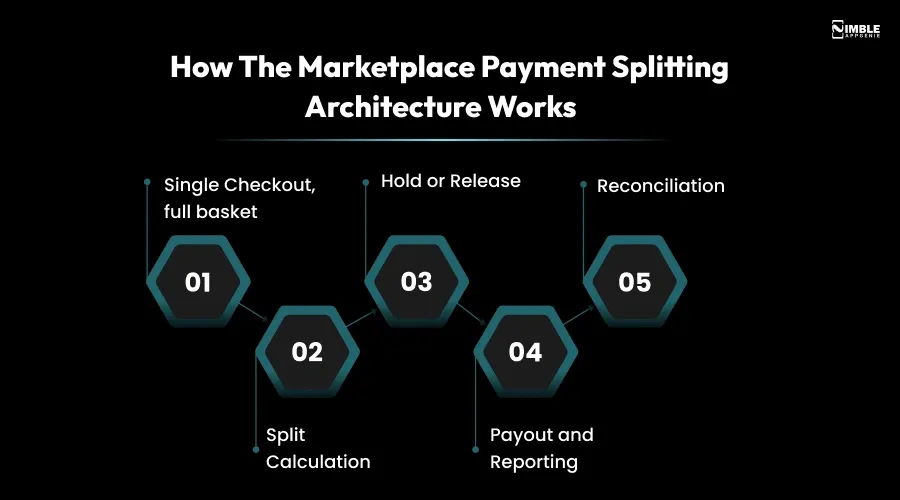
1. Single Checkout, full basket
The buyer pays once, for the complete order even if it includes items from four different vendors. This offers one charge, one experience.
2. Split Calculation
The system applies your commission rules and evaluates exactly what each vendor is owed, per line item, in real time.
3. Hold or Release
Funds either release instantly, wait for a scheduled payout cycle, or sit in escrow until delivery is confirmed – a business decision, not a technical default.
4. Payout and Reporting
Vendors get paid on their rail of choice; tax is withheld where required, and every transaction generates a line-item record.
5. Reconciliation
Every dollar in is matched to every dollar out automatically, so finance is not closing the books with a spreadsheet.
Instant, scheduled, or escrow – the payout timing decision
This is a cash flow and trust decision as much as a technical one.
Instant payouts build vendor loyalty fast but leave you exposed if a refund comes in after the money is gone. Escrow holds funds until delivery or service confirmation, protecting the platform but frustrating vendors who want to get paid sooner.
Scheduled payouts (daily, weekly, and every two weeks) are the middle ground most marketplaces land on as they scale. There’s no universally correct answer here; it depends on your return rate, your vendor relationships, and how much risk your platform is willing to carry.
Here, infrastructure choices like eWallet-based payout systems come in, offering vendors a place to hold and manage funds between payout cycles, rather than pushing every dollar out immediately.
What it Costs to Build Marketplace Payment Splitting Right
Payment splitting is regularly underpriced in early marketplace budgets because it “looks like a Stripe integration.” But, in reality, it’s usually 20-30% of a marketplace’s real engineering complexity, even on a platform that otherwise looks simple.
| Build path | Typical cost range | What you actually get |
| Plugin / SaaS overlay | $150–$500/yr + fees | Fast to launch, but limited to that platform’s split logic and payout rules |
| Payment gateway integration only | $15,000–$40,000 | Covers the split mechanics, but leaves compliance, reconciliation, and edge cases to you |
| Custom-built payment infrastructure | $40,000–$150,000+ | Full control over commission logic, payout timing, compliance workflows, and multi-region support |
What actually impacts the cost: how many payout regions and currencies you support, whether you need escrow versus instant payouts, how complex your commission structure is (flat rate vs. tiered by vendor category), and how complex compliance automation (KYC, tax withholding, 1099-style reporting) you need built in rather than handled manually.
Full context on total cost, timeline, and the rest of the marketplace stack is covered in our complete guide to building a marketplace app.

Choosing the Right Build Path
Off-the-shelf and white-label payment splitting can work for early-stage, low-complexity marketplaces – simple commission models, a single region, and low transaction volume. It’s a legitimate way to validate an idea fast on a tight budget.
But most marketplaces that plan to grow hit their limits quickly. The moment you need tiered commission by vendor category, custom dispute handling, multi-currency payouts, or region-specific compliance, generic infrastructure starts working against you rather than for you.
That’s when custom-built payment settings stop being a nice-to-have and become the thing protecting your margins, your vendor relationships, and your ability to expand into new markets without re-architecting everything.
If you are validating an idea with a handful of vendors and a simple flat commission, start lean. If you are building something meant to scale after a few hundred vendors or into multiple regions, architect the payment layer properly from the start – retrofitting it later is far more expensive than building it right at once.
How Nimble AppGenie Approaches Marketplace Payment Splitting?
We have built multi-vendor marketplaces where the challenging engineering issue was not the product catalog or the vendor dashboard – it was getting money to move accurately, on time, across every vendor, edge cases, and region.
On Close2mi, a multi-vendor beauty and grooming services marketplace we built, the core challenge was exactly this: connecting customers with hundreds of local vendors while keeping every payment transaction secure and reliable across the platform.

Nimble AppGenie’s experts have also built dedicated payment infrastructure directly, including CUT, an eWallet app designed around exactly this kind of payout and fund-management complexity.
Our approach treats payment splitting as core marketplace architecture, not a plug-in:
- Compliance built in, including KYC/KYB onboarding, tax handling, and dispute workflows, drawing on our broader fintech and payments infrastructure experience.
- Commission and payout logic designed around your actual business model – flat, hybrid, or tiered – not forced into a generic template.
- Reconciliation and reporting built for scale from day one, so your finance team is not matching transactions by hand at 500 vendors.
- Payout flexibility – instant, scheduled, or escrow-based – set to match your cash-flow and vendor-trust needs, not a default.
We build this as custom infrastructure because most marketplaces that plan to expand outgrow the generic version fast, and rebuilding payment logic after launch is far more expensive than architecting it correctly the first time.

Final Thought
Payment splitting rarely fails loudly. It fails quietly: a vendor who stops trusting your payout schedule, a compliance gap nobody notices until it’s expensive, a reconciliation process that eats a finance hire’s whole week every month. None of that shows up in a demo. All of it shows up six months after launch, once real vendors and real money are moving through the system.
The marketplaces that get this right don’t treat payment splitting as a feature to add on later. They treat it as the financial foundation the rest of the platform stands on, and they build it that way from the start.
FAQs
Rarely, and that’s intentional. Routing every payment through the platform is what makes commission capture, dispute handling, and audit trails possible. Direct vendor payments bypass all of that.
It depends on who is the Merchant of Record. If the platform is, it carries chargeback and compliance liability but gives buyers a simpler experience. If vendors are, the platform’s risk is lower, but payouts and buyer trust get more complex. This should be decided deliberately, early, not left to whatever your payment gateway defaults to.
Stripe Connect handles a lot of identity verification, PCI tokenization, global payouts, and it’s what most marketplaces use as a starting point. But it doesn’t automatically solve your commission logic, dispute policy, or regional tax strategy. Those still need to be architected around it, not assumed to come free.
Instant payouts send vendor funds immediately after checkout. Escrow holds funds until delivery or service completion is confirmed. Scheduled payouts release funds on a set cycle, like weekly or biweekly. Each trades off vendor satisfaction against platform risk differently; there’s no single right answer, only the right one for your model.
That’s a business rule you set, not a technical limitation. Some marketplaces pay out every transaction; others batch smaller balances until they cross a threshold to reduce transfer fees. Either works; it should match your vendor agreements and cost structure.
A basic gateway integration can run $15,000–$40,000. Custom-built payment infrastructure with full compliance, multi-region payouts, and flexible commission logic typically runs $40,000–$150,000+, depending on complexity. The biggest cost drivers are payout regions, commission complexity, and how much compliance you automate versus handle manually.

Madan is the Backend Solutions Architect at Nimble AppGenie, specializing in the design of secure, high-concurrency systems that power complex mobile ecosystems. With deep expertise in server-side logic and database management, he ensures every platform is built with enterprise-grade security. In his free time, he is an avid researcher of emerging technologies; he spends his time deconstructing the latest backend frameworks and reading technical papers to ensure our solutions remain at the absolute forefront of industry innovation.
Table of Contents




No Comments
Comments are closed.