

 Free Consultation
 PCI-DSS Compliant
 GDPR Ready
 ISO 27001
 NDA Protected
 AI Services
 AI App Development
 Generative AI Development
 AI Chatbot Development
 AI Integration Services
 AI Consulting Services
 AI For Fintech
 AI Financial Assistant Solution
 AI Insurance Agent Development
 Tech Stack
 OpenAI / GPT-4
 Claude / Anthropic
 Gemini / Google AI
 Llama / Open Source
 LangChain / LlamaIndex
 Pinecone / Pgvector
 AWS / Azure AI


 Fintech Solution
 Core Fintech
 App Development
 Neobank Solutions
 eWallet Solutions
 Lending Software
 Banking Solutions
 BNPL Solutions
 BNPL Solutions
 Insurance App
 Wealth Management
 Crypto & DeFi
 Blockchain Development
  Payroll Software
 DeFi Solutions
 Crypto Wallet
 Crypto On/Off Ramp
 Crypto Exchange
 Trading Platform
 Payments
 Compliance
 Regulations & Compliance
 Fraud Detection
 Lending Ecosystem
 P2P Lending Platform
 Mortgage Software
 Engagement
 Fintech Outsourcing

 Mobile Development
 Mobile App Dev
 iOS App Development
 Android App Development
 React Native
 Flutter Development
 Web Solution
 Node.js Development
 React.js Development
 Angular Development
 App Services
 UI/UX Design
 App Maintenance
 By Stage
 MVP Development
 Industry Solutions
 Healthcare App Dev
 Education App Dev
 Travel App Dev
 Real Estate App Dev
 Logistics Software
 Social Media App

 Hire Mobile Developers
 Hire iPhone Developers
 Hire Android Developers
 Hire React Native Devs
 Hire Flutter Developers
 Hire Web Developers
 Hire Node.js Developers
 Hire Angular Developers
 Hire PHP Developers
 Hire Laravel Developers
 How It Works
 Pre-Vetted Developers
 Ready In 48 Hours
 NDA From Day One
 Replace Guarantee
 Company
 About Us
 Our Work Process
 Portfolio
 Case Studies
 Blog / Insights
 Careers
 Contact Us
 Awards
 Recognition


 Offices


Key Takeaways
- Integrate recurring donation and micro-giving payments into your app by understanding the requirements, selecting the right payment gateway, designing the subscription, adding donor service, and then testing it.
- Different reasons to integrate recurring donation and micro-giving payments into your app are that it attracts new donors, helps with micro-transactions, and creates a social impact.
- The overall cost to integrate recurring donation and micro-giving payments varies from $20,000 to over $100,000. This cost varies depending on factors such as the donor self-service portal, fraud prevention, and third-party integrations.
- Partnering with Nimble AppGenie can be helpful in building a complete system for integrating recurring donations, as the engineers are well experienced in fintech services.
With the growing need for CSR, it has become important to implement recurring donation and micro-giving payments into your app.
If you are a startup, an enterprise, or a non-profit organisation thinking about a regular system for recurring donations, then learning how to integrate it can be helpful.
Recurring donors give significantly more over a lifetime than one-time donors.
The global micro-donation charity app market was valued at $2.8 billion in 2025, and is further projected to expand to $7.5billion by 2034. This represents the growing need to integrate recurring donation & micro-giving payments into your app.
Hence, in this guide, we will walk you through the concept, reasons to integrate them, steps, and cost to integrate recurring donation and micro-giving payments into your app.
Let’s get started.
What are Recurring Donations and Micro-Giving?
Recurring donations are financial gifts a donor elects to make on a regular schedule to your organization, rather than a one-time gift. These are gifts to a nonprofit organization made by a donor on an ongoing basis, typically monthly.
Nonprofit organizations receive benefits from recurring donations because they offer consistent revenue streams and also help the organizations to maintain long-term relationships with supporters.
On the other hand, micro-giving payments are small financial donations that are made directly via an app for a specific cause and digital item. Microgiving is the act of donating very small amounts of money. It drives customer engagement, enhances brand loyalty, and even helps to create a positive social impact with minimal friction.
You can consider it one of the important APIs in fintech, driving an effective social impact for your business.
How do non-profit organizations benefit from recurring donations?
The non-profit organization benefits from recurring donations via steady cash flow, higher overall lifetime value, and stronger donor retention. Here, recurring giving comes in several formats, including donations from credit cards and donor-advised funds, that offers a greater overall lifetime value compared to one-time gifts.
Now, let’s get ahead with stating the reasons for why to integrate recurring donations and micro-giving payments into your app.
Why Integrate Recurring Donations & Micro-Giving Payments into Your App?
If you are an entrepreneur or a fintech company, integrating recurring donations and micro-giving payments into your app increases user engagement, creates steady revenue, and even builds a sense of community.
Here’s why you need to integrate recurring donations and micro-giving payments into your app:
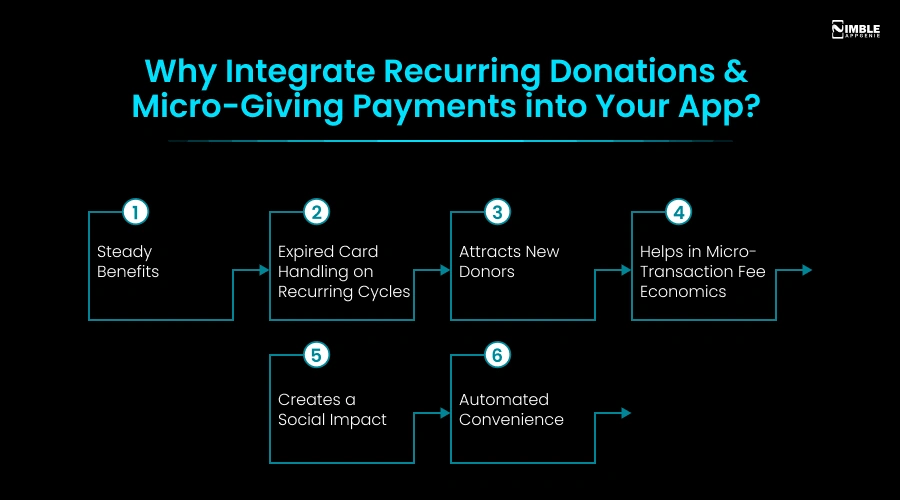
1. Steady Benefits
Integrating recurring donations and micro-giving features does offer highly predictive advantages and long-term strategic benefits for startups and fintech platforms.
These donations offer recurring benefits by creating a predictable income stream that enhances financial stability and long-term planning for the organizations.
2. Expired Card Handling on Recurring Cycles
Recurring donation platforms handle expired cards on recurring cycles by using automated backend tools such as card account updaters and smart retries. It acts as a reminder and helps you to proceed with recurring donations and micro-giving payments.
It happens during recurring donations because the payment cards naturally expire over time, and failing the ongoing updates breaks the ongoing billing schedule.
3. Attracts New Donors
Integrating recurring donations and micro-giving payments into the application attracts new donors, which involves time-consuming marketing outreach and financial investment.
It helps startups and even fintech organizations to treat recurring donations as a feature and not as a complete fundraising strategy. They attract new donors by offering an approachable, low-barrier entry point for giving and building powerful community trust.
4. Helps in Micro-Transaction Fee Economics
Integrating recurring donations and micro-giving resolves the issue of fixed processing fees destroying the small profit margins. It even replaces the scattered, standalone micro payments with consolidated and predictable batch values.
Additionally, the micro-transaction fee economics helps in determining whether a micro-giving program is financially viable or is a total loss.
5. Creates a Social Impact
If you are a startup or enterprise thinking of creating a large social impact, then integrating recurring donations and micro-giving helps to transform the apps from simple utilities into powerful engines for offering social impact.
It further helps in building user loyalty and offers benefits for startups such as boosting customer loyalty, increasing engagement, and building brand trust.
6. Automated Convenience
Integrating recurring donations offers automated convenience by removing the manual tasks and even repetitive steps for donors and the organizations.
Here, the enterprises need not set an alarm to proceed with the donations; all they need is to integrate recurring donations and micro-giving payments into their app to have an automated process.
Now, another question arises: “how to integrate recurring donations and micro-giving payments into your app?”
Well, you should follow the complete set of steps for creating a highly scalable subscription engine that is combined with a frictionless checkout experience.
For more detailed information on the process to integrate recurring donations, the following section is helpful.
How to Integrate Recurring Donations & Micro-Giving Payments into Your App?
You should start by examining your requirements for your app, selecting the right payment gateway for your app, and designing the subscription for your recurring donations, building the logic, adopting security and testing for compliance before launch.
Here is the list of steps on how to integrate recurring donations & micro-giving payments into your app:
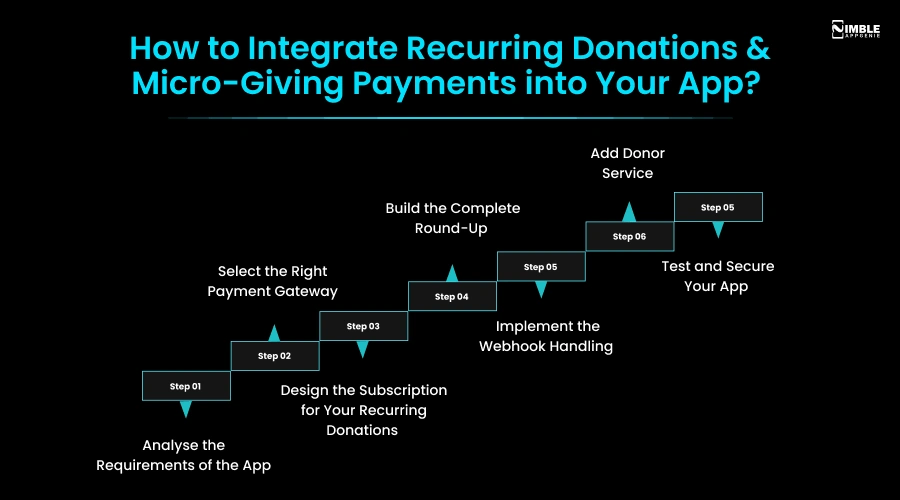
Step 1: Analyse the Requirements of the App
You should study your app completely to determine the app requirements by balancing the user experience and exploring current market demands.
To integrate recurring donations into your app, you are required to analyse recurring frequency options, micro-giving mechanics, and whether the donors need self-service support.
Step 2: Select the Right Payment Gateway
Now, you should select the right payment gateway by comparing different payment gateways such as Stripe, PayPal, Braintree, and even Razorpay. Here, you should match the fee structure, security requirements, and customer payment options with your app.
You can even connect with an experienced team of developers at Nimble AppGenie, providing the best fintech app development solutions. They can help you to select the right payment gateway for micro-giving payments in your app.
Step 3: Design the Subscription for Your Recurring Donations
In this step, you should design the recurring donations that require setting up automated subscription billing models, balancing user flexibility with predictable organizational revenue.
For designing, you need to build tables that separate the donor profiles, the subscription records, and individual payment events. You should select the right color, theme, and complete typography for integrating recurring donations and micro-giving in your app.
Also Read: How to Design the Fintech App?
Step 4: Build the Complete Round-Up
Building the complete round-up system requires connecting the user’s bank transactions, calculating spare change, and even helping to process the payments smoothly.
Here, you create the complete core tech stack for this system. It all requires an infrastructure that securely monitors transactions, aggregates change, and even bills the user on a schedule.
Step 5: Implement the Webhook Handling
Now, you should implement the webhook handling, where you need to set up an asynchronous listener that processes events sent by your payment gateway.
The legacy raiseDonors can send webhook events that notify your application any time a specific event happens. Connecting webhooks to popular automation tools allows the legacy raiseDonors data to flow into hundreds of popular automation tools.
Step 6: Add Donor Service
For adding a donor service while integrating recurring donation and micro-giving payments into your app, you need to give the donors a portal or in-app flow to update their card, change frequency, and cancel without contacting support.
Additionally, you should integrate all the payment methods that your donor base actually expects, such as different cards, ACH, Apple Pay, and Google Pay, as friction here is an important driver.
Step 7: Test and Secure Your App
Now, before launching it, you should test your recurring donations and micro-giving payments in your app. Testing and securing a mobile and web app with recurring donations requires a strict focus on payment data protection.
Here, you should test this integration under different parameters, such as in case of traffic, in case of low demand, etc. This will verify that the newly added API or network works smoothly.
Many of the startups and enterprises often ask, “How long does it take to integrate recurring donation payments?”
The timeline to integrate recurring donation payments falls anywhere from 10 minutes using no-code payment links to 4 to 6 weeks.
Another important factor here is “cost”. Let’s get ahead to discover complete details on cost.
Cost to Integrate Recurring Donations & Micro-Giving Payments into Your App
The cost to integrate recurring donations and micro-giving payments into your app varies from $20,000 to over $100,000. This cost varies due to different factors such as payment gateway costs, infrastructure costs, integration costs, backend complexity, and even compliance.
Lets breakdown the cost to understand it in detail:
| Factor | Cost Impact |
| Number of Payment Gateways | +$8,000 – $15,000 per additional gateway |
| Payment Methods (ACH, Apple Pay, Google Pay, wallets) | +$5,000 – $12,000 |
| Micro-Giving / Round-Up Logic | +$15,000 – $25,000 |
| Donor Self-Service Portal | +$6,000 – $12,000 |
| Platform Coverage (Web + Mobile) | +20–30% of total build cost |
| Multi-Currency / Cross-Border Support | +$10,000 – $20,000 |
| Compliance Scope (PCI-DSS, GDPR, KYC/AML) | +$10,000 – $20,000 |
| Fraud Prevention & Security | +$8,000 – $15,000 |
| Advanced Reporting & Analytics | +$7,000 – $15,000 |
| Third-Party Integrations (CRM, accounting, email/SMS) | +$5,000 – $10,000 per integration |
| Legacy System Retrofit | +15–25% depending on complexity |
| White-Label / Multi-Org Support | +$20,000 – $35,000 |
In the case of fintech app development cost, recurring donations and micro-giving payments cost is included if you are adding this feature.
Which is the Best Company to Integrate Recurring Donations & Micro-Giving Payments Into the App?
Nimble AppGenie is the best fintech software solutions provider, assisting startups and enterprises to integrate recurring donations and micro-giving payments into the app. Here you will find engineers to use API and effective tools required to bring your vision into reality.
The experts provide niche fintech services and have a proven track record in delivering solutions related to different kinds of fintech and all finance-related services. The company implements the latest compliance practices and integrates frictionless micro-giving and spare-change features.
Additionally, Nimble AppGenie engineers offer secure measures that ensure your app and its content are safe while connecting with the target audience. Hence, selecting Nimble AppGenie can be your best option.
Conclusion
Recurring donations and micro-giving payments integration is the process of using automated tools that let users support a cause and even an app with regular and very small financial contributions.
Different reasons to consider while integrating recurring donation and micro-giving payments are steady benefits, expired card handling, attracting new donors, helping micro-transaction fee economics, and creating a social impact.
FAQs
To integrate recurring donations and micro-giving payments into your app, you should analyse the requirements of the app, select the right payment gateway, design the subscription for your recurring donations, build it, implement the webhook, and then test the app.
You should integrate recurring donations and micro-giving payments into your app because it offers steady benefits, expired card handling, attracts new donors, helps with micro-transactions, creates a social impact, and provides automated convenience.
You can select among Stripe and PayPal for integrating recurring donations and micro-giving payments into your app. There are other tools that you can consider, such as Givebutter, CharityEngine, iATS payments, and Snowball.
The round-up donations do allow the customers to automatically donate their spare change to charity by rounding their donation total to the nearest dollar or by tracking the microtransactions via a linked credit card.
The overall cost to add recurring donations to an existing app can be between $20,000 and over $100,000. Furthermore, this cost can vary depending on different factors such as payment gateway costs, infrastructure costs, integration costs, backend complexity, and even compliance.

Niketan Sharma, CTO, Nimble AppGenie, is a tech enthusiast with more than a decade of experience in delivering high-value solutions that allow a brand to penetrate the market easily. With a strong hold on mobile app development, he is actively working to help businesses identify the potential of digital transformation by sharing insightful statistics, guides & blogs.
Table of Contents




No Comments
Comments are closed.