

 Free Consultation
 PCI-DSS Compliant
 GDPR Ready
 ISO 27001
 NDA Protected
 AI Services
 AI App Development
 Generative AI Development
 AI Chatbot Development
 AI Integration Services
 AI Consulting Services
 AI For Fintech
 AI Financial Assistant Solution
 AI Insurance Agent Development
 Tech Stack
 OpenAI / GPT-4
 Claude / Anthropic
 Gemini / Google AI
 Llama / Open Source
 LangChain / LlamaIndex
 Pinecone / Pgvector
 AWS / Azure AI


 Fintech Solution
 Core Fintech
 App Development
 Neobank Solutions
 eWallet Solutions
 Lending Software
 Banking Solutions
 BNPL Solutions
 BNPL Solutions
 Insurance App
 Wealth Management
 Crypto & DeFi
 Blockchain Development
  Payroll Software
 DeFi Solutions
 Crypto Wallet
 Crypto On/Off Ramp
 Crypto Exchange
 Trading Platform
 Payments
 Compliance
 Regulations & Compliance
 Fraud Detection
 Lending Ecosystem
 P2P Lending Platform
 Mortgage Software
 Engagement
 Fintech Outsourcing

 Mobile Development
 Mobile App Dev
 iOS App Development
 Android App Development
 React Native
 Flutter Development
 Web Solution
 Node.js Development
 React.js Development
 Angular Development
 App Services
 UI/UX Design
 App Maintenance
 By Stage
 MVP Development
 Industry Solutions
 Healthcare App Dev
 Education App Dev
 Travel App Dev
 Real Estate App Dev
 Logistics Software
 Social Media App

 Hire Mobile Developers
 Hire iPhone Developers
 Hire Android Developers
 Hire React Native Devs
 Hire Flutter Developers
 Hire Web Developers
 Hire Node.js Developers
 Hire Angular Developers
 Hire PHP Developers
 Hire Laravel Developers
 How It Works
 Pre-Vetted Developers
 Ready In 48 Hours
 NDA From Day One
 Replace Guarantee
 Company
 About Us
 Our Work Process
 Portfolio
 Case Studies
 Blog / Insights
 Careers
 Contact Us
 Awards
 Recognition


 Offices



TL;DR
- Cost to build a Revolut-like app ranges between $20,000–$200,000, depending on features, team location, and whether you’re building an MVP or full product.
- An MVP (onboarding, wallet, KYC, P2P transfers) can be launched for $25,000–$45,000 in 3–4 months.
- The biggest cost drivers are your tech stack, team region, and how many features you build in V1, not the app idea itself.
- Use React Native (cross-platform), Node.js backend, and Onfido for KYC. This combination saves $15,000–$25,000 vs. building native.
- A full Revolut clone with trading, crypto, and multi-currency vaults takes 6–9 months and a team of 5–6 people.
- Indian and Eastern European dev teams deliver the same quality at 40–60% less than US/UK rates.
- Security and compliance (KYC, PCI-DSS, AML) aren’t optional; budget 15–20% of the total build cost for this alone.
- Nimble AppGenie has built fintech products across KYC systems, multi-currency wallets, and trading modules, and offers a free 30-minute scoping call to break down your specific build cost.
The cost to develop an app like Revolut ranges from $20,000 to $200,000, depending on features, team location, and complexity.
A basic MVP, covering onboarding, wallet, and P2P transfers, sits around $20,000–$50,000. A full-scale product matching Revolut’s current feature set will run $150,000 and above.
This guide breaks down exactly what drives that number: feature-by-feature costs, tech stack, team rates by region, and a realistic timeline.
Revolut: A Complete Overview
Revolut is one of the most recognized fintech companies in the world, designed to ease how people manage money through a single digital platform. Founded in 2015, the company initially focused on providing low-cost international money transfers and currency exchange services.
Over time, it expanded into a broader financial ecosystem that combines banking, payments, investments, and personal finance tools into one application.
Revolut’s growth has also been driven by transforming consumer expectations. Modern users increasingly prefer mobile-first financial services that provide faster onboarding, real-time transaction tracking, transparent pricing, and greater control over spending.

By addressing these needs, Revolut has evolved beyond a digital payment app and positioned itself as a top financial super app serving users across global markets.
Today, the platform offers a wide range of services, including multi-currency accounts, international transfers, virtual and physical cards, investment tools, budgeting features, and business financial solutions.
Its continued expansion reflects a larger shift in the fintech industry toward integrated digital banking experiences that prioritize convenience and accessibility.
What Does It Actually Cost to Build an App Like Revolut?
The total cost depends on how many features you build, where your team is based, and whether you are building an MVP or a full product.
Below is a feature-by-feature cost breakdown.
| Feature | Complexity | Estimated Cost (USD) |
| User Onboarding & KYC | Medium | $3,000 – $8,000 |
| Multi-Currency Wallet | High | $8,000 – $15,000 |
| Card Management | Medium | $5,000 – $10,000 |
| P2P Transfers | Medium | $4,000 – $8,000 |
| Crypto/Stock Trading Module | Very High | $10,000 – $20,000 |
| Spending Analytics | Medium | $3,000 – $6,000 |
| Push Notifications | Low | $1,000 – $2,500 |
| Admin Dashboard | Medium | $4,000 – $8,000 |
| Security & Compliance Layer | High | $8,000 – $15,000 |
- MVP Build (3–4 months): Focus on onboarding, wallet, KYC, and P2P transfers only. Estimated cost: $25,000–$45,000. Enough to validate the product with real users before investing further.
- Full Product Build (8–12 months): All features above plus trading, vaults, premium tiers, and analytics. Estimated cost: $120,000–$200,000, depending on team location.
Factors Affecting the Cost to Build an App Like Revolut
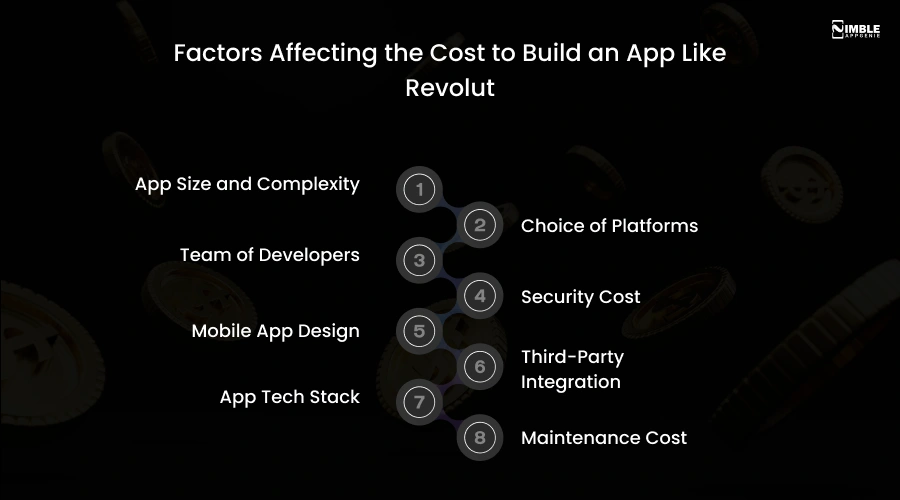
1. App Size and Complexity
A simple MVP (onboarding, wallet, transfers) costs $20,000–$45,000. Adding trading, crypto, and AI-driven analytics pushes the build to $100,000+. Every major feature module adds 4–8 weeks of development time and $5,000–$20,000 to the budget. Scope your MVP tightly, add complexity in Version 2.
2. Team of Developers
A standard app development team for a Revolut-like build: 1 Project Manager, 2 Backend Developers, 1 Frontend Developer, 1 UI/UX Designer, 1 QA Engineer.
| Region | Hourly Rate | Full Project Estimate |
| USA / UK | $100 – $150/hr | $150,000 – $200,000 |
| Eastern Europe | $50 – $80/hr | $80,000 – $120,000 |
| India | $20 – $40/hr | $20,000 – $60,000 |
| Southeast Asia | $25 – $45/hr | $25,000 – $65,000 |
For most startups, an Indian or Eastern European team offers the best cost-to-quality ratio. Nimble AppGenie operates this model, giving you senior developers at a lower rate than in the US.
3. Mobile App Design
Design for a fintech app is not cosmetic; it directly affects user trust and conversion. A Revolut-like app needs a clean, minimal UI with intuitive navigation.
Budget:
- Basic UI/UX: $5,000–$10,000.
- Custom design with animations and full prototype: $15,000–$30,000. Skimping here costs you users, not money.
4. App Tech Stack
Your tech stack choice can shift total costs by $15,000–$30,000. Here is the recommended stack for a Revolut-like app:
| Layer | Technology |
| Frontend | React Native (cross-platform) |
| Backend | Node.js or Python (Django) |
| Database | PostgreSQL + Redis |
| Payments API | Stripe, Modulr, or Railsbank |
| KYC/AML | Onfido or Jumio |
| Cloud | AWS or Google Cloud |
React Native covers Android and iOS in a codebase; this alone saves $15,000–$25,000 vs. building native apps separately.
5. Choice of Platforms
Build cross-platform from day one using React Native. This covers both Android and iOS simultaneously.
- Native iOS-only: $20,000–$40,000.
- Native Android-only: $10,000–$30,000.
- Cross-platform (React Native): $25,000–$50,000 for both.
For a fintech MVP, cross-platform is always the smarter first move.
6. Security Cost
Security is non-negotiable in a fintech app. Budget 15–20% of the total build cost for security. This includes: SSL/TLS encryption, two-factor authentication (2FA), end-to-end data encryption, PCI-DSS compliance for payment processing, and penetration testing before launch. Cutting corners here will cost far more in data breach liability.
Estimated security cost: $8,000–$25,000.
7. Third-Party Integration
Key integrations for a Revolut-like app and their cost impact:
- Payment Gateway (Stripe/Braintree): $3,000–$6,000.
- KYC Verification (Onfido/Jumio): $4,000–$8,000.
- Currency Exchange API (Open Exchange Rates/Fixer): $1,000–$3,000. Push Notifications (Firebase): $500–$1,500.
- Banking-as-a-Service (Railsbank/Modulr): $8,000–$15,000.
Each integration adds a development time budget of 1–2 weeks per major API.
8. Maintenance Cost
Plan for 15–20% of the original build cost per year in maintenance. On a $60,000 app, that’s $9,000–$12,000/year. This covers bug fixes, OS updates (Android/iOS release new versions annually), security patches, and server costs.
Do not skip a maintenance budget; fintech apps with unpatched security vulnerabilities get banned from app stores.

Recommended Tech Stack for a Revolut-Like App
The right tech stack reduces both build time and cost. Here is what we recommend for a scalable, secure fintech app:
| Layer | Technology & Why |
| Frontend | React Native Saves $15K–$25K
Cross-platform covers both iOS and Android in one codebase. No need to build native apps separately, which is the single biggest dev cost reduction available. |
| Backend | Node.js
Fast and non-blocking, ideal for real-time financial transactions where latency matters. Large ecosystem of fintech-compatible libraries. Scales horizontally without re-architecting. |
| Database | PostgreSQL + Redis
PostgreSQL handles transactional data (ACID-compliant, audit trails, financial records). Redis handles sessions, caching, and real-time balance reads, keeping the app fast under load. |
| Payments | Stripe or Railsbank PCI-compliant
Fastest integration path for card processing and multi-currency support. Railsbank is the better choice if you need full Banking-as-a-Service (BaaS); it lets you operate under a licensed provider while you apply for your own licence. |
| KYC/AML | Onfido Used by real neobanks
Best-in-class ID verification accuracy. Used by Revolut, Monzo, and others. Handles document checks, biometric verification, and ongoing AML screening. Integration cost: $4,000–$8,000. |
| Cloud | AWS
Most fintech-compliant cloud provider, dedicated financial services infrastructure, SOC 2 / ISO 27001 certified, and available in all major regulatory jurisdictions. Also, the easiest to scale as user volume grows. |
| Security | Auth0 + HashiCorp Vault
Auth0 handles authentication (OAuth 2.0, MFA, SSO) without building it from scratch. HashiCorp Vault manages API keys, tokens, and secrets; nothing sensitive sits in plain text in your codebase or environment variables. |
Avoid over-engineering the stack for a V1. Start with proven tools. Scale the infrastructure once you have real user volume.
How Much Time Does It Take to Develop an App Like Revolut?
To build an app like Revolut, you need a total of 6-9 months (for MVP). The timeline depends on various factors, such as cost, developers’ location, app complexity, and the number of features.
| Phase | What Happens | Duration |
| Discovery & Scoping | Feature list, wireframes, tech decisions | 2–3 weeks |
| UI/UX Design | Full-screen designs, clickable prototype | 3–4 weeks |
| Backend Development | APIs, database setup, payment integration | 8–12 weeks |
| Frontend Development | iOS + Android builds (React Native) | 8–10 weeks |
| QA & Security Testing | Functional, load, and penetration testing | 3–4 weeks |
| App Store Submission | Review process + server setup + launch | 1–2 weeks |
| Total | MVP build end-to-end | 6–9 months |
For an MVP (onboarding, wallet, transfers only), you can cut this to 3–4 months by limiting the scope to the first 4 phases and launching on one platform first.
Revolut vs. Monzo vs. Wise – What’s the Development Difference?
| App | Core Complexity | Estimated Build Cost |
| Revolut Clone | High – multi-currency, trading, crypto, vaults | $80,000 – $200,000 |
| Monzo Clone | Medium – banking, budgeting, no trading layer | $50,000 – $120,000 |
| Wise Clone | Medium-High – FX-focused, multi-currency transfers | $60,000 – $130,000 |
If you want to build a Revolut alternative, the trading and crypto modules are what drive up costs. If you want to launch faster and cheaper, model your MVP on Monzo’s feature set, build the basics well, then layer in investment features in V2.
Monetization Strategies to Cover the Cost of Developing an App Like Revolut
What are the key app monetization strategies to include while developing an app like Revolut?
Fintech app monetization strategies are useful in earning revenue and sustaining a competitive advantage.
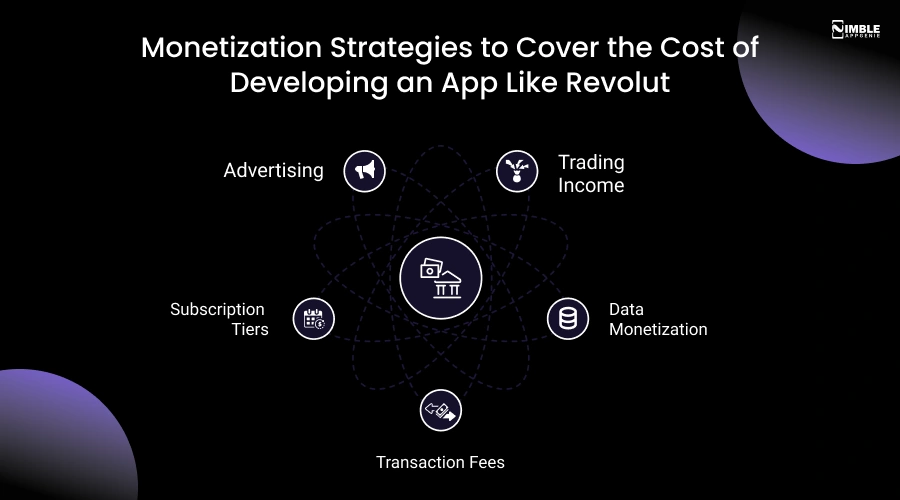
1. Advertising
Partner with financial brands (insurance, investment platforms) for native in-app placements. Revolut earns from this on its free tier. Keep ads non-intrusive; users of financial apps have zero tolerance for aggressive advertising.
2. Subscription Tiers
Revolut charges £2.99-£12.99/month for Premium and Metal plans. If 10% of your users convert to paid, that becomes your primary revenue engine. Design the free tier so users hit its limits within the first week; that’s the upgrade trigger.
3. Transaction Fees
Lock advanced features (higher transfer limits, premium analytics, and metal card) behind a paywall. Revolut’s free tier creates the desire to upgrade; design yours to do the same.
4. Data Monetization
Aggregate (anonymized) spending data is valuable to financial institutions and market researchers. Always get explicit user consent; GDPR compliance is not optional.
5. Trading Income
Charge a small commission (0.5%–1.5%) on crypto and stock trades. Only viable once you have regulatory approval in your target market, factor in licensing costs.
Now, as we have already discussed the cost and monetization practices, if you are still confused or concerned about the platform, then connecting to an experienced company might be helpful.
How Nimble AppGenie Helps Build a Revolut-like App Within Your Budget?
Nimble AppGenie, a top neobank development company, has built fintech products across KYC systems, multi-currency wallets, P2P transfer engines, and trading modules. Our team of 50+ developers includes specialists in React Native, Node.js, and banking API integration.
We work with both first-time founders and established financial businesses expanding into mobile.
Our developers do in-depth research before taking your idea to market and help you evaluate the current value of your idea for the customers.
Thus, we are a client-friendly fintech app development company when it comes to making your dream app a success.
Conclusion
To determine the cost of building an app like Revolut, it’s important to understand the different types of factors impacting it.
Here are the different factors impacting the cost, which can be the complexity of the app, size, app design, technology selection, choice of platforms, maintenance, security costs, and the team of developers.
Apart from the cost, another resource that might impact the app is time. The approximate time taken to build an app can vary from 7 months to 13 months, depending on complexity and the number of developers.
Connecting with an experienced company can assist you in bringing your dream project to life.
FAQs

Niketan Sharma, CTO, Nimble AppGenie, is a tech enthusiast with more than a decade of experience in delivering high-value solutions that allow a brand to penetrate the market easily. With a strong hold on mobile app development, he is actively working to help businesses identify the potential of digital transformation by sharing insightful statistics, guides & blogs.
Table of Contents




No Comments
Comments are closed.