

 Free Consultation
 PCI-DSS Compliant
 GDPR Ready
 ISO 27001
 NDA Protected
 AI Services
 AI App Development
 Generative AI Development
 AI Chatbot Development
 AI Integration Services
 AI Consulting Services
 AI For Fintech
 AI Financial Assistant Solution
 AI Insurance Agent Development
 Tech Stack
 OpenAI / GPT-4
 Claude / Anthropic
 Gemini / Google AI
 Llama / Open Source
 LangChain / LlamaIndex
 Pinecone / Pgvector
 AWS / Azure AI


 Fintech Solution
 Core Fintech
 Fintech App Development
 Neobank App Development
 eWallet App Development
 Lending Software
 Banking Software Development
 BNPL Solution
 BNPL App Development
 Insurance App
 Wealth Management App
 Blockchain Development
 Payroll Software Development
 DeFi App Development
 Crypto Wallet Dev
 Crypto On Ramp Off Ramp
 Crypto Exchange Dev
 Trading Platform Dev
 Payments
 Compliance
 Fintech & Digital Regulations
 Fraud Detection
 Lending Ecosystem
 P2P Lending Platform
 Mortgage Software
 Engagement
 Outsourcing Dev

 Mobile Development
 Mobile App Dev
 iOS App Development
 Android App Development
 React Native
 Flutter Development
 Web Solution
 Node.js Development
 React.js Development
 Angular Development
 App Services
 UI/UX Design
 App Maintenance
 By Stage
 MVP Development
 Industry Solutions
 Healthcare App Dev
 Education App Dev
 Travel App Dev
 Real Estate App Dev
 Logistics Software
 Social Media App

 Hire Mobile Developers
 Hire iPhone Developers
 Hire Android Developers
 Hire React Native Devs
 Hire Flutter Developers
 Hire Web Developers
 Hire Node.js Developers
 Hire Angular Developers
 Hire PHP Developers
 Hire Laravel Developers
 How It Works
 Pre-Vetted Developers
 Ready In 48 Hours
 NDA From Day One
 Replace Guarantee
 Company
 About Us
 Our Work Process
 Portfolio
 Case Studies
 Blog / Insights
 Careers
 Contact Us
 Awards
 Recognition


 Offices



TL;DR
- A Botim-like app today needs four layers, not one: HD voice/video calling, an AI layer (translation, smart replies), compliance, and a payments/wallet layer.
- Realistic costs range from around $40,000 for a single-market MVP to $250,000+ for a full-featured app with wallet and compliance built in.
- Timelines run 4 to 12 months, depending on how many features, platforms, and countries you launch with.
- The hardest part usually is not the calling technology; it’s compliance: money transmitter rules, KYC/AML, and VoIP regulations differ by country.
- Nimble AppGenie‘s fintech team has already solved the wallet-plus-compliance problem in production, on a live multi-country e-wallet build.
- Choosing the right development partner matters more than chasing the “perfect” tech stack; most serious contenders use similar technology underneath.
“How much does it cost to build an app like Botim?” It’s one of the most common questions founders type into ChatGPT and Google before they ever call a development agency. A Botim-like app is not just a video-calling tool. If done right, it’s a communication and payments platform developed for markets where standard messaging apps face limitations.
This plain-English guide for founders and product leaders by Nimble AppGenie’s fintech specialists is on what a Botim-like app needs in 2026 – beyond calling and chat. Also, read on for the real features, development process, and cost ranges, based on how fintech-focused teams actually build these apps today.
Botim itself has already made this shift. Its current app store listing markets it as “Connect. Pay. Explore. All in One App,” with in-chat money transfers, bill payments, mobile recharge, a multi-currency prepaid card, and an AI companion for calls and messages, not only HD video calling. If you are planning a Botim-like app for your business, you are setting a clear goal or standard.
Why Businesses Are Building Botim-Like Apps Now?
Two markets are converging, and that’s exactly why a Botim-like app is worth taking seriously as a business, not only a tech project.
The global mobile messaging market is projected to reach $595.8 billion by 2035, up from $136.2 billion as recorded in 2025, at a 15.9% CAGR. (Source: Future Market Insights)
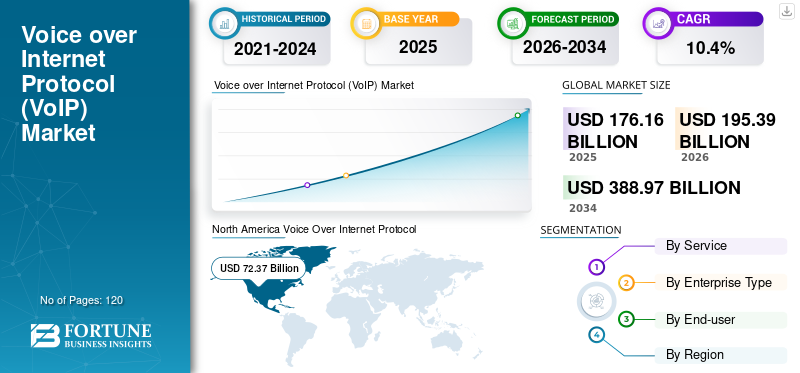
The global VoIP market is likely to be valued at $389 billion by 2034, up from $176 billion in 2025, at a 10.4% CAGR (Source: Fortune Business Insights)
Communication apps are expanding because more of everyday life happens on a phone. Payment apps are growing because banking infrastructure still covers a huge part of the world.
Botim itself sits at that intersection, founded in Dubai in 2018 and acquired by Astra Tech in 2023; it expanded by offering people a legal way to call home in VoIP-restricted markets, then layered financial services on top once it had the user base. That’s the real playbook: communication first, then monetization through payments.
For a startup or an established business, that means a Botim-like app is rarely just a “chat app” project. It’s a candidate for a super-app strategy – start with one high-frequency use case (calling), then expand into services users already trust you with. In other words, the real opportunity is to create a platform like Botim, not just clone its calling screen.
What Do Most “Botim Clone” Guides Get Wrong?
We scanned the guides currently ranking for “Botim clone” and “app like Botim”. Most follow the same pattern: a generic feature checklist (group calls, chat, encryption), a wide cost range with no proper breakdown of what impacts the price, and a standard tech stack list (Swift, Kotlin, Firebase, Node.js, WebRTC) with no explanation of why those options matter for a business.
Three gaps stand out, and they are exactly where a business-focused plan demands to go deeper.
The payment layer is considered an afterthought. Almost none of the existing guides clarify that “send money in chat” and “get a prepaid card” trigger real financial regulation, not just app store review.
Compliance is not priced in. KYC/AML verification, money transmitter licensing, and PCI-DSS scope change both the cost and timeline, sometimes significantly. Skipping this in a cost estimate sets founders up for a budget surprise later.
There’s no real production example. Most guides describe features as a problem in general. Very few showcase what building the compliance-and-wallet layer actually looks like once it is live with real users, real regulators, and real money.
The rest of this guide is built to close those three gaps.
Must-Have Features of Botim-like App Development
Instead of a long feature list, think of the Botim app’s features in four layers, each answering a different question a user or a regulator might ask.
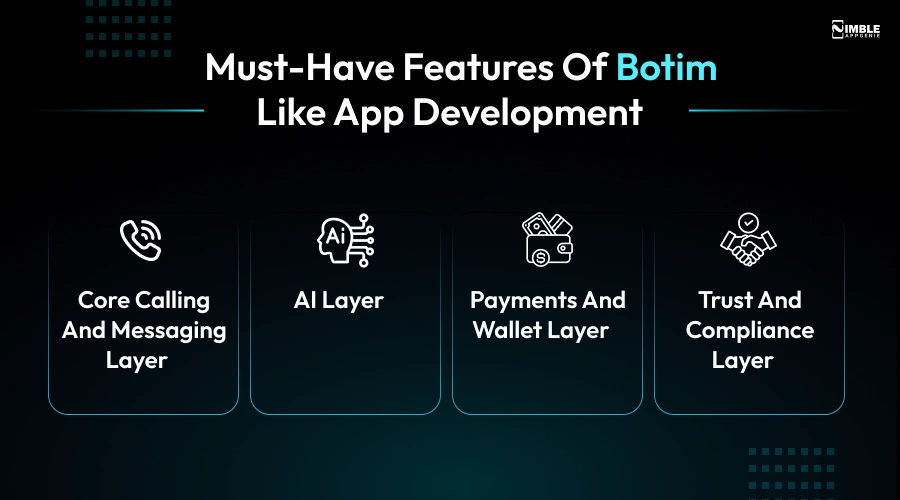
1. Core calling and messaging layer
- HD voice and video calling, including group calls
- Text messaging with media, file, and voice-note sharing
- Cross-platform sync across iOS, Android, and web
- Contact discovery, presence status, and call history
- End-to-end encryption for calls and messages
2. AI layer
- Real-time translation during calls and chats, for cross-border users
- An AI assistant that can help with calls, messages, or basic account questions
- Smart reply suggestions and call-quality enhancement filters
3. Payments and wallet layer
- In-app wallet with local and cross-border money transfer
- A virtual (and optionally physical) prepaid card
- Bill payments and mobile recharge
- Transaction history and real-time notifications
- This is the layer where an eWallet app development partner proves their value by building a safe, legal, and working payment app that is worth the money you pay them. It’s a different discipline from building a calling app, and it’s where most agencies that specialize in messaging apps run out of depth.
4. Trust and compliance layer
- KYC and AML verification at signup and on flagged transactions
- Fraud detection on payment and account activity
- Data residency and encryption aligned to each market’s regulations
- Licensed banking or payment partner integration for card issuance
Architecture of a Botim-like App Explained For Business Decision-Makers
Well, to make good architectural decisions, you need to understand what each choice costs you in speed, money, and risk.
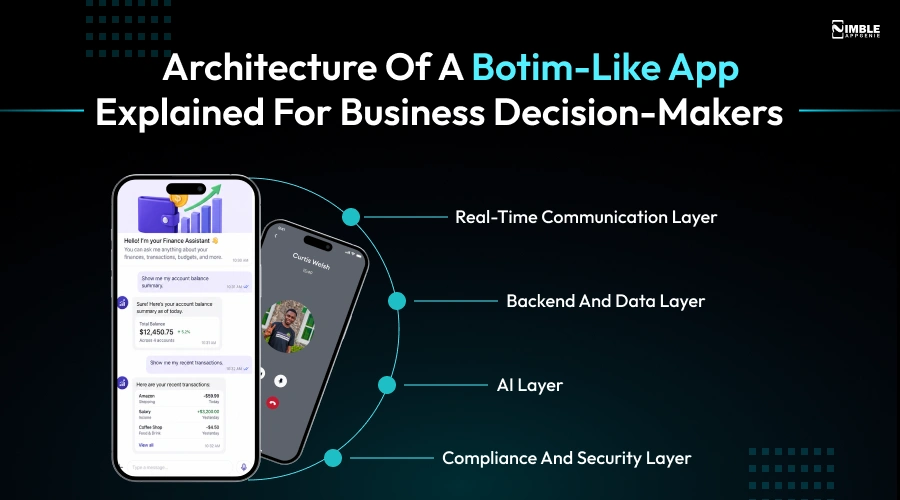
1. Real-Time Communication Layer
Calls run on WebRTC, connected through signaling, and relay servers that route audio and video between devices, even when both users are on restrictive networks.
This is the layer that decides whether calls stay clear on a weak 3G connection in a rural area, which matters specifically if your target market has patchy infrastructure. Underinvesting here is the single most common reason Botim-style apps get poor reviews after launch.
2. Backend and Data Layer
Messaging, calling, and payments should not share the same service boundary. Payment services should sit in a tightly scoped, audited environment to meet PCI-DSS requirements; calling and messaging don’t carry the same regulatory weight.
Separating them keeps your compliance audit smaller and your calling infrastructure free to scale independently. Choosing the right mobile tech stack is actually a series of trade-offs like this one, not a single “best” answer.
3. AI Layer
AI assistants and real-time translation usually connect to a large language model API rather than being built from scratch.
The business decision here is about latency (how fast a translation appears mid-call and cost per interaction at scale – not which model is technically “smartest.”
4. Compliance and Security Layer
This layer wraps around everything else: encryption, identity verification, audit logging, fraud monitoring. It’s the layer regulators and banking partners will actually inspect.
So, it needs to be part of the architecture from day one, not added before a funding round or a bank partnership.
Botim App Development Process, Start To Launch
An efficient Botim app development process generally moves through six phases:
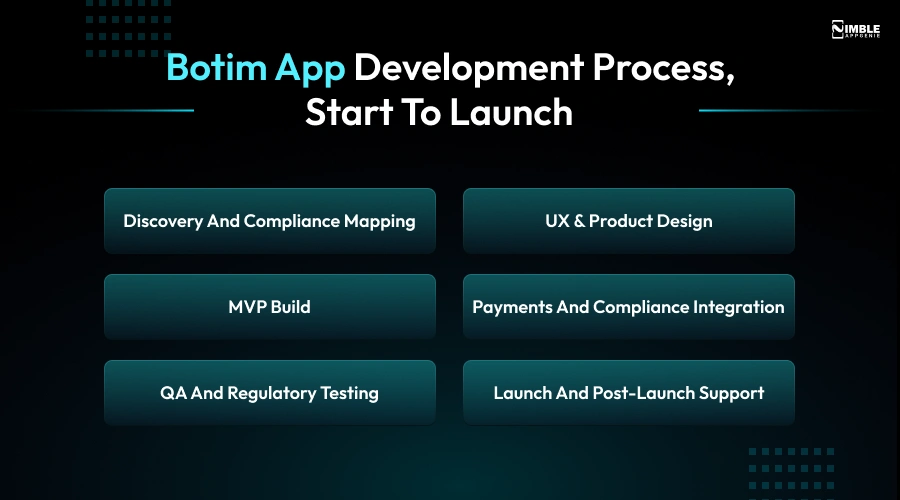
1. Discovery And Compliance Mapping
Defining your target markets, then mapping VoIP and financial regulations for each one before writing a line of code.
2. UX & Product Design
Designing calls, payment flows, and chat so they feel like one product, not three apps stitched together. See our approach to UI/UX design for apps.
3. MVP Build
A single-market version with core calling, chat, and basic wallet features is scoped as an MVP, so you can validate demand before scaling spend.
4. Payments and Compliance Integration
Connecting a licensed banking partner, fraud detection, and a KYC/AML provider, and auditing the flows.
5. QA and Regulatory Testing
Internal QA first, then closed beta testing with real users in your target market, as navigation and trust issues are barely seen.
6. Launch and Post-Launch Support
Phased rollout by country, with monitoring on call quality, support response time, and transaction success rates.
Costs to Develop an App Like Botim
Cost depends far more on which layers you include than on which country you hire developers in. Here is a realistic breakdown by scope:
| Build tier | What’s included | Typical cost | Timeline |
| Single-market MVP | Voice + video calling, text chat, groups, one platform | $40,000 – $80,000 | 3–4 months |
| Full cross-platform app | iOS + Android + web, HD calling, AI translation, media sharing | $90,000 – $180,000 | 5–7 months |
| Fintech-integrated app | All of the above, plus wallet, bill pay, KYC/AML, prepaid card, multi-country compliance | $180,000 – $350,000+ | 7–12 months |
A few things affect the price inside each tier:
- How many countries you launch in at once,
- Whether you need a licensed banking partner for card issuance, and
- How much of the AI layer (translation, assistant) you build versus buy via an API.
Businesses that start with a tightly scoped MVP and expand the wallet layer after validating demand generally spend less overall than those that try to launch everything at once.
How a Botim-Like App Makes Money?
Once the core product is live, revenue usually comes from three places, and most successful apps in this category use more than one at once:
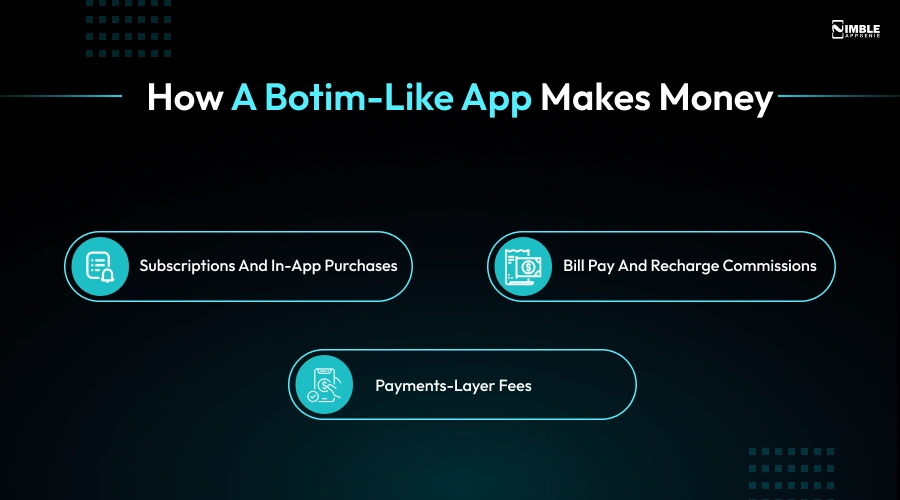
1. Subscriptions and In-app Purchases
An ad-free tier, premium AI features, and extended group call limits sold as a monthly plan.
2. Bill Pay and Recharge Commissions
A smaller per-transaction cut but high-frequency as users tend to repeat these actions monthly.
3. Payments-Layer Fees
This is where the fintech build starts paying for itself: transaction fees on transfers, interchange revenue from prepaid card usage, and foreign exchange margins on cross-border payments.
The pattern worth noting: pure calling apps monetize mainly through subscriptions, which caps revenue per user fairly low. Once a wallet is added, revenue per active user usually rises, because payment fees scale with how much money moves through the app, not just how many calls someone makes.
That’s the real financial case for building the fintech layer in rather than treating it as a future add-on.
A Related Build: Nimble AppGenie’s African Wallet Project
Case Study – Building the payments-and-compliance layer, at scale
The challenging part of a Botim-like app – KYC/AML, money movement, and licensed card issuance is exactly the issue Nimble AppGenie’s fintech team solved when it built a live multi-currency wallet for 14 countries across Central and West Africa.
- A free virtual prepaid Visa card issued instantly through a licensed banking partner (ECOBANK Gabon), with a physical card delivered within 24 hours.
- Real-time biometric KYC and AML screening, completed in-app in real time.
- IBAN issuance so users could receive international transfers, many for the first time.
- An app engineered to work reliably on affordable Android phones over 3G connections.
- An agent cash network with real-time reconciliation for markets where cash is still the norm.
- More than 1,000 people joined the waitlist before public launch. The lesson that applies directly to a Botim-like app: design compliance from day one, and build for the network conditions your actual users have, not the ones you wish they had.
Why Work With Nimble AppGenie?
Building a calling app requires mobile development skills. Building a Botim-like app takes that along with fintech compliance expertise, layered on top. Most agencies are strong at one and weak at the other.
The experienced fintech team at Nimble AppGenie works across both, with over 8 years and 350+ solutions delivered for startups and enterprises in 50+ countries. The team is ISO 27001 certified and PCI-DSS compliant, works as an AWS partner, and has hands-on experience with fintech app development, cross-border payments infrastructure, and fintech API integrations, not just messaging UI.
If Botim app development is on your roadmap, that combination is what keeps a project from stalling at the point most guides skip over the moment a banking partner or regulator asks how your compliance actually works.
How to Choose a Development Partner for a Botim-Like App?
Picking a vendor for this kind of build is different from picking one for a standard app. A few things are worth checking before you sign anything:
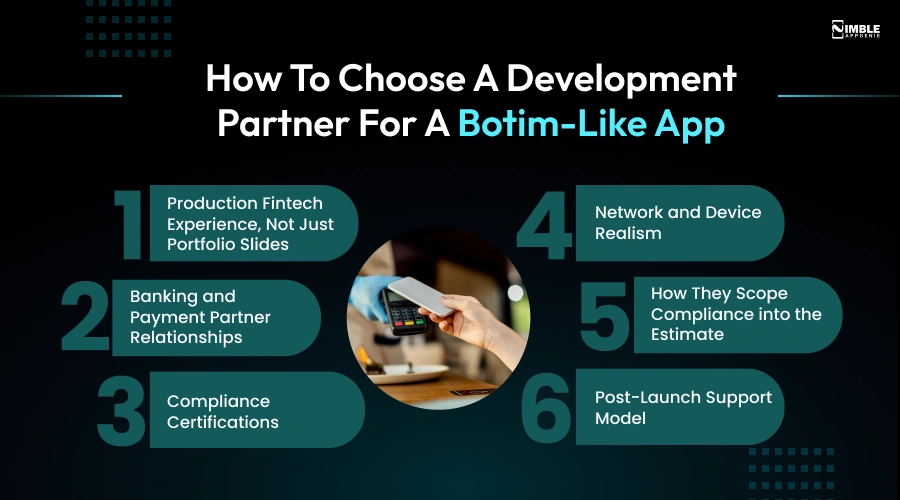
1. Production Fintech Experience, Not Just Portfolio Slides
Ask to see a live product where the vendor built the compliance and payments layer – not just designed the UI for one. Anyone can mock up a wallet screen; far fewer teams have shipped one that passed a bank’s audit.
2. Banking and Payment Partner Relationships
A vendor that has already worked with licensed banking partners for card issuance or cross-border transfers will save you months versus one starting that relationship from zero.
3. Compliance Certifications
ISO 27001 and PCI-DSS are not nice-to-haves for this build; they are the baseline. If a vendor doesn’t already have these, you are paying to educate them on your dime.
4. Network and Device Realism
Ask how they test call quality on weak connections and low-end Android devices, especially if you are targeting emerging markets. This is where a lot of Botim-style apps fail after launch, quietly, in app store reviews.
5. How They Scope Compliance into the Estimate
If a quote doesn’t mention KYC/AML, data residency, or money transmitter licensing at all, the number is incomplete – you will find the real cost later, mid-project.
6. Post-Launch Support Model
Compliance is not a one-time build – fraud patterns shift, licensing renews, and regulations change. Ask what ongoing support looks like before you need it.
A vendor that can speak to all six without hesitation has probably already developed something like this. One that can only speak to the first has probably only built the calling part.
Conclusion
A Botim-like app is not a calling app with a wallet bolted on; it’s a fintech product that happens to start with calling. The businesses that get this right treat payments, compliance, and communication as one build from day one, not three separate phases. Costs and timelines shift a lot depending on how much of those layers you take on, but starting with a tightly scoped MVP and expanding from there tends to beat trying to launch everything at once.
If you are weighing this build for your business, the fastest way to get a real answer – on timeline, cost, and what regulatory groundwork you will need – is to connect with a team that’s already shipped the hardest part: the compliance-and-wallet layer, in production.
FAQs
Cost depends on scope. A single-market MVP with calling and chat typically runs $40,000–$80,000. A full cross-platform app with AI translation adds up to $90,000–$180,000. A fintech-integrated version with a wallet, prepaid card, and multi-country compliance runs $180,000–$350,000 or more.
An MVP can launch in 3–4 months. A full-featured, cross-platform app with AI features usually takes 5–7 months. Adding a compliant payments and wallet layer across multiple countries extends that to 7–12 months, largely due to compliance and banking-partner integration timelines.
Yes, and for most businesses it should be the plan from the start rather than a later add-on. Botim itself now leads with “Connect. Pay. Explore.” Adding a wallet, bill pay, and card issuance means partnering with a licensed bank and building KYC/AML into onboarding, which is a fintech development discipline, not just a mobile app feature.
A clone script reuses an existing codebase to launch faster and cheaper, but it limits how far you can customize features, branding, and critical compliance flows for your specific markets. A custom build costs more upfront but gives you full control over the payments layer, data residency, and regulatory approach, which matters once you’re handling real money.
It depends entirely on the country and how the app is licensed and operated there. Botim itself operates as a licensed VoIP provider in markets like the UAE rather than working around restrictions. Any business entering a VoIP-restricted market should get local regulatory guidance before development, not after.

Niketan Sharma, CTO, Nimble AppGenie, is a tech enthusiast with more than a decade of experience in delivering high-value solutions that allow a brand to penetrate the market easily. With a strong hold on mobile app development, he is actively working to help businesses identify the potential of digital transformation by sharing insightful statistics, guides & blogs.
Table of Contents




No Comments
Comments are closed.