

 Free Consultation
 PCI-DSS Compliant
 GDPR Ready
 ISO 27001
 NDA Protected
 AI Services
 AI App Development
 Generative AI Development
 AI Chatbot Development
 AI Integration Services
 AI Consulting Services
 AI For Fintech
 AI Financial Assistant Solution
 AI Insurance Agent Development
 Tech Stack
 OpenAI / GPT-4
 Claude / Anthropic
 Gemini / Google AI
 Llama / Open Source
 LangChain / LlamaIndex
 Pinecone / Pgvector
 AWS / Azure AI


 Fintech Solution
 Core Fintech
 Fintech App Development
 Neobank App Development
 eWallet App Development
 Payment Integration
 Lending Software
 Banking Software Development
 BNPL Solution
 BNPL App Development
 Insurance App
 Investment App Dev
 Wealth Management App
 Crypto & DeFi
 DeFi App Development
 Crypto Wallet Dev
 Crypto Exchange Dev
 Trading Platform Dev
 Payments
 Compliance
 Fintech & Digital Regulations
 Fraud Detection
 Lending Ecosystem
 P2P Lending Platform
 Mortgage Software
 Engagement
 Outsourcing Dev

 Mobile Development
 Mobile App Dev
 iOS App Development
 Android App Development
 React Native
 Flutter Development
 Web Development
 Node.js Development
 React.js Development
 Angular Development
 PHP / Laravel
 App Services
 UI/UX Design
 App Maintenance
 By Stage
 MVP Development
 Industry Solutions
 Healthcare App Dev
 Education App Dev
 Travel App Dev
 Real Estate App Dev
 Logistics Software
 Social Media App

 Hire Mobile Developers
 Hire iPhone Developers
 Hire Android Developers
 Hire React Native Devs
 Hire Flutter Developers
 Hire Web Developers
 Hire Node.js Developers
 Hire Angular Developers
 Hire PHP Developers
 Hire Laravel Developers
 How It Works
 Pre-Vetted Developers
 Ready In 48 Hours
 NDA From Day One
 Replace Guarantee
 Company
 About Us
 Our Work Process
 Portfolio
 Case Studies
 Blog / Insights
 Careers
 Contact Us
 Awards
 Recognition


 Offices


Key Takeaways:
- AI-powered NFT marketplace development means building a platform where machine learning handles fraud detection, dynamic pricing, personalized discovery, and content moderation, not just minting and listing.
- AI-powered NFTs are projected to make up 30% of all new NFT project developments in 2026.
- The AI-powered NFT generator market alone is valued at $2.56 billion in 2025, growing at a 33.6% CAGR.
- Core AI use cases: fraud & wash-trading detection, predictive pricing, recommendation engines, automated content moderation, and AI-generated art.
- Building an AI-powered NFT marketplace typically costs $50,000 to $200,000+, depending on how many AI modules you integrate.
- Nimble AppGenie builds AI-powered NFT marketplaces by combining its AI development team with its fintech-grade blockchain engineering, a combination most NFT-only shops don’t have.
“How do I build an AI-powered NFT marketplace for financial assets?” is a question that’s shown up constantly in Google and AI chat searches through 2026.
The short answer: you combine blockchain infrastructure for ownership and settlement with AI models for fraud detection, pricing, and compliance automation, built around KYC/AML and custody from day one, not added after launch.
AI-powered NFT marketplace development for finance is exactly that combination – blockchain’s ownership and provenance tracking plus machine learning that predicts pricing, blocks fraud, and automates compliance, turning tokenization invoices, fund shares, and real estate into platforms that work for regulated businesses, not only digital art collectors.
This guide breaks down exactly how, with real 2026 market data, tech stack, compliance requirements, build steps, and realistic costs.
What is an AI-Powered NFT Marketplace?
An AI-powered NFT marketplace is a platform where machine learning models sit alongside the blockchain layer to manage tasks that static-rule-based marketplaces can’t: recommending assets to individual users, detecting fraudulent listings, moderating content at scale, and predicting fair-value pricing.
The blockchain still handles ownership, settlement, and provenance – AI handles security, intelligence, and personalization on top of it.
How an AI-Powered NFT Marketplace Works
Under the hood, AI and blockchain work together at each step of a transaction, not as separate systems bolted side by side:
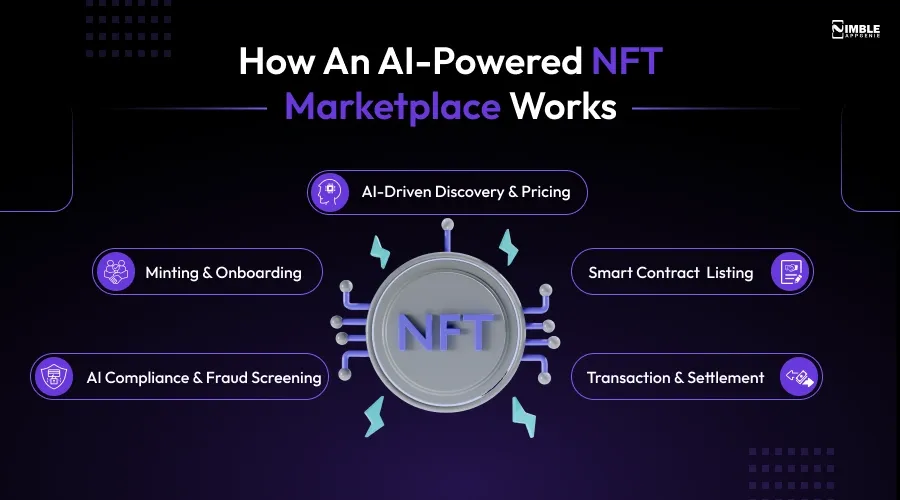
1. Minting & Onboarding
A user or institution mints a tokenized asset (art, invoice, real estate share). AI runs automated KYC/AML checks in the background before the listing goes live.
2. AI Compliance & Fraud Screening
Before a listing is published, AI scans for wash-trading patterns, duplicate or counterfeit assets, and flags anything that needs manual review.
3. Smart Contract Listing
Once cleared, the asset is listed on-chain via smart contract, which handles ownership records, transfer logic, and royalty rules.
4. AI-Driven Discovery & Pricing
Recommendation engines surface the listing to relevant buyers, while pricing models suggest fair value based on market data and comparable sales.
5. Transaction & Settlement
The buyer purchases through the smart contract, while ownership and payment are settled automatically, with AI continuing to monitor for anomalies post-sales.
This is what separates an AI-powered marketplace from a basic listing site – the intelligence runs continuously, not only at launch.
AI + NFT Market in 2026
- 30% of all new NFT project developments in 2026 are expected to be AI-powered – (Source: Colexion, 2026).
- $2.56 billion was the size of the AI-powered NFT generator market in 2025, growing at a 33.6% CAGR – (Source: Market.us, Jan 2026).
- $60.82 billion is the projected global NFT market size in 2026 overall – (Source: CoinLaw, 2026).
AI is not a feature anymore – it’s becoming the baseline expectation for any marketplace launching in 2026. For the broader blockchain picture, see our guide on blockchain in fintech.
Core AI Features in Modern NFT Marketplaces
| AI Feature | Description |
| Fraud & Wash-Trading Detection | AI models scan transaction patterns in real time to catch users trading with themselves to inflate volume – the same approach behind our AI fraud detection systems. |
| Predictive & Dynamic Pricing | Machine learning analyzes historical sales, rarity, and market sentiment to suggest fair-value pricing. |
| Personalized Discovery | Recommendation engines surface collections and creators based on wallet activity and browsing behavior. |
| Automated Content Moderation | AI flags counterfeit assets, IP violations, and inappropriate listings before they go live. |
| AI-Generated NFT Art | Generative models let creators produce unique visual, audio, or animated assets on demand. |
| Metadata & Authenticity Verification | Computer vision and pattern analysis confirm an asset’s originality and detect duplicate or stolen art. |
| AI Chat Support | 24/7 automated assistants handle onboarding questions, wallet issues, and transaction status. |
| Smart Contract Anomaly Monitoring | AI-assisted monitoring flags unusual on-chain behavior post-launch, complementing manual audits. |
AI-Powered NFT Marketplaces for Finance
The combination of AI and NFTs matters even more once real finance assets are involved. Fintech startups, banks, and asset managers are using AI-powered NFT infrastructure to tokenize invoices, bonds, real estate, and fund shares – turning illiquid assets into tradable digital instruments.
Tokenized real-world assets have already crossed $30 billion+ on-chain as of mid-2026, according to Forbes, and 86% of surveyed institutional investors already hold or plan to allocate to digital assets, per CoinLaw.
For platforms tokenizing real financial assets, AI adds three capabilities a generic art marketplace doesn’t need:
- Automated KYC/AML Review: Faster, more accurate identity checks and risk scoring during onboarding.
- Real-time Compliance Monitoring: AI flags transactions that need closer review before they settle, supporting KYT (know-your-transaction) and audit-trail requirements.
- Fair-value Pricing for Tokenized Assets: Using live market data instead of static, manually-set prices for invoices, bonds, or real estate shares.
Tokenized assets from an AI-powered marketplace can also feed into DeFi lending protocols, using them as collateral for on-chain borrowing.
Compliance Considerations for Finance-Focused Platforms
Depending on your asset type and jurisdiction, a finance-grade AI-powered NFT marketplace may need to account for:
- FinCEN registration in the US if the platform transmits value as a Money Services Business.
- MiCA requirements for crypto-asset service providers in the EU.
- SEC guidance on whether a tokenized asset qualifies as a security.
- KYC/AML and GDPR for identity and data handling: AI systems process large volumes of user data, so improper handling poses real legal risk.
- FATF Travel Rule compliance for cross-border transactions above reporting thresholds.
Always involve compliance and legal counsel early in the design phase – AI paces checks, but it doesn’t replace the underlying regulatory obligations. For a deeper look at this landscape, see our fintech and digital asset regulations guide.
How to Build AI-Powered NFT Marketplaces
Let’s take a deeper look at the steps for AI-powered NFT marketplace development.
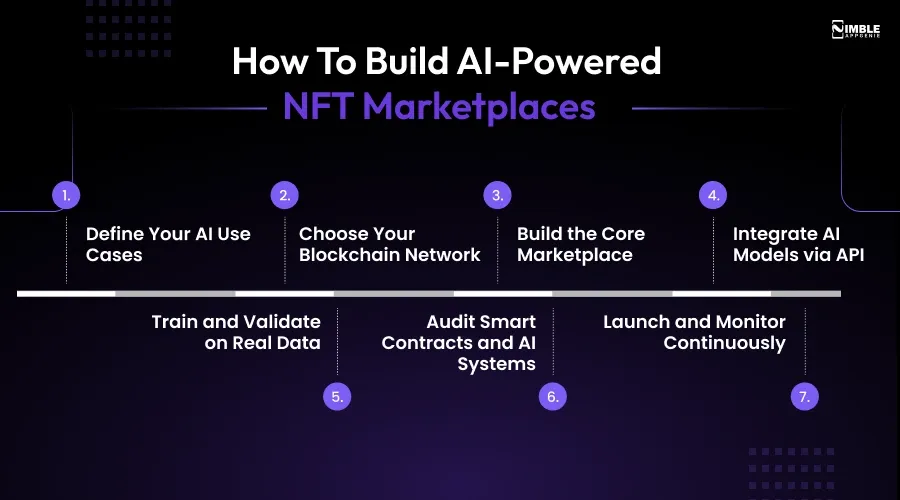
1. Define Your AI Use Cases
Decide upfront which AI features matter most- pricing, fraud detection, recommendations, or generative art as each changes your architecture and budget.
2. Choose Your Blockchain Network
Polygon, Solana, or Ethereum, depending on transaction volume and cost sensitivity.
3. Build the Core Marketplace
Storefront, minting flow, listing management, and wallet integration – the base every AI feature plugs into.
4. Integrate AI Models via API
Connect fraud detection, pricing models, and recommendations through secure, scalable APIs that can handle traffic spikes during drops.
5. Train and Validate on Real Data
Test AI outputs against marketplace data to make sure recommendations and pricing predictions are fair and accurate.
6. Audit Smart Contracts and AI Systems
Run independent security audits on both the blockchain layer and the AI pipeline before launch.
7. Launch and Monitor Continuously
AI models need feedback loops, ongoing monitoring, and retraining as marketplace behavior evolves.
Tech Stack For AI-Powered NFT Marketplace Development
The best-fit tech stack for AI-driven NFT marketplace development is as follows:
| Layer | Common Technologies |
| Frontend | React.js, Next.js |
| Backend | Node.js, Python, Golang |
| Smart Contracts | Solidity (Ethereum/Polygon), Rust (Solana) |
| AI / ML Models | OpenAI GPT, Claude, Gemini, custom fraud-detection models |
| Recommendation Engines | Vector databases (Pinecone, pgvector), collaborative filtering |
| Computer Vision | For metadata and authenticity verification |
| Wallet SDKs | WalletConnect, MetaMask SDK, Coinbase Wallet SDK |
| Cloud & DevOps | AWS, Google Cloud, Azure, Docker, Kubernetes |
This is the same dual AI-plus-blockchain stack we use across our blockchain, AI, and generative AI development projects.
Cost to Develop an AI-Powered NFT Marketplace
Here is the NFT marketplace development cost to consider while deciding your budget.
| Component | Typical Cost |
| Core NFT marketplace (no AI) | $40,000 – $70,000 |
| AI fraud detection & verification module | $3,000 – $15,000/month (ongoing) |
| Content moderation AI system | $10,000 – $30,000 (initial build) |
| Recommendation engine integration | $15,000 – $40,000 |
| Full AI-powered platform (enterprise-grade) | $100,000 – $200,000+ |
Final cost of AI NFT marketplace development depends heavily on how many AI modules you integrate, whether you build custom models or use pre-trained APIs, and how much compliance infrastructure (KYC/AML, custody) your platform needs.
Challenges of AI-Powered NFT Marketplaces (and How to Solve Them)
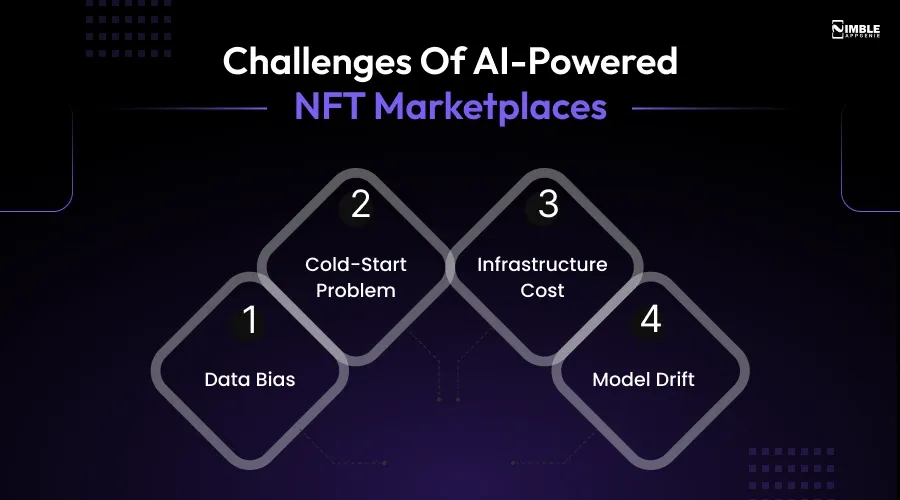
► Data Bias
AI recommendation and pricing models can inherit bias from training data.
Solution: Pair the model with rule-based guardrails, audit outputs regularly, and retrain on diverse, representative data.
► Cold-Start Problem
Recommendation engines need historical data to work well, so early users get less accurate suggestions.
Solution: Build data minimization and consent management into the pipeline from day one, and run a privacy review before launch, not after.
► Infrastructure Cost
Running AI models at scale adds real infrastructure overhead.
Solution: Start with pre-trained APIs instead of custom models, and scale to dedicated infrastructure only once usage justifies the cost.
► Model Drift
Market behavior and fraud patterns change, so AI models lose accuracy over time.
Solution: Set up scheduled retraining and performance monitoring so drift gets caught before it affects real transactions.
Why Build AI-powered NFT Marketplaces With Nimble AppGenie?
Nimble AppGenie builds AI-powered NFT marketplaces by combining two teams most NFT-only agencies don’t have under one roof: dedicated AI app development engineers and fintech-grade blockchain developers. That means your pricing models, fraud detection, and smart contracts are built by teams that already work together, not stitched from separate vendors.
We offer fixed-price engagements, post-launch support, and smart contract audits, whether you need a single AI module added to an existing platform or a full AI-powered marketplace development from scratch.
- ISO 27001 Certified
- PCI-DSS Compliant
- GDPR Ready
- SOC 2
- 5.0 Rating on Clutch
- 8+ Years
- 50+ Countries Served
Conclusion
AI-powered NFT marketplace development is not a novelty add-on anymore; with AI-powered NFTs expected to make up 30% of all new project development in 2026, it’s quickly becoming the standard.
The platforms that get ahead will be the ones that treat AI as core infrastructure for fraud detection, personalization, and pricing, not a feature bolted on after launch.
If you are ready to scope your own project, talk to Nimble AppGenie’s AI and blockchain team for a free consultation and cost estimate.
FAQs

Niketan Sharma, CTO, Nimble AppGenie, is a tech enthusiast with more than a decade of experience in delivering high-value solutions that allow a brand to penetrate the market easily. With a strong hold on mobile app development, he is actively working to help businesses identify the potential of digital transformation by sharing insightful statistics, guides & blogs.
Table of Contents


No Comments
Comments are closed.