

 Free Consultation
 PCI-DSS Compliant
 GDPR Ready
 ISO 27001
 NDA Protected
 AI Services
 AI App Development
 Generative AI Development
 AI Chatbot Development
 AI Integration Services
 AI Consulting Services
 AI For Fintech
 AI Financial Assistant Solution
 AI Insurance Agent Development
 Tech Stack
 OpenAI / GPT-4
 Claude / Anthropic
 Gemini / Google AI
 Llama / Open Source
 LangChain / LlamaIndex
 Pinecone / Pgvector
 AWS / Azure AI


 Fintech Solution
 Core Fintech
 App Development
 Neobank Solutions
 eWallet Solutions
 Lending Software
 Banking Solutions
 BNPL Solutions
 BNPL Solutions
 Insurance App
 Wealth Management
 Crypto & DeFi
 Blockchain Development
  Payroll Software
 DeFi Solutions
 Crypto Wallet
 Crypto On/Off Ramp
 Crypto Exchange
 Trading Platform
 Payments
 Compliance
 Regulations & Compliance
 Fraud Detection
 Lending Ecosystem
 P2P Lending Platform
 Mortgage Software
 Engagement
 Fintech Outsourcing

 Mobile Development
 Mobile App Dev
 iOS App Development
 Android App Development
 React Native
 Flutter Development
 Web Solution
 Node.js Development
 React.js Development
 Angular Development
 App Services
 UI/UX Design
 App Maintenance
 By Stage
 MVP Development
 Industry Solutions
 Healthcare App Dev
 Education App Dev
 Travel App Dev
 Real Estate App Dev
 Logistics Software
 Social Media App

 Hire Mobile Developers
 Hire iPhone Developers
 Hire Android Developers
 Hire React Native Devs
 Hire Flutter Developers
 Hire Web Developers
 Hire Node.js Developers
 Hire Angular Developers
 Hire PHP Developers
 Hire Laravel Developers
 How It Works
 Pre-Vetted Developers
 Ready In 48 Hours
 NDA From Day One
 Replace Guarantee
 Company
 About Us
 Our Work Process
 Portfolio
 Case Studies
 Blog / Insights
 Careers
 Contact Us
 Awards
 Recognition


 Offices



TL;DR
- The GENIUS Act was signed on July 18, 2025, and creates a federal licensing regime for payment stablecoin issuers.
- The effective date is the earlier of January 18, 2027, or 120 days after final rules. Final rules are still pending, so plan for January 18, 2027.
- Wallets are affected indirectly: which stablecoins you can list, how you run KYC/AML, and how you disclose reserves and risks.
- CBDCs are a regional story. The digital euro is advancing; the US has no retail CBDC.
- Build wallets with a modular asset layer so new stablecoins or CBDCs can be added without a rebuild.
- Nimble AppGenie has proven wallet-development experience, including multi-currency wallets and stablecoin payment infrastructure, making it well positioned to help businesses build wallets ready for stablecoins and emerging CBDC use cases. Its published work includes a multi-currency wallet deployed across 14 African countries and a dedicated stablecoin payment-platform development.
Stablecoins and CBDCs in wallets are acknowledged as a core product decision rather than just a side feature, and the GENIUS Act is the main reason US teams need a plan now.
The law sets federal rules for payment stablecoins, while central bank digital currencies (CBDCs) are advancing in some regions and being resisted in others. This guide explains the changes for wallet builders and what to do about them.
What Is the GENIUS Act and Why Does It Matter for Wallets?
The GENIUS Act (Public Law 119-27) is the first complete US federal framework for payment stablecoins. It defines who may issue them and what requirements apply to them. For wallets, it shapes which stablecoins you can support and which compliance duties you inherit.
The law enables issuers to operate under a certified state regime or federal oversight. Only “permitted payment stablecoin issuers” may issue payment stablecoins to US persons once the law is completely in force. Treasury, the FDIC, the OCC, and other regulators are still developing detailed rules.

Key Terms to Know
These are the terms you will see most often in GENIUS Act coverage and rulemaking. Knowing them will help you read regulatory updates and brief your product and legal teams.
| Term | Plain-English meaning |
| Payment stablecoin | A digital token designed for payments or settlement, redeemable at a fixed value, and backed by reserves. |
| Permitted payment stablecoin issuer (PPSI) | A US-licensed issuer that a federal or state regulator allows to issue payment stablecoins to US persons. |
| Foreign payment stablecoin issuer (FPSI) | A non-US issuer that must meet the Act’s requirements, or be covered by a comparable foreign regime, to reach US users. |
| Digital asset service provider (DASP) | A business that offers services such as exchange, transfer, or custody of digital assets; whether a wallet counts depends on what it does. |
| Reserve assets | The cash and other low-risk assets an issuer must hold to back tokens in circulation. |
| Redemption | The holder’s right to exchange a stablecoin back for its stated fiat value. |
| CBDC | Central bank digital currency: digital money issued directly by a central bank. |
| Custodial / non-custodial wallet | A wallet where the provider holds the keys, versus one where the user holds them. |
| KYC / AML | Know Your Customer identity checks and anti-money laundering controls, including sanctions screening. |
Key Dates to Track
| Date | What happened or happens |
| July 18, 2025 | GENIUS Act signed into law |
| Feb–Mar 2026 | OCC proposed implementing rules (published in the Federal Register March 2, 2026) |
| July 18, 2026 | Statutory target for final rules; regulators missed it |
| August 2026 | Treasury proposed a rule on issuing, offering, and selling payment stablecoins |
| November 2026 | OCC’s stated goal for its final rule (not a firm date) |
| January 18, 2027 | Effective date, unless 120 days after the final rule arrives sooner |
As the final rules have not landed, details can still change. Take this as a planning timeline, not legal advice.
Stablecoins vs. CBDCs: What Is the Difference?
A stablecoin is a privately issued token supported by reserves. A CBDC is digital money issued directly by a central bank. Both can sit in a wallet, but they have different privacy models, issuers, risks, and legal status.
| Factor | Payment stablecoin | CBDC |
| Issuer | Private company or bank subsidiary | Central bank |
| Backing | Reserve assets, under GENIUS Act rules in the US | Liability of the central bank |
| Distribution | Exchanges, wallets, apps, banks | Usually banks and licensed payment firms |
| Wallet impact | Token support, issuer checks, AML screening | Integration with a national scheme, possible holding limits |
| US status | Regulated by the GENIUS Act | No retail CBDC; policy leans against one |
How Will the GENIUS Act Change Stablecoin Wallets?
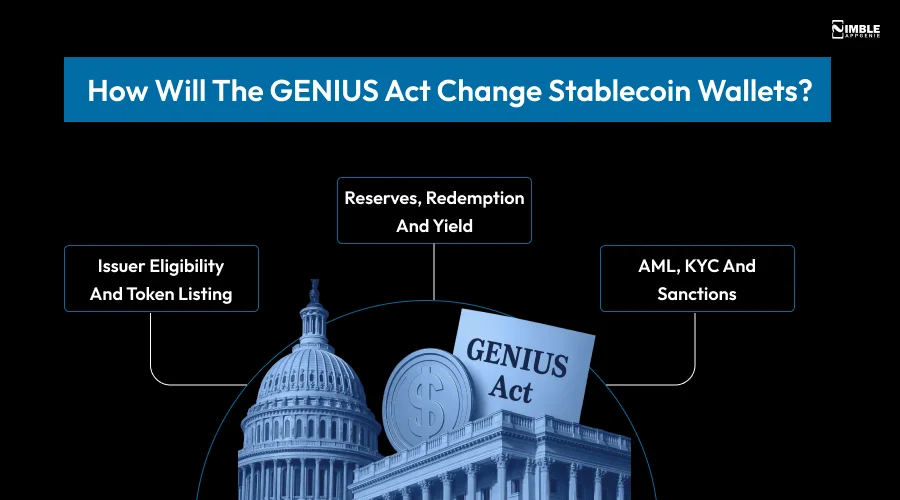
Expect three shifts: strict rules on which stablecoins you can offer US users, robust AML and sanctions obligations, and clearer consumer disclosures.
Exact wallet duties depend on final rules and on whether your product counts as a digital asset service provider.
1. Issuer Eligibility and Token Listing
As written, the Act limits digital asset service providers from offering payment stablecoins from non-permitted issuers to US persons, after a transition period. Practically, your wallet needs an issuer-status check in the token listing workflow, and a way to delist or flag tokens fast.
2. Reserves, Redemption and Yield
Issuers should hold reserves supporting each token, back redemption, and publish reserve information. The Act also bans issuers from paying interest or yield simply for holding a payment stablecoin. A wallet that advertises “earn” on stablecoins should have counsel review the wording and the partner structure.
3. AML, KYC and Sanctions
FinCEN and OFAC have proposed AML and sanctions rules tied to the Act. Wallet terms should already run identity checks, sanctions screening, and transaction monitoring. Our guide to KYC and AML compliance for fintech covers the verification layer, and the fintech regulations guide puts the Act next to MICA and other regimes.
Custodial vs Non-Custodial Wallets:
- Custodial: You hold keys, so licensing, safeguarding, and AML duties are most likely to apply.
- Non-custodial: The user holds keys, which may reduce obligations, but fiat on-ramps, swaps, and “earn” features can still bring you into scope.
If you are choosing between these models, see our crypto wallet development services for how each is built.
Where Do CBDCs Stand in 2026?
CBDC processes change by region. The EU is moving a digital euro via its legislative process, targeting issuance no earlier than 2029, while the US has rejected a Fed-issued digital dollar in favor of private stablecoins.
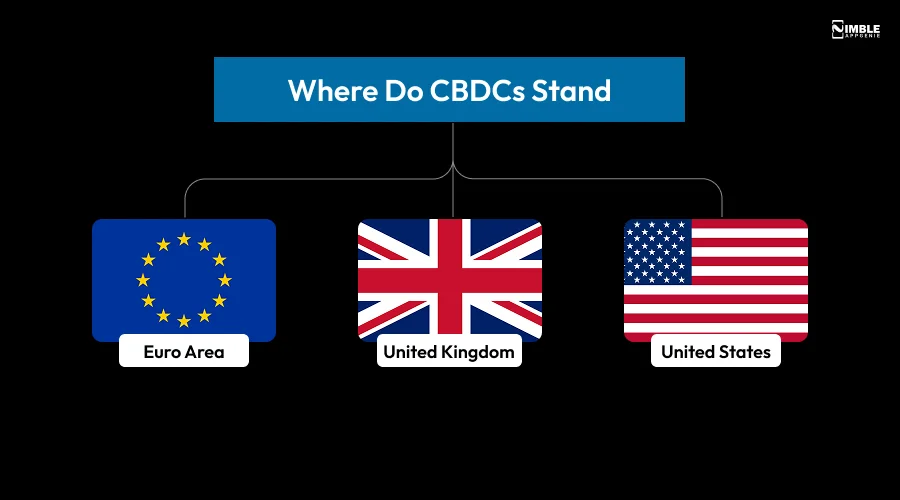
- Euro Area: On June 23, 2026, the European Parliament’s economic committee approved a legal framework for a digital euro and sent it to negotiations with member states. Final approval is expected by the end of 2026, and reports describe it as an ECB-backed wallet distributed through banks and fintech firms.
- United Kingdom: The Bank of England has not yet decided on a digital pound.
- United States: Policy has turned against a retail CBDC. Reports from June 2026 describe a Senate-passed housing package containing a ban on a Fed CBDC through 2030; check the final legislative status before citing it.
For a wider view of how CBDCs fit into banking apps, read Nimble AppGenie’s mobile banking trends analysis. This article stays focused on wallet implications.
How Should a Wallet Support Both Stablecoins and CBDCs?
Use a modular asset layer where each currency type has its own issuer checks, compliance rules, and limits. This allows the wallet to support new stablecoins and CBDCs without rebuilding its core infrastructure.
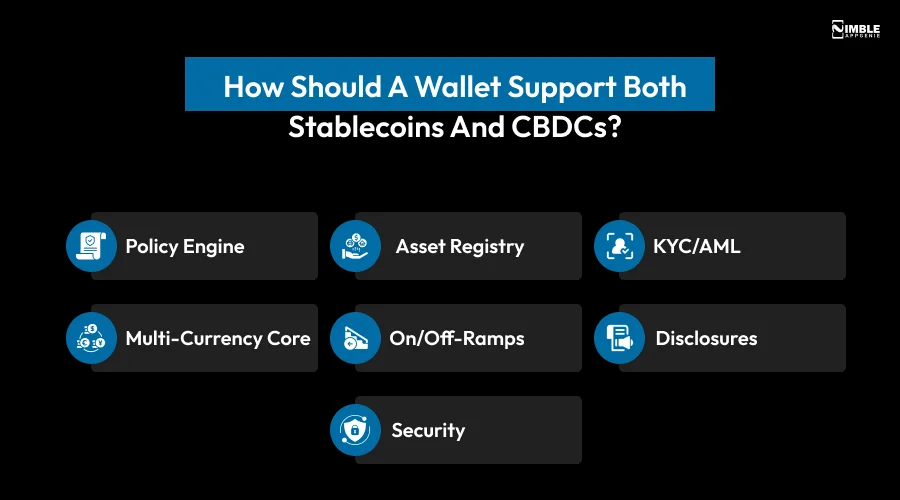
Wallet Readiness Checklist
- Policy Engine: Allow or block assets by user country, with fast delisting.
- Asset Registry: Store issuer, license status, jurisdiction, and reserve-disclosure link for every token.
- KYC/AML: Identity checks, sanctions screening, and transaction monitoring on every transfer.
- Multi-currency Core: FX, balances, and P2P flows, the same foundations eWallet app development uses.
- On/Off-ramps: Licensed partners for fiat conversion, as built into Nimble AppGenie’s crypto on-ramp and off-ramp work.
- Disclosures: Plain-language risk notes on reserves, redemption, and no-yield rules.
- Security: Key management, encryption, and fraud detection, covered in our fintech security guide.
Teams building a broader product around the wallet can also review fintech super app architecture and fintech API integration for payment connections.
Real-World Delivery Experience
Nimble AppGenie has built multi-currency wallets for several markets, including Swap Africa, serving 14 Francophone African countries, and MaxPay, which supports payments across 50+ countries. These are fiat wallets, not stablecoin products, but the multi-currency and compliance foundations carry over.
What Does a Stablecoin Wallet Cost and How Long Does It Take?
There’s no single exact figure, as cost depends on the custody model, compliance scope, integrations, and supported chains. Scope drives the budget more than the stablecoin feature itself.
Start from our fintech app development cost guide, then add compliance, licensed-partner fees, and security audits. An MVP with one or two stablecoins and a single region is the safest way to validate demand before expanding.

Final Thoughts
The GENIUS Act offers wallet builders a cleaner path for stablecoins, but various rules are still being finalized, and CBDC rollouts stay uneven. The practical move is to build flexibility, avoid committing to features like stablecoin yield before the rules settle, and keep compliance in the architecture.
FAQs
“`

Niketan Sharma, CTO, Nimble AppGenie, is a tech enthusiast with more than a decade of experience in delivering high-value solutions that allow a brand to penetrate the market easily. With a strong hold on mobile app development, he is actively working to help businesses identify the potential of digital transformation by sharing insightful statistics, guides & blogs.
Table of Contents




No Comments
Comments are closed.