

 Free Consultation
 PCI-DSS Compliant
 GDPR Ready
 ISO 27001
 NDA Protected
 AI Services
 AI App Development
 Generative AI Development
 AI Chatbot Development
 AI Integration Services
 AI Consulting Services
 AI For Fintech
 AI Financial Assistant Solution
 AI Insurance Agent Development
 Tech Stack
 OpenAI / GPT-4
 Claude / Anthropic
 Gemini / Google AI
 Llama / Open Source
 LangChain / LlamaIndex
 Pinecone / Pgvector
 AWS / Azure AI


 Fintech Solution
 Core Fintech
 App Development
 Neobank Solutions
 eWallet Solutions
 Lending Software
 Banking Solutions
 BNPL Solutions
 BNPL Solutions
 Insurance App
 Wealth Management
 Crypto & DeFi
 Blockchain Development
  Payroll Software
 DeFi Solutions
 Crypto Wallet
 Crypto On/Off Ramp
 Crypto Exchange
 Trading Platform
 Payments
 Compliance
 Regulations & Compliance
 Fraud Detection
 Lending Ecosystem
 P2P Lending Platform
 Mortgage Software
 Engagement
 Fintech Outsourcing

 Mobile Development
 Mobile App Dev
 iOS App Development
 Android App Development
 React Native
 Flutter Development
 Web Solution
 Node.js Development
 React.js Development
 Angular Development
 App Services
 UI/UX Design
 App Maintenance
 By Stage
 MVP Development
 Industry Solutions
 Healthcare App Dev
 Education App Dev
 Travel App Dev
 Real Estate App Dev
 Logistics Software
 Social Media App

 Hire Mobile Developers
 Hire iPhone Developers
 Hire Android Developers
 Hire React Native Devs
 Hire Flutter Developers
 Hire Web Developers
 Hire Node.js Developers
 Hire Angular Developers
 Hire PHP Developers
 Hire Laravel Developers
 How It Works
 Pre-Vetted Developers
 Ready In 48 Hours
 NDA From Day One
 Replace Guarantee
 Company
 About Us
 Our Work Process
 Portfolio
 Case Studies
 Blog / Insights
 Careers
 Contact Us
 Awards
 Recognition


 Offices



Key Takeaways:
- FSRA compliance for fintech startups covers the rules governing fintech businesses in ADGM.
- The three stages of regulatory compliances comprises of principle-based approach, a risk-based approach, and activity-based supervision.
- The key steps to follow for adopting the FSRA licences for fintech startups begin with product classification and end with testing of the app.
- The cost and timelines to adopt vary from $20,000 to $50,000+. This timeline varies from 3 to 6 months.
- Key challenges that you might face here are selecting the wrong licensing category upfront and treating licensing as a legal problem only.
- To overcome these challenges, you should follow best practices and should connect with leading fintech organizations like Nimble AppGenie.
Launching a new startup in the UAE or even in Abu Dhabi requires more than an innovative product and strong technology.
Fintech organisations need to consider compliance to enhance the overall performance of their enterprises.
Well, when it comes to Abu Dhabi, you should follow FSRA compliance. But what are these, and how are they implemented?
Let’s find the complete solutions related to FSRA compliance for fintech startups in this guide.
The Regulatory Landscape: FSRA, ADGM, and How UAE Fintech Regulation Actually Works
The Financial Services Regulatory Authority (FSRA) is the independent regulator of the Abu Dhabi Global Market (ADGM), which is an international financial free zone in Abu Dhabi.
FSRA is the statutory regulator for financial services within the Abu Dhabi Global Market (ADGM), an international financial free zone in Abu Dhabi.
When it comes to ADGM, it is a financial services centre in Abu Dhabi, which is the capital of the UAE. The regulator of ADGM is the FSRA, which is an integrated supervisor clearly responsible for the authorization, supervision, and even enforcement for firms across all financial services.
Fintech firms need to comply with fintech and digital payments regulations and compliance and within the same, FSRA is a key term when it comes to Abu Dhabi.
From a policy perspective, the FSRA has implemented a variety of innovation-focused regulatory frameworks and regulations. These regulatory frameworks are for crypto-assets, robo-advice, and even API usage, to ensure clarity for startups and for institutions.
This FSRA offers a technology infrastructure for institutions and startups to host solutions and tests. Additionally, the ADGM Digital Lab is a complete cloud-based environment for promoting institutional and even startup use cases.
But how does FSRA work?
Its regulatory process generally comprises these stages:
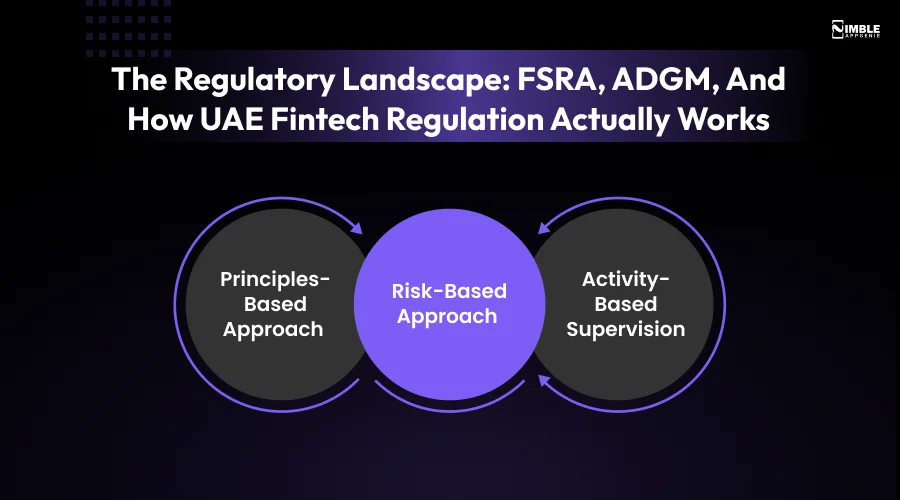
Principles-Based Approach
This approach focuses on achieving fair consumer outcomes rather than enforcing the rigid, as well as the box-checking requirements. It is a foundational framework that is used to govern financial institutions and even financial unions, insurance, and pensions.
Risk-Based Approach
FSRA is an independent financial services regulator for the Abu Dhabi Global Market. Thus, rather than auditing each business equally, the complete regulatory framework relies on the risk-based supervisory framework (RBSF).
Activity-Based Supervision
When it comes to VARA, it also mandates that companies under the purview of FSRA adhere to the activity-specific rulebooks in addition to the five mandatory rulebooks related to the provision of virtual asset activities.
To build a fintech app, it is important that you opt for key compliances of FSRA, but what are they? When it comes to fintech startups, let’s take a look at the table below:
| Compliance area | Key requirement |
| FSRA authorisation | Obtain the appropriate Financial Services Permission before launch. |
| Regulatory classification | Identify all regulated activities performed by the product. |
| Governance & capital | Maintain fit-and-proper governance and meet capital, liquidity, and prudential requirements. |
| AML/CFT & sanctions | Conduct KYC, beneficial-owner checks, transaction monitoring, suspicious-activity reporting, and sanctions screening. |
| Customer & product protection | Apply suitability, fair-treatment, disclosures, target-market, product-approval, and outcome-monitoring requirements. |
| Financial promotions | Ensure marketing is clear, fair, and not misleading. |
| Client assets | Safeguard, segregate, and reconcile client money and assets. |
| Technology & outsourcing | Maintain cybersecurity, resilience, incident response, and effective third-party oversight. |
| Records & complaints | Maintain complete records and documented complaints/remediation processes. |
| Regulatory reporting | Submit required reports and notify FSRA of material incidents or changes. |
| Wind-down | Maintain an orderly closure plan that protects customers. |
But here the question is, “Do you actually need an FSRA licence?
Do You Actually Need an FSRA Licence?
Yes, you need an FSRA licence if your business carries out a regulated financial activity by way of business in or from Abu Dhabi Global Market (ADGM). Additionally, if you are operating in sectors such as healthcare invoicing, insurance, and even mortgages in Ontario, it is important for you to meet all the specific requirements.
The firm also requires a registration authority commercial licence along with FSRA permission. Carrying on a regulated activity without permission is a serious and potentially criminal breach.
So, what is counted as a regulated activity?
An activity specified in Schedule 1 to the FSMR can be considered a regulated activity. An authorised firm holds a financial services permission that specifies exactly which regulated activities it may conduct, which specified investments it may deal in, and on what conditions.
The FSRA does assess the applicant against the threshold conditions for authorisation and a fit-and-proper standard of integrity, competence, and compatibility.
Here, an authorised firm holds a financial services permission that specifies exactly which regulated activities it may conduct, in relation to which specified investments, and on what conditions.
All the top fintech apps do follow the compliance requirements for offering fintech services.
Furthermore, the two paths that you can adopt are RegLab Sandbox vs. direct full authorisation for proceeding with FSRA compliance for fintech startups.

Two Paths: RegLab Sandbox vs. Direct Full Authorisation
If you are launching a regulated product, one of the crucial decisions that you need to make is whether to seek a temporary testing environment via a Regulatory Laboratory (RegLab) Sandbox or applying directly for full authorization.
Here’s a comparison of the two paths related to RegLab Sandbox vs Direct Full Authorisation:
RegLab Sandbox vs. Direct Full Authorisation (FSP)
| RegLab Sandbox | Direct FSP | |
| Who it’s for | Unproven / early-stage models | Proven, ready-to-scale models |
| Scale | Capped clients & volume | Unrestricted |
| Duration | Max 2 years, then exit or upgrade | Permanent from day one |
| Capital required | Reduced, proportionate | Full prudential capital |
| Compliance depth | Light, phased AML/KYC | Full compliance manual, AML/CFT, risk framework upfront |
| Best fit | Pre-Series A, novel products | Series A+, institutional-backed, established models |
Well, now that you are cleared with what type of regulatory framework you need to consider for your fintech startups, now let’s proceed with the right step-by-step process of FSRA licensing in the next section.
Step-by-Step: The FSRA Licensing Process
The complete process of FSRA compliance for fintech startups begins with product classification, pre-application engagement, and fit and proper assessment, risk and control, and then ends with testing the implemented process.
Let’s begin with the complete process below:
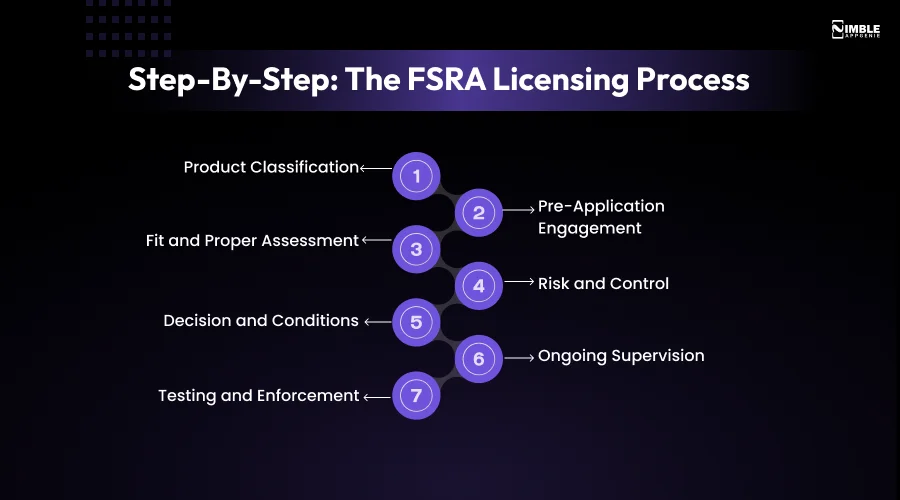
Step 1: Product Classification
The fintech organization identifies its products and determines whether it performs a regulated activity, including payment services, lending, investment management, insurance, custody, and even virtual-asset services.
Step 2: Pre-Application Engagement
In this step, the applicant discusses its business model, technology, risks, and even the proposed controls with the FSRA before submitting a formal application. This is the step that comprises early talks, community outreach, documentation, and even fees.
Step 4: Fit and Proper Assessment
FSRA assesses the firm’s directors and even all shareholders, including senior managers, along with the approved individuals. The core dimensions of assessment comprise integrity and reputation, competence, and financial soundness.
Step 5: Risk and Control
This is a core framework in FSRA compliance for fintech startups. The requirements during the FSRA authorization process are to prove that an applicant can successfully manage all operations. It examines all the anti-money-laundering processes.
Step 6: Decision and Conditions
Now, it is up to the institution, that it can approve or reject your application based on the type of documents submitted. Here, FSRA evaluates the activities of the firm, along with the customer’s product, as well as transaction volumes.
Step 7: Ongoing Supervision
This is the next step in FSRA compliance for fintech startups, where all authorised firms must submit reports and records, and should notify all incidents, and undergo inspections.
Step 8: Testing and Enforcement
Now, the innovative firms can enter the RegLab under controlled conditions. Additionally, the FSRA can issue directions and can even impose penalties. It further includes a complete licensing procedure, from operational verification and ongoing compliance to regulatory penalties.
Also Read: Fintech App Testing
Additionally, you need to clarify the business model for opting for FSRA compliance for fintech startups.
A Clear and Credible Business Model
If you want FSRA compliance approval for fintech startups, you need to opt for the following measures:
Step 1: Explain how the product works from customer onboarding through transaction completion.
Step 2: Identify the Following Parameters:
- Target customers
- Revenue model for your business
- Distribution channels
- Third-party providers
- Key operational dependencies
- Expected volumes and risks
Step 3: Define the target market for your product
Step 4: Consider customer suitability first.
Now, as you have adopted FSRA compliance for fintech startups, there are certain expectations of FSRA from your product; let’s clarify them in the next section.
What Does FSRA Actually Expect from Your Product?
FSRA, with respect to the ADGM, generally expects more than a functioning product. Thus, FSRA expects a product that is:
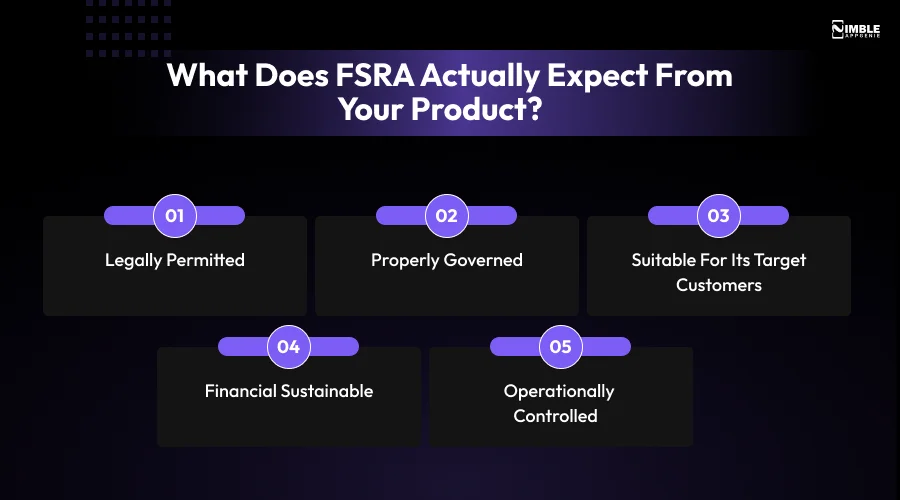
- Legally permitted
- Properly governed
- Suitable for its target customers
- Financial sustainable
- Operationally controlled
By following the FSRA regulations, it is important to look for the expected costs and effective timelines that the founders actually budget for.
Costs & Timelines: What Founders Actually Budget
Adopting and implementing FSRA compliance for a fintech startup in ADGM typically requires an initial setup and an investment of $20,000 to over $50,000+ in direct regulatory fees alone, plus $50,000 to $150,000+ annually in the operational and staffing overhead.
This cost has an effective range because of the complexity of the app adopting and implementing the right compliance frameworks, which is a significant capital and operational commitment.
Additionally, adopting and implementing the FSRA compliance for fintech startups can typically take from 3 to 6 months for a full financial services permission (FSP), or up to 2 years if your fintech startup utilizes the ADGM RegLab sandbox environment.
Bonus Read: Cost to Build a Fintech App
Well, even when considering the cost and timelines for FSRA compliance for fintech startups, you might face challenges in the implementation process. Let’s get ahead of them in the next section.

Common Founder Pain Points (and How to Avoid Them)
You might face challenges related to the legal wall, selecting the wrong license category, and many more:
- Selecting the wrong license category upfront.
- Naming placeholder controlled-function holders
- Treating compliance as a legal-only problem by ignoring the product architecture.
- Creating the product before the regulatory conversation starts.
Well, when it comes to selecting the right solutions to avoid these pain points, let’s consider the given best practices:
- Adopt the compliances by design architecture
- RegTech & automation deployment
- Consider the strategic partner & Sandbox ecosystem
- Embed risk management, governance, and technical controls into their operational DNA from day one.
Which is the Best Company to Connect for Ensuring FSRA Compliance for Fintech Startups?
Nimble AppGenie is the best fintech app development company that offers a wide range of services, ensuring that you follow the right compliance by embedding the regulatory requirements directly into the app’s foundational development cycle.
This is why you need to consider Nimble AppGenie:
- Nimble AppGenie is a global fintech software development company that creates secure and scalable digital financial solutions.
- It will offer a specialized technical framework where security and compliance are part of the baseline codebase rather than an afterthought.
- Allows native integration with compliance ecosystems, including KYC/AML frameworks along with secure payment gateways.
- Nimble AppGenie connects with fintech startups early to stress-test ideas against regional regulatory frameworks.
Conclusion
FSRA compliance for startups is a framework that fintech companies need to adopt to ensure that they comply with the right and strategic compliances. The key regulatory compliances that you should follow are FSRA authorization, regulatory classification, governance and capital, along with AML sanctions.
The requirement for FSRA compliance for fintech startups is all about where the business carries out a regulated financial activity by way of business in or from ADGM.
The process for FSRA compliance for fintech startups begins with product classification, pre-application engagement, and further ends on ongoing supervision, and then to the testing as well as enforcement. Partnering with potential fintech development partners is important for engaging fintech startups.
FAQs
All fintech startups must comply with the multi-layered legal, financial, and cybersecurity frameworks not only to gain the trust of their target audience, but also to comply with the regulatory compliance requirements. The core licensing and regulatory approvals include activity-based licensing, along with corporate registration.
The key regulatory FSRA compliances for fintech startups to follow in 2026 are RBI master directions, digital lending norms, data protection norms, along with the compliances of cybersecurity and infosec. You should establish a foundational corporate structure, implementing strict AML and KYC procedures.
The complete FSRA compliance process for fintech startups begins with product classification, pre-application engagement, fit and proper assessment, along with the risk and control measures. This process further ends with ongoing supervision, along with testing of compliance.
The overall cost to implement FSRA compliance for fintech startups varies from $20,000 to over $50,000+. Depending on different factors such as the scope of licensed activities, upfront licensing and registration fees, and technology integration.
If you exclude the FSRA compliance requirements for fintech startups, it will result in several operational, financial, and legal consequences for your company. This can even cause your fintech startup to fail.

Niketan Sharma, CTO, Nimble AppGenie, is a tech enthusiast with more than a decade of experience in delivering high-value solutions that allow a brand to penetrate the market easily. With a strong hold on mobile app development, he is actively working to help businesses identify the potential of digital transformation by sharing insightful statistics, guides & blogs.
Table of Contents




No Comments
Comments are closed.