

 Free Consultation
 PCI-DSS Compliant
 GDPR Ready
 ISO 27001
 NDA Protected
 AI Services
 AI App Development
 Generative AI Development
 AI Chatbot Development
 AI Integration Services
 AI Consulting Services
 AI For Fintech
 AI Financial Assistant Solution
 AI Insurance Agent Development
 Tech Stack
 OpenAI / GPT-4
 Claude / Anthropic
 Gemini / Google AI
 Llama / Open Source
 LangChain / LlamaIndex
 Pinecone / Pgvector
 AWS / Azure AI


 Fintech Solution
 Core Fintech
 App Development
 Neobank Solutions
 eWallet Solutions
 Lending Software
 Banking Solutions
 BNPL Solutions
 BNPL Solutions
 Insurance App
 Wealth Management
 Crypto & DeFi
 Blockchain Development
  Payroll Software
 DeFi Solutions
 Crypto Wallet
 Crypto On/Off Ramp
 Crypto Exchange
 Trading Platform
 Payments
 Compliance
 Regulations & Compliance
 Fraud Detection
 Lending Ecosystem
 P2P Lending Platform
 Mortgage Software
 Engagement
 Fintech Outsourcing

 Mobile Development
 Mobile App Dev
 iOS App Development
 Android App Development
 React Native
 Flutter Development
 Web Solution
 Node.js Development
 React.js Development
 Angular Development
 App Services
 UI/UX Design
 App Maintenance
 By Stage
 MVP Development
 Industry Solutions
 Healthcare App Dev
 Education App Dev
 Travel App Dev
 Real Estate App Dev
 Logistics Software
 Social Media App

 Hire Mobile Developers
 Hire iPhone Developers
 Hire Android Developers
 Hire React Native Devs
 Hire Flutter Developers
 Hire Web Developers
 Hire Node.js Developers
 Hire Angular Developers
 Hire PHP Developers
 Hire Laravel Developers
 How It Works
 Pre-Vetted Developers
 Ready In 48 Hours
 NDA From Day One
 Replace Guarantee
 Company
 About Us
 Our Work Process
 Portfolio
 Case Studies
 Blog / Insights
 Careers
 Contact Us
 Awards
 Recognition


 Offices



TL;DR
- You start a payment processing company by choosing your model (ISO, PayFac, or acquirer), registering with card networks through a sponsor bank, meeting PCI DSS requirements, and deciding what processing technology to build versus license.
- An ISO/MSP path needs roughly $50,000–$200,000 in capital and 3–6 months; a PayFac path costs more upfront because you take on merchant underwriting liability; a full acquirer or EMI path needs far more capital and time.
- Visa and Mastercard each charge around $5,000 to register, plus roughly $5,000 a year to stay in good standing per network.
- PCI DSS compliance isn’t optional at any level, and how much card data you touch directly decides your compliance burden.
- Nimble AppGenie builds the processing and gateway infrastructure teams need once they have picked a license path, not before, since the wrong stack for the wrong license wastes both time and money.
- Most founders lose the most time by building technology before they have settled their license path, not the other way around.
Starting a payment processing company depends on three things occurring in the right order: choosing the right role and license for whatever you are building, getting a sponsor bank and card network registration in place, and deciding how much of the processing stack you build versus license. Following the wrong order will make you spend a year building technology you can’t legally use yet.
Our experts have written this guide for founders and operators who are well-versed in the fact that payment space is not one thing – you are deciding between an ISO, a payment facilitator (PayFac), or something closer to a complete acquirer, and want real capital numbers and real timelines, not a sales page dressed up as a guide.
Quick Answer: How Do You Start a Payment Processing Company?
First, pick your business model – PayFac, ISO/MSP, or direct acquirer- so you can decide your capital, liability, and timeline.
Then secure a sponsor bank, register with Visa and Mastercard, put PCI DSS compliance in place, and decide whether to build your processing and gateway technology or license a current white-label stack. You can build your merchant-facing product only after those pieces are settled.
Payment Processor vs. Payment Gateway vs. PSP: What You Are Actually Building
These terms are used loosely, and mixing them early is how founders end up building the wrong thing.
Here is the practical breakdown:
| Term | What it does | Best fit |
| Payment processor | Talks directly to acquiring banks, issuing banks, and card networks to authorize and settle transactions | Teams building deep payment infrastructure or holding a direct acquiring relationship |
| Payment gateway | The technical layer between merchant checkout and the processor – collects payment data, sends it for authorization, returns the result | SaaS platforms, marketplaces, and ecommerce tools that need control over checkout |
| PSP (Payment Service Provider) | Bundles gateway, processing, and merchant onboarding into one service, often as a PayFac | Founders who want to offer a full merchant-facing payments product without becoming an acquirer themselves |
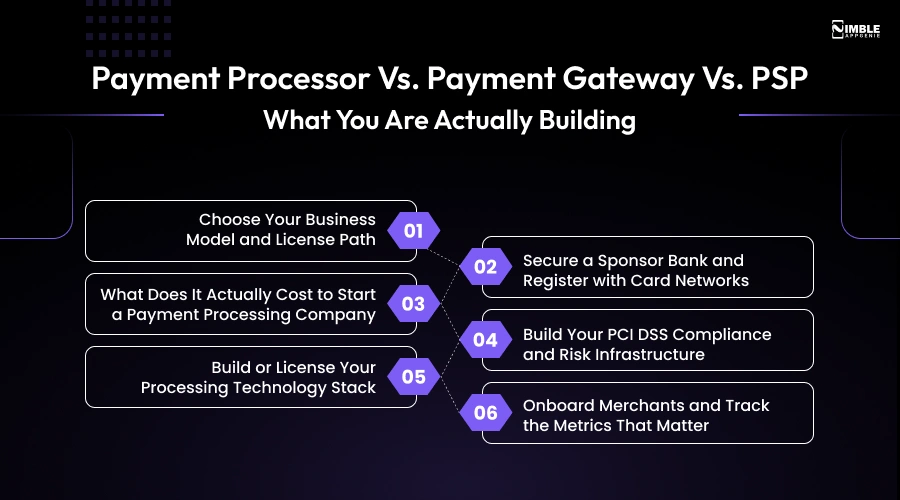
Step 1: Choose Your Business Model and License Path
Most people who say they want to “start a processing company” are actually choosing between three models, each with distinct regulatory and capital requirements.
| Model | Typical Capital | Timeline | What It Involves |
| ISO / MSP | Roughly $50,000–$200,000, plus $5,000 registration fees per card network | 3–6 months | Sell and support merchant accounts under a sponsor bank’s registration; you don’t hold settlement risk directly |
| PayFac (Payment Facilitator) | Higher than ISO – you are underwriting sub-merchants and carrying their risk | 6–12 months, longer if building your own underwriting engine | Register as a master merchant with Visa and Mastercard, onboard sub-merchants under your own risk umbrella |
| Direct acquirer / PI or EMI license | PI license: roughly $125,000–$350,000 depending on jurisdiction. EMI license: higher, since it also allows holding customer funds | 12+ months | Become a principal member of Visa and Mastercard, or hold your own payment institution license, with full control and full regulatory exposure. |
The PayFac model is usually pitched as the modern default, and for various SaaS and marketplace founders, it’s the right fit. But it comes with a trade-off that’s easy to underestimate: you inherit merchant underwriting liability. You are at risk if a sub-merchant commits fraud or can’t cover, not your sponsor bank.
Step 2: Secure a Sponsor Bank and Register with Card Networks
Visa and Mastercard don’t allow non-bank entities to plug directly into their networks. You need a sponsor bank, also known as an acquiring bank, to vouch for you and submit your registration. Expect the sponsor to review your business model, financials, and the backgrounds of your principals before they will take that step.
Once a sponsor agrees to support you, registration with Visa and Mastercard runs around $5,000 per network, with a similar annual fee to maintain good standing. Budget for both networks if you want comprehensive merchant acceptance – most processors do.
Step 3: What Does It Actually Cost to Start a Payment Processing Company in 2026?
Cost splits into four categories, and founders usually budget only for the first one.
- Licensing and Registration: $10,000 combined for Visa and Mastercard registration, plus your model’s capital requirement – $50,000-$200,000 for an ISO, more for a PayFac or a PI/EMI license.
- Technology: A gateway and processing stack built from scratch is a multi-month, six-figure-plus engineering effort. Licensing white-label rails reduces this to weeks, at the cost of less control over your product roadmap.
- Sponsor Bank Relationship: Some sponsors charge setup or minimum-volume fees on top of the underwriting review, distinct from network registration.
- Compliance and Risk Operations: PCI DSS assessment, a compliance function, and fraud monitoring tools that are staffed and running before you onboard your first merchant, not after.
If you want the same cost breakdown applied to a specific app type – eWallet, digital banking, or lending – our fintech app development cost guide covers that in more detail.
Step 4: Build Your PCI DSS Compliance and Risk Infrastructure
How do you meet PCI DSS as a new payment processor? Start by reducing how much cardholder data actually touches your systems – hosted fields and tokenization reduce your compliance scope significantly – then layer in fraud monitoring, documented security controls, and chargeback management before your first live transaction.
Whether you are a PayFac underwriting your sub-merchants or an ISO reselling someone else’s processing, PCI DSS applies at each level. The cost and scope of your assessment scale with how much raw card data flows through a processor’s hosted tools versus your own infrastructure.

Step 5: Build or License Your Processing Technology Stack
In the complete roadmap, this is the one decision you can compress. Licensing and registration take months regardless of whatever you do. Your technology is the only factor you control.
A completely custom processing and gateway stack offers you the most flexibility on merchant experience, pricing, and routing; it’s a critical engineering commitment – apart from a multi-month build even with an experienced team.
White-label processing rails get you to market faster at the cost of being tied to another vendor’s fee structure and roadmap. Most PSPs launching in 2026 utilize a hybrid: licensed core processing infrastructure with a merchant dashboard and custom gateway on top, which keeps the product distinct without rebuilding settlement and card-networking connectivity from zero.
Step 6: Onboard Merchants and Track the Metrics That Matter
Once you are live, the figures that tell you whether the business is healthy look distinct from generic SaaS metrics. Watch the metrics below:
- Authorization Rate: The share of transactions that get approval on the first attempt.
- Merchant Approval Rate: How many applications clear underwriting without manual escalation.
- Chargeback Ratio: Card networks impose real penalties once this crosses their thresholds.
- Fraud Loss Rate: Specifically crucial for PayFacs carrying sub-merchant risk.
- Time to Settlement: How long merchants wait to see funds land, a direct driver of merchant satisfaction.
- Merchant Churn: Usually the first sign that your pricing or support is not working before it appears anywhere else.
Build, License, or Partner? Where Nimble AppGenie Fits
There’s no single choice between building a processing stack, licensing white-label rails, or starting as an ISO on someone else’s infrastructure. A team with robust acquiring connections and real payments expertise generally benefits from more custom control.
Once a model proves out, a team validating a niche vertical is usually better off launching on licensing rails and building custom pieces.
We build processing technology and gateways across all three paths – custom PSP infrastructure for teams with their registrations, white-label integrations for rapid launches, and migration work for teams expanding their current platforms.
Related Reading:
- How to Launch a Digital Bank in 2026 – for founders weighing a deposit-taking license instead of a payments-only model
- How to Start a Fintech Business – the broader landscape across digital banking, payments, lending, and insurance
- How Much Does It Cost to Build a Fintech App? – feature-by-feature cost breakdowns
FAQs
It depends on your model. An ISO/MSP path typically needs $50,000–$200,000 in capital plus around $10,000 combined for Visa and Mastercard registration. A PayFac path costs more because you’re underwriting merchant risk yourself. A direct acquirer or EMI license needs significantly more capital, often $125,000–$350,000 or higher depending on jurisdiction and whether you’re holding customer funds.
An ISO sells and supports merchant accounts under a sponsor bank’s registration without directly carrying settlement risk. A PayFac registers as a master merchant and onboards sub-merchants under its own risk umbrella, which means it takes on underwriting liability that the ISO model doesn’t.
No, not for most models. ISOs and PayFacs operate through a sponsor bank’s registration rather than holding their own banking license. You’d only need a payment institution (PI) or e-money institution (EMI) license if you’re acting as a direct acquirer or need to hold customer funds yourself.
An ISO path typically takes 3 to 6 months from sponsor approval to launch. A PayFac path runs 6 to 12 months, longer if you’re building your own underwriting engine. A direct acquirer or full license path is the longest, often 12 months or more.
Yes. PCI DSS applies regardless of whether you’re an ISO, a PayFac, or a direct acquirer. The scope and cost of compliance scale with how much cardholder data actually passes through your own systems versus a processor’s hosted, already-compliant tools.

Niketan Sharma, CTO, Nimble AppGenie, is a tech enthusiast with more than a decade of experience in delivering high-value solutions that allow a brand to penetrate the market easily. With a strong hold on mobile app development, he is actively working to help businesses identify the potential of digital transformation by sharing insightful statistics, guides & blogs.
Table of Contents




No Comments
Comments are closed.