Free Consultation
 PCI-DSS Compliant
 GDPR Ready
 ISO 27001
 NDA Protected
 AI Services
 AI App Development
 Generative AI Development
 AI Chatbot Development
 AI Integration Services
 AI For Fintech
 AI Financial Assistant Solution
 AI Insurance Agent Development
 Tech Stack
 OpenAI / GPT-4
 Claude / Anthropic
 Gemini / Google AI
 Llama / Open Source
 LangChain / LlamaIndex
 Pinecone / Pgvector
 AWS / Azure AI


 Fintech Solution
 Core Fintech
 Fintech App Development
 Neobank App Development
 eWallet App Development
 Payment Integration
 Lending Software
 BNPL Solution
 BNPL App Development
 Insurance App
 Investment App Dev
 Wealth Management App
 Crypto & DeFi
 DeFi App Development
 Crypto Wallet Dev
 Crypto Exchange Dev
 Trading Platform Dev
 Payments
 Compliance
 RegTech App Dev
 Fraud Detection
 Lending Ecosystem
 P2P Lending Platform
 Mortgage Lending
 Engagement
 Outsourcing Dev


 Mobile Development
 Mobile App Dev
 iOS App Development
 Android App Development
 React Native
 Flutter Development
 Web Development
 Node.js Development
 React.js Development
 Angular Development
 PHP / Laravel
 App Services
 UI/UX Design
 App Maintenance
 By Stage
 MVP Development
 Industry Solutions
 Healthcare App Dev
 Education App Dev
 Travel App Dev
 Real Estate App Dev
 Logistics Software
 Social Media App


 Hire Mobile Developers
 Hire iPhone Developers
 Hire Android Developers
 Hire React Native Devs
 Hire Flutter Developers
 Hire Web Developers
 Hire Node.js Developers
 Hire Angular Developers
 Hire PHP Developers
 Hire Laravel Developers
 How It Works
 Pre-Vetted Developers
 Ready In 48 Hours
 NDA From Day One
 Replace Guarantee

 Company
 About Us
 Portfolio
 Case Studies
 Blog / Insights
 Careers
 Contact Us
 Recognition


 Offices



TL;DR
- You validate a payment product before building an MVP by running a proof of concept in banking – a small, time-boxed test – that proves your single riskiest assumption (regulatory, technical, or commercial) holds up, using sandbox or simulated data instead of a live product.
- A PoC is not a prototype and not an MVP. A PoC proves feasibility, a prototype shows the experience, and an MVP is a real product real users can transact on.
- Skipping validation is the single biggest reason fintech budgets get wasted – most overruns trace back to a compliance, integration, or demand assumption nobody tested first.
- A payment PoC typically runs 2–6 weeks and costs a fraction of MVP development, because you’re proving one risky assumption, not shipping a product.
- The output of a good PoC is a go/no-go decision backed by evidence, not a working app – that’s what an MVP is for.
- Nimble AppGenie works with fintech founders at this exact stage, helping them figure out what to test before committing to a full build.
If you are a fintech founder, product leader, banking executive, or business planning to launch a payment product, you might already have an idea and a rough sense of what it should do.
The question is not whether the idea looks good on paper – it’s whether it can work within real regulatory requirements, payment infrastructure, banking-partner constraints, and user behavior. A proof of concept (PoC) helps answer those questions before an MVP needs significantly more time and investment.
A focused PoC allows you to test your product’s riskiest assumptions, uncover technical or regulatory barriers, and validate whether the underlying concept is viable.
For businesses planning a new payment platform, digital wallet, lending solution, banking product, or other fintech application, these insights can help determine whether to move forward with MVP development, refine the product concept, or stop before committing larger resources.
What Is a Proof of Concept (PoC) in Banking?
A proof of concept (PoC) in banking is a small, focused test built to prove that a specific payment or banking idea is technically, operationally, and commercially viable before any product development begins.
It answers one narrow question (can this work at all?) rather than just delivering a usable product. A PoC is disposable by design; it exists to generate evidence, not revenue.
Practically, a banking PoC usually aims at one of three risk types.
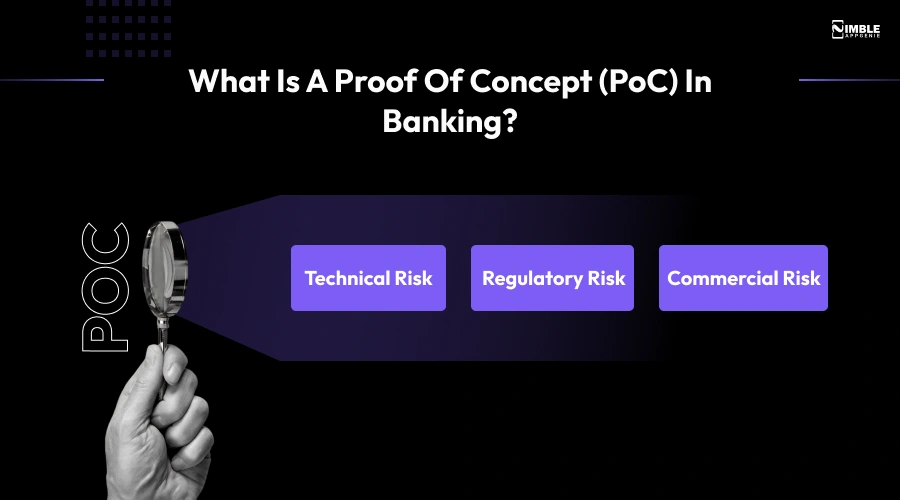
1. Technical Risk
- Can you move money the way you are imagining?
- Does the core banking API, ledger system, or card network support the flow you have designed?
2. Regulatory Risk
- Does this need a money transmitter license, a full banking charter, or an EMI license?
- Will the target jurisdiction’s KYC/AML rules even allow the flow you want?
3. Commercial Risk
- Will a bank or BaaS provider actually partner with you at this stage?
- Will users complete the flow, or does it fall apart at step two?
A PoC is intentionally narrow. It might be a single API call proving that a partner bank’s sandbox supports immediate payouts, or a spreadsheet model proving unit economics hold at scale for a merchant payment solution. It is not meant to look or feel like a real product.
PoC vs Prototype vs MVP: What’s the Difference?
These three terms are used interchangeably in fintech pitch decks, and that’s where a lot of budget gets misallocated. They test distinct things, at different costs, for distinct audiences.
| Proof of Concept | Prototype | MVP | |
| Question it answers | Can this work at all? | What would this feel like to use? | Will real users adopt and pay for this? |
| Audience | Internal team, technical leads, sometimes a banking partner | Internal team, investors, design partners | Real end users, in a live (if limited) environment |
| Output | Test results, feasibility notes, a go/no-go decision | Clickable mockup or non-functional demo | A working, if minimal, product |
| Handles real money? | Rarely – sandbox or simulated data | No | Yes, typically in a limited/pilot scope |
| Typical timeline | 2–6 weeks | 2–4 weeks | 3–6 months |
| Typical cost | Low four figures to low five figures | Low, mostly design time | See fintech app development cost and MVP app development cost breakdowns |
| Regulatory exposure | Minimal, if scoped correctly | None | Real – licensing, compliance, and liability apply |
The order matters. A PoC should come before a prototype in banking, particularly because the biggest risks – partner-bank approval, licensing, and transaction settlement – are regulatory and technical, not visual.
There’s little point polishing a checkout screen for a payment flow that turns out to need a license you don’t have.
Why Validate a Payment Product Before Building an MVP?
The assumptions that break products in banking and payments are about compliance, settlement, and partnership mechanics, and are expensive to discover late.
A few of the most common ways payment ideas fail after an MVP has already been built, rather than before:
- A banking partner won’t support the flow. The sandbox worked, but the partner’s production risk team rejects the use case at underwriting.
- A licensing requirement rises mid-build. The team assumed a BaaS partnership would cover it; the regulators disagreed.
- The unit economics don’t survive interchange or processing fees. The margin looked fine on a spreadsheet that didn’t account for real-world transaction costs.
- The core banking or ledger integration doesn’t behave as documented. APIs that look clean in documentation usually have edge cases that only show up under real transaction volume.
- Users abandon the flow at a step nobody tested. Often, KYC and AML compliance checks, the funding step, and somewhere compliance friction meets user patience.
Each of these is cheap to find out during a two-week PoC and costly to find out three months into an MVP build with a team on payroll.
When Do You Actually Need a Banking PoC?
Not every fintech idea needs a formal PoC – a simple feature addition to a system you already run generally doesn’t. A PoC earns its cost when you are encountering genuine uncertainty, particularly when:
- You are entering a new regulatory jurisdiction and are not certain which license path applies.
- Your product depends on a bank or BaaS partner whose willingness to support your use case has not been confirmed.
- You are building on unfamiliar rails – a new core banking provider, a new card network, real-time payment rails you haven’t integrated before.
- You are testing a new revenue model (embedded finance, interest-based, BNPL) where the economics have not been proven at your scale.
- The team has more than one open technical question about whether the flow is even possible as designed. This is also common ground for founders weighing building an AML compliance platform alongside a payment product, since both hinge on the same regulatory uncertainty.
If none of these apply and you are simply extending a validated system, you can likely move straight to scoping an MVP.
How to Validate a Payment Product With a PoC: Step-by-Step
Validating a banking or payment idea is not about building software – it is about designing the smallest possible test that answers your riskiest question first. Below is the sequence that tends to work:
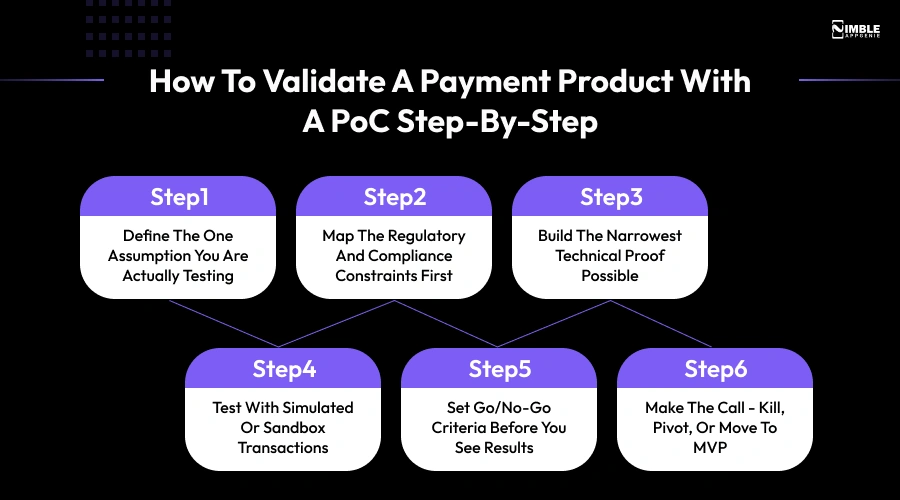
1. Define the One Assumption You are actually Testing
Every PoC should begin with a single, falsifiable statement – not a feature list. “We can settle instant payouts through Partner Bank X’s sandbox in under 10 seconds” is testable. “We want to see if people like our app” is not a PoC question; that’s user research.
Write the assumption down before you write any code. If you can’t state it in one sentence, the scope is not narrow enough yet.
2. Map the Regulatory and Compliance Constraints First
Before you start with a technical build, identify what licensing path applies to the flow you are testing – EMI, full banking license, a BaaS partnership, or payment institution registration that covers it for you. This step alone eliminates a large share of dead-end builds.
If you are unsure which licensing path fits your model, you should review how neobanks typically approach banking licensing country by country before committing to an architecture.
3. Build the Narrowest Technical Proof Possible
This is generally a sandbox integration, a limited API test, or a script – not a UI. The goal is to prove the mechanism works, not finish it. If your PoC involves payment routing or gateway behavior specifically, it helps to understand the underlying mechanics of payment gateway integration or, if the flow spans multiple processors, a payment orchestration layer – before you design your own test.
4. Test with Simulated or Sandbox Transactions
Run the flow with test data through the actual rails you plan to use in production – sandbox environments from your banking partner, card network test cards, or a controlled pilot with a handful of real users if regulation allows. The point is to surface behavior that documentation doesn’t show you.
5. Set Go/No-Go Criteria Before You See Results
Decide in advance what “this works” looks like – a specific settlement time, a specific approval rate, a specific compliance sign-off. Without this, teams tend to rationalize ambiguous results into a “yes” because they are emotionally invested in the idea.
6. Make the Call – Kill, Pivot, Or Move to MVP
A PoC has done its job whether the answer is yes or no. If it’s a no, you have saved months of MVP spend. If it’s a yes, you move into MVP scoping with your riskiest assumptions already validated, which is exactly when a realistic fintech MVP cost estimate becomes worth building.
What Does a Banking PoC Cost?
A payment PoC usually costs a fraction of MVP development because you are proving one mechanism rather than building a usable product, but exact figures vary widely by scope quote a single universal number responsibly.
What factors drive the cost up or down:
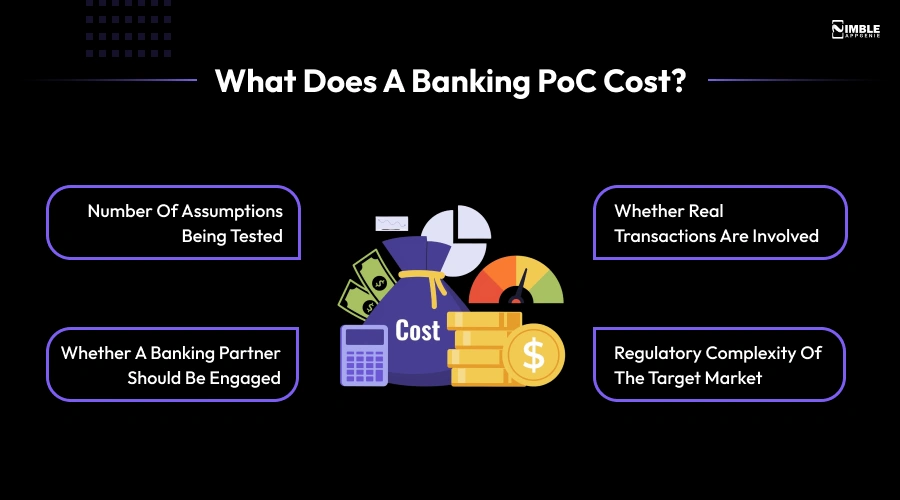
- Number of assumptions being tested: Testing one assumption is more economical; three separate questions are really three PoCs.
- Whether a banking partner should be engaged: Partner onboarding and sandbox access can add real time even before development begins.
- Regulatory complexity of the target market: A US-only payments PoC is a different scope than one spanning multiple EU jurisdictions.
- Whether real transactions are involved: Simulated data is faster and cheaper than a live, regulator-compliant pilot.
For context on what comes after, once your PoC validates the idea, it is worth reviewing what fintech app development actually costs in 2026, and MVP development cost particularly, so you can budget the complete path from validation to launch rather than just the first step.
Common Mistakes When Validating a Payment Product with Solutions
1. Skipping regulatory research until the technical build ends. This is the single most costly ordering mistake in fintech PoCs.
Solution: Start with a regulatory feasibility assessment before writing code. Identify applicable licenses, PCI-DSS requirements, KYC/AML obligations, payment-network restrictions, data-protection rules, and banking or acquiring dependencies. Use these findings to define the PoC’s technical scope and avoid validating a payment flow that can’t legally or operationally reach production.
2. Testing too many assumptions at once. A PoC that tries to validate compliance, unit economics, and UX simultaneously is not a PoC; it’s an underfunded MVP.
Solution: Identify the riskiest assumption and design the PoC around testing it first. Limit each PoC to one primary hypothesis and some supporting questions. For example, validate whether the proposed payment architecture can successfully authorize, process, and reconcile transactions before spending resources on broader UX or feature development.
3. Treating a working demo as proof it is ready to scale. An in-progress sandbox integration tells you almost nothing relevant to production behavior under real volume.
Solution: Separate proof of concept from production-readiness testing. Once the core hypothesis is validated, latency, transaction testing throughout, reconciliation, failure recovery, fraud handling, third-party API, and security controls all help limit the under controlled situations. You should treat a successful sandbox transaction as evidence that the concept works, not that the system is all set for production volume.
4. No preset success criteria, and without a clear bar, unclear outcomes get interpreted as “good enough to proceed.”
Solution: Set quantifiable pass/fail criteria before the PoC starts. Depending on the hypothesis, define thresholds for transaction success rate, reconciliation accuracy, user completion rate, processing latency, transaction cost, and API reliability. Specify what results will trigger an MVP build, a decision to stop, or another validation cycle.
5. Building the PoC to impress investors rather than to find the truth. A PoC for a good demo, rather than an honest test, defeats the purpose.
Solution: Prioritize evidence over presentation. Build just the essentials to use realistic transaction scenarios, test the riskiest assumption, and document failures and edge cases alongside successful outcomes. The final PoC report should apparently show what was validated, what stays uncertain, what failed, and whether the evidence supports moving to an MVP.
From PoC to MVP: What Happens After Validation?
Once your PoC confirms the core assumption holds – the partner bank supports the flow, the license path is viable, and the economics work – the next step is to scope an MVP around the most limited version of the product that allows real users to transact.
This is also a stage where you revisit the questions you knowingly delayed during the PoC: which banking model fits your business (BaaS, full bank, or a licensed neobank structure), what compliance program should be in place before launch, and what payment infrastructure you will build or buy.
If banking is the validated product rather than a pure-payments play, at this edge it’s worth reading up on building a mobile banking app. Each of these is a significant decision in its own right and worth researching rather than wrapping into your PoC scope.
FAQs
A PoC proves a payment idea is technically and regulatorily feasible, without needing to look or function like a real product. An MVP is a working product – minimal but functional – that real users can transact through, with licensing, compliance, and support.
Most focused payment PoCs run 2–6 weeks. Scope creep is the main reason they run longer; a PoC testing more than one core assumption typically deserves to be split into two.
Usually not, if the PoC is scoped to sandbox environments, simulated transactions, or a partner bank’s test infrastructure. You will need to confirm licensing before moving to a live MVP that handles real customer funds.
You can, but you’re then testing your regulatory and technical assumptions with a live budget and a live team, instead of a small, disposable test. For low-uncertainty ideas built on infrastructure you already understand, this can be the right call. For anything involving a new license, a new partner bank, or new payment rails, it rarely is.
At minimum: someone who understands the compliance landscape for your target market, an engineer who can build the narrow technical test, and someone empowered to make the kill/pivot/proceed call once results are in.

Niketan Sharma, CTO, Nimble AppGenie, is a tech enthusiast with more than a decade of experience in delivering high-value solutions that allow a brand to penetrate the market easily. With a strong hold on mobile app development, he is actively working to help businesses identify the potential of digital transformation by sharing insightful statistics, guides & blogs.