

 Free Consultation
 PCI-DSS Compliant
 GDPR Ready
 ISO 27001
 NDA Protected
 AI Services
 AI App Development
 Generative AI Development
 AI Chatbot Development
 AI Integration Services
 AI Consulting Services
 AI For Fintech
 AI Financial Assistant Solution
 AI Insurance Agent Development
 Tech Stack
 OpenAI / GPT-4
 Claude / Anthropic
 Gemini / Google AI
 Llama / Open Source
 LangChain / LlamaIndex
 Pinecone / Pgvector
 AWS / Azure AI


 Fintech Solution
 Core Fintech
 App Development
 Neobank Solutions
 eWallet Solutions
 Lending Software
 Banking Solutions
 BNPL Solutions
 BNPL Solutions
 Insurance App
 Wealth Management
 Crypto & DeFi
 Blockchain Development
  Payroll Software
 DeFi Solutions
 Crypto Wallet
 Crypto On/Off Ramp
 Crypto Exchange
 Trading Platform
 Payments
 Compliance
 Regulations & Compliance
 Fraud Detection
 Lending Ecosystem
 P2P Lending Platform
 Mortgage Software
 Engagement
 Fintech Outsourcing

 Mobile Development
 Mobile App Dev
 iOS App Development
 Android App Development
 React Native
 Flutter Development
 Web Solution
 Node.js Development
 React.js Development
 Angular Development
 App Services
 UI/UX Design
 App Maintenance
 By Stage
 MVP Development
 Industry Solutions
 Healthcare App Dev
 Education App Dev
 Travel App Dev
 Real Estate App Dev
 Logistics Software
 Social Media App

 Hire Mobile Developers
 Hire iPhone Developers
 Hire Android Developers
 Hire React Native Devs
 Hire Flutter Developers
 Hire Web Developers
 Hire Node.js Developers
 Hire Angular Developers
 Hire PHP Developers
 Hire Laravel Developers
 How It Works
 Pre-Vetted Developers
 Ready In 48 Hours
 NDA From Day One
 Replace Guarantee
 Company
 About Us
 Our Work Process
 Portfolio
 Case Studies
 Blog / Insights
 Careers
 Contact Us
 Awards
 Recognition


 Offices



Key Takeaways:
- KYC software development is the process of building the digital systems that automate identity verification and offer theft protection.
- To create KYC software, one should begin by identifying the requirements, designing the app, adopting the right tech stack, mapping the regulations, and testing the system before launch.
- The key cost to build KYC software varies due to app complexity, verification scope, integrations, jurisdiction, and timeline.
- Challenges in developing the KYC software include balancing strict regulatory compliance, false positives, data security and privacy, and inaccurate data.
- Partnering with the top software developers of Nimble AppGenie can help fintech businesses to overcome the issues in software development.
When a customer signs in to a new platform, one of the most critical questions that you can face is “can this customer be trusted?”
This is where KYC software development is required. It assists businesses in verifying identities, detecting fraud, and meeting regulatory requirements without turning onboarding into a frustrating experience.
But when it comes to a complete KYC software development process, it includes more than adding an ID-upload form.
And here, you should consider regulatory compliance, robust security measures, and the right development process.
Therefore, as the best software developers, Nimble AppGenie has identified the right formula.
Let’s get it together.
What is KYC Software?
KYC Software is a digital tool that automates customer identity verification and compliance risk assessment. This software helps businesses to verify a customer’s identity before providing services and opening an account.
It replaces slow checks with automated workflows and performs the following tasks:
- Identity document verification, such as passports or driver’s licenses.
- Facial recognition or selfie matching.
- Personal information and address checks.
- Sanctions, watchlist, and politically exposed person screening.
- Anti-money-laundering and fraud-risk checks.
- Ongoing customer monitoring and compliance reporting.
Key Features of KYC Software
The key features of KYC software comprise document verification, biometric and liveness detection, AML & watchlist screening, API integration, and ongoing monitoring.
Here is the list of features of KYC software in detail:
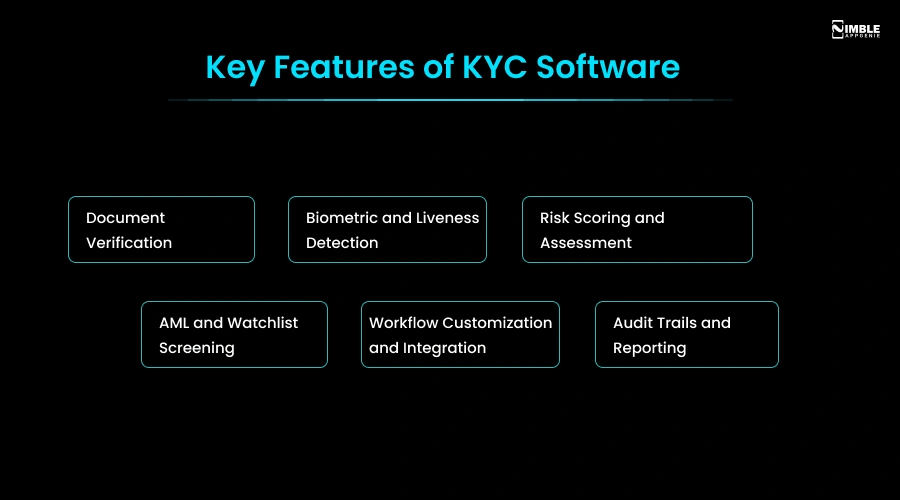
► Document Verification
Automated document verification is an AI-powered process that uses the software to scan, extract, and validate identity cards and business papers without any human help.
► Biometric and Liveness Detection
Biometrics measure unique physical or behavioral traits like your face, fingerprints, or voice to verify who you are. Liveness detection is emerging as a critical solution to verify biometric authenticity.
► Risk Scoring and Assessment
KYC software automates risk scoring and assessment by calculating a dynamic risk value for each customer based on their identity data, location, and behavior.
► AML and Watchlist Screening
KYC software automates anti-money laundering (AML) and watchlist screening is the overall process of checking individuals and companies against official databases.
► Workflow Customization and Integration
Workflow customization and application integration as a feature allow users to visually design, tailor, and connect automated tasks and data flows between different software systems without building backend infrastructure from scratch.
► Audit Trails and Reporting
Audit trail and reporting is a secure chronological record that tracks who did what in the software. It assists in tracking and keeping the record smoothly.
If you are wondering about KYC software development. Let’s get ahead with the same in the next section.
What is KYC Software Development?
KYC software development is the complete process of building digital systems that automate customer identity verification, risk assessment, and anti-money laundering.
KYC software development comprises:
- Tools and processes that businesses use to verify customer identities and assess risk.
- It checks passports, driver’s licenses, national IDs, and selfies.
- It helps to detect forged, expired, and altered documents.
- Through the biometric checks, it uses facial recognition and liveness detection.
- Searches government sanctions lists and politically exposed person databases.
- Confirms details such as residence, phone number, and date of birth.
- Rechecks customers and flags suspicious changes.
- Lets compliance teams review alerts and request more information.
Many fintech startups and organizations often ask, “What is the process of KYC software development?”
The process begins with understanding the customer’s data, studying the legal framework, defining the KYC process, outlining features, selecting the right tech stack, and testing the app.

What is the Process of KYC Software Development?
The complete process of KYC software development comprises identifying the user’s needs, studying the legal framework, defining the KYC process, outlining KYC software features, and then building the complete software.
Let’s evaluate the overall process in detail below:
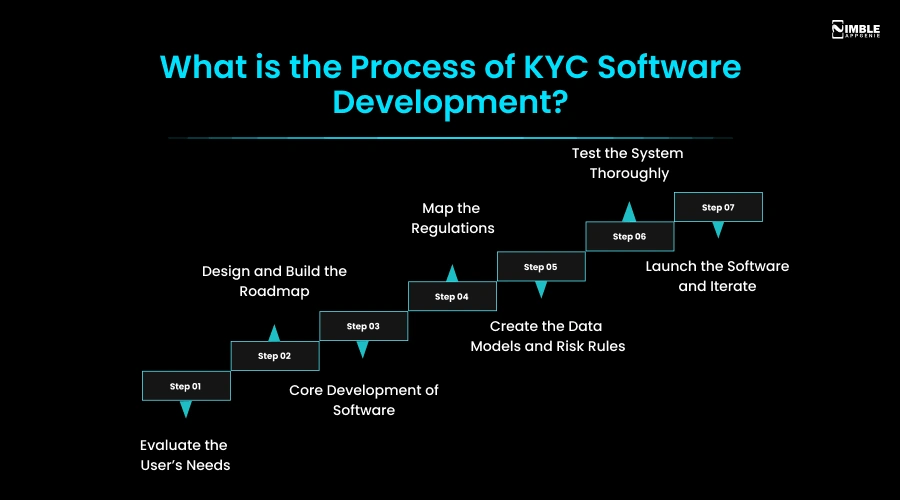
1. Evaluate the User’s Needs
Identify why and for what purpose you are building KYC software, and how it will be helpful for your target audience. Here, you need to map the stakeholders’ requirements across compliance and products.
You should:
- Know your audience.
- Identify their needs.
- Define the compliance laws and business rules for your target industry.
- Build the secure architecture for your software.
2. Design and Build the Roadmap
You can connect with a top software development company such as Nimble AppGenie to design your KYC software and create the complete roadmap defining how you will proceed with KYC software development.
It is important to:
- Plan the compliance and technological feasibility.
- Design your KYC software considering a user-friendly interface.
- Keep the customer onboarding screen simple so users do not drop off.
- Build the complete backend services.
Also Read: “How to Design a Fintech App”
3. Core Development of Software
The core software used in software development is an integrated development environment. Here, you need to state the list of technologies that should be used for aligning the product vision with a clear time-based plan for execution.
It is important to:
- Write code to create the main feature of the application.
- Define the foundational logic and specify the finance tech stack.
- Building a modular pipeline that automates identity verification and lifecycle monitoring.
- Matching the requirements of the software with the core tech stack.
4. Map the Regulations
You should evaluate what regulations and practices to be followed while KYC software development. Based on the regions and requirements of your software, you can identify regulatory practices.
Here’s what you need to do:
- Map the geographical jurisdiction.
- Define the core regulatory framework.
- Implement compliance by design.
- Identify fintech regulations complying with your KYC software.
5. Create the Data Models and Risk Rules
Build the data models and risk rules, including customer identity, verification stamps and screening results, review decisions, and reverification dates.
Here’s what you need to do:
- Define structured data models for user information.
- Evaluate the core customer identities.
- Consider unusual onboarding patterns.
- Be aware of document and biometric failures.
6. Test the System Thoroughly
Now comes the testing part, where you should test your KYC software. It’s all about checking the accuracy, security, and performance to meet the legal rules.
Here’s what you need to do:
- Opt for unit and integration testing.
- Document and ID verification testing.
- Security testing.
- Functional integration and compliance testing.
Also Read: “Fintech App Testing”
7. Launch the Software and Iterate
It is the last step under the KYC software development process. Where you launch the software on a defined platform such as the App Store or Play Store.
Here’s what you need to do:
- Define the right platform as per the target market.
- Launch it using a phased rollout and maintain it by tracking key performance.
- Opt for maintenance of the software by keeping data accurate and updating rules for changing regulations.
- After KYC software development, monitor the software, identify and reduce bugs continuously.
Before development, one of the key questions that causes trouble during KYC software development is “How much does KYC software development cost?”
How Much Does KYC Software Development Cost?
The overall KYC software development costs from $20,000 to $150,000. This cost further varies depending on your project size, scope, features, technologies, current market trends, and the skills of the development team.
Cost breakdown of KYC software development:
| Parameter | Basic ($20K–$45K) | Mid-Level ($45K–$90K) | Enterprise ($90K–$150K+) |
| Verification Scope | Document + OCR | + Biometric/liveness | + KYB + device fingerprinting |
| AML/Sanctions Screening | Basic watchlist check | Multi-source + PEP screening | Real-time, continuous (pKYC) |
| Risk Scoring | Rule-based | Configurable engine | AI/ML-driven adaptive |
| Integrations | 1–2 APIs | 3–5 (banking, payments) | 6+ (multi-vendor orchestration) |
| Jurisdictions | 1 region | 2–4 regions | 5+ regions |
| Timeline | 6–10 weeks | 3–5 months | 5–8 months |
If you are thinking of fintech app development costs, in the case of a complete fintech app development, KYC software integration cost is included in the overall budget.
What are the Challenges in KYC Software Development?
The key challenges in KYC software development comprise fraud and AI threats, global regulatory complexity, and balancing UX and conversion friction.
Let’s discuss the list of challenges in KYC software development along with the best practices:
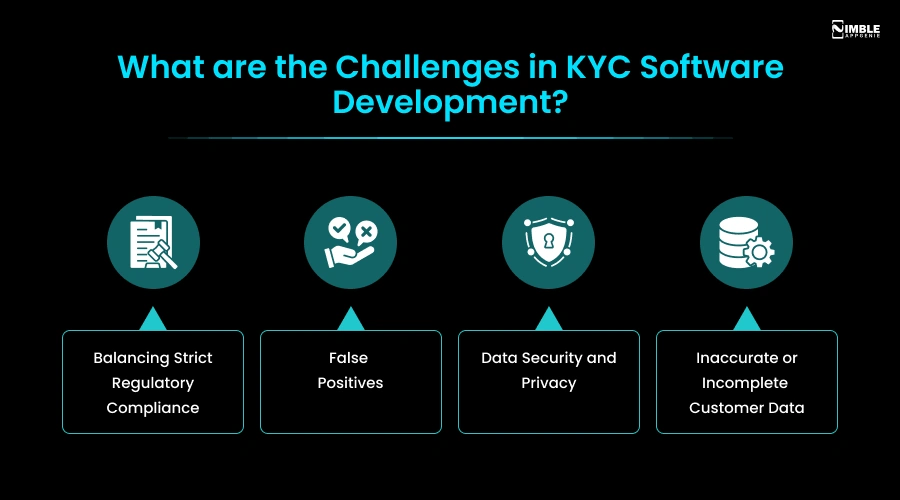
► Balancing Strict Regulatory Compliance
The key challenge in KYC software development is balancing strict regulatory compliance because of changing regulatory laws and the regulatory landscape.
Solution:
Strictly complying with the changing regulations and practices is the ultimate solution for balancing the strict regulatory compliance requirements.
Bonus Read: “Why Fintech Startups Fail”
► False Positives
It is a false alarm where a development tool reports an issue that does not actually exist. Sanctions and PEP screening can flag legitimate customers with names similar to the watchlist.
Solution :
The key solution lies in hiring software developers who can tune your detection tools, add context, and use secondary verification methods.
► Data Security and Privacy
Data security and privacy are key challenges because the system struggles to handle vast amounts of data amid cyberattacks and cybercrime.
Solution :
Adopting robust security measures is the appropriate approach to addressing data security and privacy regulations. Risk-based segmentation is another parameter that affects the data security and privacy landscape.
► Inaccurate or Incomplete Customer Data
Inaccurate or incomplete customer data is a key challenge because it directly affects the core purpose of the software and even impacts the outcome of effectively serving the user’s needs.
Solution :
The solution is to implement an effective strategy that combines automation and strict governance policies. Additionally, the solution comprises real-time data validation and data governance.
Which is the Best Company For KYC Software Development?
Nimble AppGenie is the Best company for KYC software development because our engineers first listen to your project requirements, help you to understand the current trends in technology, and then build adequate software with the right tools.
Here’s why Nimble AppGenie is the best software development company to connect:
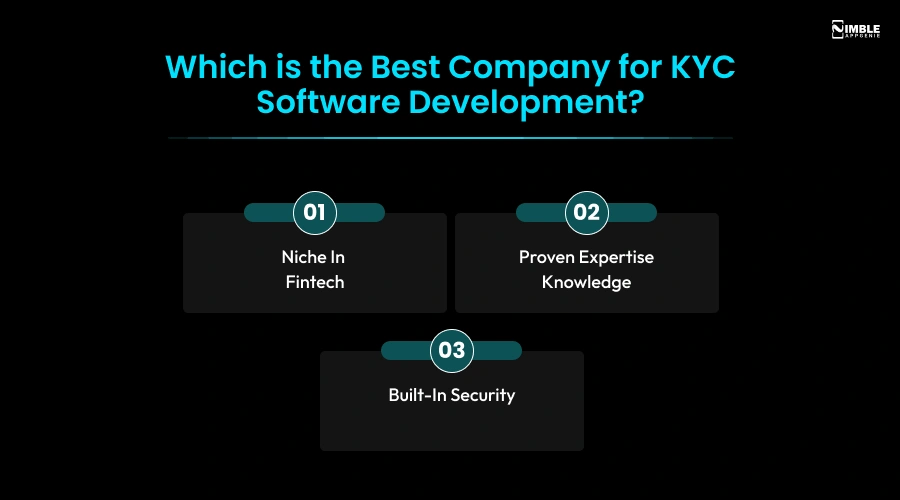
♦ Niche in Fintech
Nimble AppGenie offers fintech and compliance services because we are the top fintech app development company offering fintech-specific solutions. The engineers on the team combine cloud-native software engineering with built-in regulatory frameworks and AI-driven automation.
♦ Proven Expertise Knowledge
As the best fintech software development company, Nimble AppGenie has specialized knowledge and 8+ years of experience. It has delivered 350+ apps and 500+ other fintech solutions.
♦ Built-in Security
Nimble AppGenie offers built-in security by offering robust compliance practices. The engineers deliver every project, ensuring effective security parameters. Additionally, the team makes core architectural decisions from day one, rather than adding them as a final checkpoint.
Conclusion
KYC software development involves creating your software beginning from research to adding security and launch. The key features that you can include here are document verification, biometric and liveness, risk scoring, AML and watchlist screening, and audit trails.
The cost of building KYC software varies due to different factors such as complexity of features, tech stack, risk scoring, jurisdiction, and integrations. Here, the key challenges may comprise balancing strict regulatory requirements, false positives, data security, and inaccurate customer data.
To overcome these challenges, you need to adopt the right and effective practices. Connecting with an efficient company can be helpful here.
FAQs

Niketan Sharma, CTO, Nimble AppGenie, is a tech enthusiast with more than a decade of experience in delivering high-value solutions that allow a brand to penetrate the market easily. With a strong hold on mobile app development, he is actively working to help businesses identify the potential of digital transformation by sharing insightful statistics, guides & blogs.
Table of Contents




No Comments
Comments are closed.