

 Free Consultation
 PCI-DSS Compliant
 GDPR Ready
 ISO 27001
 NDA Protected
 AI Services
 AI App Development
 Generative AI Development
 AI Chatbot Development
 AI Integration Services
 AI Consulting Services
 AI For Fintech
 AI Financial Assistant Solution
 AI Insurance Agent Development
 Tech Stack
 OpenAI / GPT-4
 Claude / Anthropic
 Gemini / Google AI
 Llama / Open Source
 LangChain / LlamaIndex
 Pinecone / Pgvector
 AWS / Azure AI


 Fintech Solution
 Core Fintech
 App Development
 Neobank Solutions
 eWallet Solutions
 Lending Software
 Banking Solutions
 BNPL Solutions
 BNPL Solutions
 Insurance App
 Wealth Management
 Crypto & DeFi
 Blockchain Development
  Payroll Software
 DeFi Solutions
 Crypto Wallet
 Crypto On/Off Ramp
 Crypto Exchange
 Trading Platform
 Payments
 Compliance
 Regulations & Compliance
 Fraud Detection
 Lending Ecosystem
 P2P Lending Platform
 Mortgage Software
 Engagement
 Fintech Outsourcing

 Mobile Development
 Mobile App Dev
 iOS App Development
 Android App Development
 React Native
 Flutter Development
 Web Solution
 Node.js Development
 React.js Development
 Angular Development
 App Services
 UI/UX Design
 App Maintenance
 By Stage
 MVP Development
 Industry Solutions
 Healthcare App Dev
 Education App Dev
 Travel App Dev
 Real Estate App Dev
 Logistics Software
 Social Media App

 Hire Mobile Developers
 Hire iPhone Developers
 Hire Android Developers
 Hire React Native Devs
 Hire Flutter Developers
 Hire Web Developers
 Hire Node.js Developers
 Hire Angular Developers
 Hire PHP Developers
 Hire Laravel Developers
 How It Works
 Pre-Vetted Developers
 Ready In 48 Hours
 NDA From Day One
 Replace Guarantee
 Company
 About Us
 Our Work Process
 Portfolio
 Case Studies
 Blog / Insights
 Careers
 Contact Us
 Awards
 Recognition


 Offices



TL;DR
- You build a TMS by defining entities/banks/currencies first, then connecting bank rails, syncing your ERP, layering in approval controls, and adding modules (cash, payments, investments, debt, FX) in phases rather than all at once.
- A full TMS covers cash visibility, payments, investments, debt tracking, FX/risk, forecasting, and audit-ready reporting, not just bank balance aggregation.
- Building instead of buying makes sense mainly when your bank/ERP mix, entity structure, or data-ownership needs don’t fit standard vendor platforms.
- Cost ranges roughly from $60K (MVP) to $700K+ (enterprise-grade), driven mostly by the number of bank connections and depth of the reconciliation engine.
- Timeline runs 3–15 months depending on scope, and US builds need OFAC, NACHA, and (for public companies) SOX controls designed in from the start.
- Nimble AppGenie helps finance teams scope and build treasury and cash management platforms, from bank integration through compliance-ready reporting.
You can’t decide whether to build a treasury management system in one day. It usually starts with something smaller: a controller tired of manually reconciling six bank portals, a CFO who can’t get same-day visibility into cash across entities, or an audit finding that flags manual wire approvals as a risk. By the time fintech founders ask out loud, “should we build our own TMS?” The spreadsheet workarounds have usually already broken.
A team of fintech experts at Nimble AppGenie has created this guide to walk you through what’s actually involved in building a treasury management system for a US business – requirements, integration, architecture, US-based compliance considerations for treasury operations, what it costs, how long it takes, and how to decide whether building is even the right call versus buying an off-the-shelf platform.
What a Treasury Management System Actually Does?
A treasury management system (TMS) is the operating system for a company’s treasury function. Unlike a single-purpose tool that just shows cash balances or only processes payments, a full TMS typically covers:
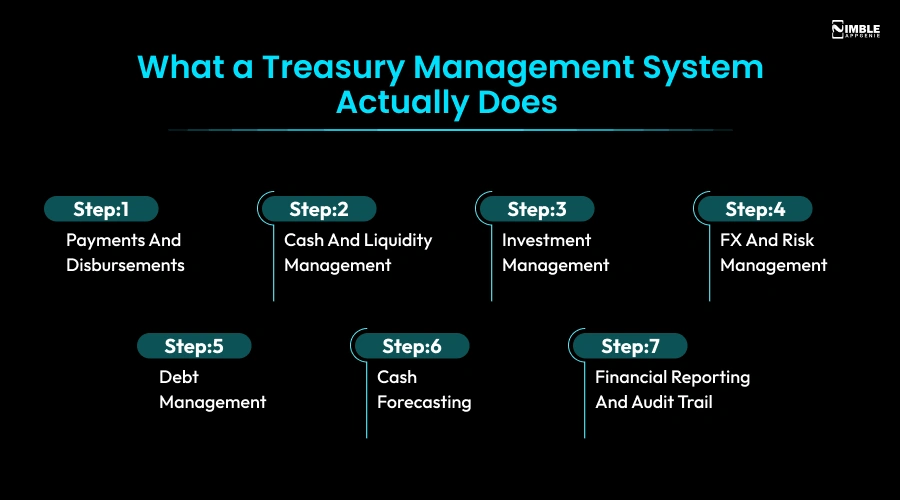
1. Payments and Disbursements
Initiating and approving wires, ACH transfers, and other payment types with proper controls.
2. Cash and Liquidity Management
Consolidated and real-time visibility into balances across every bank account, entity, and currency.
3. Investment Management
Tracking short-term investments, money market positions, and yield on idle cash.
4. FX and Risk Management
Exposure tracking and hedging for businesses with foreign currency activity.
5. Debt Management
Loan schedules, interest calculations, and covenant tracking.
6. Cash Forecasting
Short- and long-term liquidity projections based on historical and projected cash flows.
7. Financial Reporting and Audit Trail
The reporting layer that satisfies the lenders, auditors, and the board.
A narrower “cash visibility” tool that just aggregates bank balances is not the same thing as a TMS – it’s usually one module inside a larger system, or a starting point that later grows into one.
If your immediate need is closer to multi-bank balance visibility than a full treasury platform, our guide to building a multi-bank cash management platform covers that narrower build in more depth.
Why US Businesses Build Their Own TMS Instead of Buying One?
Off-the-shelf treasury management platforms (GTreasury, Kyriba, TreasuryXpress, and similar) work well for various mid-market and enterprise companies.
Typically, businesses consider a custom build instead when:
- They have distinctive entity structures, industry-specific cash flows, or multi-currency needs a generic platform doesn’t model well.
- Their bank and ERP mix doesn’t fit cleanly into a vendor’s pre-built connector library.
- Licensing costs for enterprise TMS platforms scale adversely as the company extends.
- Vendor implementation timelines (six months to over a year for larger platforms) don’t suit their internal timeline.
- They want the treasury data model to live natively alongside their own third-party vendor’s database.
None of this states buying is the wrong choice – it usually is not, for a company that matches a standard treasury workflow. Building treasury management system software only makes sense when the standard workflow doesn’t fit, or when treasury data needs to be extremely embedded in other internal systems.
Core Requirements to Define Before Development Starts
Before any architecture or treasury management systems vendor conversation, a business should answer the below questions:
- How many entities, currencies, and bank relationships need to be supported? This single answer drives most of the cost and complexity downstream.
- What existing systems does treasury data need to flow into or out of? ERP (NetSuite, SAP, Oracle, Microsoft Dynamics), accounting systems, data warehouses, and BI tools all have different integration patterns.
- What connectivity do the banks support? Not every bank offers the same options; some support modern APIs, others still require SWIFT MT/MX messaging, EBICS, or host-to-host file transfers. This varies significantly even among US banks.
- What reporting does the board, auditors, or lenders require? This shapes the data model from day one – retrofitting audit-grade reporting after the fact is expensive.
- What approval and control workflows are required? Segregation of duties, multi-level payment approval, and role-based access are non-negotiable in treasury software, not optional add-ons.
Key Features of a Treasury Management System
| Module | What It Does |
| Cash positioning | Aggregates balances across banks/entities into one real-time view |
| Payments & disbursements | Initiates and routes ACH, wire, and check payments with approval workflows |
| Cash forecasting | Projects liquidity based on historical patterns and scheduled inflows/outflows |
| Investment tracking | Monitors short-term investment positions and returns |
| Debt & covenant tracking | Tracks loan balances, interest schedules, and covenant compliance |
| FX exposure & hedging | Tracks currency exposure and hedge positions for multi-currency operations |
| Bank account management (BAM) | Maintains signatory records, account documentation, and account lifecycle |
| Audit trail & reporting | Produces the reporting and logs required for internal audit and external auditors |
Not every business needs each module on day one. Most successful builds start with payments, cash positioning, and reporting, then layer in investment tracking, FX modules, and debt management as treasury operations mature.
Architecture Considerations To Build Treasury Management Solutions
A TMS built for a US business usually needs to account for:
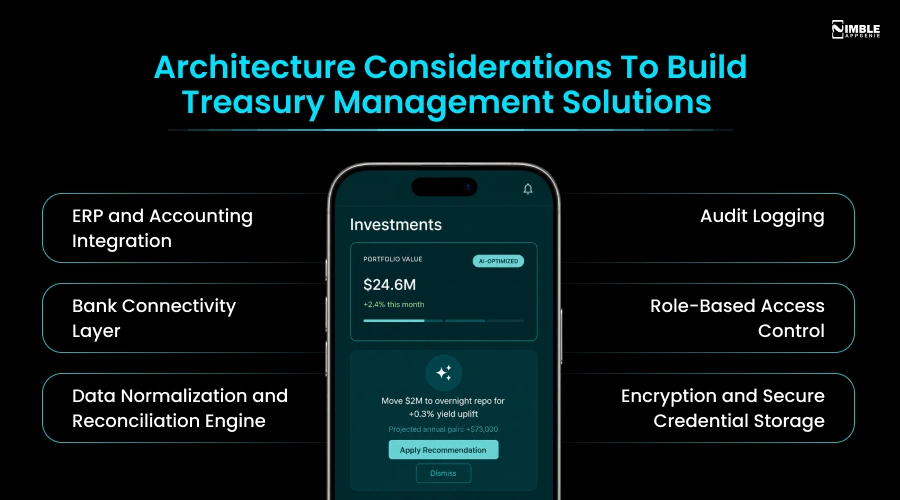
1. ERP and Accounting Integration
Bi-directional sync so treasury transactions post correctly to the general ledger without manual retry.
2. Bank Connectivity Layer
A dedicated integration layer that normalizes data coming from different banks in different formats (API, SWIFT, EBICS, flat-file/SFTP) into a single internal data model. This is generally the single most underestimated part of the build.
3. Data Normalization and Reconciliation Engine
Automatically matching bank transactions against internal records, flagging exceptions for human review.
4. Audit Logging
An immutable record of who did what and when, which becomes critical during external audits or SOX walkthroughs.
5. Role-Based Access Control
Different permission levels for treasury analysts, controllers, approvers, and auditors.
6. Encryption and Secure Credential Storage
Bank credentials, account data, and API keys should be encrypted at rest and in transit, usually to at least AES-256 and TLS 1.2+ standards.
US-Specific Compliance and Regulatory Considerations
Building a TMS for the US market demands considering a few concerns that differ from treasury software built for other regions:
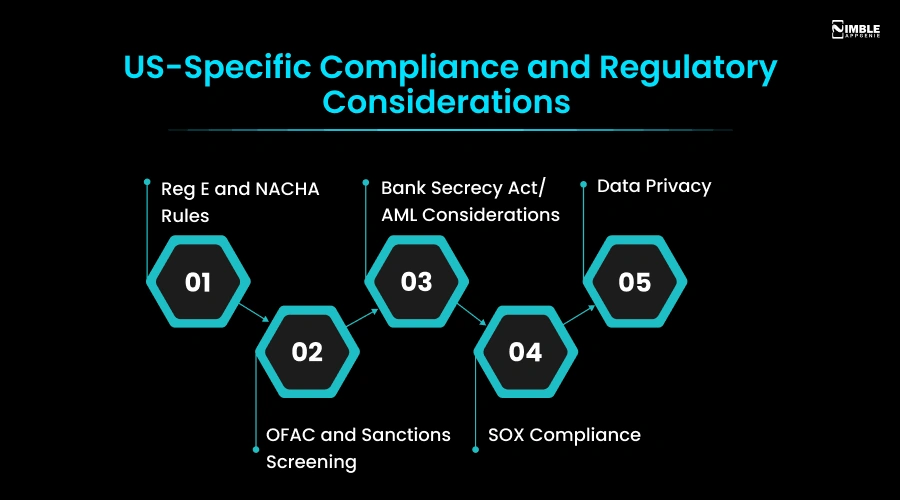
1. Reg E and NACHA Rules
ACH transactions need to comply with NACHA operating rules, and consumer-facing electronic transfers may fall under Reg E depending on the business model.
2. OFAC and Sanctions Screening
Outbound payments should be screened against OFAC’s Specially Designated Nationals list before execution, and specifically for wires involving international counterparties.
3. Bank Secrecy Act/AML Considerations
Relevant if the business or its banking partners need monitoring of unusual transaction patterns.
4. SOX Compliance
For public companies, treasury controls (approval workflows, audit trails, segregation of duties) are directly in scope for SOX 404 testing, and the system needs to produce evidence auditors can rely on.
5. Data Privacy
Financial account data usually falls under state-level data protection requirements (e.g., California’s CCPA) even without a dedicated federal financial privacy law equivalent to GDPR.
None of these requirements mean the business itself requires a banking license – a company building a TMS to manage its own accounts is building internal software, not becoming a financial institution. But the controls above still need to be designed in from the start, not bolted on later.
Integrations a Treasury Management System Typically Needs
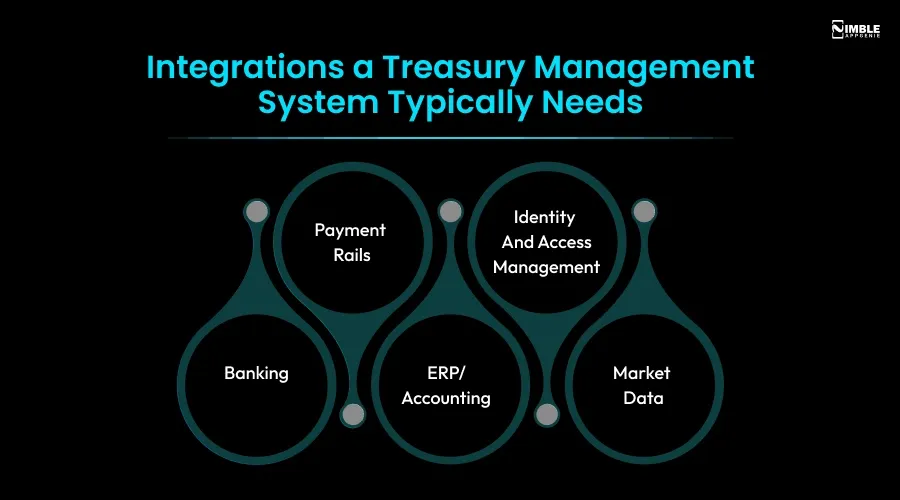
- Banking: Direct bank APIs where available, EBICS, SWIFT MT/MX messaging, or SFTP file exchange for banks without modern API support.
- Payment Rails: ACH networks, card networks, Fedwire depending on payment types supported. If ACH is a core part of your treasury build, our guide to building custom ACH payment software and ACH vs. wire transfer comparison go deeper into the mechanics, NACHA formatting, and cost/settlement trade-offs than this overview covers.
- ERP/Accounting: SAP, NetSuite, Microsoft Dynamics, Oracle, and QuickBooks (for smaller and mid-market companies).
- Identity and Access Management: SSO (typically via OAuth and SAML) so treasury staff authenticate through existing corporate identity providers.
- Market Data: FX rates and money market rates for businesses tracking investments or currency exposure.
What It Costs to Build a Treasury Management System
Costs vary widely based on the number of bank/ERP integrations, scope, and how many modules are included. As a general guide:
| Treasury Management Platform | Scope | Estimated Development Cost |
| MVP / Single-Entity | Cash visibility and payments; one or two banks; basic approval workflow; one ERP integration | $60,000–$120,000 |
| Mid-Market Platform | Multiple entities and banks; cash forecasting; investment tracking; standard reporting | $120,000–$300,000 |
| Enterprise-Grade Platform | Multi-entity and multi-currency; FX and debt management; complex SWIFT/EBICS bank connectivity; SOX-ready audit trails; custom BI/reporting layer | $300,000–$700,000+ |
The two biggest cost drivers are almost always the number of bank connections (each one is effectively its own integration project) and the depth of the reconciliation and reporting engine.
Ongoing costs include bank connectivity fees, hosting, monitoring, and maintenance, typically running several thousand dollars a month once the system is live. Budget for it separately from the initial build cost.

Timeline Required to Build Treasury Management Systems
| Treasury Management Platform | Scope | Estimated Development Timeline |
| MVP / Single-Entity | Cash visibility and payments; one or two banks; basic approval workflow; one ERP integration | 3–5 months |
| Mid-Market Platform | Multiple entities and banks; cash forecasting; investment tracking; standard reporting | 5–9 months |
| Enterprise-Grade Platform | Multi-entity and multi-currency; FX and debt management; complex SWIFT/EBICS bank connectivity; SOX-ready audit trails; custom BI/reporting layer | 9–15 months |
Build vs. Buy: How to Decide
| Consideration | Leans Toward Buying | Leans Toward Building |
| Bank and ERP mix | Matches vendor’s standard connector library | Unusual combination not well supported off-the-shelf |
| Timeline pressure | Need something live in weeks | Timeline allows for a proper build cycle |
| Entity/currency complexity | Standard, well-supported structure | Complex, non-standard multi-entity setup |
| Internal engineering capacity | Limited internal dev/IT resourcing | In-house or partner engineering capacity available |
| Long-term cost | Lower total cost at smaller scale | Licensing costs scale poorly as usage grows |
| Data ownership needs | Vendor-hosted data model is acceptable | Treasury data must live natively alongside internal systems |
Many businesses choose a hybrid path; buy a narrower tool (a bank connectivity or cash visibility layer) first, prove the ROI, and build a fuller custom TMS once the scope and requirements are well understood.
Common Challenges in Building a TMS with Possible Solutions
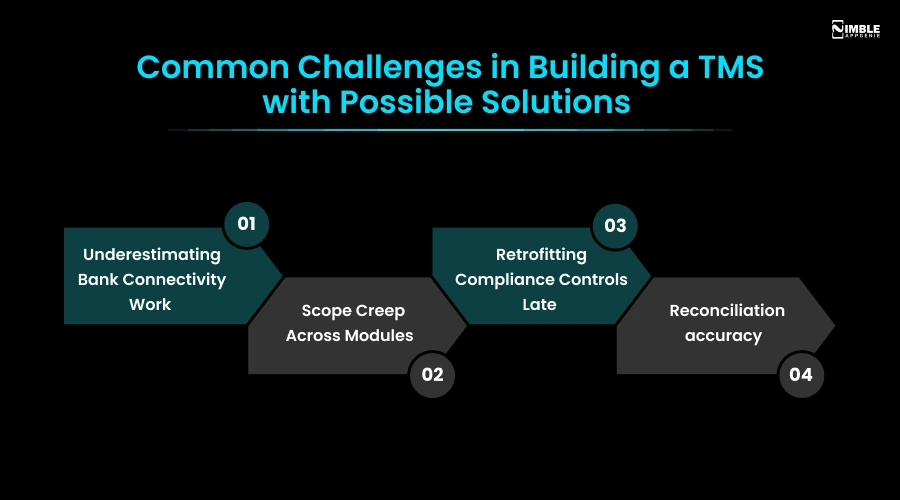
Challenge 1: Underestimating Bank Connectivity Work
Every bank behaves slightly differently even when they claim to support the same standard (EBICS, SWIFT, or API). Message formats, file specifications, and authentication methods vary bank to bank, and documentation is usually incomplete or outdated.
Solution: Treat every bank connection as its own mini-project with its own testing and sign-off cycle, not a checkbox on a shared timeline. Build a normalization layer early so new banks can be onboarded by mapping to an internal standard rather than writing core logic each time, and budget 20-30% extra time specifically for this layer.
Challenge 2: Scope Creep Across Modules
Trying to launch cash management, debt tracking, investments, and FX hedging simultaneously is one of the most common reasons treasury builds stall or blow through budget.
Solution: Sequence modules by business impact. Launch cash positioning, core reporting, and payments first, prove the system works reliably, then layer in investment tracking, FX modules, and debt management in later phases based on actual treasury priorities.
Challenge 3: Retrofitting Compliance Controls Late
Approval workflows, audit logging, and segregation of duties are far more costly to add after the system is built than to design in from the start. Teams that treat compliance as a “phase two” item usually end up re-architecting core data models to support audit trails.
Solution: Map out required controls (segregation of duties, approval hierarchies, audit logging) during the requirements phase, before architecture decisions are locked in. Involve compliance stakeholders or internal audit in design reviews from day one, not at UAT.
Challenge 4: Reconciliation accuracy
Automated matching between internal records and bank data needs a well-designed exception-handling workflow, or treasury staff end up doing manual reconciliation anyway-defeating the purpose of the build.
Solution: Design the matching engine around configurable rules (data windows, amount tolerances, reference-number matching) rather than exact-match only, and build a clear exception queue so unmatched items are surfaced for review instead of silently failing.
Evaluating a Development Partner to Build a TMS for Your Business
If a business decides to build rather than buy, choosing the right treasury management system development company matters as much as the architecture itself.
Nimble AppGenie’s fintech development background is one example of the kind of domain expertise worth looking for.
Evaluate the following aspects:
- Prior experience specifically with payments, treasury, or banking integrations – not only general fintech experience.
- A track record of building systems that have passed SOX or similar audit scrutiny.
- Familiarity with EBICS, SWIFT, and bank API standards, since this is usually the toughest technical piece.
- Whether they design for controls and compliance from the start of the architecture phase, rather than treating it as a later add-on.
- How they approach phased delivery – a partner who pushes for a single launch across every module is usually underestimating the integration complexity.
Where to Go From Here
Building a treasury management system is a significant undertaking. But for businesses with a bank, entity, or currency setup that doesn’t fit neatly into an off-the-shelf platform, it’s often the more sustainable long-term path.
The key is getting the requirements, architecture, and compliance controls right before writing a line of code – retrofitting any of these later is far more expensive than planning for them up front.
Working with a Development Partner
Nimble AppGenie works with finance teams and fintechs on treasury and cash management platform builds, from initial scoping through bank integration and compliance-ready reporting. If you scope a build for your own business, our team is happy to talk through your specific bank, entity, and integration requirements.
FAQs
No. A business building a TMS to manage its own accounts and cash is building internal software, not acting as a licensed financial institution. You do need to meet data security and, depending on your bank relationships, connectivity compliance requirements.
Yes. Most mid-market and enterprise ERP and accounting platforms, including NetSuite and QuickBooks, support API or file-based integration that a custom TMS can connect to.
A cash visibility or multi-bank cash platform typically covers only the balance aggregation and reporting piece. A full TMS extends that into payments, investments, debt tracking, FX/risk management, and audit-grade reporting.
Only if your banks require it; some banks now support modern REST APIs directly; others, particularly for international wires or older banking relationships, still rely on SWIFT MT/MX or EBICS.
Most businesses see measurable time savings (fewer manual reconciliations, faster payment approvals) within the first few months of go-live, though full ROI depends heavily on how many manual processes the system is replacing.

Niketan Sharma, CTO, Nimble AppGenie, is a tech enthusiast with more than a decade of experience in delivering high-value solutions that allow a brand to penetrate the market easily. With a strong hold on mobile app development, he is actively working to help businesses identify the potential of digital transformation by sharing insightful statistics, guides & blogs.
Table of Contents




No Comments
Comments are closed.