

 Free Consultation
 PCI-DSS Compliant
 GDPR Ready
 ISO 27001
 NDA Protected
 AI Services
 AI App Development
 Generative AI Development
 AI Chatbot Development
 AI Integration Services
 AI Consulting Services
 AI For Fintech
 AI Financial Assistant Solution
 AI Insurance Agent Development
 Tech Stack
 OpenAI / GPT-4
 Claude / Anthropic
 Gemini / Google AI
 Llama / Open Source
 LangChain / LlamaIndex
 Pinecone / Pgvector
 AWS / Azure AI


 Fintech Solution
 Core Fintech
 App Development
 Neobank Solutions
 eWallet Solutions
 Lending Software
 Banking Solutions
 BNPL Solutions
 BNPL Solutions
 Insurance App
 Wealth Management
 Crypto & DeFi
 Blockchain Development
  Payroll Software
 DeFi Solutions
 Crypto Wallet
 Crypto On/Off Ramp
 Crypto Exchange
 Trading Platform
 Payments
 Compliance
 Regulations & Compliance
 Fraud Detection
 Lending Ecosystem
 P2P Lending Platform
 Mortgage Software
 Engagement
 Fintech Outsourcing

 Mobile Development
 Mobile App Dev
 iOS App Development
 Android App Development
 React Native
 Flutter Development
 Web Solution
 Node.js Development
 React.js Development
 Angular Development
 App Services
 UI/UX Design
 App Maintenance
 By Stage
 MVP Development
 Industry Solutions
 Healthcare App Dev
 Education App Dev
 Travel App Dev
 Real Estate App Dev
 Logistics Software
 Social Media App

 Hire Mobile Developers
 Hire iPhone Developers
 Hire Android Developers
 Hire React Native Devs
 Hire Flutter Developers
 Hire Web Developers
 Hire Node.js Developers
 Hire Angular Developers
 Hire PHP Developers
 Hire Laravel Developers
 How It Works
 Pre-Vetted Developers
 Ready In 48 Hours
 NDA From Day One
 Replace Guarantee
 Company
 About Us
 Our Work Process
 Portfolio
 Case Studies
 Blog / Insights
 Careers
 Contact Us
 Awards
 Recognition


 Offices



Quick Answer:
ACH transfers are best for regular, lower-cost payments like payroll and vendor bills. Wire transfers are best for large, urgent, or international payments. ACH is cheaper and reversible. Wire is faster and final. Choose based on the size, timing, and destination of your payment.
Key Takeaways:
- ACH vs wire transfer for business depends on payment speed, cost, amount, and destination. ACH transfer works best for recurring domestic payments, while wire transfer is better for urgent or international transactions.
- ACH payments are low-cost and usually settle in 1 to 3 business days. Same-day ACH is also available for faster payroll, vendor payments, and subscription billing.
- Wire transfers move money directly between banks and usually arrive the same day in the US. International wire transfer payments can take 1 to 5 business days through the SWIFT network.
- ACH transfer fees are usually a few cents per transaction, while wire transfer fees can range from $15 to $50. International wire transfers may also include hidden foreign exchange markups.
- Businesses use ACH for payroll, recurring vendor payments, and customer billing. Wire transfer is commonly used for real estate deals, international suppliers, and high-value payments.
- RTP and FedNow are newer real-time payment systems offering instant transfers at lower costs.
When it comes to ACH vs wire transfer, most businesses pick one based on habit or what their bank suggests. That is fine, until a payroll gets delayed, a real estate closing falls through, or you realise you paid $40 for a transfer that cost 50 cents the other way.
Both payment methods move money between bank accounts. But they work differently, cost differently, and serve different situations. Using the wrong one at the wrong time has real consequences.
If you are also building a payment feature into your app or platform, then this guide is for you. It breaks down exactly how each payment type works, what it costs, how long it takes, and when to use it. It can help you get the payment infrastructure right from the start.
So, let’s begin!
What Is an ACH Transfer?
ACH stands for Automated Clearing House. It is a network that moves money electronically between US bank accounts.
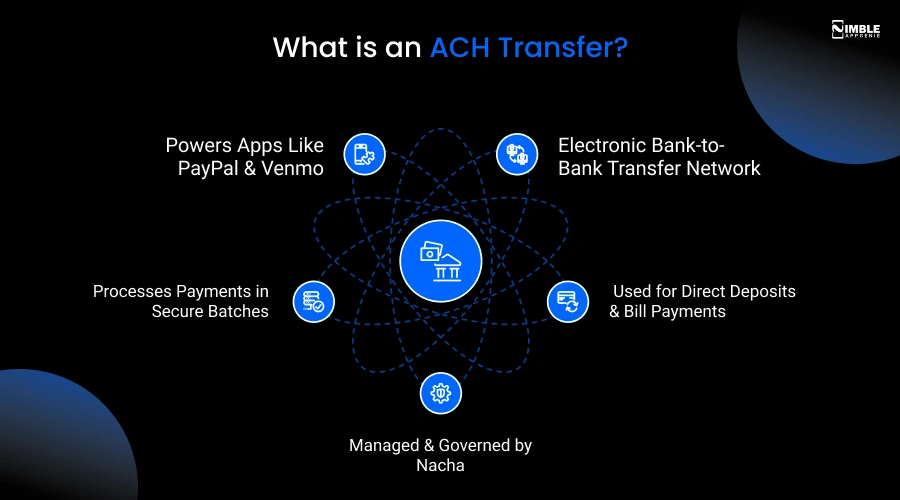
You have almost certainly used ACH, even if you did not know it by that name. Direct deposit, online bill pay, automatic subscription charges, and most peer-to-peer apps like PayPal and Venmo all run on the ACH network.
Nacha runs and governs the ACH network. When you initiate an ACH payment, your bank bundles it into a batch with other transactions from the same processing window. That batch goes to the ACH network, which routes each payment to the right recipient bank.
ACH Push vs ACH Pull
There are two types of ACH transactions:
- ACH push: You send money to someone else. For example, paying a vendor.
- ACH pull: You authorize someone to pull money from your account. For example, a subscription service charges your account each month.
Both types move money the same way. The difference is just who initiates the transfer.
Standard ACH vs Same-Day ACH
Not all ACH transfers move at the same speed. There are three tiers:
- Standard ACH: It settles in 1 to 3 business days.
- Next-Day ACH: It settles the next business day.
- Same-Day ACH: It sets the same business day if submitted before the 4:45 PM ET cut-off.
Same-day ACH has a per-transaction limit of $1 million. It costs a bit more but is mostly cheaper than a wire transfer.
| Example: You run a 50-person company and process payroll every two weeks. You use ACH to direct-deposit salaries. Submitting payroll on Wednesday afternoon means your employees see the money in their accounts by Friday morning. The total cost is a few cents per transaction. |
What is a Wire Transfer?
A wire transfer moves money directly from one bank to another. Unlike ACH, it does not batch with other transactions. It goes out individually and almost in real time.
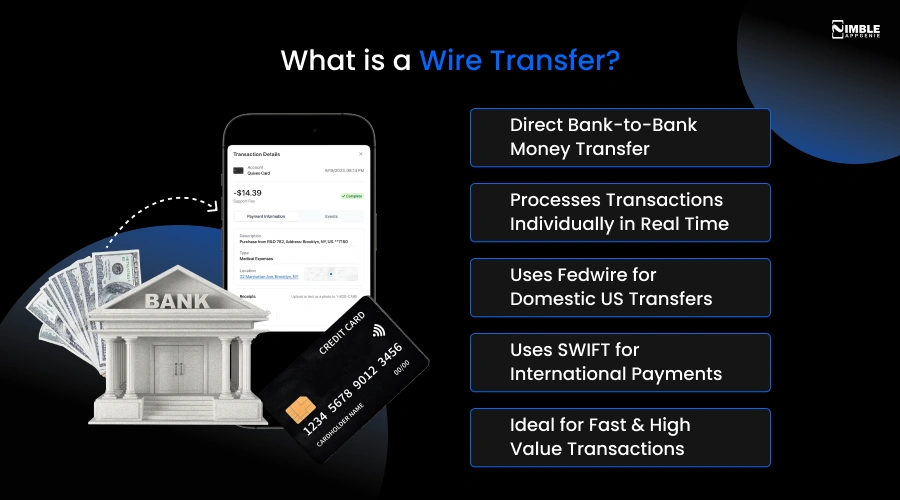
For domestic US transfers, banks use the Fedwire network. For international money transfers, banks use the SWIFT network, which connects financial institutions globally.
Domestic vs International Wire
Domestic wires are easy. Your bank debits your account, sends the funds to the recipient bank, and the money arrives the same day, as long as you submit before your bank’s cut-off time. Cut-off times simply fall between 3 PM and 5 PM ET.
International wires are more complex. Your money may travel through one or more intermediary banks before reaching its destination. Each intermediary can deduct its own fee. Transmit time is usually 1 to 5 business days, depending on the destination country.
| For example, you import raw materials from a manufacturer in Germany. They require full payment before shipping. You send a SWIFT wire transfer on Monday morning. The funds arrive in Germany by Wednesday, and your order ships on Thursday. A US-only ACH could not have handled this at all. |
ACH vs Wire Transfer: A Quick Comparison
ACH and wire transfers are two common ways to send money electronically, but they work differently. Wire transfers are usually faster and send money directly between banks. ACH transfers go through a processing network and may take a few business days.
Here is the comparison table of ACH vs Wire Transfer. Take a look at how the two electronic payment types compare across the factors that matter most to businesses.
| Feature | ACH Transfer | Wire Transfer |
| Settlement time | 1–3 business days (standard); same day available | Same day (domestic); 1–5 days (international) |
| Outgoing fee | $0.20–$1.50 per transaction | $15–$50 per transfer |
| Incoming fee | Free or minimal | $10–$20 at most banks |
| Reversible? | Yes — within a limited window | No — rarely |
| Transaction limit | $1M per transaction (same-day ACH) | No federal cap |
| International? | US only (limited IAT exceptions) | Yes — worldwide via SWIFT |
| Processing style | Batch | Individual |
| Best for | Payroll, recurring bills, vendor payments | Large, urgent, or international payments |
| Risk level | Lower (reversible) | Higher (irreversible) |
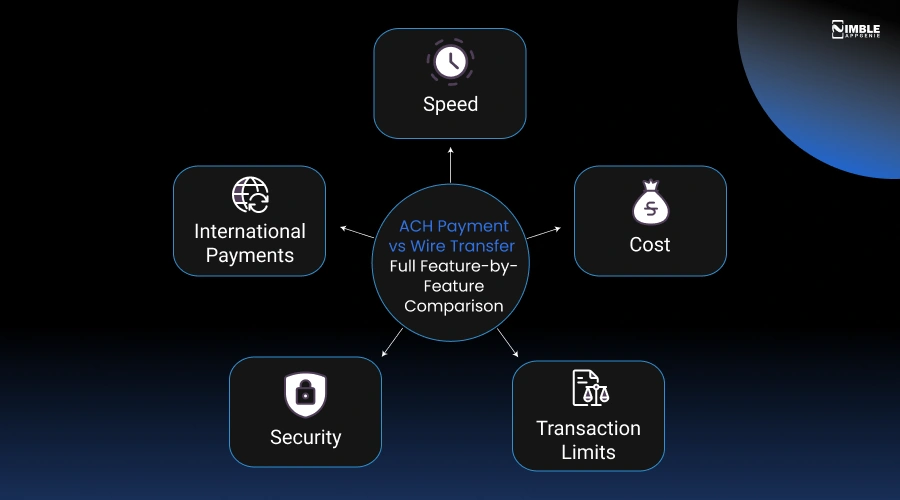
ACH Payment vs Wire Transfer: Full Feature-by-Feature Comparison
Now that you have deeply understood every payment method, let’s put ACH transfer vs Wire Transfer side by side across the factors that matter most for businesses. Take a look at the wire transfer vs ACH comparison in detail.
1. Speed Comparison
Speed is often the deciding factor when choosing between an ACH payment vs wire transfer. Here is what actually happens on each timeline.
Standard ACH takes 1 to 3 business days. Same-day ACH requires submission before 4:45 PM ET. It does not run on weekends or federal holidays. Domestic wires settle within hours if sent before your bank’s cut-off. International wires take 2 to 5 business days.
# Real World Gap
For most routine payments, the speed gap does not matter. An ACH submitted on Wednesday afternoon usually arrives by Friday. But if you need funds there by tomorrow morning and it is already Thursday afternoon, a wire transfer is your only reliable option.
| Factor | ACH Transfer | Wire Transfer |
| Standard processing time | 1-3 business days | Domestic: same day or within hours |
| Faster option | Same-day ACH available | Usually already fast |
| International timing | Limited support | 2-5 business days |
| Weekend/Holiday processing | Not processed on weekends or federal holidays | Depends on banks, but usually business days only |
| Cut-off Time | Same-day ACH cut-off: 4:45 PM ET | Bank-specific cut-off times |
| Best use cases | Routine payments like payroll and vendor payments | Urgent or high-value payments |
2. Cost Comparison: What Your Business Actually Pays
This is the difference between ACH and wire transfer from each other. The cost gap is significant if you run high volumes of transactions.
-
ACH Transfer Costs
ACH is cheap. Many business accounts include a set number of free ACH transfers monthly. Incoming ACH is almost always free.
-
Wire Transfer Fees by Bank
Here are the current approximate fees at major US banks for business accounts. Always confirm directly with your bank before planning.
| Bank | Out-Domestic | In-Domestic | Out – International | In – International |
| Chase business | $25–$35 | $15 | $40–$50 | $15 |
| Bank of America Business | $30 | $15 | $45 | $16 |
| Wells Fargo Business | $30 | $15 | $45 | $16 |
| Citi Business | $25 | Free | $35 | Free |
Fees shown are approximate and may vary by account type or negotiated pricing. Verify current rates with your bank.
-
The Hidden Cost: FX Markup on International Wires
Banks convert your dollars at a rate worse than the mid-market exchange rate. The markup is typically 2% to 4%. On a $50,000 payment, that is $1,000 to $2,000 in hidden costs on top of the transfer fee.
If you send international payments regularly, compare fintech apps like Wise Business or Airwallex. They usually offer rates closer to the mid-market rate.

3. Transaction Limits
For same-day ACH, Nacha sets a per-transaction limit of $1 million. Standard ACH has no Nacha cap, but your bank sets its own daily limits, which vary from $25,000 to several million dollars per day.
If you need to go above your bank’s limit, call the business line. Limit increases are common for established accounts.
There is a federal cap on wire transfers. Banks set their own limits. For very large wires, your bank may ask for additional verification. That is a fraud detection and prevention step, not a legal restriction.
| Factor | ACH Transfer | Wire Transfer |
| Same-day Limit | $1 million per transaction | No federal limit |
| Standard limit | Bank-dependent | Bank-dependent |
| Daily limits | Usually $25,000 to several million | Usually very high |
| Large transaction approval | Possible bank approval needed | Verification often required |
4. Security and Fraud Risks
Both payment types carry fraud risk, and fintech security is really important, but the risk profiles are very different.
(i) ACH Fraud and Returns
The main ACH risk is unauthorised debits. Someone gets your account and routing number and pulls funds without your permission. ACH is reversible. Businesses typically have 24 hours from when a transaction posts to dispute it.
Common ACH return codes:
- R01 – Insufficient funds
- R02 – Account closed
- R10 – Customer advises not authorized
- R29 – Corporate customer advises not authorized
- R16 – Account frozen
Note: business accounts have a 24-hour dispute window. Consumer accounts have 60 days. Check your bank’s terms.
(ii) Wire Transfer Fraud
Wire fraud is a different level of risk. Once a wire leaves your bank, it is almost impossible to recover. There is no return code system and no standard reversal window.
The FBI’s Internet Crime Complaint Center reported that Business Email Compromise scams cost US businesses over $2.9 billion in 2023. Most BEC scams end in a fraudulent wire transfer.
How to Protect Your Business?
- It requires dual authorization for all wire transfers.
- Never update vendor banking details based on email alone. Call the vendor on a known number.
- Use callback verification for any new or changed payment instructions.
- Whitelist known recipients in your banking portal.
- Train your team to recognize urgency-based pressure tactics.
- Set up real-time alerts for every outgoing wire.
| Factor | ACH Transfer | Wire Transfer |
| Fraud type | Unauthorized ACH pulls | Wire fraud and BEC scams |
| Reversible? | Yes, within the dispute window | Usually no |
| Dispute window | Business: more than 24 hours | Very limited |
| Consumer protection | Stronger | Limited |
| Main risk | Account or routing misuse | Irrecoverable transfers |
5. International Payments: ACH vs Wire Transfer
(i) Can you use ACH for international payments?
Not really. ACH is a US-only network. International ACH Transfer technically exists but is rarely supported by most SMBs. For cross-border payments, ACH is not a real option.
(ii) SWIFT Wire for international payments
International wires use SWIFT. You need the recipient’s SWIFT/BIC code and IBAN. Transit often goes through intermediary banks, each potentially deducting a fee. Expect 1 to 5 business days for funds to arrive.
| Factor | ACH Transfer | Wire Transfer |
| International Support | Very limited | Widely Supported |
| Network used | ACH/IAT | SWIFT |
| Required Details | Limited international support | SWIFT/BIC/IBAN address |
| Processing time | Rarely used internationally | 1-5 business days |
| Intermediary bank fees | Rare | Common |
When to Use ACH and Wire Transfer?
You can use ACH when:
- You pay employees through payroll, direct deposit.
- recurring vendor or supplier payments.
- collecting customer payments or subscriptions.
- The amount is under $1 million.
- You have 1-3 business days of flexibility.
- Payment is within the US.
- You want the ability to reverse if something goes wrong.
You can use a wire transfer when:
- Payment must arrive the same day.
- Paying international vendors or contractors.
- Real estate closings or large asset purchases.
- The amount exceeds your bank’s ACH daily limit.
- The recipient specifically requires a wire.
- One-time, high-value transaction.
- Speed matters more than the transfer cost.
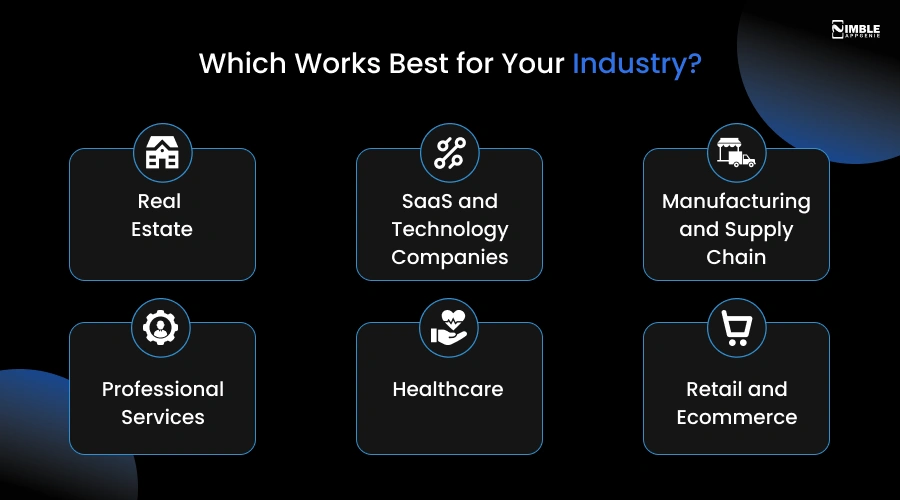
Which Works Best for Your Industry?
The right choice often depends on what your business does. Let’s take a look at the quick breakdown by industry.
1. Real Estate
You can use wire for closings, down payments, and escrow. These are large, time-sensitive, one-time transactions where the recipient typically requires a wire.
However, you can use ACH for collecting required rent from tenants or paying property management fees on a schedule.
2. SaaS and Technology Companies
Use ACH to collect subscription payments from customers and pay recurring vendor bills. For enterprise software deals with a large upfront license fee, a wire transfer is often the cleaner option. It is faster and expected by the recipient.
3. Manufacturing and Supply Chain
You can use ACH for domestic suppliers you pay on a regular schedule. But you can use wire for international suppliers who need payment in foreign currency or who need funds before shipping.
4. Professional Services
Law firms, accountants, and consultants often collect retainers via wire, especially for large client engagements. Recurring invoices and smaller fees are well-suited to ACH.
5. Healthcare
Insurance reimbursements and Medicare payments typically arrive via ACH. Payments between healthcare facilities or for equipment purchases often go through wire transfer.
6. Retail and E-commerce
Domestic vendor payments and supplier invoices work well with ACH. Overseas inventory purchases typically need international wire transfers or fintech alternatives.
ACH, Wire, RTP, and FedNow: The Four-Way Comparison
Two newer payment rails are becoming more widely available: Real-Time Payments and FedNow. They are worth knowing about if you are building transaction processing systems or evaluating future options.
What is RTP?
RTP is run by the clearing house. It processes payments instantly, 24 hours a day, 7 days a week, 365 days a year. Funds arrive in seconds, not hours or days. The per-transaction limit is $1 million.
What is FedNow?
FedNow is the Federal Reserve’s instant payment network, launched in 2023. It works similarly to RTP, offering real-time settlement around the clock. The current per-transaction limit is $500,000, though individual banks may set lower limits.
Neither RTP nor FedNow is universally available yet. Not all banks support them. But adoption is growing quickly.
| Feature | Standard ACH | Wire | KTP | FedNow |
| Speed | 1-3 business days | Same day (domestic) | Seconds | Seconds |
| Costs | $0.20-$1.50 | $15-$50 | $0.01-$0.05 | Low |
| Max per transaction | $1M (same-day) | No federal cap | $1M | $500K |
| 24/7 available? | No | No | Yes | Yes |
| International? | No | Yes | No | No |
| Reversible? | Yes (limited window) | No | No | No |
If your bank supports RTP or FedNow, it can be a compelling middle ground: wire-like speed at a cost closer to ACH. You can ask your bank whether these rails are available for your account type.
Compliance and Regulatory Aspects to Consider
Most businesses do not need to worry about fintech regulations and compliance until they do. Here is what to know in advance.
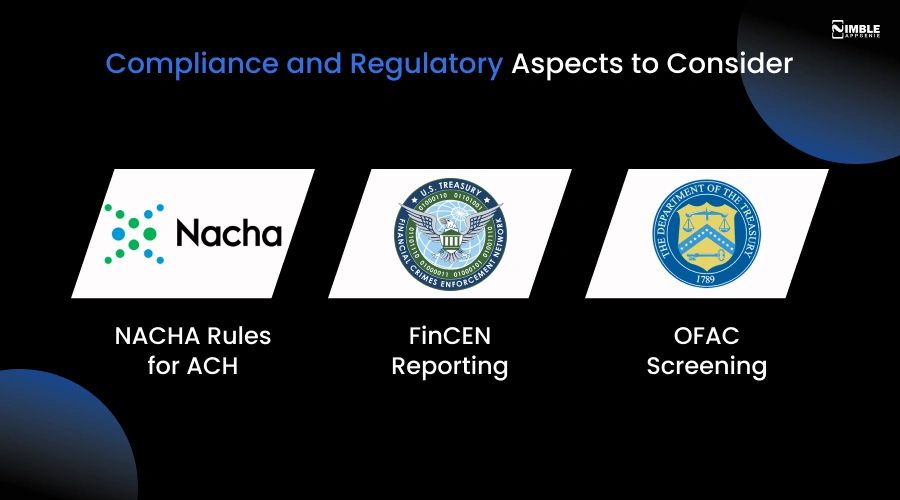
1. NACHA Rules for ACH
If your business originates ACH payments, you need a relationship with an Originating Depository Financial Institution.
That is typically your bank. Your bank is responsible for ensuring you comply with Nacha’s operating rules. It includes proper authorization from recipients before pulling funds.
2. FinCEN Reporting
Banks must file Currency Transaction Reports for cash transactions over $10,000. Wire transfers are not cash, so CTRs do not apply directly.
However, wire transfers above $3,000 require bank-level recordkeeping under the Bank Secrecy Act. Unusual patterns can trigger a Suspicious Activity Report.
3. OFAC Screening
Your bank screens every international wire against the OFAC sanctions list. If a name, entity, or country matches, the payment is blocked or delayed. This is why some international wires take longer than expected without a clear explanation.
How Nimble AppGenie Helps You Build Secure and Scalable Payment Systems?
If you are developing a mobile app or digital platform that manages payments, the choice between ACH and wire is not just a business decision. It is a technical architecture decision.
Getting it right from the start means fewer compliance issues, lower transaction costs, and a better experience for your users. As a fintech app development company, Nimble AppGenie creates and integrates payment systems for startups and growing businesses.
If your app needs to support ACH direct deposits, wire disbursements, subscription billing, or real-time payment rails like RTP and FedNow, we design the infrastructure to match your use case.
What Can We Help With?
- Choosing the right payment rail for your software solution
- Integrating payment APIs like Plaid, Stripe, Dwolla, JPMorgan, and others
- Building compliant payment flows with proper authorization and audit trails
- Designing fraud prevention controls into your payment architecture
- Structuring payment systems for fintech apps, marketplaces, and SaaS platforms
Nimble AppGenie helps you build a payment infrastructure that scales without requiring a full rebuild at the next stage.

Conclusion
ACH vs Wire transfers serve different purposes. They are not competing products, and they are tools for different jobs. Use ACH for routine, recurring, domestic payments where cost matters and you have a day or two. It is cheap, reversible, and built for volume.
Additionally, you can use wire when you need same-day delivery, the payment is international, the amount is very large, or the recipient specifically requires it. Just make sure your controls are in place before you hit send.
If your bank supports RTP or FedNow, it is worth asking about them. They offer wire-like speed at ACH-like costs, and adoption is growing fast. Most businesses will use both over time. The key is knowing which to reach for and when.
FAQs
Standard ACH takes 1 to 3 business days. Next-day ACH settles the following business day. Same-day ACH settles the same day if submitted before 4:45 PM ET.
Domestic wires typically arrive the same day, within a few hours of submission. International wires take 1 to 5 business days, depending on the destination and the number of intermediary banks involved.
No. ACH is a US-only network. International ACH Transfers technically exist but are rarely supported for most business use cases. For cross-border payments, use a wire transfer or a fintech alternative.
ACH is almost always the right choice for payroll. It is lower cost, supports recurring payments, and integrates with most payroll software. Wire transfers are not designed for high-volume recurring payments.

Niketan Sharma, CTO, Nimble AppGenie, is a tech enthusiast with more than a decade of experience in delivering high-value solutions that allow a brand to penetrate the market easily. With a strong hold on mobile app development, he is actively working to help businesses identify the potential of digital transformation by sharing insightful statistics, guides & blogs.
Table of Contents




No Comments
Comments are closed.