

 Free Consultation
 PCI-DSS Compliant
 GDPR Ready
 ISO 27001
 NDA Protected
 AI Services
 AI App Development
 Generative AI Development
 AI Chatbot Development
 AI Integration Services
 AI Consulting Services
 AI For Fintech
 AI Financial Assistant Solution
 AI Insurance Agent Development
 Tech Stack
 OpenAI / GPT-4
 Claude / Anthropic
 Gemini / Google AI
 Llama / Open Source
 LangChain / LlamaIndex
 Pinecone / Pgvector
 AWS / Azure AI


 Fintech Solution
 Core Fintech
 App Development
 Neobank Solutions
 eWallet Solutions
 Lending Software
 Banking Solutions
 BNPL Solutions
 BNPL Solutions
 Insurance App
 Wealth Management
 Crypto & DeFi
 Blockchain Development
  Payroll Software
 DeFi Solutions
 Crypto Wallet
 Crypto On/Off Ramp
 Crypto Exchange
 Trading Platform
 Payments
 Compliance
 Regulations & Compliance
 Fraud Detection
 Lending Ecosystem
 P2P Lending Platform
 Mortgage Software
 Engagement
 Fintech Outsourcing

 Mobile Development
 Mobile App Dev
 iOS App Development
 Android App Development
 React Native
 Flutter Development
 Web Solution
 Node.js Development
 React.js Development
 Angular Development
 App Services
 UI/UX Design
 App Maintenance
 By Stage
 MVP Development
 Industry Solutions
 Healthcare App Dev
 Education App Dev
 Travel App Dev
 Real Estate App Dev
 Logistics Software
 Social Media App

 Hire Mobile Developers
 Hire iPhone Developers
 Hire Android Developers
 Hire React Native Devs
 Hire Flutter Developers
 Hire Web Developers
 Hire Node.js Developers
 Hire Angular Developers
 Hire PHP Developers
 Hire Laravel Developers
 How It Works
 Pre-Vetted Developers
 Ready In 48 Hours
 NDA From Day One
 Replace Guarantee
 Company
 About Us
 Our Work Process
 Portfolio
 Case Studies
 Blog / Insights
 Careers
 Contact Us
 Awards
 Recognition


 Offices



Key Takeaways:
- To create a payment tracking system, you should map payment flow, design the payment tracking system, integrate payment rails, add reconciliation, and test the complete system.
- Building a payment tracking system is hard because of different stakeholders, payment delays and failures, data reconciliation, limited connectivity, high transaction volume, and increasing fraud.
- The overall cost to create a payment tracking system for the agri supply chain varies from $40,000 to $250,000+. This cost can vary due to several factors, such as system complexity, offline-first mobile capability, and regulatory compliance across different regions.
- Different challenges comprises of fragmented ecosystem, infrastructure gaps, financial and legal risks, and scope creep.
- Here, connecting with Nimble AppGenie can help you build the complete payment tracking system for agir supply chains.
The agriculture logistics market size is estimated to be estimated at USD 267.89 billion in 2025 and is even expected to reach USD 330.20 billion by 2030.
With this growing market, you can establish a unique identity by creating a payment tracking system for agri supply chains.
Because agricultural supply chains move billions of dollars between farmers, aggregators, processors, and buyers every season. Still, there are payment delays, mismatched records, and limited rural connectivity that cause disputes and cash flow gaps.
Hence, with the help of a dedicated payment tracking system, you can solve this by linking every transaction directly to the physical milestones such as harvest, shipment, and delivery.
It’s a trust infrastructure that reduces fraud, speeds up settlements, and keeps farmers paid on time. Here’s exactly how to build one.
What is a Payment Tracking System in Agri Supply Chains?
A payment tracking system for agricultural supply chains is a digital platform that monitors, records, and verifies financial transactions between farmers, buyers, processors, and distributors.
It ensures transparent pricing, reduces payment delays, and builds trust through tracking every transfer from the initial harvest sale to final delivery.
Supply chain payment tracking for agricultural marketplaces is a digital system that links financial settlements directly to the physical product milestones, including harvest, shipping, and delivery.
A payment tracking system comprises.
- Tools to monitor financial transactions.
- Automate escrow or milestone payments.
- Maintain a transparent ledger across the farmers.
- Ensures transparent pricing.
- Secure digital goods for every exchange of goods.
When mobile banking apps for fintechs are created, they enhance the user experience by simplifying the payment processes. Even in the case of agricultural supply chains, it resolves the issues related to payment tracking and transparency.
One of the important questions for agricultural enterprises is: “Why create a payment tracking system for agri supply chains?”
Why is Building a Payment Tracking System Hard?
Building a payment tracking system for agricultural enterprises is hard because it monitors financial transactions, prevents cash flow gaps, and reduces manual errors.
Additionally, payments comprise multiple parties, systems, and transaction stages.
Here is the complete list of reasons to create a payment tracking system or why electronic payment services in the agri supply chain are important:
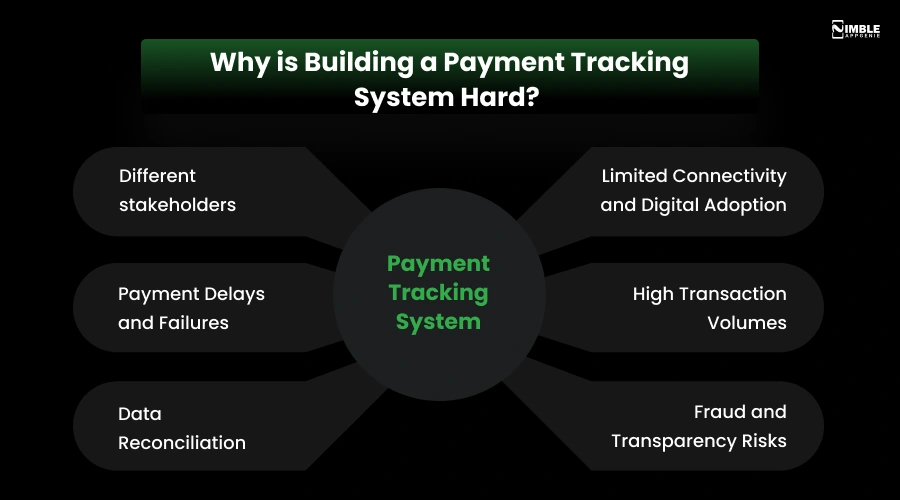
1. Different stakeholders
Farmers, aggregators, suppliers, banks, and retailers can all use different systems and payment methods; hence, building a combined system that caters to the needs of all can be hard to build.
2. Payment Delays and Failures
Payment delays and failures can be a reason, as bank delays, failed transactions, partial payments, and duplicate payments can make it difficult to know the true payment status. It provides real-time visibility and automates follow-ups.
3. Data Reconciliation
Data reconciliation is the core reason for building a payment tracking system for agri supply chains because the payment records must be matched with invoices, purchase orders, delivery quantities, and farmer records. Here, even small mismatches can create disputes.
4. Limited Connectivity and Digital Adoption
Argiculture majorly belongs to rural areas. These rural areas may have unreliable internet access, while some farmers or suppliers may still rely on cash and manual records. Thus, building a payment tracking system for these areas can be challenging.
5. High Transaction Volumes
High transaction volumes create massive data volume, which makes manual tracking impossible. Especially during the harvest seasons, thousands of payments are made that need to be tracked and reconciled quickly. Here, a payment tracking system automates reconciliation, prevents revenue loss, and provides real-time financial visibility.
6. Fraud and Transparency Risks
The system must provide a reliable audit trail to prevent payment manipulation and ensure that suppliers receive the correct amount. The growing fraud risk in payments can be a major reason, but they come with inherent risks for businesses and consumers.
Now, as you are well aware, building a payment tracking system for agri supply chains helps you get ahead with the steps to create payment tracking systems for agri supply chains.
How to Build Payment Tracking Systems for Agri Supply Chains?
The complete process adopted by top engineers at Nimble AppGenie begins with identifying the payment flow in agri supply chains, choosing the digital payment rails, designing the payment data models, integrating payment rails, adding reconciliation, and then testing.
Here is the complete list of how to create a payment tracking system for agri supply chains:
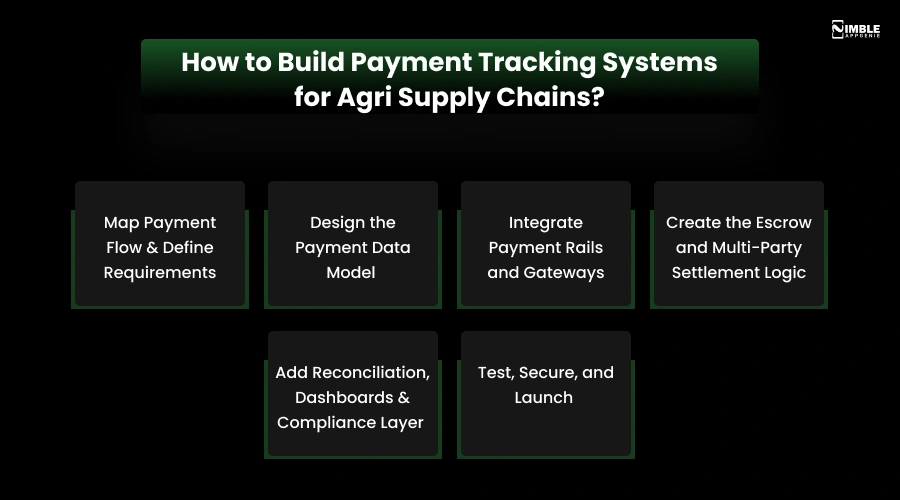
Step 1: Map Payment Flow & Define Requirements
This is the foremost step, where you need to map the payment flow and define the requirements. For mapping a payment flow and defining requirements, you should outline the lifecycle of a transaction from initiation to reconciliation.
Here’s how you need to map the payment flow and define requirements:
- Evaluate the working process of your app.
- Identify the transaction flows and where they are getting ahead.
- Analyse the needs of agricultural supply chains.
- Comprises documenting the end-to-end journey of a transaction.
Step 2: Design the Payment Data Model
To design a robust payment data model, core entities should define payment layers from pending, escrow, released, and settled. It handles thousands of transactions daily, with efficient management of user accounts, transaction records, and security measures.
- Design a robust payment data model, separate the intent, and create immutable audit logs.
- Link financial transactions directly to the physical inventory moments and multi-tier actor milestones.
- Designing the database for the payment system comprises considerations such as user management and real-time updates.
Bonus Read: Fintech App Design
Step 3: Integrate Payment Rails and Gateways
Payment rails and gateways are the infrastructure and networks that enable money to move between financial institutions, businesses, and individuals. They define the rules, protocols, and pathways through which payment information and funds travel.
- Connect your app to a payment gateway API
- Capture the payment events via webhooks.
- Build a complete payment tracker system that should comprise payment state, ledger, refunds, and reporting, as per the requirements of the app.
Step 4: Create the Escrow and Multi-Party Settlement Logic
Now, it’s time to create an Escrow and a multi-party settlement that helps deliver collaborative B2B projects, marketplace transactions, joint ventures, and partnerships, and that helps to make the compliance and governance system simple.
- Learn to handle legal compliance and secure fund holdings.
- Design a state machine that tracks deposits.
- Validate conditional milestones among different stakeholders.
- Execute the waterfall settlement process.
Step 5: Add Reconciliation, Dashboards & Compliance Layer
The right step to add reconciliation, dashboards, and the compliance layer is the Fintech Operations Infrastructure Implementation Phase. It occurs immediately after the core ledger and transaction processes.
- It requires a decoupled architecture where the core data flows into modules.
- Implementing the dashboard layer.
- Adding and implementing the reconciliation layer.
- Connecting with experts like Nimble AppGenie to create these three layers for your app.
Step 6: Test, Secure, and Launch
To create a payment tracking system for agri supply chains, you should test the complete systems, needs to offer security. And then launch it. Without testing the payment system, you cannot rely completely on the security. Hence, you should go for:
- A unit test, conduct offline syncs, test user workflows, and test load capacity.
- For security, you should follow a robust security approach, using multi-factor login.
- To launch, train the farmers and suppliers on how to use the app.
That’s how you can build and launch a payment tracking system for the agri supply chains.
Well, for building this payment tracking system for the agri supply chains, you should consider the complete cost factor. In the next section, lets count on the cost estimation to build payment tracking systems for agri supply chains.
What’s the Cost to Build a Payment Tracking System for Agri Supply Chains?
The overall cost to make a payment tracking system for agri supply chains can vary from $40,000 to $250,000+. Different factors impacting the complete cost include feature scope, technology stack, integrations, and the development team.
Here’s the complete cost breakdown for the cost to create a payment tracking system:
| Complexity Tier | Cost Range | What’s Included |
| Basic / MVP | $40,000 – $70,000 | Single payment gateway integration, basic transaction ledger, simple dashboard, manual reconciliation, standard user roles (farmer/buyer). |
| Mid-Range | $70,000 – $150,000 | Multiple payment rails, automated reconciliation, escrow/milestone-based release logic, real-time notifications, KYC/AML compliance module, admin analytics dashboard. |
| Advanced / Enterprise | $150,000 – $250,000 | Multi-party settlement engine, blockchain-based audit trail, offline/low-connectivity sync for rural users, custom ERP/accounting integrations, advanced fraud detection, multi-region compliance. |
| Custom / Large-Scale | $250,000+ | Full-scale platform for high transaction volumes, AI-driven fraud/anomaly detection, multi-currency and cross-border settlement, dedicated infrastructure, ongoing DevOps/maintenance. |
Different factors do have a core impact on building a payment tracking system for agri supply chains, such as system complexity, offline-first mobile capability, and regulatory compliance across different regions.
Here is a question that is most often asked: “How does a payment tracking system work in an agricultural supply chain?”
A payment tracking system in an agricultural supply chain uses digital tools, smart contracts, and ledgers to record, verify, and automate the financial transactions between the farmers, middlemen, and processors.
Also Read: Fintech App Development Cost
Now, let’s get ahead of the diverse challenges that you might face in creating the payment tracking system for agri supply chains in the next section.
Challenges to Create a Payment Tracking System For Agri Supply Chains
Different challenges that you might face range from ensuring fair prices for farmers to battling inefficiencies in the supply chains. Additionally, inconsistent weighing practices and tampered records during procurement are other issues to watch out for while building a payment tracking system.
Here is the list of challenges that you should consider:
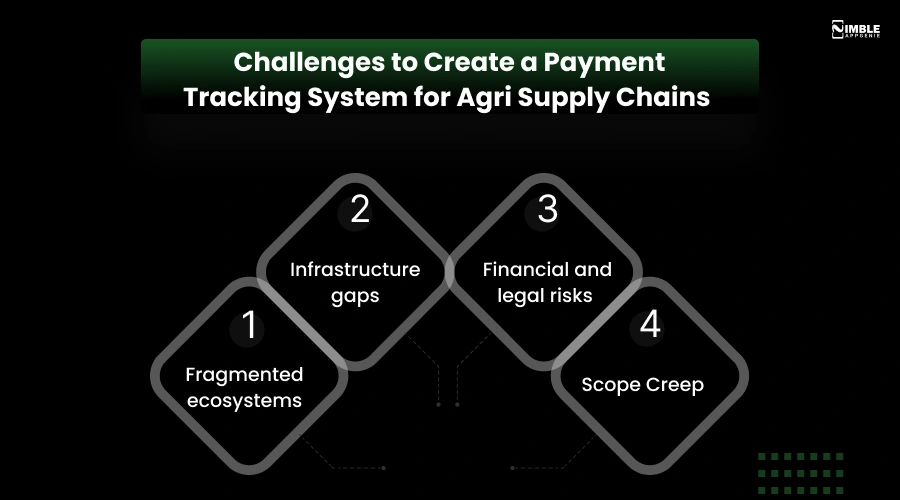
► Fragmented ecosystems
Fragmented ecosystems are a key challenge because it causes major delays and errors while creating a payment tracking system.
It forces a single system to connect with thousands of incompatible networks. And there is rarely a single, standardized flow for who buys, who pays, and how transactions are recorded.
► Infrastructure gaps
Infrastructure gaps can be a major issue, as it disrupts the continuous flow of data and transactions. It can cause poor internet connection, unreliable power, and low digital literacy, along with fragmented transport networks.
It refers to missing physical, digital, and institutional foundations that prevent smooth and real-time financing.
► Financial and legal risks
Financial and legal risks are another key challenge in payment tracking systems because errors cause major money loss, broken contracts, and heavy fines. Here, the financial risks comprise payment errors, fraud, and transaction costs.
It is a major risk because it helps to deal with sensitive financial information and potentially coordinating transactions between farmers, buyers, and payment providers.
► Scope Creep
If you are not clear about the requirements for building a payment tracking system for agri supply chains, then it can result in an app failure, as you will not be aware of the app’s goal.
Additionally, agricultural supply chains are highly volatile, multi-layered, and unstandardized, that result in failure of your supply chain project.
To overcome these challenges, you should connect with the right team of developers such as Nimble AppGenie.
Which is the Best Company to Create a Payment Tracking System For Agri Supply Chains?
Nimble AppGenie is the best fintech app development company, whose experts are masters in delivering effective payment solutions. Here, engineers build secure, compliance-ready fintech architecture with dual-sided visibility.
Rather than using general templates, our developers design custom eWallet and banking solutions that integrate seamlessly with the core financial software and banking APIs. This setup ensures transaction transparency and multi-layered fraud prevention.
Here’s why connect with Nimble AppGenie:
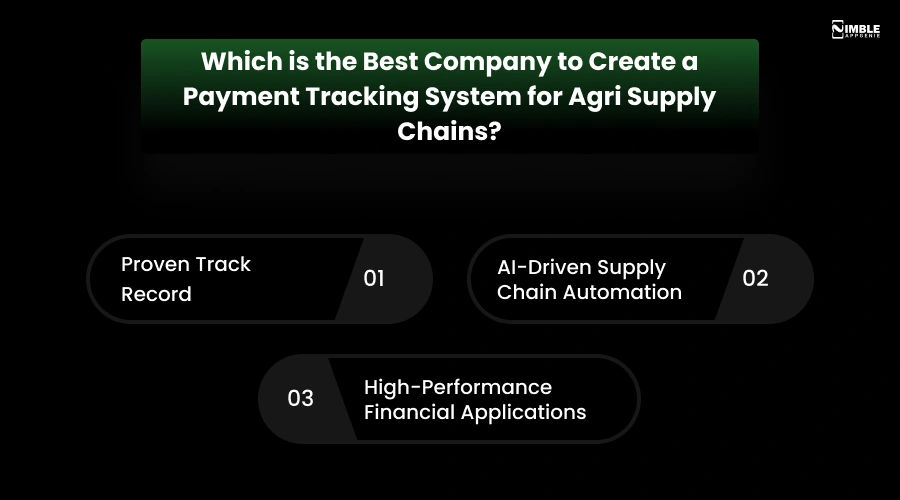
♦ Proven Track Record
Nimble AppGenie maintains a proven track record in agricultural supply chains by translating its deep core competencies into fintech and logistics software development. We have delivered 350+ software solutions in fintech.
♦ AI-Driven Supply Chain Automation
The experts at Nimble AppGenie offer AI-driven supply chain automation solutions, and they operate as a custom software, web, and mobile app development company that focuses heavily on fintech and general logistics engineering.
♦ High-Performance Financial Applications
Nimble AppGenie delivers high-performance financial applications by combining an AI-native engineering foundation and strict regulatory compliance from day one. The company integrates scalable cloud infrastructure and optimized tech stacks such as Python and Node.js.
By connecting with this leading fintech software development company, you can build your customized solutions.
Conclusion
You can create a payment tracking system by mapping the payment flow, designing the payment data model, integrating the payment data model, creating the Escrow, and testing the complete app.
While building the payment tracking system, different challenges include a fragmented ecosystem, infrastructure gaps, and scope creep. To adopt the best solutions, you should connect with the best company.
FAQs
A payment tracking system in agriculture supply chains is a digital tool that records and monitors the transactions between buyers, farmers, and processors. The core functions comprise transaction processing, digital payouts, and audit trails.
The overall cost to create a payment tracking system varies $40,000 to $250,000+. There are many factors impacting this cost that vary by system complexity, offline-first mobile capability, and regulatory compliance across different regions.
Building a payment tracking system is hard because of different stakeholders, payment delays and failures, data reconciliation, limited connectivity, high transaction volume, fraud, and transparency.
You can create a payment tracking system by mapping the payment flow, designing the payment data model, integrating payment rails, creating the escrow, adding reconciliation, testing, and launching the payment tracking system.
The challenges comprise a fragmented ecosystem, infrastructure gaps, financial and legal risks, and scope creep. To resolve these major hurdles, you should connect with a leading company.
To prevent payment fraud in agricultural transactions, use secure digital services that hold funds until the delivery is confirmed. Through robust security features, you can enhance the security of your app.

Niketan Sharma, CTO, Nimble AppGenie, is a tech enthusiast with more than a decade of experience in delivering high-value solutions that allow a brand to penetrate the market easily. With a strong hold on mobile app development, he is actively working to help businesses identify the potential of digital transformation by sharing insightful statistics, guides & blogs.
Table of Contents




No Comments
Comments are closed.