

 Free Consultation
 PCI-DSS Compliant
 GDPR Ready
 ISO 27001
 NDA Protected
 AI Services
 AI App Development
 Generative AI Development
 AI Chatbot Development
 AI Integration Services
 AI Consulting Services
 AI For Fintech
 AI Financial Assistant Solution
 AI Insurance Agent Development
 Tech Stack
 OpenAI / GPT-4
 Claude / Anthropic
 Gemini / Google AI
 Llama / Open Source
 LangChain / LlamaIndex
 Pinecone / Pgvector
 AWS / Azure AI


 Fintech Solution
 Core Fintech
 App Development
 Neobank Solutions
 eWallet Solutions
 Lending Software
 Banking Solutions
 BNPL Solutions
 BNPL Solutions
 Insurance App
 Wealth Management
 Crypto & DeFi
 Blockchain Development
  Payroll Software
 DeFi Solutions
 Crypto Wallet
 Crypto On/Off Ramp
 Crypto Exchange
 Trading Platform
 Payments
 Compliance
 Regulations & Compliance
 Fraud Detection
 Lending Ecosystem
 P2P Lending Platform
 Mortgage Software
 Engagement
 Fintech Outsourcing

 Mobile Development
 Mobile App Dev
 iOS App Development
 Android App Development
 React Native
 Flutter Development
 Web Solution
 Node.js Development
 React.js Development
 Angular Development
 App Services
 UI/UX Design
 App Maintenance
 By Stage
 MVP Development
 Industry Solutions
 Healthcare App Dev
 Education App Dev
 Travel App Dev
 Real Estate App Dev
 Logistics Software
 Social Media App

 Hire Mobile Developers
 Hire iPhone Developers
 Hire Android Developers
 Hire React Native Devs
 Hire Flutter Developers
 Hire Web Developers
 Hire Node.js Developers
 Hire Angular Developers
 Hire PHP Developers
 Hire Laravel Developers
 How It Works
 Pre-Vetted Developers
 Ready In 48 Hours
 NDA From Day One
 Replace Guarantee
 Company
 About Us
 Our Work Process
 Portfolio
 Case Studies
 Blog / Insights
 Careers
 Contact Us
 Awards
 Recognition


 Offices



Key Takeaways:
- Real-time payment reconciliation for fintech apps replaces slow, error-prone batch reviews by matching transactions against the bank and PSP records.
- The core reasons for the need for real-time reconciliation are timing differences, hidden operational costs, offers deployed visibility.
- Real-time reconciliation systems need unique transaction identification, event-driven updates, stream processing, idempotent processing, and exception management.
- The steps to be taken to build a real-time payment reconciliation system are designing a unique ID, selecting event-driven integration, building classification, creating exceptions, and performing a continuous audit.
- Partnering with the right company, such as Nimble AppGenie, can help you build effective real-time payment reconciliation for fintech apps.
What if your ledger says one number, your bank statement says another, and somewhere in between, a customer is waiting for payment that needs to be cleared?
This is the gap that real-time payments can close for your fintech app. Instead of waiting for end-of-day batches to catch errors, real-time payment reconciliation for fintech apps matches each transaction against the bank and processor records.
If you are a fintech startup or a fintech entrepreneur, catching the matches in minutes for your customers is important. Therefore, real-time payment reconciliation for fintech apps plays a critical role here. It helps to catch mismatches in minutes, not just in weeks.
In this guide, we will walk you through the complete information related to the concept of real-time payment reconciliation, reasons, steps to build it, and diverse challenges.
Let’s get started.
What is Real-Time Payment Reconciliation?
Real-time payment reconciliation is the continuous, automated process of matching incoming and outgoing payments with the corresponding transactions in your accounting, banking, and payment systems as soon as the payment happens.
These funds can assist with instant fund availability, finality, and transparency. Unlike traditional payment methods, RTP can settle transactions within seconds, offering immediate confirmation and clearance between the sender and receiver.
These reconciliation statements are an instant, automated process that replaces the old methods that wait for monthly batch reviews.
When it comes to fintech, it is an automated process of verifying operational truth through matching internal transactions against PSPs and banks.
It is one of the global trends in instant payment technologies followed by fintech apps.
How Does Real-Time Payment Reconciliation Work?
Real-time payment reconciliation continuously matches and validates the financial transactions across the systems as they happen instead of using end-of-day batches.
Why Manual and Batch Reconciliation Breaks Down For Fintechs?
The major pain points of fintechs are the timing gap problem and the hidden operational cost of manual matching, where not every mismatch is an error.
Here is the list of reasons why manual and batch reconciliation break down for fintechs:
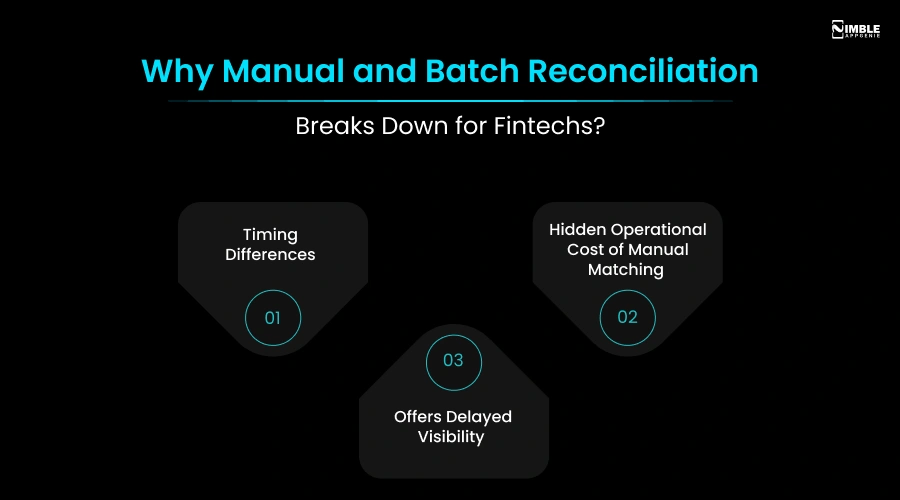
► Timing Differences
Sometimes the transactions that are processed on the 31st that hit bank feeds on the 1st generate false mismatches, without any rules for timing gaps, where these teams must manually clear these errors every month-end.
The real-time payment rails settle in seconds, while the batch reconciliation still runs overnight; that creates blind spots in live cash visibility.
► Hidden Operational Cost of Manual Matching
The batch reconciliation breaks down because the transaction volume grows faster and higher than human capacity. Different reasons include linear cost growth, slower settlements, high error rates, and engineering drain.
Here, the finance teams spend hours daily cross-referencing PSP reports and internal ledgers by hand. This increases errors and leads to failure of fintech apps.
► Offers Delayed Visibility
The time gap in transactions results in delayed visibility by creating a time gap between when a transaction happens and when it is recorded.
Manual bank reconciliation is an incredibly time-intensive process that pulls your finance professionals away from strategic and value-adding activities.
Many fintech startups often ask, “What if you ignore real-time payment reconciliation?”
Well, it will lead to a disaster for your fintech app. For identifying manual and batch reconciliation.
The Real Cost of Poor Payment Reconciliation
Delayed invoice payments are choking small businesses’ cash flow, which creates severe direct and hidden costs that extend far beyond simple spreadsheet errors. It even triggers compounding revenue leakage and critical regulatory non-compliance.
The revenue leakage from unresolved or unnoticed mismatches costs more for fintech apps. Here, the customer trust risk arises when balance, payout, or refund errors reach the end users.
The real cost even results in lost or trapped revenue, higher operational costs, delayed cash visibility, and customer dissatisfaction.
Implementing the reconciliation system for fintech apps can increase the overall cost to build a fintech app, but it will resolve most of your payment errors.
Many fintech startups and enterprises often ask, “How can they build a real-time reconciliation system? Or “What do real-time reconciliation systems actually need?”
What Do Real-Time Reconciliation Systems Actually Need?
Real-time reconciliation systems require live data ingestion via APIs, high-speed streaming engines, and data normalization.
Let’s learn what they need in depth:
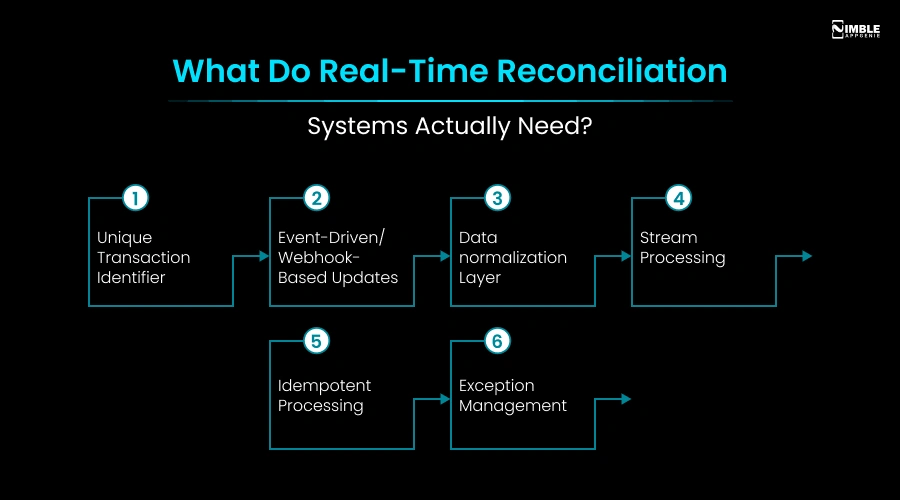
♦ Unique Transaction Identifier
Real-time reconciliation uses the unique transaction identifier as a permanent digital anchor. It is a specific reference attached to a financial transaction, user, or partner in an electronic payment system.
These identifiers instantly connect internal ledger entries and external bank statements by matching the precise alphanumeric strings when the movement data event occurs.
♦ Event-Driven/Webhook-Based Updates
The event-driven and webhook-based updates replace slow polling by instantly pushing HTTP POST notifications from a source system to a reconciliation engine.
The main purpose of webhook-based updates is it significantly accelerate financial matching by shifting systems from manual or batch-oriented processing to the millisecond level.
♦ Data-normalization Layer
A data-normalization layer standardizes the incoming data formats into a single unified format. It removes redundancies and delivers consistent, structured, and easily queryable data within the databases.
The main goal of the data normalization layer in real-time payment reconciliation is to achieve a standardized data format across the entire system.
♦ Stream Processing
Stream processing is one of the most crucial components of real-time payment reconciliation systems. It continuously ingests, analyzes, and acts on data as it is generated, providing valuable insights without delay.
In real-time reconciliation systems, stream processing detects discrepancies, missing payments, and data mismatches within milliseconds of their occurrence using tools such as Apache Flink.
♦ Idempotent Processing
Idempotent processing is crucial in real-time reconciliation systems, and it matters because it ensures that the same event is processed only once the same result without creating any duplicate records.
Idempotent processing allows systems to retry on failed networks without fear of any side effects.
♦ Exception Management
Exception management in the real-time payment reconciliation system is the automated procedure of detecting, isolating, and resolving transaction mismatches the moment they occur.
Instead of halting the transaction flow, the system flags outliers such as mismatched amounts, missing settlements, and duplicate payments on live dashboards.
Now, let’s get ahead with how to create a real-time reconciliation system in your fintech app in the following section.
How to Build Real-Time Reconciliation Into Your Fintech App?
The key steps to build a real-time reconciliation system into your fintech app begin with setting up the unified data pipeline, choosing the event-driven integration, building break classification, making every event idempotent, and monitoring continuously post-launch.
Here’s the step-by-step process to create real-time reconciliation in your fintech app:
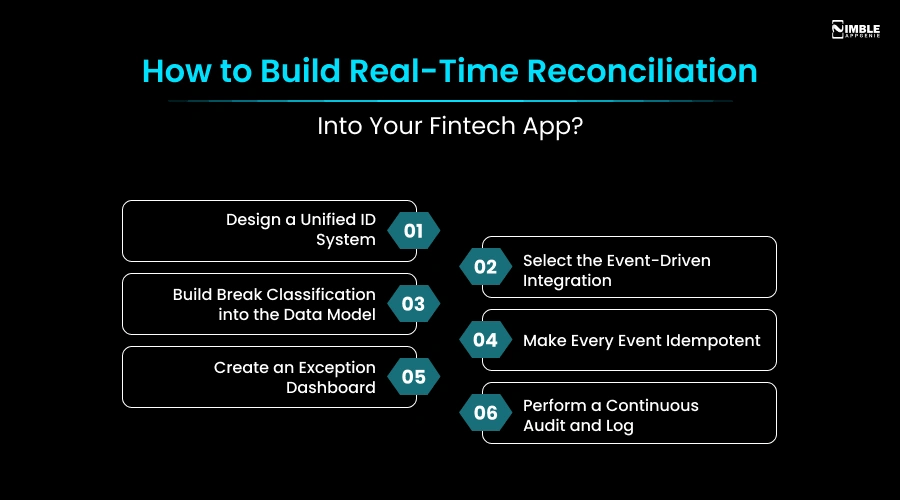
Step 1: Design a Unified ID System
For designing a unified ID system, you should create a globally unique and immutable transaction ID that links the order, the payment attempt, the processor’s transaction record, and the settlement batch.
Core components include:
- Timestamp
- Node Identifier
- Sequence Number
Step 2: Select the Event-Driven Integration
To select an event-driven integration for a real-time reconciliation system, you should define data throughput and latency limits. Now, you should connect with your PSPs and banking partners through webhooks and real-time event streams instead of scheduled file pulls. This is what makes reconciliation “real-time” instead of just “faster batch processing”.
Core Components include:
- Event producers
- Event routing and management
- Event consumers
Step 3: Build Break Classification into the Data Model
To build the break classification into the data model, you need to define a clear taxonomy of break types, including planned, unplanned, and systemic cycles. Don’t just flag “mismatch” or unmatched; structure the complete system to auto-tag as timing delays, fees, or true errors.
Core components include:
- Data ingestion and state
- Taxonomy & storage
- Classification engine
Step 4: Make Every Event Idempotent
Under this step, you should design the system so effectively that a repeated “payment settled” webhook cannot be processed twice. Additionally, duplicate events are one of the most common causes of false reconciliation errors at scale.
Core components include:
- Unique event identifier
- Idempotency repository
- Transactional lock manager
- Idempotency key
Step 5: Create an Exception Dashboard
For building an exception dashboard, one should build a centralized UI that ingests live event streams via WebSockets and provides one-click workflows for manual reviews.
Core components include:
- Summary metrics
- Tirage queue
- Detail drawer
- Action toolbar
Step 6: Perform a Continuous Audit and Log
Now, under this step, you should perform a regular audit and log that helps your business to identify any errors automatically before they can create blunders for your fintech app. This step comprises real-time reconciliation by capturing the immutable event streams.
Core components include:
- Automated transaction matching
- Real-time audit
- Continuous data ingestion
- Secure audit trail
In this process of building real-time payment reconciliation, you might face certain challenges; let’s examine them all in the following section.
Challenges and Best Practices For Real-Time Reconciliation For Fintech Apps
First lets talk about the challenges, such as data system challenges, operational and logic challenges, along with the security challenges.
These challenges can occur due to several factors, such as high data volume, distributed systems, and network latency.
Along with the challenges, let’s look at the best practices:
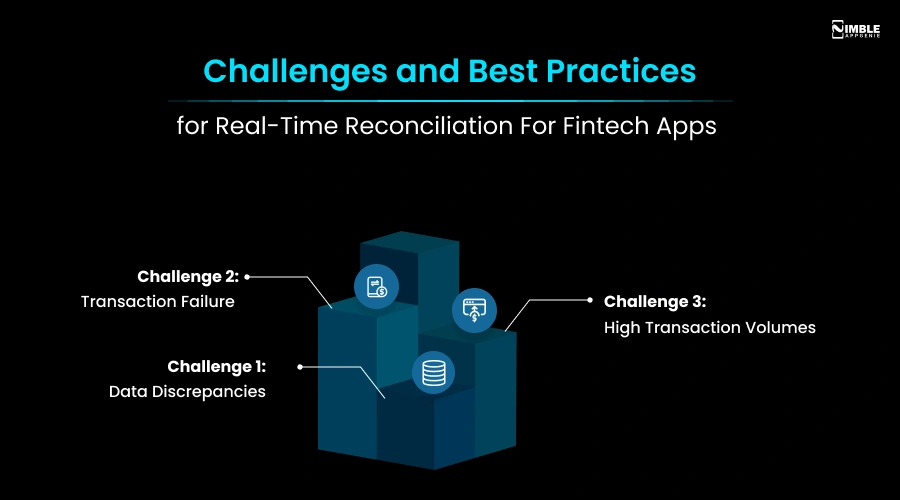
1. Data Discrepancies
The wrong data sources from disparate systems can lead to mismatches in transactions, which even require time-intensive manual corrections. It breaks the automated matching rules, causes delays in transaction settlements, and can cause fraud.
Solution :
The right solution for real-time payment reconciliation discrepancies is an automated exception workflow management system.
2. Transaction Failure
While implementing or building real-time reconciliation for fintech apps, you might face the challenge of transaction failure. If you already have a fintech app and want to add real-time reconciliation, transaction failure can be the core challenge.
Solution :
To resolve it, you need to connect with experienced developers such as the engineers at Nimble AppGenie, who can help you create a unique ID solution for your platform without any downtime for your app.
3. High Transaction Volumes
High transaction volumes can break or impact the fintech app’s security. Therefore, processing and managing the thousands and millions of transactions requires robust infrastructure.
Solution :
Build a highly scalable infrastructure that can help process trillions of transactions on a daily basis. Here, you need scalable infrastructure and efficient processing.
Thus, connecting with an experienced team of experts is important at this point.
Which is the Best Real-Time Payment Reconciliation For Fintech Apps?
Nimble AppGenie is the best fintech app development company that is capable of resolving your real-time issues of fintech apps by building ledger accuracy and automated reconciliation logic into your app’s core architecture.
Here’s why you need to select Nimble AppGenie:
- The developers offer custom architecture for your fintech apps.
- Implements robust backend stacks to support real-time payments.
- Nimble AppGenie is the leading fintech software development company that connects multiple payment gateways.
- Has proven expertise in fintech and has delivered 350+ apps.
Conclusion
Real-time reconciliation for fintech apps matters, as it helps businesses to have an automated process of matching incoming and outgoing payments with the corresponding transactions.
Different reasons why manual and batch reconciliation break down for fintech are timing differences, hidden operational costs of manual matching, and delayed visibility.
It is a complete process that begins with designing a unified ID, selecting event-driven integration, making every transaction idempotent, and creating an exception dashboard.
The key challenges to overcome here are data discrepancies, transaction failures, and high transaction volumes. You should connect with an experienced team to build a real-time reconciliation for fintechs.
FAQs

Niketan Sharma, CTO, Nimble AppGenie, is a tech enthusiast with more than a decade of experience in delivering high-value solutions that allow a brand to penetrate the market easily. With a strong hold on mobile app development, he is actively working to help businesses identify the potential of digital transformation by sharing insightful statistics, guides & blogs.
Table of Contents




No Comments
Comments are closed.