

 Free Consultation
 PCI-DSS Compliant
 GDPR Ready
 ISO 27001
 NDA Protected
 AI Services
 AI App Development
 Generative AI Development
 AI Chatbot Development
 AI Integration Services
 AI Consulting Services
 AI For Fintech
 AI Financial Assistant Solution
 AI Insurance Agent Development
 Tech Stack
 OpenAI / GPT-4
 Claude / Anthropic
 Gemini / Google AI
 Llama / Open Source
 LangChain / LlamaIndex
 Pinecone / Pgvector
 AWS / Azure AI


 Fintech Solution
 Core Fintech
 App Development
 Neobank Solutions
 eWallet Solutions
 Lending Software
 Banking Solutions
 BNPL Solutions
 BNPL Solutions
 Insurance App
 Wealth Management
 Crypto & DeFi
 Blockchain Development
  Payroll Software
 DeFi Solutions
 Crypto Wallet
 Crypto On/Off Ramp
 Crypto Exchange
 Trading Platform
 Payments
 Compliance
 Regulations & Compliance
 Fraud Detection
 Lending Ecosystem
 P2P Lending Platform
 Mortgage Software
 Engagement
 Fintech Outsourcing

 Mobile Development
 Mobile App Dev
 iOS App Development
 Android App Development
 React Native
 Flutter Development
 Web Solution
 Node.js Development
 React.js Development
 Angular Development
 App Services
 UI/UX Design
 App Maintenance
 By Stage
 MVP Development
 Industry Solutions
 Healthcare App Dev
 Education App Dev
 Travel App Dev
 Real Estate App Dev
 Logistics Software
 Social Media App

 Hire Mobile Developers
 Hire iPhone Developers
 Hire Android Developers
 Hire React Native Devs
 Hire Flutter Developers
 Hire Web Developers
 Hire Node.js Developers
 Hire Angular Developers
 Hire PHP Developers
 Hire Laravel Developers
 How It Works
 Pre-Vetted Developers
 Ready In 48 Hours
 NDA From Day One
 Replace Guarantee
 Company
 About Us
 Our Work Process
 Portfolio
 Case Studies
 Blog / Insights
 Careers
 Contact Us
 Awards
 Recognition


 Offices



TL;DR
- Software release management for fintech apps is the complete structured process that begins with the planning, testing, and even scheduling of updates to code, flags, databases, etc.
- Fintech software release is important because it accelerates time to market, manages risks, enhances collaboration, boosts customer satisfaction, and enables continuous improvement.
- The process begins with planning, branching, development, automated testing, data/schema, deployment to staging, and production deployment.
- Signs that your release process is holding you back are long lead times, poor planning, data uncertainty, and ineffective communication.
- Best practices to adopt are end-to-end product, CI/CD build, and structured agile planning.
- Partnering with Nimble AppGenie can help you build customized release management for fintech apps.
What if your fintech app pushes a routine Friday update, and suddenly, within minutes, all the payments starts falling, and KYC checks time out.
This is not due to any bug; this is a release management failure. Hence, it results in a high business risk with a large price tag.
So, what is software release management for a fintech app, and how to avail it?
Software release management for a fintech app is a compliance checkpoint, a trust safeguard, and a line of defense against any costly downtime. It is a change list and management process that saves your app even during and after development.
To avail it, you need to connect with the right team of developers, such as Nimble AppGenie.
As a fintech startup and a business owner, you should be very well aware of fintech software releases; if not, don’t worry.
This guide covers it all, from concept, importance, process, and best practices.
Let’s get started.
What is Software Release Management?
Software release management is all about managing the changes that get released into the environments. But here, the changes include more than the code edits performed by the developers.
It also includes:
- Configuration/ flags
- Database schema
- Infrastructure changes
- Security or any dependency updates.
Software release management is the complete process of planning, scheduling, controlling,
and coordinating software builds across different environments, all the way to production. It encompasses release and deployment management as well as service management.
Software release management serves as an organizational bridge among developers, testers, and operations to deliver new features and software without bugs.
It involves coordinating the efforts across teams to ensure that the software is delivered efficiently, reliably, and with minimal risk.
This is the modern software development discipline that streamlines the complete process from ideation to release.
Whether you have completed the fintech app design or even the complete development, software releases, updates, and changes are possible.
But what is the major difference between software release management and deployment management?
Well, let’s explore it in the next section.
Release Management vs. Deployment Management
Deployment management refers to the complete process for making the software available on the target environments, including the servers, execution, and cloud platform. Here, the deployment focuses on ensuring that the software is correctly installed and is ready to be executed.
On the other hand, release management refers to the complete process of making the deployed software available to the end users. The primary objective of releasing software is to make the software available to the end users and to the other stakeholders.
Here is the list of key differences between release management vs deployment management:
| Release Management | Deployment Management |
| Manages the overall release lifecycle and changes. | Manages the technical rollout of software. |
| Covers planning, testing, approvals, and release coordination. | Focuses on moving code from one environment to another. |
| Broader process focused on what, when, and why. | Specific process focused on how and where. |
| Example: Planning a new fintech app version. | Example: Deploying that version to production. |
Well, here, one of the crucial question arises: how is a complete process of software development different from release management?
Basically, during development, you focus on the complete SDLC (software development life cycle). But release management is the work after development; here you will evaluate what changes need to be made in the software.
One of the important points here is that, under the development cycle, it is till the development and launch take place. While release management can take place during development of the software, or after development and before launch, and even after launch.
It happens when changes are required to be made in the software.
You must be very clear about software release management and how it makes a difference from deployment management.
But why is it important for fintech applications?
Well, there are different reasons; let’s learn them all in the next section.

Why is Software Release Management important for Fintech Apps?
There are many reasons why software release management is important for fintech apps, such as security and risk control, accelerating time to market, enhancing software quality, managing risks, and even helping to improve collaboration.
Here is the complete list of the reasons why software release management is crucial for fintech apps:
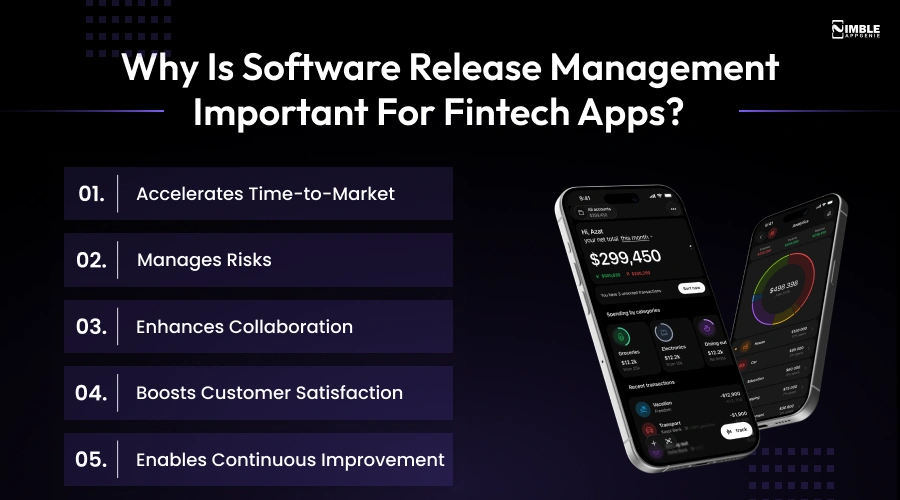
1. Accelerates Time-to-Market
Software release management assists fintech apps in launching faster by automating deployments, minimizing manual errors, and streamlining compliance checks. It assists teams in pushing secure code for fintech apps faster, with test updates, and by managing strict financial regulations smoothly.
2. Manages Risks
You can reduce the risks for financial apps by enforcing strict testing, along with rapid rollback plans. It breaks the large changes into smaller pieces and even creates plans to revert changes if an error occurs. The core purpose of release management is mitigating the operational, financial, and reputation risks.
3. Enhances Collaboration
Software release management for fintech apps enhances collaboration between the developers and businesses. It helps minimize bugs and maintain consistent performance across different environments. Software release management offers a single source of truth for schedules and aligns with cross-functional goals.
4. Boosts Customer Satisfaction
It helps to ensure new features, updates, and bug fixes arrive predictably, reliably, and with minimal service disruption. Boosting customer satisfaction via the software release means delivering valuable updates with zero downtime and even free of critical bugs. It helps in fixing annoying bugs, delivering new features, and improving overall performance.
5. Enables Continuous Improvement
Software release management enables continuous improvement as money is moving in real time. Here, failed payments and slow transaction processes, along with stuck payments, directly impact and affect customer funds. It helps to turn deployment into a short feedback loop.
Now, for these reasons, are you ready to comply with the fintech software release management processes?
Well, if yes, then let’s get ahead to the next section stating the complete process of fintech software release management.
What is the Fintech Software Release Management Process?
The right process for fintech software release management begins with planning, development, branching, automated testing, data schema, and production deployment.
Let’s learn all the steps in detail for the fintech software release management process:
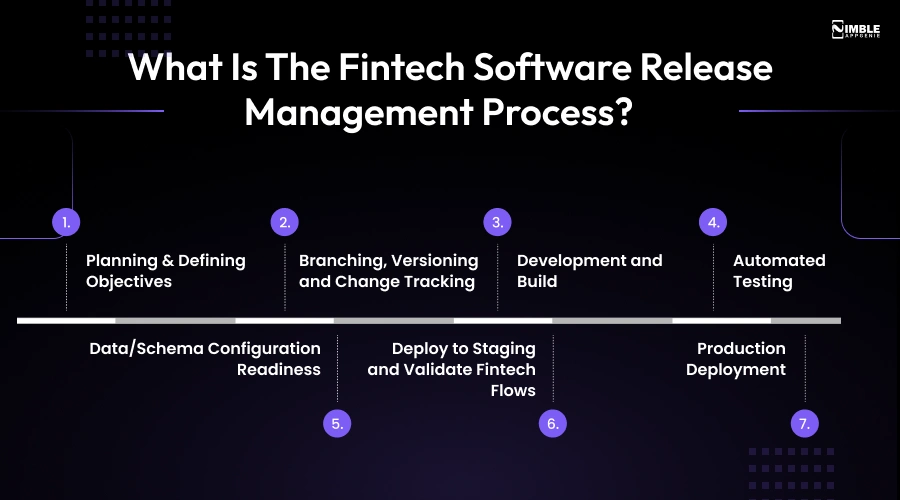
Step 1: Planning & Defining Objectives
A fintech software release management process is implemented with a defined purpose and goal. Planning for the software release management process includes allocating the right software functional resources.
This is what you need to adopt:
- Submit a request for new technology or changes to the existing software.
- Decide if it is a UI tweak or a payment-flow change that is required.
- Each request is evaluated for logic, feasibility, and whether it can be fulfilled by reconfiguring, that is an already-in-production app version.
Many fintech startups often ask, “What is the right plan to adopt fintech software release management for my app?”
The right plan to build and implement a fintech software management process will depend on your software and its overall requirements. You need to evaluate each request for logic and feasibility.
Step 2: Branching, Versioning and Change Tracking
Under branching, you create an isolated line of code that ensures code stability and bug fixes before deployment. Among the various branching strategies, release branching carves out a dedicated space for prepping the upcoming release version.
Here’s what you need to do:
- Need to opt for automated CI/CD pipelines
- Define the versioning rules
- Ensure that every release artifact is traceable and follows through code commits, builds, artifacts, and then deployment
This step is all about checking out what will change in the software. Here you will control and coordinate the changes that you roll out. It can be any type of change, such as configuration changes, database changes, patches, and rolling out changes.
Step 3: Development and Build
During this phase, all the software requirements are transferred into code. The new version that is designed is implemented into the software that will be executed here.
You need to ensure:
- Financial logic, data encryption, and fintech regulatory compliance are built into the software before it moves to testing.
- You should include the version control system, branching strategy, and code review standards for the financial-grade code.
- Manage the different code versions and branches to prevent any conflicts and to ensure that the release candidate is based on the most recent version of the code.
It is a vital step because it merges different code streams, resolves system dependencies, and runs initial checks to catch merge conflicts.
You should use controlled CI pipelines, produce immutable artifacts, and sign or attest the artifacts where possible.
Also Read: Fintech App Architecture
Step 3: Automated Testing
Automated testing under software release management replaces the slow, error-prone manual checks with fast and repeatable scripts.
As a fintech business, you need to opt for:
- Unit tests
- Integration tests
- Contract tests, including API and event schemas.
- Opt for security checks
- Conduct performance and regression tests if the change affects the critical paths.
AI debugging can also help developers identify and fix code issues before release, reducing the risk of errors that could affect payment processing and other critical functions.
The core benefits of automated testing under software release management is it offers consistency in the process, speed and accuracy, along with early defect detection with seamless regression testing.
Step 4: Data/Schema Configuration Readiness
The data and schema configuration readiness step ensures that all the database changes, scripts, configurations, and reference data are tested, valid, and well synchronized under the process.
Here’s what you need to know:
- It is the foundational blueprint for data configuration that ensures a fintech application can securely and efficiently handle financial data.
- Data schema stability guarantees stability in fintech and shapes data storage to meet strict legal requirements for fintech.
- Implement audit trails in the design to track every data change for financial auditors.
Now, with software release management, the next step is to deploy to staging and validate the fintech flows.
Step 5: Deploy to Staging and Validate Fintech Flows
This step helps to move the tested code into a near-production staging environment for running end-to-end checks for financial transactions and for regulatory rules. It includes moving your code to a test server that looks like the real app.
Here’s what you need to know in this step:
- Test the KYC/AML for fake user ID scans and name checks pass or fail correctly.
- Move the fake money using test credit cards or wire transfers.
- Verify that the third-party banks and the payment partners send status updates back to your app.
Use the fake money and even sandbox tokens to test complete transactions under software release management.
Step 6: Production Deployment
Production deployment is all about deploying your fintech release management for the fintech apps, and includes governance, real-time monitoring, and risk control of live financial environments.
This is what you need to do for your fintech app:
- Test your app thoroughly before shipping to production.
- Immediately check for the key business and technical signals. If metrics cross agreed limits, roll back or stop further rollout.
- Verify the dependencies, capacity, connectivity to payment, and confirm the right secrets are in place while adopting production deployment.
Here, many fintech firms often ask, “What is safe deployment in financial software? “
Safe deployment depends on your software and the effective security parameters that it uses for enabling software release management.
Have you implemented or adopted a software release management process yet? If yes, what is holding you back?
Well, there can be several reasons for this, such as manual processes, siloed teams, inadequate testing, and lack of visibility. In the following section lets check out all the concerned reasons.
Signs Your Release Process is Holding You Back
There are various signs that the software release process holds you back, such as it takes a long lead time to reach customer usage or testing. High lead times happen when deployments rely on manual approvals and handoffs between siloed teams.
Additionally, different challenges can be faced during fintech software release:
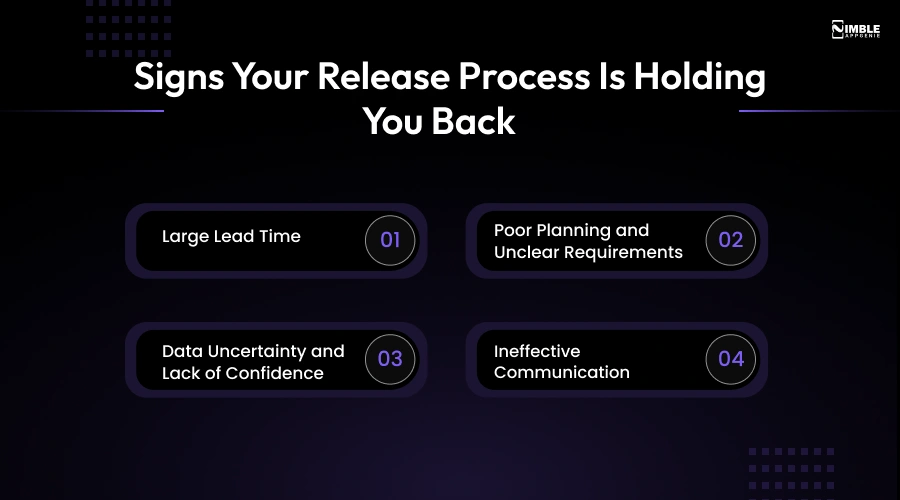
1. Large Lead Time
One of the core challenges fintech apps often face is software release management, which can lead to long downtime and even low release frequency.
It increases batch sizes and even the accumulated risk. The key factors that might cause delays for your fintech app here are large batches, complex dependencies, and limited automation.
2. Poor Planning and Unclear Requirements
Inadequate planning stands as one of the leading causes of software release delays for your fintech software. If there are no plans for proper software release management, you are setting your team up for failure from the start.
Additionally, if your goal for software release management is not clear, it can result in a failure of your process.
3. Data Uncertainty and Lack of Confidence
Data uncertainty and lack of confidence act as a bottleneck for fintech software because poor data security can create a huge risk to user trust among users. It can even result in losing your users.
When it comes to software release management, the lack of implementation of robust security measures in the process results in fintech software release failure.
4. Ineffective Communication
Release management comprises collaboration between different teams, where effective communication is important. However, poor communication often leads to confusion along with delays in the complete release process.
To enhance communication, enterprises should establish clear communication channels and a complete plan.
Following these challenges, there are certain best practices for a reliable fintech release management strategy that should be followed.
Best Practices for a Reliable Fintech Release Management Strategy
The key practices to adopt for a reliable fintech release management strategy comprise adopting automation, using feature flags, enhancing monitoring and observability, and streamlining communication and collaboration.
Here is a list of key practices for reliable fintech release management:
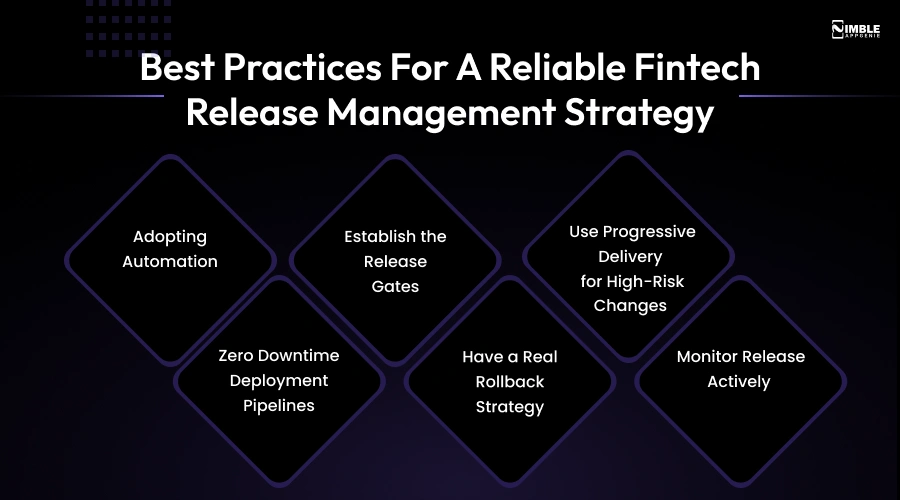
1. Adopting Automation
Adopting automation is the gateway to achieving success because it removes manual errors and cuts down on repetitive tasks. It frees up your human workforce so that they can focus on other strategy-based tasks.
2. Zero Downtime Deployment Pipelines
Zero-downtime deployment pipelines update the software without taking any application offline and interrupting user access. This strategy is helpful in stopping service drops and helps save money in case of fintech software release management.
3. Establish the Release Gates
Release gates are automated and manual quality checkpoints that software must pass before moving to production. When it comes to fintech, these release gates minimize the risks, ensure compliance, and prevent any downtime.
4. Have a Real Rollback Strategy
Having a real rollback strategy is a key practice for a reliable release management system that ensures safe recovery when the deployment fails. Adopting this strategy in fintech will help in stopping financial loss and protecting data integrity.
5. Use Progressive Delivery for High-Risk Changes
The release management software combines automated testing, canary deployments, and feature flags that help reduce the risk involved in high-risk changes. This practice is a fintech trend that enables quality assurance in fintech.
6. Monitor Release Actively
You need to monitor every set of software releases actively, which comprises real-time tracking of system performance, user feedback, and error metrics immediately after the deployment to ensure stability and quickly address operational anomalies.
Well, to adopt the right practices for your customized fintech software, you need to connect with the right company.
Which is the Best Company to Proceed with Software Release Management?
Nimble AppGenie is the best fintech software development company to proceed with software release management because the developers create a complete plan for your software when changes are required.
Our developers at Nimble AppGenie study every case thoroughly and help you to frame the complete plan for pursuing software release management.
This is what our developers offer:
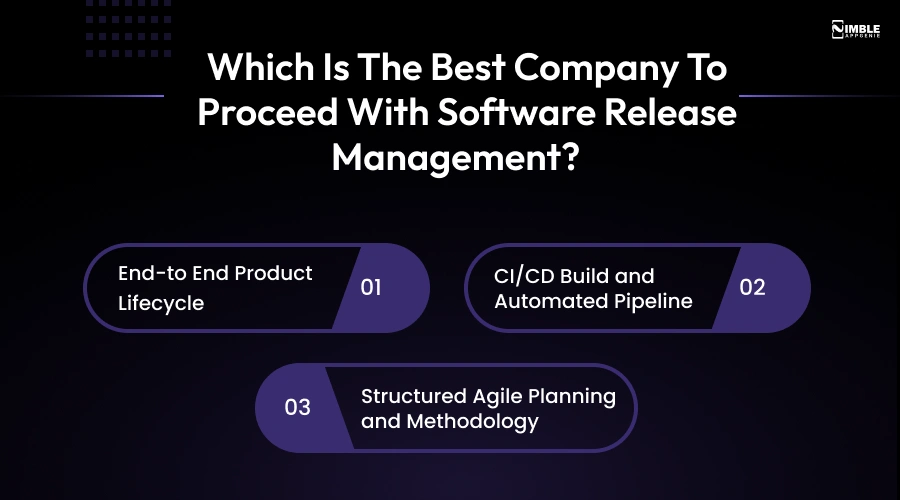
1. End-to End Product Lifecycle
Nimble AppGenie offers strategy and planning, UI/UX design, engineering and development, AI & compliance integration, and even offers maintenance and support. The company handles every phase of a digital product’s evolution from initial ideation to post-launch optimization.
2. CI/CD Build and Automated Pipeline
The developers of Nimble AppGenie offer CI/CD build and automated pipeline services where the company merges development and operations to eliminate deployment friction. It further comprises continuous integration, automated packaging, and visual workflows.
3. Structured Agile Planning and Methodology
Nimble AppGenie structured its agile planning and methodology by breaking projects into iterative and sprint-based cycles. It is the core process that combines discovery, AI-backed technical architecture, and continuous quality assurance.
By connecting with the best fintech app development company, you can build your customized software.

Conclusion
Software release management offers a well-structured framework to plan, schedule, control, and coordinate the software builds and updates from development through testing and live production. Here, the crucial reasons are accelerating time to market, managing risks, enhancing collaboration, boosting customer satisfaction, and enabling continuous improvement.
The right process for fintech software development begins with planning, branching, development, automated testing, data configuration, deploying to staging, and production deployment.
The key practices that can be helpful here are adopting automation, establishing release gates, having a real rollback, using progressive delivery, and monitoring the release actively.
FAQs

Niketan Sharma, CTO, Nimble AppGenie, is a tech enthusiast with more than a decade of experience in delivering high-value solutions that allow a brand to penetrate the market easily. With a strong hold on mobile app development, he is actively working to help businesses identify the potential of digital transformation by sharing insightful statistics, guides & blogs.
Table of Contents




No Comments
Comments are closed.