

 Free Consultation
 PCI-DSS Compliant
 GDPR Ready
 ISO 27001
 NDA Protected
 AI Services
 AI App Development
 Generative AI Development
 AI Chatbot Development
 AI Integration Services
 AI Consulting Services
 AI For Fintech
 AI Financial Assistant Solution
 AI Insurance Agent Development
 Tech Stack
 OpenAI / GPT-4
 Claude / Anthropic
 Gemini / Google AI
 Llama / Open Source
 LangChain / LlamaIndex
 Pinecone / Pgvector
 AWS / Azure AI


 Fintech Solution
 Core Fintech
 App Development
 Neobank Solutions
 eWallet Solutions
 Lending Software
 Banking Solutions
 BNPL Solutions
 BNPL Solutions
 Insurance App
 Wealth Management
 Crypto & DeFi
 Blockchain Development
  Payroll Software
 DeFi Solutions
 Crypto Wallet
 Crypto On/Off Ramp
 Crypto Exchange
 Trading Platform
 Payments
 Compliance
 Regulations & Compliance
 Fraud Detection
 Lending Ecosystem
 P2P Lending Platform
 Mortgage Software
 Engagement
 Fintech Outsourcing

 Mobile Development
 Mobile App Dev
 iOS App Development
 Android App Development
 React Native
 Flutter Development
 Web Solution
 Node.js Development
 React.js Development
 Angular Development
 App Services
 UI/UX Design
 App Maintenance
 By Stage
 MVP Development
 Industry Solutions
 Healthcare App Dev
 Education App Dev
 Travel App Dev
 Real Estate App Dev
 Logistics Software
 Social Media App

 Hire Mobile Developers
 Hire iPhone Developers
 Hire Android Developers
 Hire React Native Devs
 Hire Flutter Developers
 Hire Web Developers
 Hire Node.js Developers
 Hire Angular Developers
 Hire PHP Developers
 Hire Laravel Developers
 How It Works
 Pre-Vetted Developers
 Ready In 48 Hours
 NDA From Day One
 Replace Guarantee
 Company
 About Us
 Our Work Process
 Portfolio
 Case Studies
 Blog / Insights
 Careers
 Contact Us
 Awards
 Recognition


 Offices


Key Takeaways:
- To design a fintech referral program, you should clarify the requirements, build the architecture, design the app, and then set up analytics.
- For enhancing trust economics, driving high LTV, and lowering the cost, it is important to design a fintech referral program.
- Overall cost to design the fintech user acquisition strategy varies from $1000 to $20,000+. This cost depends on the app requirements and target audience.
- Important pillars to opt for building the program are rewarding structuring design, frictionless sharing, compliance-first architecture, fraud prevention, gamification, and data attribution.
- Most fintech referral programs fail because of not offer the right incentives, overcomplicate the referral process, ignore the post-referral process, and fail to promote the program.
- Partner with Nimble AppGenie to build your customized fintech referral program.
To design a fintech referral program, you need to understand your fintech app requirements, create a complete architecture, integrate security measures, design the app, set up analytics, and test the complete fintech referral program.
You might have spent thousands of dollars on paid ads, and your CAC keeps growing, and your best users are already telling about your services to other users for free. So, why isn’t it turning into signups?
Well, the answer here is a lack of a fintech referral program or a poor fintech referral program.
As a fintech startup or a fintech entrepreneur, you should be worried about engaging and attracting the target audience, but you know well that your app has the potential to gain the attention of users.
A fintech referral program can be your solution. In this guide, we will walk you through the concept of a fintech referral program, reasons to invest in a fintech referral program, how to design a fintech referral program, and even the cost.
The team of Nimble AppGenie has also discussed the 6 pillars that is a practical strategy to create your fintech referral program.
Let’s get ahead with this together.
What is a Fintech Referral Program?
A fintech referral program is a growth marketing strategy that fintech firms adopt to reward their users for bringing in new customers. It is a motivation program for users of fintech apps developed by fintech companies, designed to inspire them to connect more customers to the fintech app or software.
These programs use double-sided incentives both for the person who shares the links and for the person who connects with the app via the shared link.
The key components includes here are the advocate (person who shares the link), the referral friend (who connects via the link), mutual rewards for both, and an automated verification tracking system that works only when a specific action is performed.
Now, as a fintech startup or an enterprise, one of the crucial points is ‘why start a fintech referral program?”
Even if you have a budget of lakhs for advertising, investing in building a fintech referral program can give you a strong identity among your users.
To convert your best fintech app ideas into reality, you should be aware of why you need to include a referral program strategy.
Why Start a Fintech Referral Program?
The fintech referral program works as word-of-mouth marketing that turns your genuine users into a distribution channel. This is a strategy that works on the ground level. Instead of paying thousands or lakhs for advertising, here you are investing in a successful outcome.
Here’s what you should know:
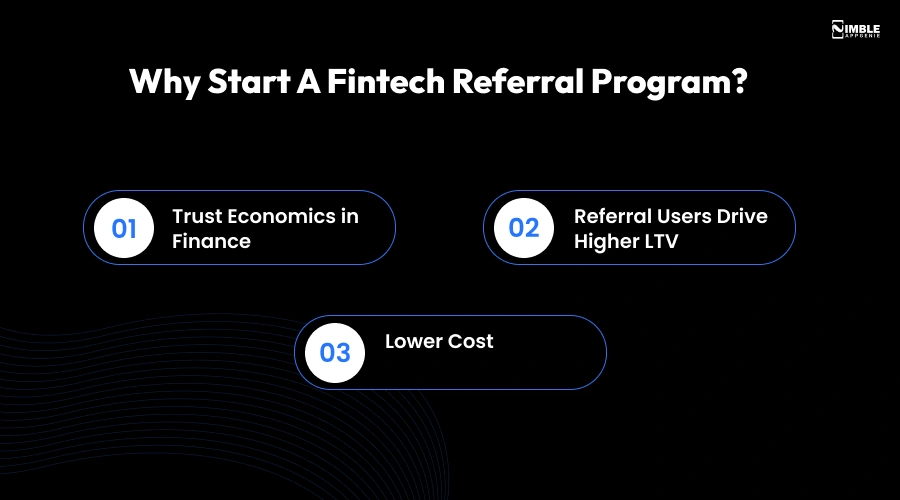
► Trust Economics in Finance
Finance, now, can be seen as fintech is a term where a user will trust only their known ones or a well-trusted friend or relative. Now, if their friend recommends your fintech app, the other person will definitely trust it.
Do you know that 88% of respondents most trust recommendations from people they know?
Well, it’s true. Therefore, trust economics in finance works well.
► Referral Users Drive Higher LTV
As a fintech startup, you might be very clear that you need a high LTV (lifetime value). And this is possible in the case of designing a fintech referral program.
User retention in fintech can be a challenge for most of the fintech startups and enterprises, and the solution for this is building a fintech referral program.
► Lower Cost
Designing a fintech referral program can help you to save overall costs. Here, the cost you pay to retain users is lower than the cost you spend on overall advertising.
Hence, it is an important method to retain users and save costs at the same time.
If you are tired of paying $100 to $150 per install via paid channels, then a fintech referral program can be a savior, but only if it is designed right.
Many fintech startups and fintech enterprises often ask, “Is my Fintech Business Ready for a Referral Program?”
If you have launched your fintech software in the market, then yes, your fintech business is ready for a referral program.
All you need is to examine the right design, referral structure, rewards, eligibility, and processes needed to launch and manage the program. With the experts at Nimble AppGenie, it is possible to create a successful referral program.
How to Design a Fintech Referral Program That Runs Itself?
To design a fintech referral program, you need to follow the end user, that is the “friend,” not the “referer”. Every step should be taken for the friend, so it can become simple for them to sign in and use the app.
Let’s get into the details of “how to build a fintech referral program from scratch?”
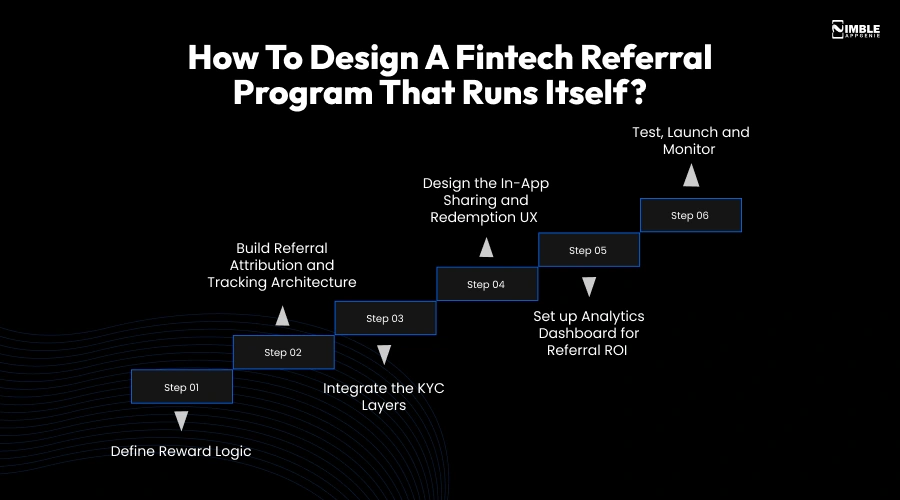
Step 1: Define Reward Logic
This is the first step to building a fintech referral program, where you should identify why you need one. There should be a strong point in creating a referral program. Pay both the referrer and referee.
You should balance the user incentives with strict financial compliance and the unit economics.
Step 2: Build Referral Attribution and Tracking Architecture
With the experts of Nimble AppGenie, you can build a complete referral attribution and tracking architecture system that requires connecting your marketing channels to your backend database.
This tracking architecture should be able to accurately capture the interest of the users, identify their usage patterns, and reward them rather than relying on cookies.
Step 3: Integrate the KYC Layers
Now, you should add the KYC/AML layers into the fintech referral program that prevent fraud, bonus abuse, and compliance penalties. Here, compliance and regulations matter because fraudsters create thousands of accounts to trick the referral bonuses.
Additionally, money laundering can be a case in the absence of fintech security, where every layer of your product can create a code to compliance.
Step 4: Design the In-App Sharing and Redemption UX
Designing is the core and most significant part to attract and retain the end customers. Here, you should think of the friend to whom the referrer will share the link. Hence, make the design engaging with clickable buttons.
You can provide pre-filled, one-tap sharing links via SMS, WhatsApp, and through simple copy-paste. Along with the sharing, there should be a redemption UX that should be instant and transparent.
Step 5: Set up Analytics Dashboard For Referral ROI
As a fintech startup and entrepreneur, you should set up the analytics dashboard by connecting with the referral software and storing the checkout data to a reporting tool. It is a single screen that shows your most important metrics and KPIs in a visual and simple format.
Here, you should connect your referral tracking tool and CRM data to a visualization platform. It will help you to track all the referrals.
Step 6: Test, Launch and Monitor
Now, this is the final step, where you should test the complete program and then launch it on the defined platform. In this step, you should verify tracking security, roll out a phased beta release, and track the fraud rates.
This is the step where you will test and monitor the complete app. Here, you should check each program and how it is able to offer automatic referrers.
For more convenience, implementing AI in fintech is one of the crucial and best steps to take that will be useful in adopting smart data for personalizing offers, predicting which users will share, and how well the reward will be useful for the end user.
Now, one of the most important questions is “how much does it cost to design a fintech referral program?”
Because when you build a fintech referral program, one of the important factors is “cost”.
Thus, to estimate the right cost, let’s switch over to the next section.
Bonus Read: “Fintech App Design”
How Much Does It Cost to Design a Fintech Referral Program?
The overall cost to design a fintech referral program can vary from $1000 to $20,000+ depending on your app and the type of referral program you want to insert in the system.
If you are building a fintech app from scratch, then the cost to build a fintech app can include this cost. Only in the case where you want a fintech referral program as a feature.
Different factors that divide the cost are your requirement of teh fintech app, the architecture of your app, the type of security you want, and finally, it depends on your referral program selection.
Let’s have a complete cost breakdown to build a fintech referral program from scratch:
| Cost Parameter | What Impacts the Cost | Estimated Cost |
| Referral Strategy & Design | Program rules, incentives, eligibility, referral journey | $1,000–$2,500 |
| Referral & Attribution Architecture | Referral links/codes, tracking, attribution logic, event flows | $2,000–$5,000 |
| Backend & API Development | User/referral management, APIs, databases, integrations | $2,000–$5,000 |
| Rewards & Payout System | Commission calculation, reward triggers, payout workflows | $1,000–$3,000 |
| Fraud & Compliance Controls | Duplicate detection, abuse prevention, KYC/compliance requirements | $1,000–$3,000 |
| Dashboard & Reporting | Referral performance, attribution, conversions, ROI reporting | $1,000–$2,500 |
| Testing & Deployment | QA, security testing, production deployment and monitoring | $1,000–$2,500 |
| Total Estimated Cost | Depends on integrations, scale, customization & compliance complexity | $1,000–$20,000 |
Well, after defining the cost, are you ready to design a fintech referral program?
If yes, then look into the next section stating what engineers of Nimble AppGenie can offer you that other companies can’t.
6 Pillars of a Fintech Referral Program That Actually Works
A successful fintech referral program requires strategic planning, clear mechanics, and seamless application. Here is the list of 6 pillars that you can undertake while building and designing your fintech referral program.
Let’s examine the complete set of pillars of a fintech referral program below:
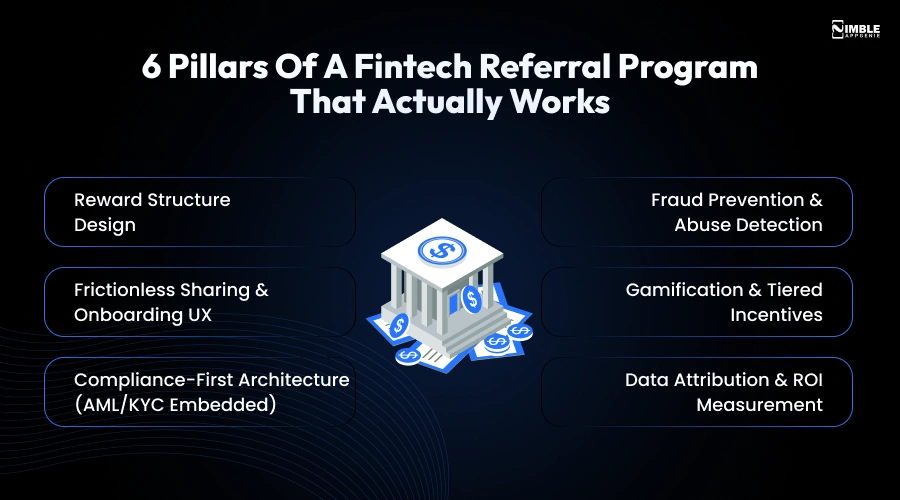
1. Reward Structure Design
The structure of a fintech referral program plays an important role. If your reward is not valuable or cannot be understood instantly, nothing else in the program matters.
The best fintech rewards mirror the core product; in the case of the Robinhood app, it gives stock as a referral reward, not cash, because its product is stock.
You should note that the generic rewards get ignored; hence, the reward must match your core product value. Creating a reward structure is possible with the top-listed fintech app development company, such as Nimble AppGenie.
2. Frictionless Sharing & Onboarding UX
The frictionless sharing and onboarding UX is a core and most important pillar because it minimizes the psychological and technical barriers.
Under every extra tap between “I want to refer someone” and “done,” there are many steps involved. Where you might lose your end user. When it comes to fintech specifically, the referred friend’s onboarding is usually the biggest drop-off point.
It is not the sharing step itself. Fintech apps face high user skepticism due to financial security concerns, which makes a seamless user experience essential to maintain momentum.
3. Compliance-First Architecture (AML/KYC Embedded)
The compliance-first architecture is one of the core pillars that separates a fintech referral program from a regular consumer app. You cannot pay out the cash reward to a person who has an unverified identity.
You need to perform KYC checks before reward payout and hold fraud-flagged referrals.
Hence, you need to develop a highly secure fintech application, and you cannot let the referral incentives function as an unlicensed inducement tied to credit products.
4. Fraud Prevention & Abuse Detection
Fraud prevention and Abuse detection in a fintech referral program helps to protect your business from any kind of fake signups. Here you can implement self-referral detection, device fingerprinting, and velocity checks.
You should be well aware that the same device ID is used across referrers, which results in securing the app from bad actors because cash rewards do attract people who search for loopholes to earn extra cash.
Without fraud controls, your referral budget can become a coupon-farming exploit. Here, the financial platforms handle real money, identity verification, and regulated assets.
5. Gamification & Tiered Incentives
Gamification and tiered incentives are one of the crucial pillars for designing a fintech referral program. It is an important pillar that turns a referral feature into a recurring growth loop.
You should introduce gamification in fintech referral programs after you have 60 to 90 days of baseline data from the above four pillars.
With gamification in fintech, you can offer early access to new features, higher transaction limits, or a founding member badge. It is specifically effective for Gen Zs. You can take the reference of the gamified rewards approach, along with tiered and streak-based rewards to drive repeat referrals.
6. Data Attribution & ROI Measurement
You should go through the complete referral funnel metrics from shares, signups, activated users, to LTV. Here, the attribution modeling comprises multi-touch vs last-click.
A referral program you can’t measure is a referral program that you cannot improve. This pillar is what turns the program from a “feature we built” into “growth channel we can optimize”.
The data attribution and ROI measurement is the final pillar that turns marketing spend into verifiable financial growth.
Well, if you are going forward with the fintech referral program, it is essential to evaluate the top examples of fintech who have implemented it and has booked 100% results.
Let’s get ahead with the core examples of top referral programs in the next section.
Examples of Top Referral Programs
With the core examples of top referral programs, you can identify the top fintech apps that are your competitors.
Let’s check out the complete list below:
| App | Type of Referral Program |
| Robinhood | Gamified free-stock reward, stock rewards worth $5–$200 for both referrer and friend |
| PayPal | Classic double-sided cash bonus, the foundational cash-reward model in fintech |
| Revolut | Cash reward + waitlist-based growth loop, users moved up a pre-launch waitlist by inviting friends |
| Coinbase | Crypto-based reward, payout tied to referred user’s activation, not just signup |
With the examples, you should examine the top reasons why most fintech referral programs fail.
Why Do Most Fintech Referral Programs Fail?
Most of the fintech referral programs fail due to various reasons, such as not offering the right incentives to users, overcomplicating the referral process, ignoring post-referral engagement, and no security.
Let’s list the complete challenges:
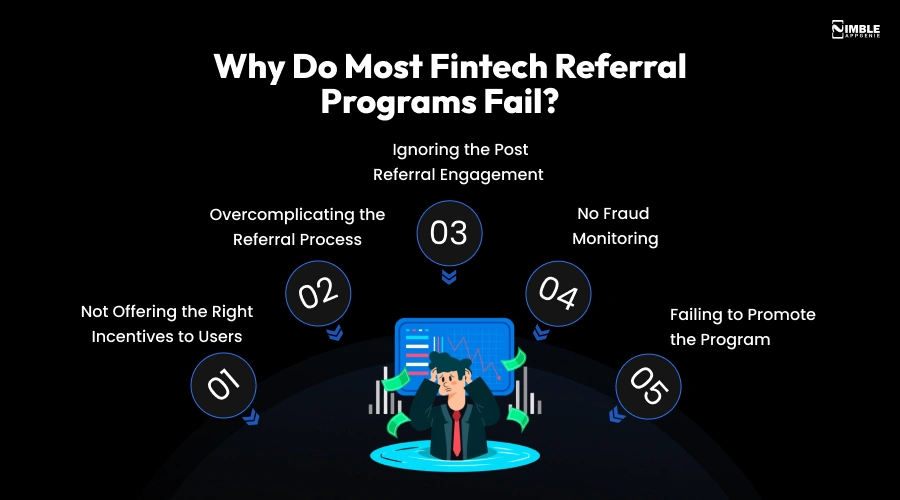
♦ Not Offering the Right Incentives to Users
If you are avoiding offering the right incentives to the users, either the offer is too small, too large, or irrelevant to your customers. What if your offer doesn’t excite the user to connect with you? Well, it will result in a fintech referral program failure.
♦ Overcomplicating the Referral Process
A too complicated referral program will never drive users’ attention. It forces users to log in, fill out forms, or share only through certain channels. It kills the momentum of sharing and even the expectations to earn the reward because they have to go through a long process to claim the reward.
♦ Ignoring the Post-Referral Engagement
After the referral, most of the users delete the software or even ignore using it, which fails a fintech referral program. Here, a lack of post-referral communication loses trust in the brand, which hurts repeat referrals. It makes your brand look disorganized and different.
♦ No Fraud Monitoring
If you don’t cover your fintech referral program under the security of the complete app, this can become a loophole in your software and is enough to attract many cybercriminals. It drains marketing budgets and even forces companies to shut down the unprofitable campaigns.
♦ Failing to Promote the Program
You might have the best referral program in the industry, but it is of no use if your target users don’t know about it. Thus, not reaching out to the target users is a big gap that might result in failure of your fintech referral program.
Which Company is Right to Design a Fintech Referral Program?
The experts at Nimble AppGenie offer end-to-end fintech solutions and build payment systems, lending platforms, DeFi platforms, along with wealth management software.
The core services that the company provides:
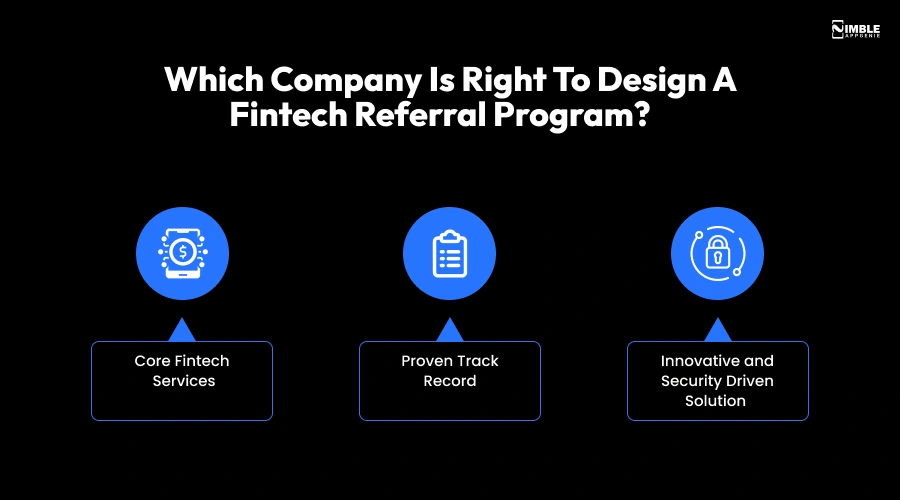
➤ Core Fintech Services
With Nimble AppGenie, you will find the core fintech services, as they have a niche in this field. We know well the right solutions and core fintech referral programs that actually drive user acquisition.
➤ Proven Track Record
The team at Nimble AppGenie has already done it earlier and has a proven track record of delivering effective fintech apps and solutions addressing the core fintech issue. Through the delivery of over 350+ successful projects, we have a track record of success.
➤ Innovative and Security-Driven Solution
The team of Nimble AppGenie delivers innovative and security-driven solutions through embedding compliance structures, advanced encryption, and artificial intelligence directly into the core architecture of mobile and web apps from day one.

Conclusion
You can design a fintech referral program that begins with defining the reward logic, building the referral attribution, and integrating the KYC, designing the app, and setting up the analytics.
The core pillars to follow here are rewarding the structure design, frictionless sharing, compliance-first, fraud prevention, gamification, and data attribution.
The key challenges comprise not offering the right incentives to users, overcomplicating the referral process, no fraud monitoring, and failing to promote the program. Connecting with the right company can help here.
FAQs

Niketan Sharma, CTO, Nimble AppGenie, is a tech enthusiast with more than a decade of experience in delivering high-value solutions that allow a brand to penetrate the market easily. With a strong hold on mobile app development, he is actively working to help businesses identify the potential of digital transformation by sharing insightful statistics, guides & blogs.
Table of Contents




No Comments
Comments are closed.