

 Free Consultation
 PCI-DSS Compliant
 GDPR Ready
 ISO 27001
 NDA Protected
 AI Services
 AI App Development
 Generative AI Development
 AI Chatbot Development
 AI Integration Services
 AI Consulting Services
 AI For Fintech
 AI Financial Assistant Solution
 AI Insurance Agent Development
 Tech Stack
 OpenAI / GPT-4
 Claude / Anthropic
 Gemini / Google AI
 Llama / Open Source
 LangChain / LlamaIndex
 Pinecone / Pgvector
 AWS / Azure AI


 Fintech Solution
 Core Fintech
 App Development
 Neobank Solutions
 eWallet Solutions
 Lending Software
 Banking Solutions
 BNPL Solutions
 BNPL Solutions
 Insurance App
 Wealth Management
 Crypto & DeFi
 Blockchain Development
  Payroll Software
 DeFi Solutions
 Crypto Wallet
 Crypto On/Off Ramp
 Crypto Exchange
 Trading Platform
 Payments
 Compliance
 Regulations & Compliance
 Fraud Detection
 Lending Ecosystem
 P2P Lending Platform
 Mortgage Software
 Engagement
 Fintech Outsourcing

 Mobile Development
 Mobile App Dev
 iOS App Development
 Android App Development
 React Native
 Flutter Development
 Web Solution
 Node.js Development
 React.js Development
 Angular Development
 App Services
 UI/UX Design
 App Maintenance
 By Stage
 MVP Development
 Industry Solutions
 Healthcare App Dev
 Education App Dev
 Travel App Dev
 Real Estate App Dev
 Logistics Software
 Social Media App

 Hire Mobile Developers
 Hire iPhone Developers
 Hire Android Developers
 Hire React Native Devs
 Hire Flutter Developers
 Hire Web Developers
 Hire Node.js Developers
 Hire Angular Developers
 Hire PHP Developers
 Hire Laravel Developers
 How It Works
 Pre-Vetted Developers
 Ready In 48 Hours
 NDA From Day One
 Replace Guarantee
 Company
 About Us
 Our Work Process
 Portfolio
 Case Studies
 Blog / Insights
 Careers
 Contact Us
 Awards
 Recognition


 Offices



TL;DR
- Patient financing allows patients to split medical bills into manageable payments instead of paying the full amount upfront.
- Over 40% of US adults carry some form of medical or dental debt, per KFF, which is why financing is becoming a default app feature, not a bonus.
- You have three build paths: integrate a third-party vendor (CareCredit, Cherry, Wisetack, PayZen), build your own lending engine, or run a hybrid model.
- Compliance goes beyond HIPAA – Truth in Lending Act (Regulation Z), state lending rules, and PCI-DSS all come into play once your app touches credit.
- Showing a payment plan before checkout, not after, is the single biggest UX lever for reducing treatment abandonment.
- Budget $15,000-$90,000+, depending on whether you are integrating an API or building proprietary underwriting logic.
- Nimble AppGenie builds and integrates compliant patient financing features for healthcare startups, from vendor API work to full in-house lending architecture.
“How do I add patient financing to my healthcare app without hiring a compliance team on day one?” It’s a question we keep hearing from healthcare founders in product Slack groups, on founder forums, and in the actual prompts people type into AI search tools this year.
Patient financing has quietly moved from a “nice to have” to a standard expectation from an app that touches a medical bill. Patients expect to see a payment plan before they agree to care, not after a collection letter shows up.
Fintech experts at Nimble AppGenie have written this guide for founders, engineering leads, and product managers who decide how to add that feature, who to build it with, and what it will cost to ship. This post covers vendor options, build-vs-buy tradeoffs, integration architecture, compliance beyond HIPAA, and real costs.
What Is Patient Financing?
Patient financing is a way for patients to pay for dental, medical, or elective care over time instead of all at once. Instead of one large bill, the patient sees a series of smaller payments – sometimes interest-free, sometimes carrying a standard APR, depending on how the plan is structured.
In practice, healthcare patient financing runs through one of the three models – an in-house plan you manage directly, a third-party lender, or a financing engine embedded right into your checkout flow. We break each of those down in more detail under Patient Financing Options.
People often ask whether this is only healthcare BNPL with a different name. It’s relevant but broader. Buy now, pay later usually means short, fixed installments over a few weeks. Patient payment financing covers that, plus longer medical credit lines, multi-month provider-run plans, and deferred-interest cards – some running 12, 24, or even 60 months.
Why Add Patient Financing to Your App Now
The numbers explain the urgency better than any product pitch could. According to KFF’s 2026 health tracking poll, about half of US adults say they couldn’t cover an unexpected $500 medical bill out of pocket. Individually, KFF’s national survey data shows about 41% of US adults currently carry some form of medical or dental debt.
The Peterson-KFF Health System Tracker puts total US medical debt at around $220 billion, even though more than 90% of the population has some form of insurance. Insurance is not solving the affordability issue on its own – high deductibles and coinsurance are leaving patients with balances that can’t be paid in full.
That gap is exactly why financing has become a product decision, not only a billing-department decision. A patient who can’t see a clear payment plan at the point of care is more likely to delay treatment or not book at all. For a startup, that is lost revenue sitting in the checkout flow.

Patient Financing Options, Explained
Founders evaluating patient financing options are generally choosing along three axes: who fronts the money, how underwriting happens, and how deep the integration needs to go.
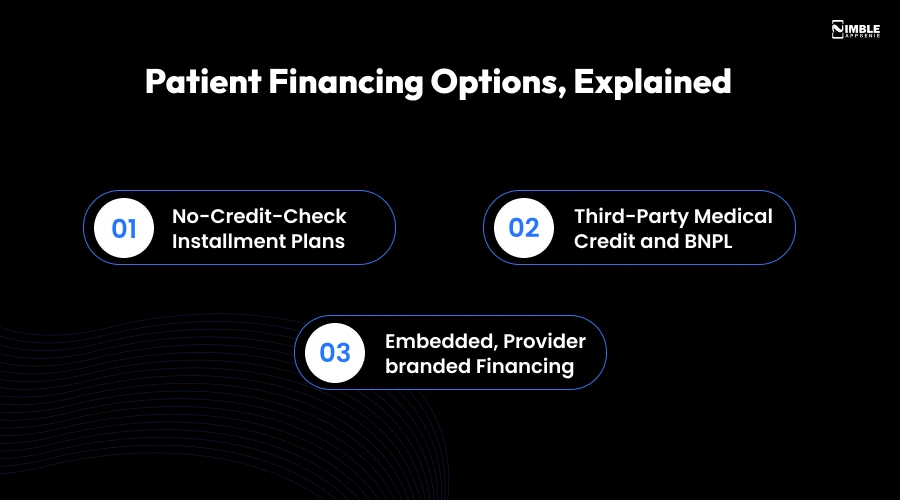
1. No-Credit-Check Installment Plans
The simplest option. The app or provider splits a bill into equal payments and auto-charges a saved card. No lending license required because a third party is extending no credit – you are just changing the payment schedule. This is the fastest to ship, but it puts the collections risk on you.
2. Third-Party Medical Credit and BNPL
A financing partner (Cherry, CareCredit, PatientFi, Wisetack, and similar) runs the credit check, forwards the funds to the provider, and collects directly from the patient. Your app’s job is only the integration: showing eligibility, plan terms, and application status inline. This is the most common path for startups that want financing live in weeks, not quarters.
3. Embedded, Provider-branded Financing
A hybrid where a bank or Banking-as-a-Service (BAAS) partner underwrites in the background, but the whole experience – application, plan terms, servicing – stays inside your app under your brand. This is what companies like PayZen have built their model around, and it’s the closest thing to owning the experience without becoming a licensed lender yourself.
Build vs. Buy vs. Hybrid
This is the decision most guides skip, and it’s the one that actually determines your compliance scope, timeline, and budget.
| Path | What You’re Building | Typical Timeline | Best For |
| Buy (vendor API) | UI + API integration with a financing partner’s existing product | 3–6 weeks | Startups that need financing live fast and don’t want lending liability |
| Hybrid (BaaS-backed) | Your own branded flow, underwriting handled by a bank/BaaS partner behind the scenes | 2–4 months | Startups that want financing as a differentiator, not just a feature |
| Build (in-house) | Proprietary underwriting, servicing, and collections logic | 4–8+ months | Later-stage companies with lending expertise and compliance resources in-house |
For most early-stage healthcare apps, buying or going hybrid is the pragmatic call. Building your own lending stack from scratch means taking on underwriting risk and lending compliance directly – worth it eventually, rarely worth it at MVP stage.
If you want the general version of this same build-vs-partner decision – outside the healthcare context – we have broken it down in our embedded finance platform development guide, including BaaS partnerships and cost ranges.
Comparing the Major Patient Financing Vendors
If you are integrating rather than building, here’s how the main healthcare financing solutions for patients compare, based on how each is publicly positioned:
| Vendor | Model | Best Fit |
| CareCredit (Synchrony) | Medical credit card, deferred-interest promos, standard APR after promo period | Broad provider networks wanting an established, widely recognized card |
| Cherry | BNPL-style plans for elective and cosmetic care | Dental, aesthetics, and elective specialty apps |
| Wisetack | True installment loans (not deferred interest), API-first integration | Startups wanting clean, transparent loan terms via API |
| PayZen | Interest-free plans embedded in EHR/patient portals, sized to ability to pay | Health systems and apps prioritizing affordability over approval speed |
| PatientFi | Digital wallet financing with soft-check application | Elective and cosmetic practice platforms |
| Benefits | Automated in-house payment plan management | Practices wanting to manage plans themselves without a lender |
None of these is universally “best”. The right fit depends on your specialty (elective care lean BNPL; primary and urgent care lean toward interest-free installment models), your patients’ typical credit profiles, and how much of the experience you want to keep under your own brand.
How to Add Patient Financing to Your App: Step by Step
Whichever way you choose, the technical shape of patient financing app development looks similar. Here’s the sequence we walk startups through:
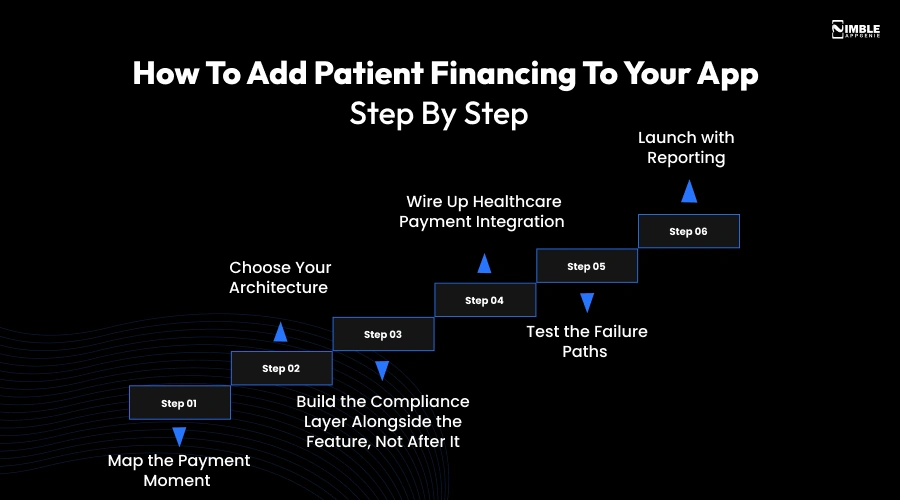
Step 1: Map the Payment Moment
Decide where financing appears: pre-service estimate, at checkout, or post-service on an outstanding balance. This single decision shapes your entire UX and API flow.
Step 2: Choose Your Architecture
For vendor integrations, this often means a server-side API call to check eligibility, a redirect or embedded widget for the application, and a webhook back to your app confirming approval and plan terms. For an in-house or hybrid build, you are designing an underwriting decision engine, a ledger for installment tracking, and a servicing layer for reminders and collections.
Step 3: Build the Compliance Layer Alongside the Feature, Not After It
Data handling (PHI + payment data together), role-based access, and audit logging need to be part of the initial architecture. Retrofitting compliance after launch is where most delays happen. Within the compliance layer, you can add AI translation tools for people who wants to get reports in their language for better understanding.
Step 4: Wire Up Healthcare Payment Integration
Connect your financing flow to your existing billing and, where relevant, your EHR/EMR system using HL7 or FHIR standards so payment status, balances, and plan terms stay in sync across systems.
Step 5: Test the Failure Paths
What happens when a patient is declined, when a payment fails, or when a plan needs to be negotiated? These edge cases are where most financing features break trust – test them as thoroughly as the success path.
Step 6: Launch with Reporting
Track approval rates, default rates, and plan adoption from day one. This data is also what a financing partner or bank will want to see if you expand the program later.
The Compliance Checklist Most Guides Skip
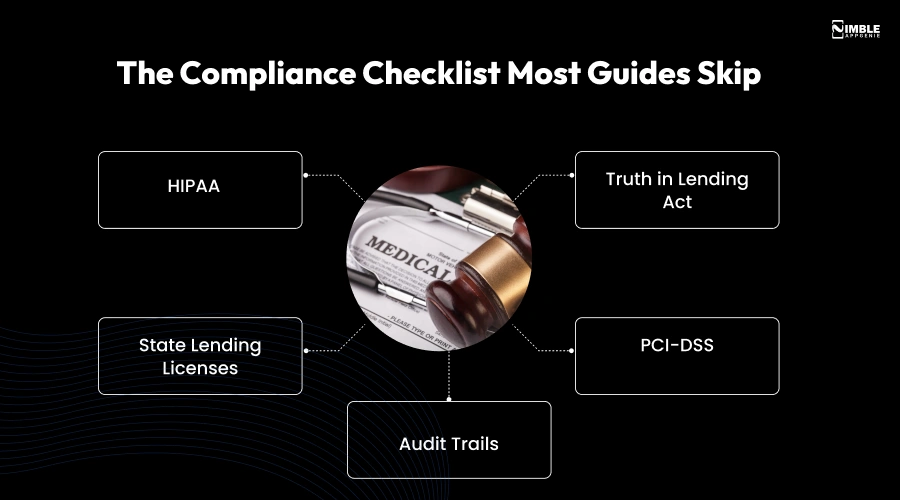
HIPAA gets all the attention, but it’s just one layer once your app starts extending or facilitating credit. For the broader regulatory landscape beyond this checklist, see our fintech regulation and compliance guide. This is general, plain-language information, not legal advice – get counsel to review your specific model before launch.
-
HIPAA
Any financing flow that touches PHI alongside payment data needs its own risk assessment and Business Associate Agreements with vendors – it is not automatic because it lives inside a healthcare app.
-
Truth in Lending Act (Regulation Z)
If you or a partner extends credit, federal rules require clear disclosure of APR, payment schedule, and total cost of financing before the patient agrees.
-
State Lending Licenses:
Originating loans directly generally requires a license in every state you operate in, or a partnership with a chartered bank that already holds one – this is the main reason most startups integrate rather than originate credit themselves.
-
PCI-DSS
Any stored or processed card data needs to meet PCI standards, regardless of whether financing is in-house or third-party.
-
Audit Trails
Every financing decision and payment event should be logged for regulatory reporting and dispute resolution.
UX That Actually Converts
The feature can be technically flawless and still fail if patients don’t understand or trust it. A few patterns that constantly cause measurable change:
- Lead with the monthly number, not the total. “$400/month for 6 months” reads very differently from “$2,400 due.”
- Show the plan before the procedure is booked, not after the bill arrives. Sticker shock at checkout is what causes abandonment.
- Be upfront about interest, or the lack of it. Ambiguity here is the rapid way to lose trust and invite a support ticket or chargeback.
- Keep the application short. Every extra form field between “interested” and “approved” is a drop-off point.
What It Costs to Add Patient Financing to an App
Costs vary a lot by build path. Here’s a realistic range for a startup adding this to an existing app in 2026:
| Scope | Cost Range | Includes |
| Single vendor API integration | $15,000 – $35,000 | Eligibility checks, application UI, webhook handling, basic reporting |
| Multi-vendor / hybrid financing flow | $35,000 – $60,000 | Two or more financing options, branded UX, EHR sync, compliance layer |
| Proprietary financing engine | $60,000 – $90,000+ | Custom underwriting logic, servicing dashboard, collections workflows, full compliance build |
These figures are specific to the financing feature itself. If you are scoping a broader healthcare fintech solutions build – insurance verification, billing, and financing together – expect a wider range; we have broken that down separately in our guide to fintech solutions for healthcare.
Mistakes Startups Make With Patient Financing
Most healthcare startups make mistakes with patient financing. Below are the major ones:
1. Choosing one vendor for every specialty. Elective care patients and chronic care patients have very different financing needs; one plan type rarely fits both.
Fix: Match the vendor to care type – BNPL-style plans for elective/cosmetic, high-cost chronic care, or longer installment plans for ongoing.
2. Treating it as a billing add-on instead of a product decision. Where and how financing appears affects conversion as much as pricing does.
Fix: Design the financing entry point alongside your core booking/checkout flow from the start, not as a settings-page afterthought bolted on post-launch.
3. Ignoring the decline path. A patient who has declined financing and hits a dead end leaves.
Fix: Always design a fallback – a reduced deposit, a financial assistance referral, and an in-house plan – so a decline is not the end of the conversation.
4. Skipping the compliance review until after vendor selection. Some financing models need licenses your company doesn’t have – better to know before you build the integration.
Fix: Run a 30-minute compliance scoping call before signing with any vendor. It’s the cheapest hour you will spend on this feature.
Building Patient Financing With Nimble AppGenie
Patient financing sits exactly where our two specialists meet – fintech app development and healthcare app development. Most agencies are strong in one and outsource the other. We build both in-house, which matters here because a financing feature has to meet fintech-grade security and healthcare-grade data handling at the same time.
For startups adding patient financing app development to an existing product, we typically start with a scoping call to map your patient volume, average bill size, and speciality against the build-vs-buy decision above, then move into lending software, BNPL app development, or vendor-integration work, depending on what fits.
- 700+ – Projects delivered across fintech and healthcare, with a 95% client retention rate.
- 350+ – Financial products built, including lending platforms, eWallets, and payment flows.
- HIPAA / PCI-DSS – Compliance built into architecture from day one, not bolted on before launch.
- 4 Offices – Houston, London, Toronto, and Dubai – supporting startups across time zones.
Conclusion
Patient financing is not a feature you add once and forget – it’s infrastructure that sits between your product, your patients’ ability to pay, and your revenue. The startups getting it right are not necessarily the ones with the biggest engineering teams; they are the ones that picked the right build path early, took compliance seriously from the start, and designed the experience around what a patient actually needs to say yes to care. Whether that means integrating a vendor in a few weeks or building a proprietary engine over a few months, the decision is worth getting right the first time.
Related Reading
- Fintech + Healthcare
Fintech Solutions for Healthcare: Features, Tech Stack & Cost - Healthcare App Dev
How to Create a Healthcare App: The Full Guide - Cost Guide
How Much Does It Cost to Build a Mobile App? - Embedded Finance
What Is Embedded Finance? How It’s Transforming Fintech - Security
Mobile App Security: A Practical Guide
FAQs

Richard Thomas is the Lead Architect at Nimble AppGenie, where he oversees the design and development of scalable, secure, and high-performance digital solutions. With deep expertise in software architecture, cloud infrastructure, and system integration, he plays a key role in transforming complex business requirements into robust technical frameworks. When he’s not architecting systems, he enjoys exploring emerging technologies and staying ahead of industry trends.
Table of Contents




No Comments
Comments are closed.