

 Free Consultation
 PCI-DSS Compliant
 GDPR Ready
 ISO 27001
 NDA Protected
 AI Services
 AI App Development
 Generative AI Development
 AI Chatbot Development
 AI Integration Services
 AI Consulting Services
 AI For Fintech
 AI Financial Assistant Solution
 AI Insurance Agent Development
 Tech Stack
 OpenAI / GPT-4
 Claude / Anthropic
 Gemini / Google AI
 Llama / Open Source
 LangChain / LlamaIndex
 Pinecone / Pgvector
 AWS / Azure AI


 Fintech Solution
 Core Fintech
 App Development
 Neobank Solutions
 eWallet Solutions
 Lending Software
 Banking Solutions
 BNPL Solutions
 BNPL Solutions
 Insurance App
 Wealth Management
 Crypto & DeFi
 Blockchain Development
  Payroll Software
 DeFi Solutions
 Crypto Wallet
 Crypto On/Off Ramp
 Crypto Exchange
 Trading Platform
 Payments
 Compliance
 Regulations & Compliance
 Fraud Detection
 Lending Ecosystem
 P2P Lending Platform
 Mortgage Software
 Engagement
 Fintech Outsourcing

 Mobile Development
 Mobile App Dev
 iOS App Development
 Android App Development
 React Native
 Flutter Development
 Web Solution
 Node.js Development
 React.js Development
 Angular Development
 App Services
 UI/UX Design
 App Maintenance
 By Stage
 MVP Development
 Industry Solutions
 Healthcare App Dev
 Education App Dev
 Travel App Dev
 Real Estate App Dev
 Logistics Software
 Social Media App

 Hire Mobile Developers
 Hire iPhone Developers
 Hire Android Developers
 Hire React Native Devs
 Hire Flutter Developers
 Hire Web Developers
 Hire Node.js Developers
 Hire Angular Developers
 Hire PHP Developers
 Hire Laravel Developers
 How It Works
 Pre-Vetted Developers
 Ready In 48 Hours
 NDA From Day One
 Replace Guarantee
 Company
 About Us
 Our Work Process
 Portfolio
 Case Studies
 Blog / Insights
 Careers
 Contact Us
 Awards
 Recognition


 Offices



Key Takeaways:
- Fintech solutions for the retail industry are becoming a major part of retail operations because they help stores manage payments, loans, invoices, and cash flow more quickly and with less manual work.
- More retailers are adding digital wallets, BNPL, and POS financing because customers want faster checkout and flexible payment options.
- Embedded finance allows retailers to offer financial services directly inside the app or website, so customers do not need to leave the store to apply for payments or financing.
- AI-powered fintech systems help retailers understand customer buying habits, suggest better offers, improve inventory planning, and create a more personalised shopping experience.
- Fraud detection solutions can identify suspicious transactions before a payment is approved, which helps retailers reduce chargebacks and protect their revenue.
- Before choosing fintech solutions for the retail industry, retailers should check their business size, existing POS and accounting systems, security needs, compliance requirements, and the total cost of the solution.
Fintech solutions for retail industry are the payment, lending, and data tools now handling most of the money side of running a store, and retail has become the biggest user of them.
Retail accounted for 62.91% of the entire US fintech market in 2025, more than banking, insurance, or any other segment, and that share is expected to grow at over 17% a year through 2031, according to Mordor Intelligence.
That is not a small trend. It means most of the fintech money being spent right now is being spent on retail specifically, not on banks building new apps.
For store owners, this shows up in things like faster payouts, BNPL at checkout, and fraud checks that catch a bad transaction before it clears, instead of a chargeback showing up weeks later.
This guide covers what these fintech solutions do, why retailers are adding them now, where they go wrong, and how to pick one that fits your store rather than the biggest name on the market.
What Are Fintech Solutions in Retail?
Fintech solutions in retail are software and financial products that allow stores to manage money tasks digitally instead of manually. It includes payments, lending, fraud checks, and reporting.
For years, retailers depended on banks and paper-based processes for these tasks. Payments took days to settle. Loans needed a branch visit. Fraud checks happened after the fact. That has changed.
Software now manages most of this directly, often developed right into a store’s app, website, or point-of-sale system. This applies to online stores and physical shops alike. A small boutique using a card reader and a large chain running an omnichannel setup both rely on fintech in some form.
Why Are Retailers Adopting Fintech Now?
Retailers are adopting fintech because customers expect faster checkout and flexible payment options, while store owners need better control over cash flow and fraud.
Customer behaviour has shifted. They want to pay in instalments, use a digital wallet, or skip the checkout line altogether.
A recent industry survey found that nearly all retail and finance decision-makers had adopted at least one embedded finance feature, and most planned to expand it further within the year.
On the business side, retailers are dealing with tighter margins and rising fraud attempts. Fintech tools give them real-time visibility into cash flow and transactions, instead of waiting for a monthly reconciliation.
Analysts also expect that within the next couple of years, more than half of customer financial transactions will start on third-party platforms rather than a bank’s own app.
This is one of the retail fintech trends 2026 is showing so far, and it is pushing retailers to rethink how they handle payments as part of their overall omnichannel retail strategy.
What Are the Key Fintech Solutions Used in Retail?
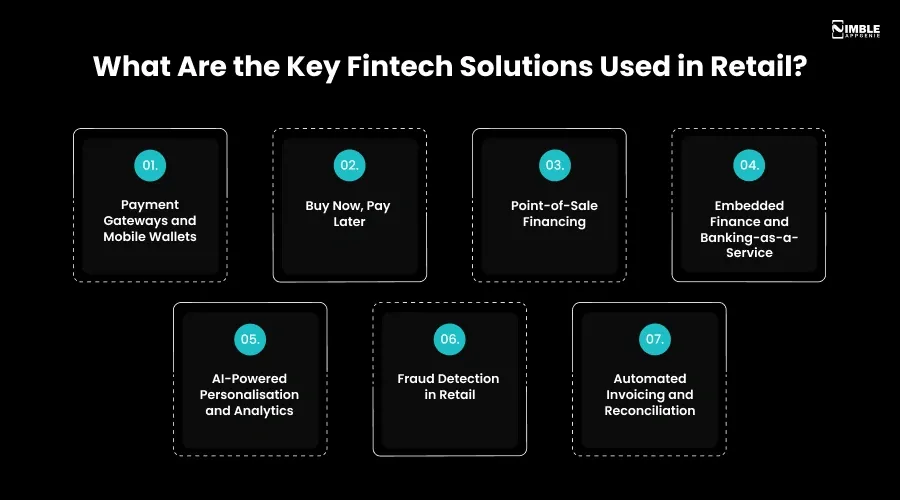
The main fintech solutions used in retail are mentioned below:
- Payment gateways
- BNPL
- Embedded finance
- Point-of-sale financing
- AI-based personalisation
- Fraud detection
- Automated invoicing
► Payment Gateways and Mobile Wallets
A digital payment gateway allows customers to pay with a card, mobile wallet, or bank transfer without the store handling raw card data itself. It is the base layer most other fintech tools sit on top of.
► Buy Now, Pay Later
BNPL splits a purchase into smaller payments, usually with no interest if paid on time. In the US alone, BNPL usage has grown to over 90 million people, which is why most mid-size and large retailers now offer it at checkout.
► Point-of-Sale Financing
POS financing offers a loan or instalment plan at the exact moment a customer is about to buy something, usually for bigger-ticket items like electronics or furniture. It works like BNPL but is often used for larger purchases with longer repayment terms.
► Embedded Finance and Banking-as-a-Service
Embedded finance means a retailer offers a financial product directly inside its own app or website, instead of sending customers directly to a bank. Its market, tied to retail and business use, is already worth trillions of dollars and is expected to keep growing through the rest of the decade.
► AI-Powered Personalisation and Analytics
Retail fintech tools now track spending patterns and use that data to suggest offers, adjust pricing, or flag a customer likely to churn. This runs alongside payment data, so retailers do not need a separate system to connect the two.
► Fraud Detection in Retail
Fraud detection in retail uses transaction patterns to catch suspicious activity before a payment goes through, rather than after a chargeback hits. This matters more as digital and cross-border payments grow, since fraud attempts grow with them.
► Automated Invoicing and Reconciliation
For retailers dealing with suppliers and distributors, fintech also automates invoice payments and matches them against purchase orders. This reduces manual bookkeeping and errors in accounts payable. It is particularly useful for retailers handling high volumes of supplier transactions.
What Are the Benefits of Fintech Solutions For Retailers?
Fintech gives retailers faster access to cash, fewer fraud losses, higher checkout conversion, and better data on their customers. These benefits show up in daily operations. A retailer using fintech solutions notices the difference within the first few billing cycles, not after a year.
Let’s check out the benefits of fintech for retailers.
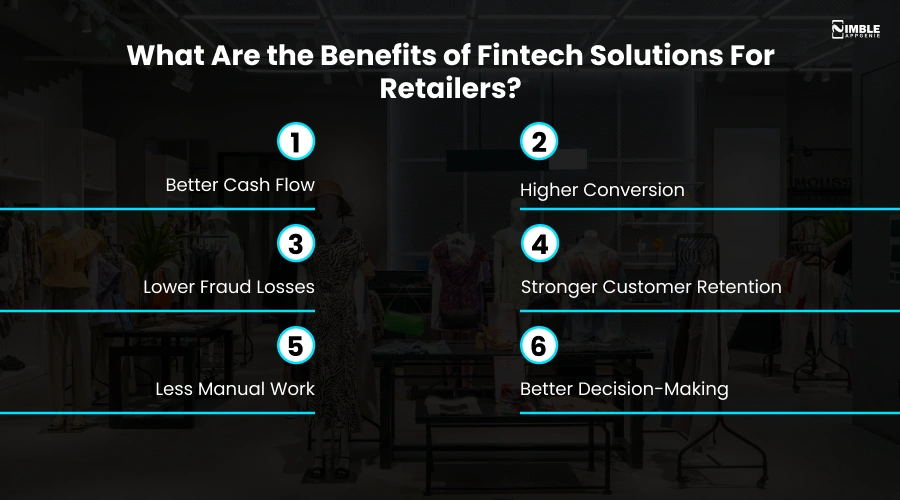
♦ Better Cash Flow
Traditional card settlements can take two to five days to land in a retailer’s bank account. Fintech platforms often settle same-day or next-day, and some go further by advancing funds against future sales, similar to a merchant cash advance.
That means a retailer is not waiting on a payment processor to restock inventory or cover payroll. For small and mid-size retailers, this alone can be the difference between taking on debt and funding growth from existing sales.
♦ Higher Conversion
Checkout drop-off is a real cost. A customer who cannot pay the way they want to often just leaves. If you offer BNPL, digital wallets, or instalment plans at checkout, it will remove that friction.
It is basically for higher-priced items where paying in full up front is the main reason a customer hesitates. Retailers offering flexible payment options typically see a noticeable lift in completed purchases compared to card-only checkout.
♦ Lower Fraud Losses
Fintech solutions for the retail industry built into modern fintech platforms flag suspicious transactions in real time, before the payment clears, instead of after a chargeback shows up weeks later.
This protects margin directly, since chargebacks cost more than the transaction itself once fees and lost inventory are factored in. It also reduces the manual work of a team investigating disputes after the fact.
♦ Stronger Customer Retention
When payment data and purchase history sit in one system, retailers can build loyalty programs and offers around actual behaviour. A customer who buys the same category every month can be offered a relevant deal at the right time.
This kind of targeting is a direct result of combining fintech data with customer data, rather than running them as separate systems.
♦ Less Manual Work
Automated invoicing and reconciliation remove a lot of repetitive bookkeeping. Instead of a finance team manually matching invoices to purchase orders and payments, the AI in a fintech system does it and flags only the exceptions.
This frees staff time for tasks that actually need a person, and reduces the human error that creeps into manual data entry.
♦ Better Decision-Making
Real-time payment and transaction data feeds directly into demand forecasting and inventory planning. Retailers can see which products are moving and adjust stock or pricing sooner, instead of waiting for a monthly sales report to catch up with what already happened.
What Are the Challenges of Adopting Fintech Solutions For Retail?
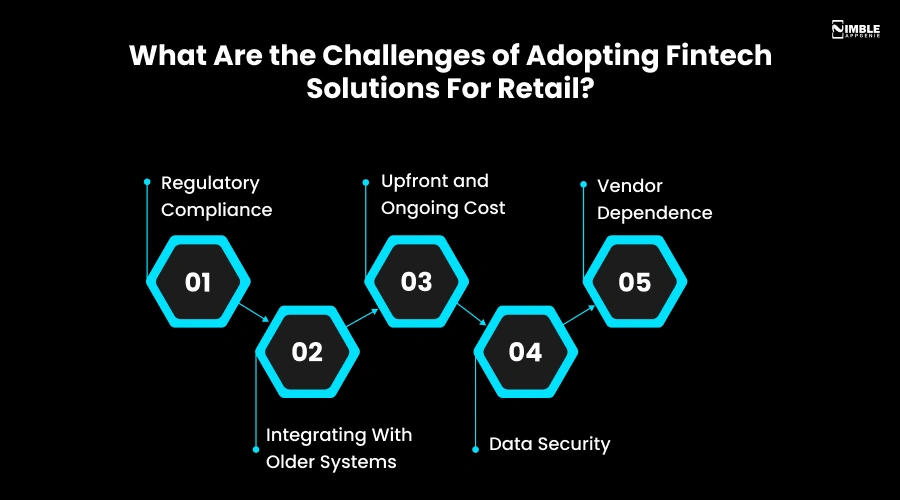
The most common challenges of adopting fintech solutions for retail are:
- Regulatory compliance
- Integrating new tools with older systems
- Upfront cost
- Data security
- Managing dependence on outside vendors
None of these challenges is a reason to avoid fintech altogether, but they are reasons to plan before signing a contract. Retailers who skip tend to run into the same problems a few months in.
➤ Regulatory Compliance
Payment and lending features are not optional extras from a legal standpoint. Digital payment regulations and compliance around data protection, consumer credit, and payment card handling may vary by country and sometimes by state or region.
For example, a BNPL feature can fall under consumer lending regulation in one market and be treated more loosely in another. Retailers expanding in borders need to check this market by market.
➤ Integrating With Older Systems
Many retailers still run POS, inventory, or accounting software that was never built to talk to modern fintech APIs. Connecting the two often means custom integration work, and in some cases, replacing parts of the older system entirely.
This takes time, and during the transition, there is a real risk of downtime at checkout or gaps in transaction records if the migration is not handled carefully.
➤ Upfront and Ongoing Cost
Pricing models differ a lot between providers. Some charge a flat monthly platform fee, others take a percentage per transaction, and a few combine both with setup costs on top.
At low sales volume, a small percentage fee looks manageable. At high volume, that same percentage can add up to a significant expense. Retailers need to model the cost at their actual transaction volume, not just compare headline pricing between vendors.
➤ Data Security
Once payment and customer financial data live inside a retailer’s own app or systems, the retailer becomes a bigger target for attackers, not just the payment provider. A breach involving financial data carries more legal and reputational cost than a breach of, say, an email list.
This means retailers need proper encryption, tokenisation, and access controls in place, not just a checkbox during vendor onboarding.
➤ Vendor Dependence
Once checkout, lending, or fraud detection runs through a third-party platform, that platform’s uptime and support response become the retailer’s problem too.
If the provider has an outage during a peak sales period, the retailer takes the hit, not the vendor. Retailers should check a provider’s track record on uptime and support response time before relying on them for anything customer-facing.
How Do You Choose the Right Fintech Solution for Your Retail Store?
Choosing the right fintech solutions for retail comes down to your e-commerce store’s size, the systems you already run, your compliance needs, the total cost, and how well the vendor supports you after you sign up.
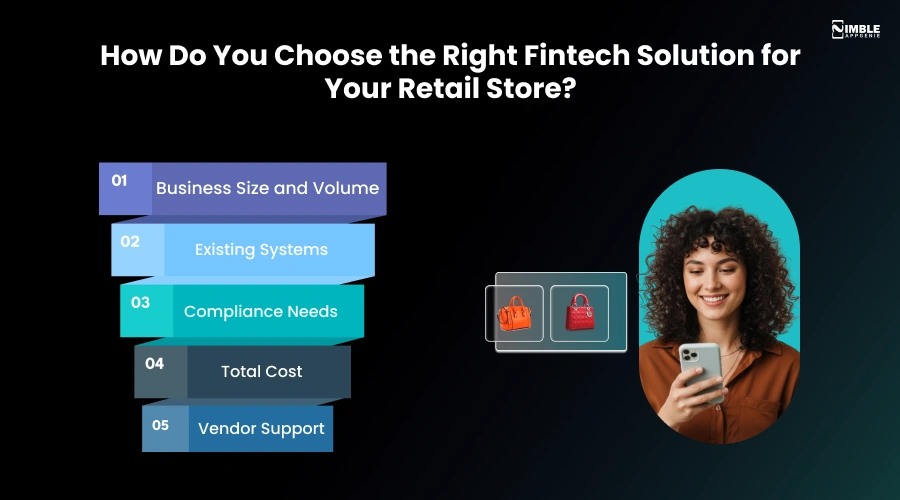
1. Business Size and Volume
A solution built for enterprise retailers may be overskilled and costly for a small store. It is vital to find out the size and volume of the business before choosing the fintech solution.
2. Existing Systems
You have to check how well the fintech solutions connect with your current POS, inventory, or accounting software.
3. Compliance Needs
Now, you have to confirm the vendor manages the regulatory requirements for your market, not just for their own operations. Compliance is important before building a fintech solution for your retail store.
4. Total Cost
You should look at their past headline pricing and check transaction fees, setup costs, and any minimums. The total cost helps you decide which fintech solutions suit your retail store.
5. Vendor Support
Lastly, you can ask how they manage downtime, disputes, and updates, since payment issues need fast answers. Hiring the best fintech solution experts can help you reduce the budget and time of your project.
How Can Nimble AppGenie Help Build a Fintech Solution for Retail?
Building a fintech solution for retail is not just about adding a payment feature. Retail businesses often need a system that can manage payments, customer data, loyalty programs, refunds, financing options, and reporting in one place.
Nimble AppGenie can help retailers build a custom fintech solution based on their business model. Our team can develop features like digital payments, POS integration, mobile wallets, loyalty and rewards programs, BNPL options, and real-time transaction tracking.
We can also connect fintech platforms with existing retail systems like inventory management, ERP, CRM, and e-commerce platforms, so data flows automatically between systems. This helps reduce manual work and gives retailers a clearer view of sales, customer activity, and payment performance.
For businesses that need stronger security and compliance, Nimble AppGenie can develop secure payment flows, user authentication, and data protection measures that support industry standards.
Whether a retailer is launching a new fintech product or upgrading an existing payment system, Nimble AppGenie, a fintech app development company, can help create a solution that is easier for customers to use and simpler for the business to manage.
Final Thought
Fintech solutions for retail are no longer a side feature for retail. It touches how customers pay, how retailers manage cash, and how both sides handle risk.
The retailers getting the most out of it are not chasing every new solution. They are choosing the ones that fit their size, their systems, and their customers, and building from there.
If you are still running payments and lending as separate, discounted tools, that gap is worth closing before it costs you customers or cash flow.
FAQs

Niketan Sharma, CTO, Nimble AppGenie, is a tech enthusiast with more than a decade of experience in delivering high-value solutions that allow a brand to penetrate the market easily. With a strong hold on mobile app development, he is actively working to help businesses identify the potential of digital transformation by sharing insightful statistics, guides & blogs.
Table of Contents




No Comments
Comments are closed.