

 Free Consultation
 PCI-DSS Compliant
 GDPR Ready
 ISO 27001
 NDA Protected
 AI Services
 AI App Development
 Generative AI Development
 AI Chatbot Development
 AI Integration Services
 AI Consulting Services
 AI For Fintech
 AI Financial Assistant Solution
 AI Insurance Agent Development
 Tech Stack
 OpenAI / GPT-4
 Claude / Anthropic
 Gemini / Google AI
 Llama / Open Source
 LangChain / LlamaIndex
 Pinecone / Pgvector
 AWS / Azure AI


 Fintech Solution
 Core Fintech
 App Development
 Neobank Solutions
 eWallet Solutions
 Lending Software
 Banking Solutions
 BNPL Solutions
 BNPL Solutions
 Insurance App
 Wealth Management
 Crypto & DeFi
 Blockchain Development
  Payroll Software
 DeFi Solutions
 Crypto Wallet
 Crypto On/Off Ramp
 Crypto Exchange
 Trading Platform
 Payments
 Compliance
 Regulations & Compliance
 Fraud Detection
 Lending Ecosystem
 P2P Lending Platform
 Mortgage Software
 Engagement
 Fintech Outsourcing

 Mobile Development
 Mobile App Dev
 iOS App Development
 Android App Development
 React Native
 Flutter Development
 Web Solution
 Node.js Development
 React.js Development
 Angular Development
 App Services
 UI/UX Design
 App Maintenance
 By Stage
 MVP Development
 Industry Solutions
 Healthcare App Dev
 Education App Dev
 Travel App Dev
 Real Estate App Dev
 Logistics Software
 Social Media App

 Hire Mobile Developers
 Hire iPhone Developers
 Hire Android Developers
 Hire React Native Devs
 Hire Flutter Developers
 Hire Web Developers
 Hire Node.js Developers
 Hire Angular Developers
 Hire PHP Developers
 Hire Laravel Developers
 How It Works
 Pre-Vetted Developers
 Ready In 48 Hours
 NDA From Day One
 Replace Guarantee
 Company
 About Us
 Our Work Process
 Portfolio
 Case Studies
 Blog / Insights
 Careers
 Contact Us
 Awards
 Recognition


 Offices



Key Takeaways:
- Crypto wallet security is critical because blockchain transactions are irreversible, making asset protection essential.
- Common crypto wallet threats include phishing attacks, unsecured Wi-Fi, wallet drainers, and device theft.
- Users should follow best practices like using cold storage, strong passwords, encrypted backups, and avoiding suspicious links.
- Businesses must implement strong encryption, multi-factor authentication, regular security audits, and compliance measures.
- In case of a wallet hack, immediate action such as securing funds, changing credentials, and investigating the breach is necessary.
- Nimble AppGenie helps businesses build secure, scalable, and AI-powered crypto wallet solutions with advanced security protocols and fintech expertise.
Crypto Wallet Security Explained: Concepts, Risks, & Best Practices
Crypto wallet is no longer a new concept in 2026, yet coding the crypto wallet security is one of the important terms to evaluate.
The market of crypto wallets is projected to reach USD 100.77 billion by 2033, with a CAGR of 26.6% from 2026 to 2033.
If you are a crypto wallet user or an entrepreneur looking forward to creating your own crypto wallet, this is the right time.
Well, losing a crypto wallet means losing all the crypto that is linked to public and private keys.
Hence, you need a way to secure your crypto wallet with the right keys, algorithms, and protocols.
In this guide to crypto wallet security, we’ll walk you through the key concepts, risks involved, and best practices to adopt in 2026.
Let’s begin the journey together.
What is Crypto Wallet Security?
Crypto wallet security refers to the protocols and practices that are used to protect the digital keys that grant access to the cryptocurrency. The blockchain transactions are irreversible, and securing the keys is the only way to keep the crypto wallet secure.
- Use of protocols and practices to secure wallets
- Wallet security simply means protecting keys
- Strong passwords and algorithms are used for security
But what is a crypto wallet? Let’s understand:
What is a Crypto Wallet?
A crypto wallet is an application that is used to secure keys and passwords for a cryptocurrency. This is termed a wallet because it is used similarly to the traditional wallets that are often used to organize cash and cards.
Thus, crypto wallet security is simply an algorithm and practices used to protect these digital keys.
But, how does a crypto wallet work? Let’s learn it too in the following section.
How Does a Crypto Wallet Work?
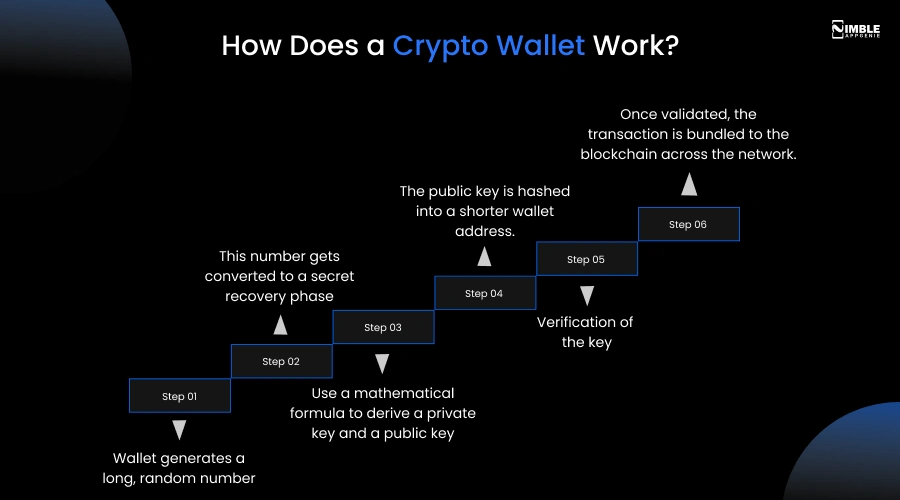
- Step 1: Wallet generates a long, random number
- Step 2: This number gets converted to a secret recovery phase
- Step 3: Use a mathematical formula to derive a private key and a public key
- Step 4: The public key is hashed into a shorter wallet address.
- Step 5: Verification of the key
- Step 6: Once validated, the transaction is bundled to the blockchain across the network.
Well, if you want to build a crypto wallet app, it is essential to know why you need to secure it. Hence lets get ahead with the same in the following section.
Why Secure a Crypto Wallet?
To develop a fintech app, whether it’s a crypto wallet or an insurance app, you should be well aware of security.
There are various reasons why secure a crypto wallet, such as it does not offer any customer support, offers protection from cyber attacks and threats.
Additionally, it offers physical loss prevention. Here’s what you need to know in detail:
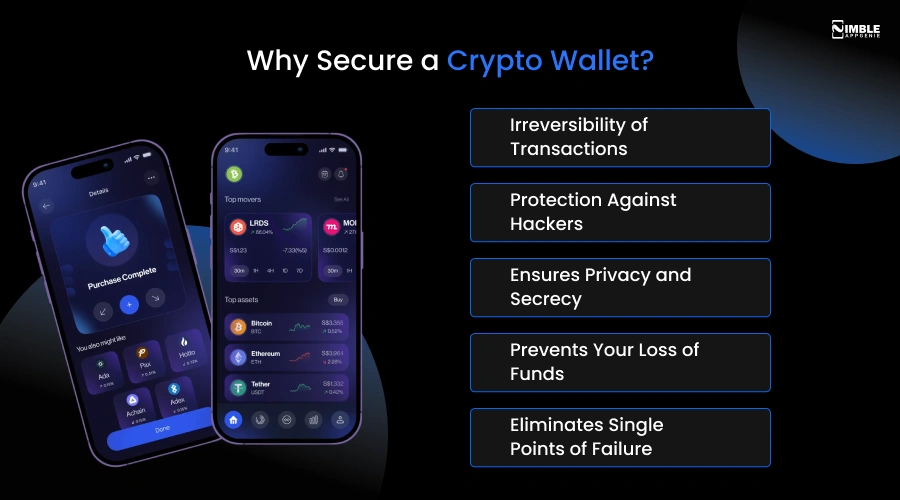
1. Irreversibility of Transactions
The blockchain transactions are immutable and cannot be reversed. These transactions cannot be canceled or refunded once done.
Hence, securing these transactions at the front-end is one of the most critical and significant reasons to secure a crypto wallet.
2. Protection Against Hackers
The crypto wallet security protects the assets through isolating the private keys, the digital credentials required to authorize the complete transaction.
With 2-factor authentication and even the mini-signature, you can protect the crypto wallet. Thus, this will help you to avail a complete protection against hackers.
3. Ensures Privacy and Secrecy
Through complete crypto wallet security, you can ensure privacy and secrecy by decoupling the real-world identities from the blockchain activity.
Here, the wallets use complete security layers to ensure that only the owner can manage the complete funds.
4. Prevents Your Loss of Funds
If the passkey gets disclosed, this act can result in losing funds and all of your savings. Thus, protecting the passkey and encrypting it with the right algorithms is crucial.
It helps in isolating the private keys from unauthorized access, as well as providing recovery mechanisms through seed recovery.
5. Eliminates Single Points of Failure
The crypto wallet security ensures privacy and secrecy through distributing complete control and data across diversified independent nodes.
Through decentralized architecture as well as implementing redundancy, systems move away from a model where a single weak password can disclose all the sensitive information.
Well, you can proceed with the diversified wallet security risks and threats in the following section.

What are the Wallet Security Risks and Threats?
There are different types of security risks and threats to focus on, such as device theft & physical damage, unsecured wi-fi, tokenization loopholes, phishing, and social engineering. Let’s get ahead with the security risks and threats:
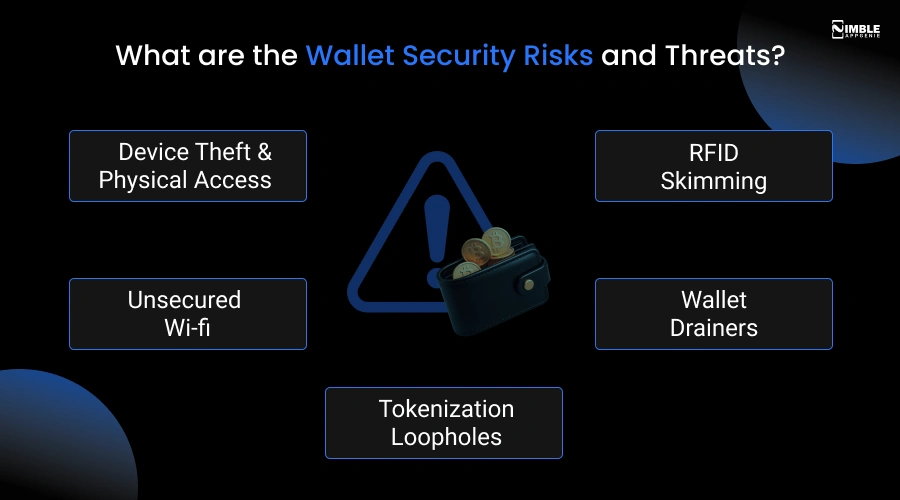
1. Device Theft & Physical Access
The device theft and the physical access do represent a critical security risk because they bypass many digital-only defenses, such as two-factor authentication and firewalls. This is one of the devastating risks that can impact the complete crypto wallet security.
2. Unsecured Wi-fi
The unsecured Wi-Fi poses a significant risk to digital and cryptocurrency wallets by allowing attackers to intercept data during transmission. With an unsecured wi-fi, the attackers can bypass the standard protections to intercept the wallet passkeys.
3. Tokenization Loopholes
The tokenization loopholes can be defined as vulnerabilities and even regulatory gaps that can arise when digital, financial, and even physical data is converted into digital tokens. This involves exploiting security, financial, or even artificial intelligence systems.
4. Wallet Drainers
The crypto wallet drainers are phishing tools and malicious scripts that act as severe security threats by tricking users into exploiting the very permissions a user grants when interacting with a decentralized application.
5. RFID Skimming
It is a critical threat and risk for a crypto wallet where a scanner wirelessly captures data from Radio Frequency identification (RFID) chips that are embedded in cards and passports. This remains a common concern in the case of credit card fraud.
Well, to avoid these threats and fraud, you need to follow the key practices for securing a crypto wallet.
Let’s dive into the details of the best practices in the following section.
Best Practices to Secure Your Crypto Wallet
It is crucial to opt for the best practices for a crypto wallet to protect it from any type of fraud and attackers. Let’s check out the diversified types of best practices from the perceptions of a user and a wallet owner (founder of the crypto wallet):
For a User
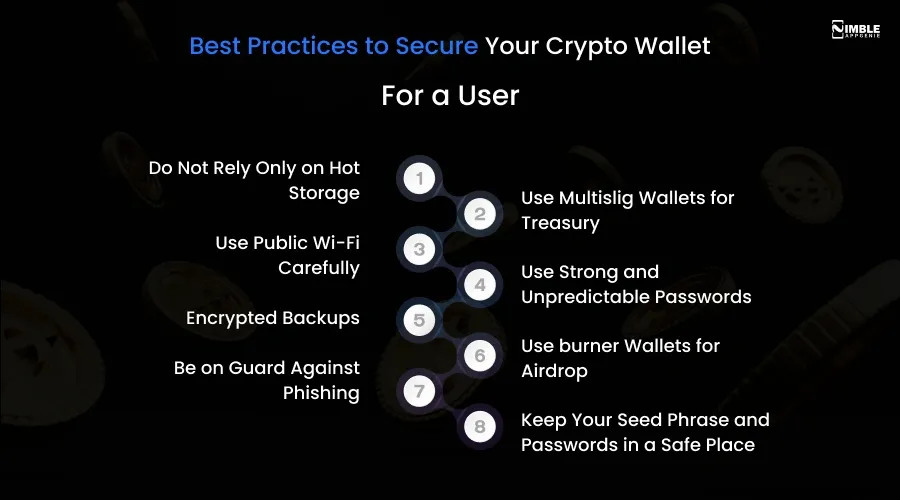
1. Do Not Rely Only on Hot Storage
Be careful with putting all your savings into one hot storage. This is too risky because these storage systems are prone to phishing and all other forms of attack. In contrast, you should keep the savings in cold storage, where you should be the one to access them.
| Note: Hot storage- These wallets are permanently connected to the internet. Cold Storage- These wallets keep keys completely isolated from the internet. |
2. Use Multislig Wallets for Treasury
The use of multisig wallets for treasury can be considered as the foundational security for diversified organizations. The multi-signature wallets are better options for the larger group of people who want to use a common treasury.
3. Use Public Wi-Fi Carefully
The use of public wi-fi is available everywhere and for everyone to freely access the internet. Here, you should be aware that not all free things are good and secure. Public Wi-Fi owners can even access some of your data once you connect.
4. Use Strong and Unpredictable Passwords
You might use strong and unpredictable passwords that might serve as the first line of defense for the crypto wallets by preventing unauthorized access even if the device is lost. Hence, you should pick the passwords from random alphanumeric keys.
5. Encrypted Backups
An encrypted backup is a data duplicate secured by the complex mathematical algorithms so that it can remain unreadable to plaintext without a specific password. These encrypted backups safeguard sensitive information and data from theft.
6. Use burner Wallets for Airdrop
A burner wallet is a temporary, disposable cryptocurrency account that is created for high-risk activities such as claiming airdrops and minting NFTs. This is one of the important practices to undertake for crypto wallet security.
7. Be on Guard Against Phishing
The hackers are getting more creative with the phishing attacks every day. It is important to be aware of phishing games and to be on the lookout for them. Here, the hackers can send you a link on Twitter or Discord, and require you to click on it.
8. Keep Your Seed Phrase and Passwords in a Safe Place
Anyone who has access to the seed phase can access the non-custodial wallet. It is crucial for you to store and keep your password secure if you use the custodial wallet. Here, the best practice is to write the password in a password manager and keep it in a safe place.
Note: Custodial Wallet- A third party holds your keys.
Non-Custodial Wallet- You are the sole owner of your private keys.
Now, let’s check out the best practices for businesses.
For a Business
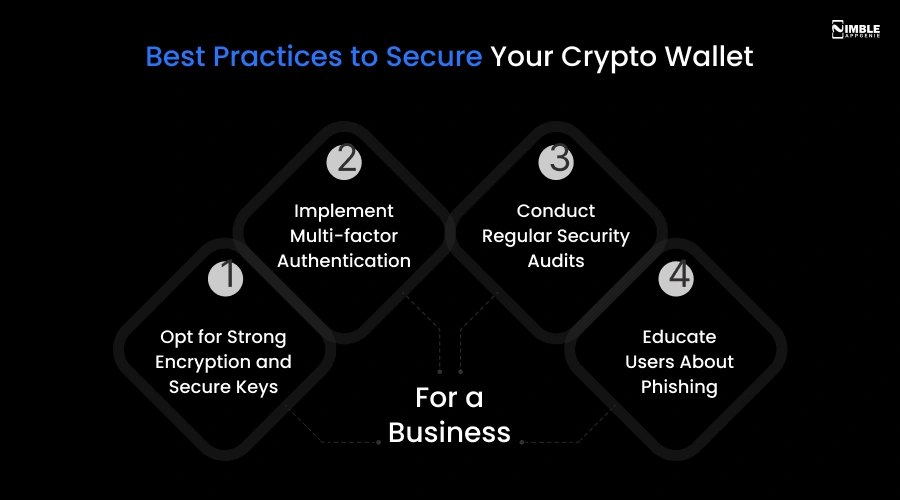
1. Opt for Strong Encryption and Secure Keys
You should opt for strong encryption and secure keys, which are the foundation of robust data security. The strong encryption renders data unreadable to unauthorized parties, while secure key management ensures that these keys remain out of attackers.
2. Implement Multi-factor Authentication
Adopt multi-factor authentication and biometric login options for added account security. This includes the implementation of a security system that requires users to verify their identity via two or more authentication factors.
Also Read: 2FA vs Multi Factor Authentication
3. Conduct Regular Security Audits
Conducting regular security audits is the complete process of evaluating the organization’s physical, digital, and operational security. It is an important practice to help you sustain the competitive environment.
4. Educate Users About Phishing
Educating the users about phishing requires a regular, multi-layered approach that combines interactive training with clear reporting mechanisms. It should build a culture of security and awareness about using your crypto wallet app.
5. Ensure Compliance with Regulations
You should ensure that your wallet complies with the regulations and standards related to financial and cybersecurity. This is one of the best practices for crypto wallet security, where the compliance has shifted from “theoretical policies” to the rigorous execution-first standards.
6. Provide a Secure Backup and Recovery Mechanism
Opting for a secure backup and recovery mechanism is the last line of defense against data loss, hardware failure, and even cyber threats like ransomware. The most robust approach does combine automated backups and end-to-end encryption.
7. Build an Incident Response Plan
It is important to build an incident response plan for a crypto app. This is all about what will happen if your app faced such a circumstance of fraud and cyber attack. The businesses should establish a cross-functional IR team and delegate emergency authority to pause operations.
Well, to develop a secure crypto platform, all you need is the right team and a static process.
But there might be a chance of hacking. Well, the situations are uncertain, and one should be prepared for them.
Yes, this is an important question: what will happen to the business or user whose crypto wallet is hacked?
Let’s check out the following section.
What to do If Your Crypto Wallet is hacked?
There are various measures to opt for if your crypto wallet is hacked, such as securing the remaining funds immediately, disconnecting and scanning your devices, tracing and documenting the hack, report an incident. Let’s check it out:
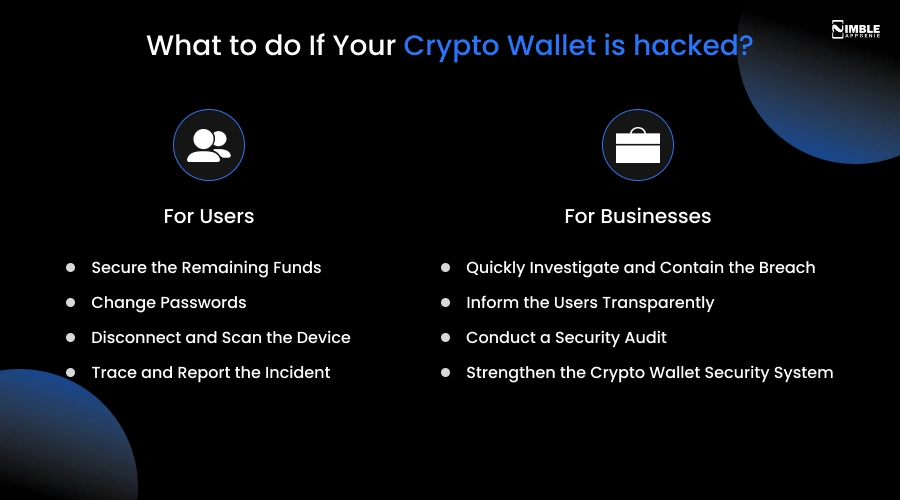
For Users
1. Secure the Remaining Funds
As a user of the app, it is a shock, but you need to take the strategic step of securing the remaining funds in your crypto account. This act should be done immediately, as you need to secure the funds and transfer them immediately to a new account.
2. Change Passwords
Another important step is to change the complete passwords and passkeys of your account so that the remaining funds can be secured and transferred. Enable 2FA and then disconnect the accounts and devices.
3. Disconnect and Scan the Device
Disconnect the device from the malicious decentralized applications. If you avoid this, then the hacker might still have permissions for your tokens. Additionally, you should instantly disconnect your wallet from any active dApp approvals.
4. Trace and Report the Incident
Now, an individual needs to track and report the complete incident so that it cannot be repeated to any other user of the app. Gather the documents and evidence of the incident and connect to the cybersecurity official branch.
For Businesses
5. Quickly Investigate and Contain the Breach
As a business, you should investigate the whole incident with responsibility. You should even make a team or hire experts who can track why and how the breach took place.
6. Inform the Users Transparently
One of the impacted area here are your crypto wallet users and their trust in your platform. Hence, they should be informed on a priority basis. This will build authenticity and transparency to respond to your users.
7. Conduct a Security Audit
Through a team, you should conduct a complete security audit of the whole incident and the activity that took place with your crypto wallet.
8. Strengthen the Crypto Wallet Security System
Furthermore, you should strengthen the complete crypto wallet security system. Monitor the loopholes closely and ensure that this practice is not repeated.
As a user, now you should be wondering, what are the most secure wallets, and as a business, you might be wondering how to find out the top and secure crypto wallets to make a clone or understand the competition.
Well, in the following section, you can evaluate the most secure crypto wallets.
What is the Best and Most Secure Crypto Wallet?
The most secure crypto wallet platforms are the ones that help users to make secure transactions easily within seconds. Let’s find out the most secure and best crypto wallets in 2026:
| # | Wallet | Type | Why It’s Secure | Best For |
| 1. | Ledger Flex | Hardware | Best all-round secure hardware wallet with a certified Secure Element chip and offline key isolation ledger | Everyday users & multi-chain holders |
| 2. | Trezor Safe 5 | Hardware | Fully open-source firmware, Shamir Backup, and air-gapped QR signing with no single point of failure | Long-term Bitcoin holders |
| 3. | Zengo | Software | MPC technology splits the private key into two parts: no seed phrase, no single point of failure. | Mobile-first & seedless security |
| 4 | ELLIPAL Titan | Hardware | Fully air-gapped device with zero USB, Bluetooth, or Wi-Fi exposure, signs via QR codes only | Maximum offline isolation |
| 5 | MetaMask | Software | Leading non-custodial hot wallet with hardware wallet integration for DeFi signing | DeFi & Web3 users |
| 6 | Trust Wallet | Software | Self-custody across 100+ blockchains with 220+ million users that never hold your private keys. | Multi-chain mobile users |
| 7 | Coinbase Wallet | Software | Non-custodial with familiar interface, integrated fiat on-ramp, and recovery options. | Beginners entering crypto |
Well, connecting with the trusted eWallet app development company, you can build your own wallet.
Why Connect with Nimble AppGenie to Build a Crypto Wallet?
You should connect with Nimble AppGenie for building and securing your crypto wallet app because we are the pioneers in the fintech industry and know all the nuances of crypto wallets.
Nimble AppGenie is the leading fintech app development company offering diversified solutions in the crypto, eWallet, insurance, and many other financial + technology driven services.
We understand the fintech world and its tiny details to revolutionize your financial project and make it a success in the competition-driven market.
Our experts are well trained to build every security layer for your crypto wallet app, whether its abolut 2FA, or an encrypted customized protocol.
The team provides high-tech AI-powered solutions for crypto wallets, understanding and growing with you from a startup to a leading enterprise venture.
Conclusion
Crypto wallet security is one of the important aspects to not be let go of. It is implementing and adopting crucial practices to secure your complete crypto wallet. A crypto wallet should be secured because the transactions are irreversible. You should opt for complete protection against hackers.
It is important to ensure privacy and security, prevent loss of funds, and you should eliminate single points of failure when securing a crypto wallet.
To secure your crypto wallet, users should opt for cold storage, avoid the use of public wi-fi, and use strong and unpredictable passwords. For businesses, they should build a strong encryption protocol, educate the users, and build a secure backup.
FAQs

Niketan Sharma, CTO, Nimble AppGenie, is a tech enthusiast with more than a decade of experience in delivering high-value solutions that allow a brand to penetrate the market easily. With a strong hold on mobile app development, he is actively working to help businesses identify the potential of digital transformation by sharing insightful statistics, guides & blogs.
Table of Contents




No Comments
Comments are closed.