

 Free Consultation
 PCI-DSS Compliant
 GDPR Ready
 ISO 27001
 NDA Protected
 AI Services
 AI App Development
 Generative AI Development
 AI Chatbot Development
 AI Integration Services
 AI Consulting Services
 AI For Fintech
 AI Financial Assistant Solution
 AI Insurance Agent Development
 Tech Stack
 OpenAI / GPT-4
 Claude / Anthropic
 Gemini / Google AI
 Llama / Open Source
 LangChain / LlamaIndex
 Pinecone / Pgvector
 AWS / Azure AI


 Fintech Solution
 Core Fintech
 App Development
 Neobank Solutions
 eWallet Solutions
 Lending Software
 Banking Solutions
 BNPL Solutions
 BNPL Solutions
 Insurance App
 Wealth Management
 Crypto & DeFi
 Blockchain Development
  Payroll Software
 DeFi Solutions
 Crypto Wallet
 Crypto On/Off Ramp
 Crypto Exchange
 Trading Platform
 Payments
 Compliance
 Regulations & Compliance
 Fraud Detection
 Lending Ecosystem
 P2P Lending Platform
 Mortgage Software
 Engagement
 Fintech Outsourcing

 Mobile Development
 Mobile App Dev
 iOS App Development
 Android App Development
 React Native
 Flutter Development
 Web Solution
 Node.js Development
 React.js Development
 Angular Development
 App Services
 UI/UX Design
 App Maintenance
 By Stage
 MVP Development
 Industry Solutions
 Healthcare App Dev
 Education App Dev
 Travel App Dev
 Real Estate App Dev
 Logistics Software
 Social Media App

 Hire Mobile Developers
 Hire iPhone Developers
 Hire Android Developers
 Hire React Native Devs
 Hire Flutter Developers
 Hire Web Developers
 Hire Node.js Developers
 Hire Angular Developers
 Hire PHP Developers
 Hire Laravel Developers
 How It Works
 Pre-Vetted Developers
 Ready In 48 Hours
 NDA From Day One
 Replace Guarantee
 Company
 About Us
 Our Work Process
 Portfolio
 Case Studies
 Blog / Insights
 Careers
 Contact Us
 Awards
 Recognition


 Offices


Key Takeaways:
- A business plan is a complete blueprint that outlines the vision, goals, and even strategies for a business.
- You should create a complete business plan for a mobile app because it increases customer and brand engagement,secures funding, allows you to personalize services, boosts sales, and does provide market validation.
- It is important to evaluate attributes such as project aim, fact-based estimates, the structure of your plan, and opting for an external review before creating a business plan.
- You can create a business plan for a mobile app beginning with an executive summary, problem statement, performing market research, opting for a solution, describing the products, and outlining the marketing strategies.
- It is important to fund your business plan, which begins with bootstrapping, friends and family, angel investors, bank loans, crowdfunding, and through building strategic partnerships.
- Connect with Nimble AppGenie, and create a successful business plan for a mobile app.
Have you written a business plan for a mobile app?
Well, if not! Then evaluating how to is the next thing to do.
You should write a complete business plan for a mobile app that begins with writing an executive summary, stating the problem statement, conducting market research, writing a solution, describing the products, stating the budget, and outlining marketing strategies.
Starting a business of a mobile app is not just a few-step thing; it’s a complete journey, and this comes with the foremost step to build a successful mobile app plan.
Well, in this guide, we have stated it all, beginning from the concept, reasons, steps, and how to acquire funds, and even monetization strategies.
Let’s begin the complete journey together!
What is a Business Plan?
A business plan is a detailed roadmap that outlines the vision, goals, target audience, and even strategies for a business.
It does act as a guide for managing focus, improving test visibility, and securing funding from banks or investors. Additionally, these documents should be treated as living, regularly updated documents.
The key components of a business plan comprise an executive summary, a company description, market analysis, operations plan, and even financial projections.
It is one of the documents that explains how the business operates.
Do you know that the US app market generated $52.3 billlion in 2024, which saw an increase of 16.4% in value?
Yes, it’s true, and more than this, the plans are created. When you create a mobile app, it is essential to write a business plan first.
Hence, before you write a complete business plan, let’s evaluate all the reasons to create one in the following section.
Why Create a Business Plan for a Mobile App?
Building a business plan for a mobile app is essential as it transforms a creative idea into a validated and scalable profitable business.
If you are ready to invest in a mobile app, then going through the following reasons can help.
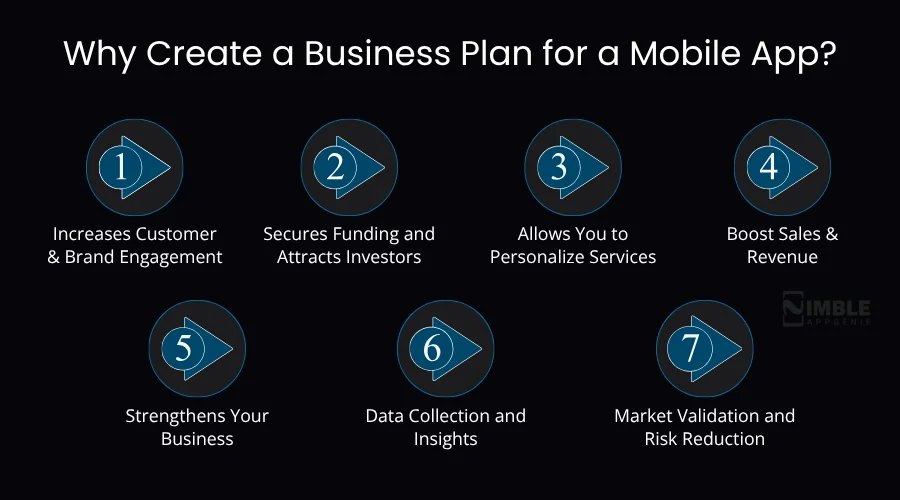
1. Increases Customer & Brand Engagement
Increasing customer and brand engagement is a core component of a business plan, as it is effective in transforming passive transactions into high-value ones. It does help to align the technical features with the user-centric marketing strategies.
2. Secures Funding and Attracts Investors
A business plan is designed in a way that it can secure funding from investors and is willing to attract them by acting as a comprehensive blueprint that validates the market demand, and then defines a clear path to profitability.
3. Allows You to Personalize Services
It acts as a strategic roadmap and defines specific target customer segments and user behavior. A business plan for a mobile app is created by identifying tailored user needs through complete market research that outlines potential feature sets.
4. Boost Sales & Revenue
A business plan can boost sales and revenue through stating a complete, well-structured roadmap, and is helpful in identifying the high-margin products. It further drives growth via strategic initiatives such as bundling products, targeted marketing, and upselling.
5. Strengthens Your Business
You should design a business plan that acts as a comprehensive roadmap to align strategic goals, optimize resource allocation, and identify potential risks. Furthermore, it accelerates growth by roughly 30% and even boosts the likelihood of securing business funds.
6. Data Collection and Insights
A business plan acts as a structured blueprint for data collection by defining the key performance indicators (KPIs), target audiences, and even operational goals. Additionally, it acts as a valuable reference point for tracking the progress of a business.
7. Market Validation and Risk Reduction
Drafting a business plan can be useful in marketing by acting as a communication tool. With the help of contact information, specialized messages, and even engagement tools such as deals and campaigns, a business plan can manage them.
Now, let’s proceed with the prospective things to keep in mind while drafting a business plan for a mobile app.
What to Think About Before You Create a Business Plan for a Mobile App?
Diversified things to keep in mind when creating a business plan for a mobile app are clarity on project aim, fact-based estimates, structure, and opting for an external review that acts as a living roadmap rather than a static document.
Let’s define the complete set of things below:
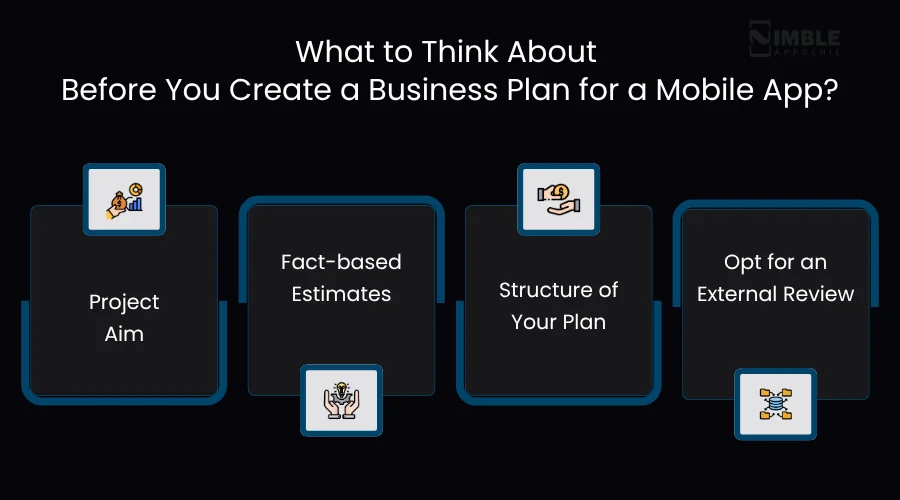
1. Project Aim
You should be very clear about what you are looking to build. It is essential to use the SMART framework for precisely deciding what the project will achieve for whom and when.
It is one of the crucial parameters where you need to create a strategic roadmap that defines the business goals and even outlines the operational tactics.
2. Fact-based Estimates
You should create a fact-based estimate that should include a realistic budget for development, marketing, and operational costs.
This needs to be a comprehensive plan that might take several weeks to research and write, by focusing on the idea.
3. Structure of Your Plan
It’s important to frame the complete structure of your business plan, where the list starts with the executive summary, company overview, and competitive analysis, and then proceeds to the monetization strategy.
This will help you to clarify your approach towards the mobile app business and further help you drive to create an excellent mobile app.
4. Opt for an External Review
You need to opt for an external review after shaping your business plan for a mobile app idea.
It involves engaging the third-party experts, such as mentors, consultants, and even specialized agencies. External reviews can help to have free mentorships and professional consultants.
Now, let’s proceed with the given section on “how to write a business plan for a mobile app?”
How to Write a Business Plan for a Mobile App?
You should start to write a business plan for a mobile app via effective steps.
Let’s examine them all, here:
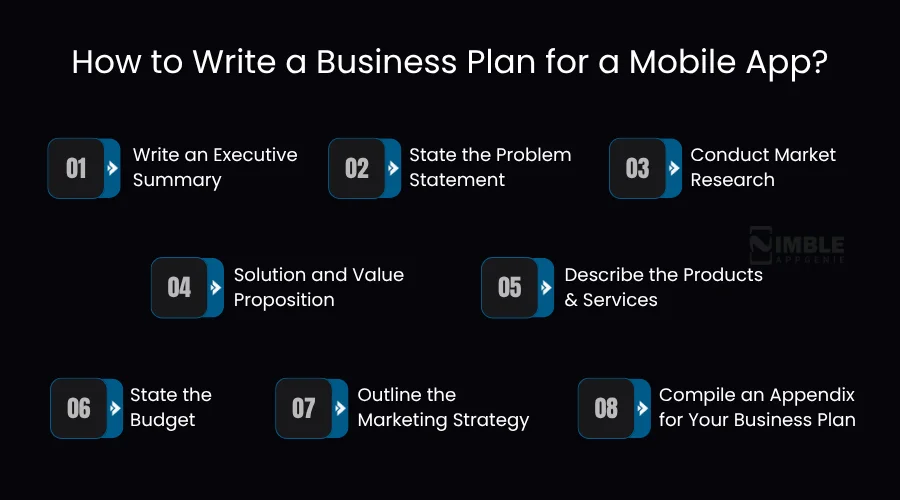
Step 1: Write an Executive Summary
The first step towards writing a business plan is to create a complete executive summary.
Now, the question is “what is an executive summary in a business plan?”
An executive summary in a business plan can be referred to as a rundown of the whole document. It does describe the current situation in the market and helps to determine the target audiences.
Furthermore, an executive summary comprises a mission statement and even the information related to leadership, operations, location, and employees.
Here’s what it comprises:
- A mission statement
- App name and one-line product description
- Target audience
- Revenue model
- Competitive landscape
Step 2: State the Problem Statement
Now, in the second step, you should start to write the core sections of your targeted mobile app business plan. One of these core sections is writing a problem statement.
At this step, you need to write a complete problem statement for your business plan.
This statement defines the specific user pain point, the context in which it occurs, and the type of impact it can drive on the target audiences.
It should include the following points:
- The problem definition
- The context & scope
- The target audience
- The gap
- The impact
Step 3: Conduct Market Research
Now, in this third step to write a business plan for a mobile app, you should conduct a complete market research.
This research will consist of identifying the target market, the target audiences, and even the gap that exists in the current changing market.
Here, you should state the complete demographic, psychographic, and professional activities, and even state the needs and interests of the audience.
To perform market research, you should state the following points:
- Industry overview & trends
- Competitor analysis
- Barriers to entry
- Gap in the market
- Target audiences
Step 4: Solution and Value Proposition
In this step, you should state the complete solution and value proposition that needs to be comprised of a specific user problem, propose your app as the direct remedy, and even the defensible benefits that differentiate it from the present competitors.
Here, you should identify what a specific pain point is for your target users and audiences. Additionally, you need to outline how you can fix the solution statement for your mobile app.
When it comes to writing a value proposition, it is all about stating how your app can resolve the issues of users and what unique value it can bring to the table.
It does focus on the benefits, including increased convenience, time savings, and even enhanced user experience.
Here’s what it comprises:
- Solution statement
- Measurable solution points
- Example figure of a business plan
- Keep it concise
- Includes a unique value proposition
Step 5: Describe the Products & Services
In the next step, you should describe the services and types of features that your mobile app will include. It is a well-balanced approach that focuses on the benefits that it will provide to the prospective users.
A product and services description can be defined as a marketing copy that includes a business’s offerings to the prospective customer.
This description should move beyond a simple list that defines how the services and products are willing to resolve prospective users’ problems.
Here’s what it should include:
- Describe what you will offer
- State the complete product/service lifecycle
- Write what impact these products offer
- Be specific in your description
- State the features that can resolve issues

Step 6: State the Budget
Now, you should consider the complete financial aspect of your mobile app. Here, you should break down the complete costs within the development phases, maintenance, and even for keeping up with the marketing strategy.
Whether it’s about the total mobile app development cost or even planning a budget for your business plan, deciding on financial terms is important. You should figure out how your budget will be used while starting a mobile app business.
Here is a complete table defining how you can use your complete budget:
| Budget Component | Approx. % of Total Budget | Purpose |
| App Development | 30–40% | Design, coding, testing, UI/UX |
| Marketing & User Acquisition | 20–30% | Ads, social media, app store optimization |
| Operations & Maintenance | 15–20% | Hosting, updates, and customer support |
| Team & Salaries | 10–20% | Developers, designers, and management |
| Legal & Administrative | 5–10% | Registration, compliance, contracts |
| Tools & Infrastructure | 5–10% | Software, APIs, cloud services |
| Contingency Reserve | 5–10% | Unexpected costs and risk buffer |
Step 7: Outline the Marketing Strategy
The key steps you should undertake for outlining the marketing strategy are defining the complete marketing goals and what types of platforms you should be available on.
A comprehensive marketing strategy for a mobile app business plan should cover the entire user lifecycle, beginning from initial awareness to long-term retention and even monetization.
Here, you need a specific, structured, and even multifaceted approach for writing a business plan for your mobile app.
It all includes:
- Define the target audience
- Build customer personas
- Evaluate the type of platforms to use
- Assess the fees of such platforms
- Connect with a reputed marketing firm
Step 8: Compile an Appendix for Your Business Plan
Now, it’s the last step towards writing your business plan for a mobile app. You can omit this section as and when required. However, it is a good section to be kept for charts, legal notes, permits, and even licenses.
Under this section, you should include the spreadsheets, historical financial statements, contracts, management team resumes, and even market research data.
Further, you can organize and format the complete business plan for your mobile app.
Here’s what it should comprise:
- Supporting documents and evidence
- Technical and product details
- Legal and financial documents
- Define your exit strategy
Yes, including an existing strategy in a business plan for your mobile app can seem a little more clunky to you.
However, it is one of the crucial parameters to attract the respective investors, because an investor wants to know why and how they can get their money back if the plan doesn’t work out.
Now, let’s switch to how you should fund your mobile app business.
How Can You Fund Your Mobile App Business?
You should fund your mobile app business by examining a mix of self-funding and seeking external capital, such as venture capitalists and angel investors.
Let’s look at the table below to learn more about how to fund your business plan for a mobile app:
| Funding Strategy | How It Works | Best For | Key Advantage |
| Bootstrapping | Use personal savings or income to fund development | Early-stage founders with limited needs | Full control, no debt or equity loss |
| Friends & Family | Borrow or raise small investments from close contacts | Initial prototype or MVP stage | Easy access, flexible terms |
| Angel Investors | Individuals invest in exchange for equity | Startups with growth potential | Mentorship + funding |
| Venture Capital | Firms invest larger sums in equity | Scalable, high-growth app startups | Large funding, strategic support |
| Crowdfunding | Raise small amounts from many people via platforms | Consumer-focused or innovative apps | Market validation + funding |
| Bank Loans | Borrow funds from banks with interest repayment | Founders with collateral or credit history | Retain ownership |
| Government Grants/Schemes | Apply for startup support programs or grants | Eligible startups (often tech/innovation) | Non-repayable funds |
| Incubators/Accelerators | Programs offering funding, mentorship, and resources | Early-stage startups needing guidance | Training + networking |
| Corporate Partnerships | Collaborate with companies for funding or resources | Apps aligned with corporate interests | Access to market + credibility |
| Revenue Pre-Sales | Earn money before launch (subscriptions, early access) | Apps with strong demand | Validates the idea, no external funding needed |
Well, here, you can even hire mobile app developers to help you decide which technique can be best for a mobile app business, because these developers are experts who know well how this business can be made from scratch.
Now, let’s switch to the key monetization strategies to be included in your business plan.
What are the Key Monetization Strategies to be Included in Your Business Plan for a Mobile App?
The key mobile app monetization strategies to be included in your business plan are subscription model, freemium model, usage-based model, direct sales, and even licensing model.
When you create a business plan, it’s essential to look at the key monetization strategies that are all about looking for the methods and tactics related to how you can earn money by creating a mobile app business.
Let’s look ahead to monetization strategies:
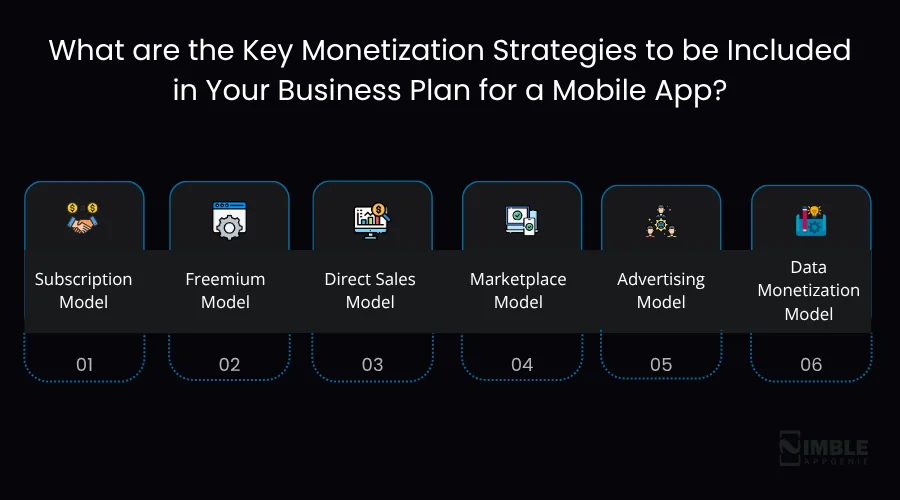
1. Subscription Model
A subscription model is a business strategy where customers pay a recurring fee for accessing the advanced features of the app, aiming to build a recurring revenue and even strong retention rates.
2. Freemium Model
For a mobile app, a freemium model is a customer acquisition strategy that offers a free and even a functional basic version, and later charges for advanced features. A freemium model acts as a customer acquisition tactic that lowers barriers to entry.
3. Direct Sales Model
A direct sales model for a mobile app comprises selling products, services, and even subscriptions directly to the end user or customer. The key aspects of this type of model are revenue generation, data control, and even the direct-to-consumer relationship.
4. Marketplace Model
A marketplace model acts as a mediator connecting buyers and sellers, which facilitates the transaction and even takes a commission. This type of model caters to different transaction types. This type of model typically features separate interfaces for buyers and sellers.
5. Advertising Model
This is a type of model that generates an additional source of revenue for mobile apps in the market. Here, you connect with third-party businesses and post their ads on your mobile app. In exchange, you earn a handsome amount of money.
6. Data Monetization Model
A data monetization model for a mobile app comprises generating revenue through ethically collecting the resources and then selling the reports after analysis to a third-party business. This model should be used only after taking permission from the users to use their data.
Got an App Idea? Let Nimble AppGenie Turn It Into a Business Plan
Connect with Nimble AppGenie, a leading mobile app development company, for converting your business idea into a business plan and then to a complete mobile app.
Our experts know well the right tactics to not only build your mobile app, but also to convert your mobile app idea into a business plan. We leverage AI-powered development for the rapid, affordable, and even the high-quality app creation across iOS, Android, and Web.
Additionally, the company facilitates success through offering AI-powered and web development services by focusing on the user-centric design for boosting engagement.
With the proven results and even the seamless workflow, you can turn your business idea into success. Our developers can help you to evaluate if your conceptualization of the idea is correct based on the current market gap and users’ demand, and how you can proceed with that idea to make it a reality.

Conclusion
Creating a business plan for a mobile app is a crucial step in turning an idea into a scalable and profitable venture. It provides clarity on goals, target audience, market opportunities, and financial requirements while reducing risks and improving decision-making.
To build a business plan, you can draft an executive summary, state a problem statement, conduct market research, opt for a solution and value proposition, and state the budget.
A well-structured plan not only attracts investors but also guides long-term growth and innovation. By treating the plan as a dynamic document and refining it regularly, businesses can stay competitive and effectively adapt to changing market trends and user needs.
FAQs
The key steps to building a business plan for a mobile app are:
- Step 1: Writing an executive summary
- Step 2: State the problem statement
- Step 3: Conducting market research
- Step 4: Solution and Value Proposition
- Step 5: Describe the products and services
- Step 6: State the budget
- Step 7: Outline the Marketing Strategies
- Step 8: Compiling an Appendix
The 7 stages of app development comprise:
- Step 1: Market research and Planning
- Step 2: Requirement Analysis
- Step 3: Mobile App Design
- Step 4: Core Development
- Step 5: Testing and Quality Assurance
- Step 6: Deployment and Launch
- Step 7: Maintenance and Updates

Niketan Sharma, CTO, Nimble AppGenie, is a tech enthusiast with more than a decade of experience in delivering high-value solutions that allow a brand to penetrate the market easily. With a strong hold on mobile app development, he is actively working to help businesses identify the potential of digital transformation by sharing insightful statistics, guides & blogs.
Table of Contents




No Comments
Comments are closed.