

 Free Consultation
 PCI-DSS Compliant
 GDPR Ready
 ISO 27001
 NDA Protected
 AI Services
 AI App Development
 Generative AI Development
 AI Chatbot Development
 AI Integration Services
 AI Consulting Services
 AI For Fintech
 AI Financial Assistant Solution
 AI Insurance Agent Development
 Tech Stack
 OpenAI / GPT-4
 Claude / Anthropic
 Gemini / Google AI
 Llama / Open Source
 LangChain / LlamaIndex
 Pinecone / Pgvector
 AWS / Azure AI


 Fintech Solution
 Core Fintech
 Fintech App Development
 Neobank App Development
 eWallet App Development
 Lending Software
 Banking Software Development
 BNPL Solution
 BNPL App Development
 Insurance App
 Wealth Management App
 Blockchain Development
 Payroll Software Development
 DeFi App Development
 Crypto Wallet Dev
 Crypto On Ramp Off Ramp
 Crypto Exchange Dev
 Trading Platform Dev
 Payments
 Compliance
 Fintech & Digital Regulations
 Fraud Detection
 Lending Ecosystem
 P2P Lending Platform
 Mortgage Software
 Engagement
 Outsourcing Dev

 Mobile Development
 Mobile App Dev
 iOS App Development
 Android App Development
 React Native
 Flutter Development
 Web Solution
 Node.js Development
 React.js Development
 Angular Development
 App Services
 UI/UX Design
 App Maintenance
 By Stage
 MVP Development
 Industry Solutions
 Healthcare App Dev
 Education App Dev
 Travel App Dev
 Real Estate App Dev
 Logistics Software
 Social Media App

 Hire Mobile Developers
 Hire iPhone Developers
 Hire Android Developers
 Hire React Native Devs
 Hire Flutter Developers
 Hire Web Developers
 Hire Node.js Developers
 Hire Angular Developers
 Hire PHP Developers
 Hire Laravel Developers
 How It Works
 Pre-Vetted Developers
 Ready In 48 Hours
 NDA From Day One
 Replace Guarantee
 Company
 About Us
 Our Work Process
 Portfolio
 Case Studies
 Blog / Insights
 Careers
 Contact Us
 Awards
 Recognition


 Offices


In a Nutshell
- Social media regulations are laws and guidelines that are aimed at controlling how social media platforms operate and manage user’s data.
- It is important to follow social media regulations because it protects personal information, prevents cyberbullying, and keeps children safe online.
- The major social media regulations are COPPA in USA, PIPEDA in Canada, online safety bill in United Kingdom, GDPR in European region, IT rules.
2021 in India, POPIA in South Africa, and Nigeria cybercrime act.
The FTC guidelines protect the fair and online practices of the users who have presence on social media platforms.
While the California Consumer Privacy Act (CCPA) is all about providing more control of data to the users. Here, the users can even see what type of data is collected and used by the companies.
Partnering with the team of Nimble AppGenie can help you to discover and implement social media app regulations based on region, and current rules.
Did you know that social media rules change from country to country? Yes, that’s true! Every day, millions of people post photos, videos, opinions, and personal moments on social media.
Apps like Facebook, Instagram, YouTube, and X feel like one global community. However, behind the scenes, each country has its own regulations that govern how these apps operate.
Social media is global, but laws are local. That means what is allowed in one county may be illegal in another. The government creates social media rules and regulations to protect users’ personal data, reduce cyberbullying, and make companies responsible for their actions.
Thus, in this blog, we will look at the social media regulations and laws around the world. By understanding these country-specific social media rules, you will know how online safety works and why platforms behave differently in different regions.
Why Do Social Media Regulations Matter?
Social media can be really fun and useful, but without regulations and compliance, it can be unsafe. That’s why online safety rules and social media laws are so important.
Let’s have a look at how these rules and laws matter :
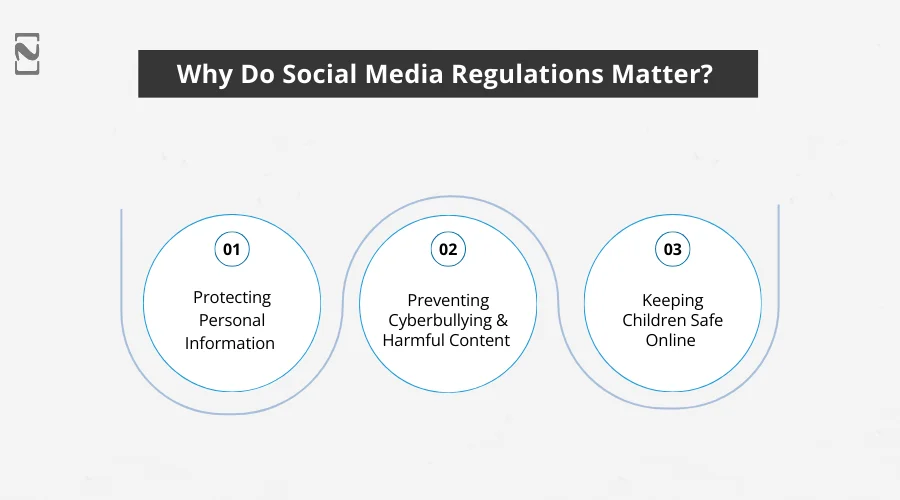
1. Protecting Personal Information
The use of social media helps a user to share a lot of personal information, like name, photos, videos, locations, and so on. Without regulations, companies could collect, sell, or even misuse this data.
Social media laws force platforms to manage personal data carefully and explain how it is used. These rules help balance the pros and cons of social media platforms by protecting users and stopping companies from selling photos or personal details without consent.
2. Preventing Cyberbullying and Harmful Content
Online bullying, hate speech, and harassment can seriously affect mental health. Social media rules often require platforms to address online bullying, hate speech, and harassment, which can seriously affect mental health.
To support these efforts, platforms also follow data security practices to protect consumers, making sure reports and personal information are handled safely. This helps minimize some harms and makes social media a more respectful place.
3. Keeping Children Safe Online
Children are more vulnerable online. They may not understand privacy risks or harmful content. Many social media regulations focus on limiting data collection from kids and blocking harmful content. Also, it requires parental consent. These laws and regulations help create safer online spaces for young users.
What are the Major Social Media Regulations Around the World?
If you are planning to build a social media app, it is vital to first get to know the social media laws and regulations of the region you are thinking of. In this section, we will discuss the different social media laws and regulations of different regions.
Let’s have a look :
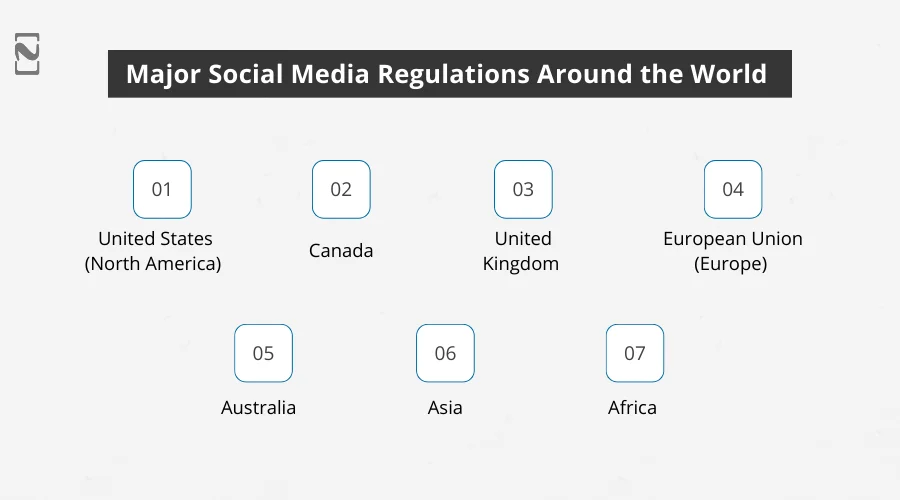
1. United States (North America)
The United States does not have one single law for social media. Instead, it uses multiple laws and guidelines. They each focus on different online safety issues.
a. COPPA – Protecting Children Under 13
The Children’s Online Privacy Protection Act (COPPA) is one of the most important online safety laws in the USA. It applies to websites, mobile apps, and social media platforms used by children under 13.
Major COPPA rules include :
- Platforms must get parental consent before collecting a child’s data.
- Children’s personal information must be protected.
- Companies cannot use kids’ data for advertising without permission.
For example, if a social media app allows children under 13 to sign up, it must limit tracking or ask parents for approval. Failure to follow COPPA can result in huge fines and legal action.
b. FTC Guidelines – Fair and Honest Online Practices
The Federal Trade Commission (FTC) protects consumers from unfair or deceptive practices online.
For social media, this includes :
- Influencers must clearly label sponsored posts.
- Platforms must avoid misleading users.
- Fake reviews and scams are illegal.
For example, if an influencer is paid to promote a product, they must clearly say it is an advertisement.
c. State Privacy Laws – California’s CCPA
Some US states have created stronger privacy rules. The most famous one is the California Consumer Privacy Act (CCPA). It provides users with more control over their data. You can see what data companies collect, request data deletion, and stop companies from selling your data.
Why CCPA matters :
Many tech companies operate in California, so this law affects users across the USA.
2. Canada
Canada takes a strong privacy-first approach to social media regulation. The focus is on consent, transparency, and data protection.
a. PIPEDA – Canada’s Main Privacy Law
The Personal Information Protection and Electronic Documents Act (PIPEDA) controls how companies collect and use personal data.
Under PIPEDA :
- Companies must explain why they collect data.
- Users must give clear and informed consent.
- Personal data must be stored securely.
For instance, a social media app must tell Canadian users exactly how their data is used before collecting it.
b. Canada’s Anti-Spam Legislation (CASL)
CASL protects users from unwanted messages and spam. It applies to marketing messages on social media, promotional emails, DMs, and automated messages.
Major CASL Rules :
- Consent is required before sending promotions.
- Users must be able to unsubscribe easily.
- Fake promotions are illegal.
Why Canada’s Social Media Laws Matter :
- Strong user privacy protection.
- Clear consent rules.
- Less spam and online abuse.
3. United Kingdom
The United Kingdom has introduced strong social media regulations to make online platforms safer. These laws focus mainly on protecting children, reducing harmful content, and making social media companies more responsible for what happens on their platforms.
a. Online Safety Bill
The Online Safety Bill is a major step to improve online safety in the UK. It places a legal responsibility on social media apps to secure and protect users from harm.
Under this law :
- Apps must remove illegal and harmful content fast instead of ignoring reports.
- Kids must be protected from content that could affect their mental or emotional health.
- Clear reporting and blocking tools must be available for users.
For instance, if a user reports abusive or dangerous content, the app is expected to review and remove it without delay.
b. Data Protection Act and UK GDPR
The Data Protection Act, along with UK GDPR, controls how personal data is handled online. These regulations ensure that social media apps respect users’ privacy.
They require apps to :
- Clearly explain what personal data they collect and why.
- Ask users for permission before collecting or sharing data.
- Enable users to request access to or deletion of their personal information.
For example, a UK user can ask a social media company to delete their stored personal data, and the company must respond.
4. European Union (Europe)
European countries take online privacy very seriously. The European Union believes that users should have good control over their personal data on social media mobile apps.
a. General Data Protection Regulation (GDPR)
The GDPR Compliance applies in all European Union countries and influences any social media apps that serve European users.
This law focuses on :
- Giving users control over their personal data.
- Making companies transparent about data use.
- Protecting users from misuse of information.
For example, the best social media platforms must ask for clear permission before tracking user activity or showing personalised ads.
Major GDPR Rules :
- Apps must explain how long data is stored.
- Users can request their data to be corrected or deleted.
- Users must clearly agree before data is collected or processed.
These regulations and rules of social media platforms make users feel more confident and secure while using social media.
Penalties Under GDPR :
- Companies can face very large financial penalties.
- Regulators may conduct detailed investigations.
- Public trust in the platform can be seriously damaged.
5. Australia
Australia has some of the strongest social media regulations in the world. Their major strong focus is on child safety and harmful online content. In recent years, the country has introduced new rules to protect young users from online risks.
Let’s take a look :
a. eSafety Act and Online Harms Laws
Australia’s eSafety Act gives authorities the power to act against cyberbullying, online abuse, and harmful content. Social networking apps are required to remove illegal or harmful content instantly when it involves children.
For example, if harmful or abusive content targets a child, platforms must remove it or face penalties.
b. New Under-16 Social Media Age Restriction
Australia has introduced a new social media regulation that restricts children under 16 from using major social media platforms.
Under this Rule :
- Social media platforms must prevent users under 16 from creating or keeping accounts.
- The responsibility is on the platforms, not on children or parents.
- Platforms must take reasonable steps to check users’ ages.
This rule applies to major apps like Instagram, Facebook, TikTok, Snapchat, YouTube, and X.
Who the Rule Applies to :
- The rule applies to users under 16 living in Australia.
- Platforms must prevent these users from creating new accounts and should aim to remove or deactivate current accounts held by under-16s.
- The restriction is on platforms, not on the children or their parents. Under-16s or their families are not fined if they have an underage account.
Consequences for Platforms :
If a platform fails to take reasonable steps to prevent under-16s from having accounts, courts can impose civil penalties of up to $33 million.
6. Asia
Asia has many social media regulations because different countries face different challenges. From strict government control in some countries to privacy-focused rules in others, it is mandatory for apps to follow local laws carefully.
a. China: Strict Censorship and Monitoring
Social media is heavily monitored and censored by the government. Platforms must remove illegal content quickly and report user activity when requested. Some very popular apps like WeChat, Douyin, and Weibo follow strict rules.
For example, Posts or videos that the government considers illegal can be removed immediately, and users may face account suspension.
b. India: IT Rules 2021
Social media companies must take responsibility for content shared on their platforms. Platforms must remove illegal content quickly and be transparent about their policies. Age restrictions and parental consent are encouraged for young users.
For example, Instagram or Facebook must act if harmful posts are reported and provide clear reporting mechanisms for users.
c. Japan & South Korea: Privacy and Age Rules
These countries focus on data protection and age restrictions. Platforms must get user consent for data collection and provide tools for reporting abuse.
Social media companies must protect children and teenagers from harmful content. For example, a Japanese platform may require age verification before allowing users under 18 to post publicly.
7. Africa
Africa is developing social media rules and regulations to improve cybersecurity, data protection, and online safety.
Let’s have a look at the regulations :
a. Nigeria: Cybercrime Act
This act focuses on preventing online scams, hacking, and harassment. The platforms must remove illegal content and cooperate with authorities. Also, users who post harmful content can be reported to the police. For example, a social media company in Nigeria can face fines if it does not remove hate speech or fraudulent posts.
b. South Africa: Protection of Personal Information Act (POPIA)
It protects the personal data of users and requires companies to get consent before collecting data. Besides, platforms must ensure the secure storage of user information. For example, a South African user can request social media platforms to delete their personal information.
Challenges Businesses Face in Implementing Social Media Rules
Businesses face many challenges when trying to follow social media regulations and compliance. From different laws in every country to high costs and constant updates, companies must carefully manage compliance and safety.
We will look at the crucial challenges you might face :
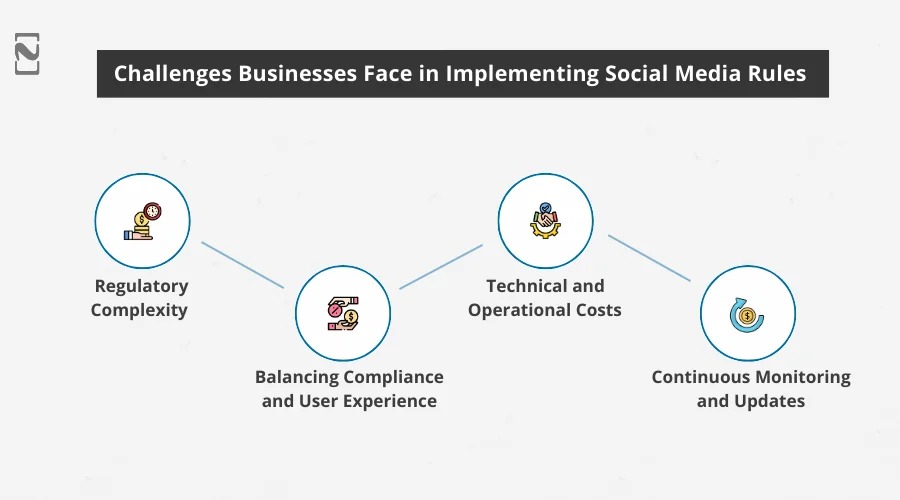
1. Regulatory Complexity
One of the biggest challenges is that every country has different social media rules and laws. What is allowed in the USA may be illegal in Europe. For instance, Europe has strict privacy laws, the USA has rules for kids under 13, and Australia now restricts social media use for children under 16.
To manage this, many companies use RegTech solutions to track and comply with regulations. Still, it takes a lot of time and effort to ensure the app follows all rules correctly across different countries.
2. Balancing Compliance and User Experience
For instance, asking users for age verification or too many consent forms can be annoying and interrupt normal use, especially when people are used to fast-changing social media trends.
Too much content moderation can also block normal posts and make users feel frustrated. You have to find a balance between following rules and keeping the app fun. If it is too strict, users might leave, but if it is too loose, it can break the law or put users at risk.
3. Technical and Operational Costs
Designing a social media app that follows all the rules costs money. Businesses need systems to check users’ ages, protect personal data, and remove harmful content. Also, they need teams to watch reports and make sure everything works correctly.
For small companies, these costs can be very high. Even big companies send millions every year to keep their apps safe and legal. So, managing money and resources while staying compliant is a real challenge.
4. Continuous Monitoring and Updates
Social media rules change all the time. A law that worked last year may be updated or replaced. You must always watch for new rules and update your app instantly.
If they do not, they can get fined, face legal problems, and have their app blocked. As you know, maintenance and updates with constant changes are a big challenge for companies operating in many countries.
How Businesses Can Leverage Compliance to Build Trust and Grow Users?
Let’s take a look :
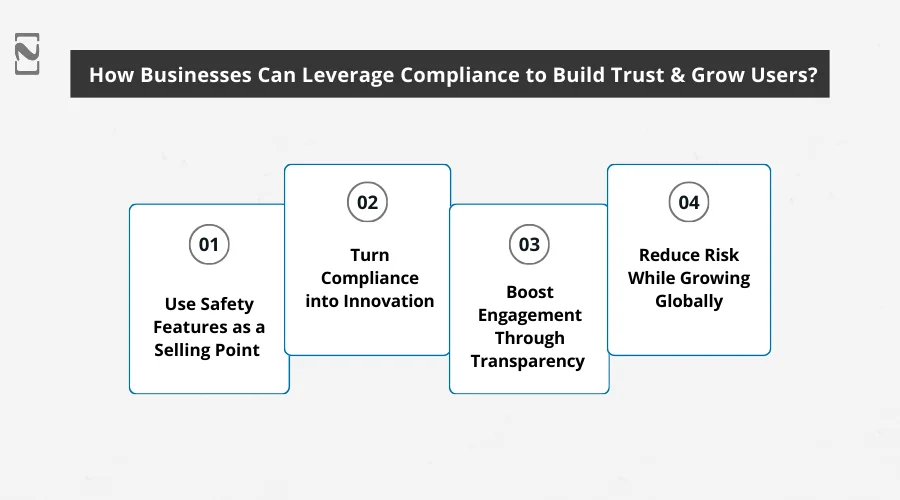
1. Use Safety Features as a Selling Point
Safety features like age check, content moderation, and privacy settings are not just rules. They are things users actually care about. When you show people that your app is safe, parents feel comfortable allowing kids to join, and users feel confident sharing content.
If you highlight these features, it can make your platform more trustworthy. This encourages people to stick around and turn safety into a reason why users choose your app over others.
2. Turn Compliance into Innovation
Following rules doesn’t have to be boring. You can turn things like consent forms and privacy controls into features that actually improve the app. For example, giving users choices on what they see or share can make them feel in control.
This way, compliance doesn’t feel like a chore. It becomes a way to make your app more user-friendly and creative while still staying safe and legal.
3. Boost Engagement Through Transparency
Being open about how you use people’s data and handle harmful content builds trust fast. When users know their information is safe and reports are taken seriously, they feel confident posting and engaging.
Besides, transparency keeps your platform friendly and fair. This encourages users to come abc and recommend it to others. Simple honey can go a long way in keeping your community active and happy.
4. Reduce Risk While Growing Globally
If you want to take your social media app international, it is vital to follow social media regulations like GDPR, COPPA, etc. Compliant apps can expand into new markets without worrying about fines, bans, or bad press.
So, it is best to plan for these rules from the start. It means your platform can safely reach more users, grow your audience, and build credibility across countries. It is all without running into legal trouble.
How Nimble AppGenie Builds Social Media Apps That Follow Regulations?
Social media app development is not just about cool features or fancy design. You have to make sure it’s safe, legal, and follows the rules. That’s where Nimble AppGenie, a social media app development company, comes in. We help businesses to create mobile apps that are fun to use and stay compliant with laws around the world.
Here’s how we do it :
1. Know the Rules First
Every country has its own laws about privacy, kids’ safety, and online content. We make sure your app fits the rules for the places it will be used.
2. Keep Data Safe
Personal info is a big deal. We design apps to store data safely, ask for permissions clearly, and protect users’ privacy.
3. Add Safety Features
Age checks, content moderation, and reporting tools help stop harmful content and keep users safe online.
4. Stay Flexible
Laws change all the time. We make sure your app can easily update to stay compliant without breaking anything.
At the end of the day, Nimble AppGenie helps you build social media apps that are safe, fun, and trustworthy, so users enjoy the platform and your business stays out of trouble.
Conclusion
Now that you have a clear understanding of social media regulations in different countries, you can see why they matter. These laws and regulations keep people safe, protect kids, and stop harmful content from spreading.
It might seem challenging to follow all the rules, but understanding them helps make social media a better place for everyone. The more we know about these laws, the easier it is to use apps safely and responsibly.
Therefore, it is vital to follow the social media rules to avoid issues. But it is about making the online world safer and more enjoyable for everyone.
FAQs

Niketan Sharma, CTO, Nimble AppGenie, is a tech enthusiast with more than a decade of experience in delivering high-value solutions that allow a brand to penetrate the market easily. With a strong hold on mobile app development, he is actively working to help businesses identify the potential of digital transformation by sharing insightful statistics, guides & blogs.
Table of Contents




No Comments
Comments are closed.