

 Free Consultation
 PCI-DSS Compliant
 GDPR Ready
 ISO 27001
 NDA Protected
 AI Services
 AI App Development
 Generative AI Development
 AI Chatbot Development
 AI Integration Services
 AI Consulting Services
 AI For Fintech
 AI Financial Assistant Solution
 AI Insurance Agent Development
 Tech Stack
 OpenAI / GPT-4
 Claude / Anthropic
 Gemini / Google AI
 Llama / Open Source
 LangChain / LlamaIndex
 Pinecone / Pgvector
 AWS / Azure AI


 Fintech Solution
 Core Fintech
 Fintech App Development
 Neobank App Development
 eWallet App Development
 Lending Software
 Banking Software Development
 BNPL Solution
 BNPL App Development
 Insurance App
 Wealth Management App
 Blockchain Development
 Payroll Software Development
 DeFi App Development
 Crypto Wallet Dev
 Crypto On Ramp Off Ramp
 Crypto Exchange Dev
 Trading Platform Dev
 Payments
 Compliance
 Fintech & Digital Regulations
 Fraud Detection
 Lending Ecosystem
 P2P Lending Platform
 Mortgage Software
 Engagement
 Outsourcing Dev

 Mobile Development
 Mobile App Dev
 iOS App Development
 Android App Development
 React Native
 Flutter Development
 Web Solution
 Node.js Development
 React.js Development
 Angular Development
 App Services
 UI/UX Design
 App Maintenance
 By Stage
 MVP Development
 Industry Solutions
 Healthcare App Dev
 Education App Dev
 Travel App Dev
 Real Estate App Dev
 Logistics Software
 Social Media App

 Hire Mobile Developers
 Hire iPhone Developers
 Hire Android Developers
 Hire React Native Devs
 Hire Flutter Developers
 Hire Web Developers
 Hire Node.js Developers
 Hire Angular Developers
 Hire PHP Developers
 Hire Laravel Developers
 How It Works
 Pre-Vetted Developers
 Ready In 48 Hours
 NDA From Day One
 Replace Guarantee
 Company
 About Us
 Our Work Process
 Portfolio
 Case Studies
 Blog / Insights
 Careers
 Contact Us
 Awards
 Recognition


 Offices


Key Takeaways (In a Nutshell)
- Social media trends include AI recommendations, intentional usage, social search, short and long videos, social commerce, creator partnerships, messaging, user-controlled algorithms, audience data, and micro-drama content.
- Users now prefer authentic, transparent, and personalized social media experiences rather than endless scrolling.
- AI-driven recommendations help platforms deliver relevant content and improve user engagement.
- Strong search features and video formats are essential for modern social media apps.
- Social commerce and messaging enable users to discover, interact, and shop within apps.
- Partnering with Nimble AppGenie helps businesses build trend-driven and scalable social media apps.
What are the top social media trends to look for in 2026?
Well, you might use AI, ML, etc. However, as per the current pace of competition, this is not enough. Along with AI-driven recommendations, you should note a shift towards intentional social media usage, social media as a new search engine, and creator partnerships.
Do you know that an ordinary person spends 2.5 hours a day on social media?
And it’s not just passive browsing. Social networks are becoming search engines, shopping hubs, and primary sources of brand discovery for many people, especially Gen Z.
This is exactly why we’ve put together this guide from users’ expectations to top social media trends for 2026.
Let’s begin it all together
What Does a User Expect from a Social Media App in 2026?
Users expect the app to display more authentic content, realistic, search for micro creators, and expect short videos.
Social media apps are based completely on users’ changing demands, and with these demands, their ideology of using the apps changes. To create a social media app for such a generation, it’s important to know what’s trendy.
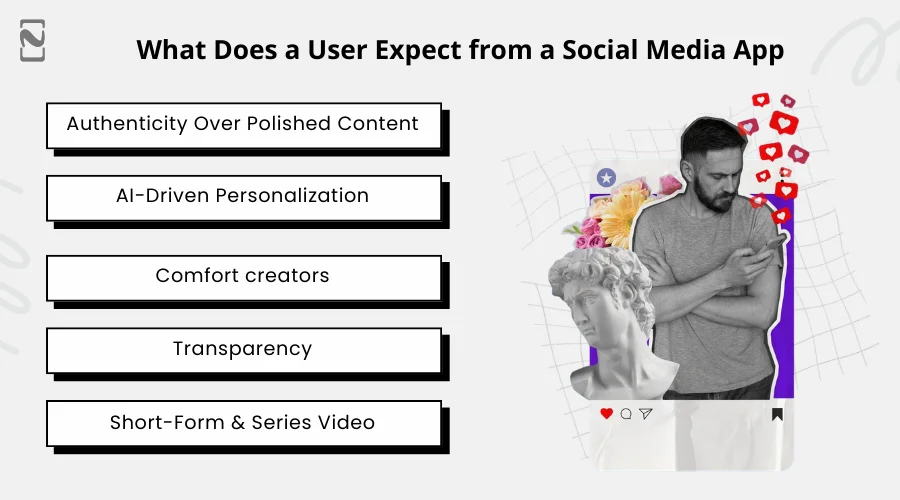
Let’s discuss all points for what a user expects from a social media app, below:
1. Authenticity Over Polished Content
People prefer authentic and human-centered content, advanced AI-driven personalization, and robust integrated social commerce. This trend is continuously escalating.
2. AI-Driven Personalization
Here, algorithms favor content retention over simple reach. People prefer more customized content that adds value to their lives.
3. Comfort creators
There is a rise in the micro-influencers who build intimate, trusted, and consistent communities, rather than large-scale influencers, who are preferred as they connect to their personal lives.
4. Transparency
In 2026, users prefer transparency in content. Even if the content is AI-generated, it should reflect connectivity and transparency.
5. Short-Form & Series Video
The short-form videos remain dominant in 2026, where the content is evolving into series and shows, that offers deeper storytelling.
For businesses, creators, and developers, this huge change means rethinking strategies from the ground up. Social media apps that listen to users and adapt to these social media trends will grow.
Now, let’s evaluate the list of top social media trends in 2026, below:
What are the Top Social Media Trends for 2026?
The top social media trends for 2026 are AI-driven recommendations, social media apps are becoming new search engines, messages can replace support pages and sales forums, and much more.
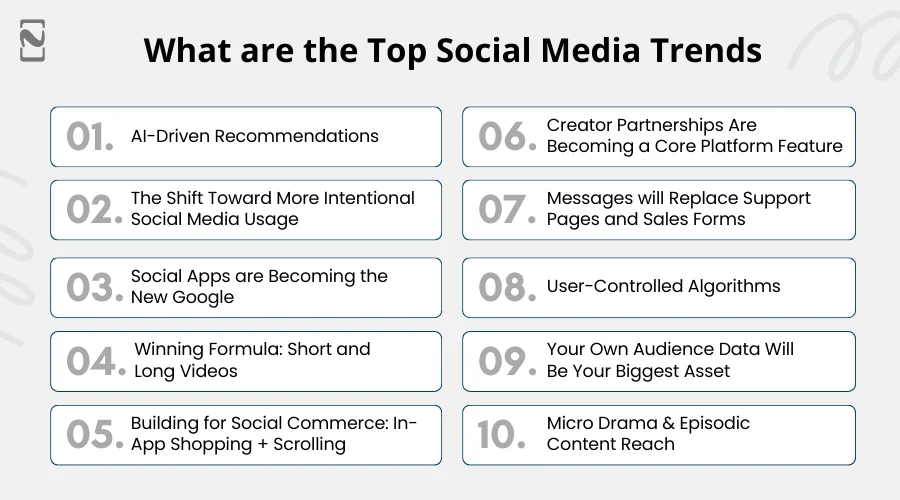
Let’s learn them all here, before you start with a social media app business.
1. AI-Driven Recommendations
People prefer the content recommendations from AI, and you can hire dedicated developers who can create ML-powered recommendation systems and perform behavior analysis.
Why It Matters?
This will enable you to identify the growing users’ needs and evaluate what they actually need from the app. AI analyzes individual user behavior, such as shares, likes, and watch time, to provide them with the content accordingly.
How to Use it?
- To implement this social media app development trend, you need to include an AI algorithm in the social media app.
- Adhere to the data-driven regulations (GDPR, CCPA) while implementing AI in a social media app.
- You can use A/B testing to compare different strategies, placements, and messaging, through continuously monitoring performance metrics.
Adding AI to social media apps is a crucial part of following the latest trends of 2026 social media.
2. The Shift Toward More Intentional Social Media Usage
People’s habits on social media are changing. Users no longer scroll endlessly or engage with everything they see. Instead, they are being selective, choosing to spend time on posts, videos, or accounts that give them real value.
Why It Matters?
As people are focusing on what they are watching on social media apps, it becomes crucial to evaluate what type of content they prefer the most. This will help you adjust AI algorithms based on users’ interests and keep you up to date on current trends.
How to Use It?
- As a business and an entrepreneur, you need to create an app that provides more value to the user. Choose algorithms that offer minimalistic designs.
- Along with this, personalize notifications that are helpful to the users for grasping attention to the app.
- Here, while designing, focus on providing high-performance, low-latency, and efficient apps.
Select the social media app tech stack that should comply with the social media app usage and can be scaled further.
3. Social Apps are Becoming the New Google
More and more people are now using social media to search for answers, products, and recommendations. They do not prefer to use older search engines like Google.
Social media apps like TikTok, Instagram, and YouTube are now go-to places for how-to content, product reviews, and lifestyle tips. In fact, as per Planly, almost 2 billion people show that over 40% of Gen Z use TikTok to search for information over Google.
Thus, creating the app’s own search engine on your social media app can bring a drastic shift to the users on your platform. It is one of the current social media app trends to worry about.
Why It Matters?
The new generation, especially Gen Z, is treating platforms like TikTok and Instagram as the primary search engines to discover, validate, and buy products or services. Hence, it is an important social media app trend to look for and include search engine functionality.
How to Use?
- As social apps are becoming new search engines, you need to look for technicalities that offer more personalized content and help users to find their answers efficiently.
- Here, it is important to add technologies that can help you to add search engines to social media platforms.
- Through including the search engine function, focus on trust and authenticity.
Evaluate the competitors, and identify what the current searches are done on the search engines. This can help you to make customized search engines as per the user’s needs.
4. Winning Formula: Short and Long Videos
It is important to evaluate whether you need to include short-form discovery or long videos content. You should identify the purpose of the app, whether it is for building focus and depth or it is for creating fan engagement.
TikTok, Instagram Reels, and YouTube Shorts have made it easy for users to consume quick, snackable content in seconds. Thus, short videos are the new social media trend to consider.
These videos grab attention, entertain, and can go viral fast. However, short videos are great for reach and awareness, and long-form content is still essential for building trust and deeper connections with your audience.
Why It Matters?
The short and long form videos can be considered as one of the best social media trends. Well, this will help you to cater to the diversified, growing audience needs and to select the social media app features accordingly.
This will help the users to have real-time connectivity and can further enhance security measures.
How to Use?
Build algorithms that support short and long video content over the social media app.
Here, you need to create a front door and a deep room system based on this social media app trend.
You should consider algorithm optimization based on the current trends and what the user prefers the most in your app, short-form content or long-form content.
Launching a minimal viable product (MVP) at first can be helpful in identifying the target audience, and then further work on one or both accordingly.
5. Building for Social Commerce: In-App Shopping + Scrolling
This is the new trend of social media apps in 2026, where the platforms are not only for scrolling, watching videos, or creating engagement. It is for brands building and marketing products as well as services.
Thus, creating social media platforms for engaging with brands or for commercial purposes is one of the important elements you can consider for your app.
The overall social commerce market size is estimated at USD 1,484.46 billion in 2025, which is further projected to reach USD 17,828.84 billion by 2033. Thus, you can include this as a social media app monetization strategy for your business.
Why It Matters?
Creating a social commerce platform for the users can be helpful in building a seamless, mobile-first shopping experience for the users.
Through connecting with the popular brands, you can strengthen your brand’s presence in this competitive market.
How to Use?
- The use of cross-platform frameworks such as React Native or Flutter should be used to speed up the development process.
- Along with this, you can utilize the hybrid approach, such as SQL and even NoSQL.
- Additionally, you need to create an intuitive UI/UX app design to engage users and e-commerce brands.
Considering that social + e-commerce is one of the important protocols to include while converting your dream social media app into reality.
“Bonus Read: How to Create a Marketplace App?”
6. Creator Partnerships Are Becoming a Core Platform Feature
In 2026, social media success would not just be about who spends on ads. It will be about who can capture attention creatively. This is one of the latest social media app trends that you need to know.
With so much content being posted every second, users are immune to traditional advertising. Bold, original, and imaginative content that stands out in the feed will outperform the most heavily funded campaigns.
For instance, small brands with limited budgets often see viral success because their content is fun, enjoyable, and highly shareable. But big brands sometimes fail when campaigns feel repetitive or too polished.
Why It Matters?
For entrepreneurs and businesses who are looking forward to social media app design, should consider the target audience as not just users but the creators too.
This is a crucial trend, as now, as a social media app owner, you need to consider the interests of users as well as creators.
How to Use?
- Adding marketing tools and even helping creators to plan strategies to reach potential users via AI can be an effective way to be ahead of the game.
- Build the algorithms focused on both the creators and users to engage the right audience.
- Here, you can add a database, such as PostgreSQL or MongoDB. Along with this, you should add real-time technologies such as Socket.io or Firebase.
Evaluate the needs of not only the users, but also the creators and even the brands.
7. Messages will Replace Support Pages and Sales Forms
By 2026, people would not want to wait on outdated support pages, fill out long forms, or deal with complicated sales processes. Instead, they expect instant, personal communication through direct messaging on social media platforms.
Mobile apps like WhatsApp and Instagram are already becoming primary platforms for customer support and sales. This allows brands to answer questions, provide recommendations, and even process orders in real time.
Why It Matters?
This social media trend matters because it helps users to directly connect with the brands, without filling out the support pages or any sales forms.
It can even help you to collect important feedback from the target audience, and then use it to improve the overall app’s performance.
How to Use?
- The adoption of AI chatbots can be an important feature to consider while looking for social media.
- Then you can link the AI chatbots with the able professionals who can further solve the user’s query successfully.
- You can opt for a personalized AI to deal with customer support.
Messaging is no longer optional. It is becoming a core part of the customer journey. Brands that adopt this trend will provide better service, increase trust, and engage more users and creators.
8. User-Controlled Algorithms
The user-controlled algorithms work by shifting the power of content curation from the platforms to users. This is one of the important social media app trends to consider when it comes to the app.
This do allows the individuals to actively adjust, define, and prioritize the criteria. Thus, it is considered an important trend for social media apps.
Why It Matters?
People prefer an app where they can change the settings as per their requirements without sharing much private information.
This trend is important to consider because connecting with the users is the end goal. Thus, building a user-centered app can help you to connect with the users successfully.
How to Use?
- Consider empathy first, begin by gaining a deep understanding of the target users’ goals, motivations, pain points, and behaviors.
- Opt for consistency and maintain a uniform visual and functional design across the app to build familiarity with the app.
- Along with this, you should leverage the user data to provide relevant content and notifications based on individual preferences.
9. Your Own Audience Data Will Be Your Biggest Asset
With increasing privacy restrictions, cookies disappearing, and platforms limiting third-party tracking, it is important to evaluate your own app’s data and understand that your audience data is more valuable than ever.
Along with this, you should boost the privacy of the data by adding security updates. This can help users to trust your app, and even help creators to use the platform for branding and gathering audiences.
Understanding the pros and cons of social media platforms helps in evaluating how these changes impact user engagement, data privacy, mental well-being, and long-term business growth.
Why It Matters?
If you want to reach the target users and grow the platform’s awareness, it’s important to know the user. This step begins with understanding audience data and how it is connected with the platform. Considering surveys about using your app can be an option to evaluate users’ views about the app.
How to Use?
- You should analyze the consistency of the target audience on your platform. Duration of time they were online, and what types of pages or posts they prefer to watch.
- Later, you can increase their duration on the app by inviting creators and assisting them with the tools to accelerate reach.
- Thus, collecting the user’s data is an important social media app development trend to know the audience.
In 2026, the social media apps that know their customers better about the type of content they prefer in your app, and the most interesting feature in your app used the most, can be identified ahead of time.
10. Micro Drama & Episodic Content Reach
You can reach the users by including the feature of episodic content that builds engagement and increases time spent on your app.
This is the current trend used by the majority of social media platforms. For instance, Instagram is seeing a surge in the short-form serialized content that builds narrative at a time to keep users engaged.
This story narrative can be a pattern you can include in your social media app, which will increase the user’s reach towards your platform.
Why It Matters?
Micro drama provides snackable, high engagement content. For a social media app, it is significant for you to increase attention time spent. Hence, considering micro drama as a latest social media trend for 2026 is crucial.
How to Use?
- Opt for algorithms and technicalities that support micro drama and offer episodic content reach.
- Use AI/ML to adopt micro drama and episodic content. You can make use of computer vision models and NLP for dubbing.
- Connect with the small influencers to keep the content relevant and realistic. You can even engage a small team to create and post such content over your own social media app.
Partnering with the small influencers can help in launching micro drama & episodic content.
Why Partner with Nimble AppGenie?
If you are looking to build your next social media app, it is significant to connect with the leading company, Nimble AppGenie, which is the best Social Media App Development Company with 8+ years of experience.
We know the current social media trends and are aware of the users’ needs related to what they prefer, how they act, etc.
Our experts are well-skilled professionals with high qualifications and experience to make your app one of the leading applications in the list of the best social media apps.
Connect with the best experts and discuss with us all your requirements related to social media apps.
Conclusion
Social media in 2026 is evolving far beyond simple content sharing. Platforms are becoming intelligent ecosystems that combine AI-driven personalization, search capabilities, social commerce, creator partnerships, and real-time messaging.
Users now expect authentic content, meaningful engagement, and personalized experiences rather than endless scrolling. For businesses planning to build or upgrade a social media app, understanding these trends is essential to remain competitive.
Features like short and long-form video support, user-controlled algorithms, and data-driven insights will shape successful platforms. By aligning product strategy with changing user behavior and creator needs, businesses can build scalable, engaging, and future-ready social media applications.
FAQs

Niketan Sharma, CTO, Nimble AppGenie, is a tech enthusiast with more than a decade of experience in delivering high-value solutions that allow a brand to penetrate the market easily. With a strong hold on mobile app development, he is actively working to help businesses identify the potential of digital transformation by sharing insightful statistics, guides & blogs.
Table of Contents




No Comments
Comments are closed.