Free Consultation
 PCI-DSS Compliant
 GDPR Ready
 ISO 27001
 NDA Protected
 AI Services
 AI App Development
 Generative AI Development
 AI Chatbot Development
 AI Integration Services
 AI For Fintech
 AI Financial Assistant Solution
 AI Insurance Agent Development
 Tech Stack
 OpenAI / GPT-4
 Claude / Anthropic
 Gemini / Google AI
 Llama / Open Source
 LangChain / LlamaIndex
 Pinecone / Pgvector
 AWS / Azure AI


 Fintech Solution
 Core Fintech
 Fintech App Development
 Neobank App Development
 eWallet App Development
 Payment Integration
 Lending Software
 BNPL Solution
 BNPL App Development
 Insurance App
 Investment App Dev
 Wealth Management App
 Crypto & DeFi
 DeFi App Development
 Crypto Wallet Dev
 Crypto Exchange Dev
 Trading Platform Dev
 Payments
 Compliance
 RegTech App Dev
 Fraud Detection
 Lending Ecosystem
 P2P Lending Platform
 Mortgage Lending
 Engagement
 Outsourcing Dev


 Mobile Development
 Mobile App Dev
 iOS App Development
 Android App Development
 React Native
 Flutter Development
 Web Development
 Node.js Development
 React.js Development
 Angular Development
 PHP / Laravel
 App Services
 UI/UX Design
 App Maintenance
 By Stage
 MVP Development
 Industry Solutions
 Healthcare App Dev
 Education App Dev
 Travel App Dev
 Real Estate App Dev
 Logistics Software
 Social Media App


 Hire Mobile Developers
 Hire iPhone Developers
 Hire Android Developers
 Hire React Native Devs
 Hire Flutter Developers
 Hire Web Developers
 Hire Node.js Developers
 Hire Angular Developers
 Hire PHP Developers
 Hire Laravel Developers
 How It Works
 Pre-Vetted Developers
 Ready In 48 Hours
 NDA From Day One
 Replace Guarantee

 Company
 About Us
 Portfolio
 Case Studies
 Blog / Insights
 Careers
 Contact Us
 Recognition


 Offices


TL;DR
- Building an app like Venmo typically costs $25,000 to $175,000, depending on platform, features, and complexity, and that figure covers development only, not licensing or compliance costs on top of it.
- Venmo has grown well past its “splitting rent with roommates” origins: it now has 100+ million total active accounts, and as of March 2026, users can send money internationally across 90 countries through PayPal’s network, its biggest expansion since launch.
- A functioning P2P app needs either its own money transmitter license or a Banking-as-a-Service (BaaS) partnership before it can legally move customer funds a separate cost and timeline from app development itself.
- Tokenization, encryption, and fraud monitoring need to be built into the architecture from day one, not patched on after launch.
- Nimble AppGenie has built P2P and wallet platforms, including Pay by Check, SatPay, and CUT.
Various businesses are looking to build “the next Venmo.” Fewer prefer to ask first what goes into the one that already exists or what it would take to compete with an app that’s already expanded into 90 new countries.
This guide breaks down what it costs to build a Venmo-style app in 2026, the missing factors from most cost estimates (security architecture, licensing), and what it takes to launch something that can actually compete.
Why Venmo Still Sets the Bar in 2026
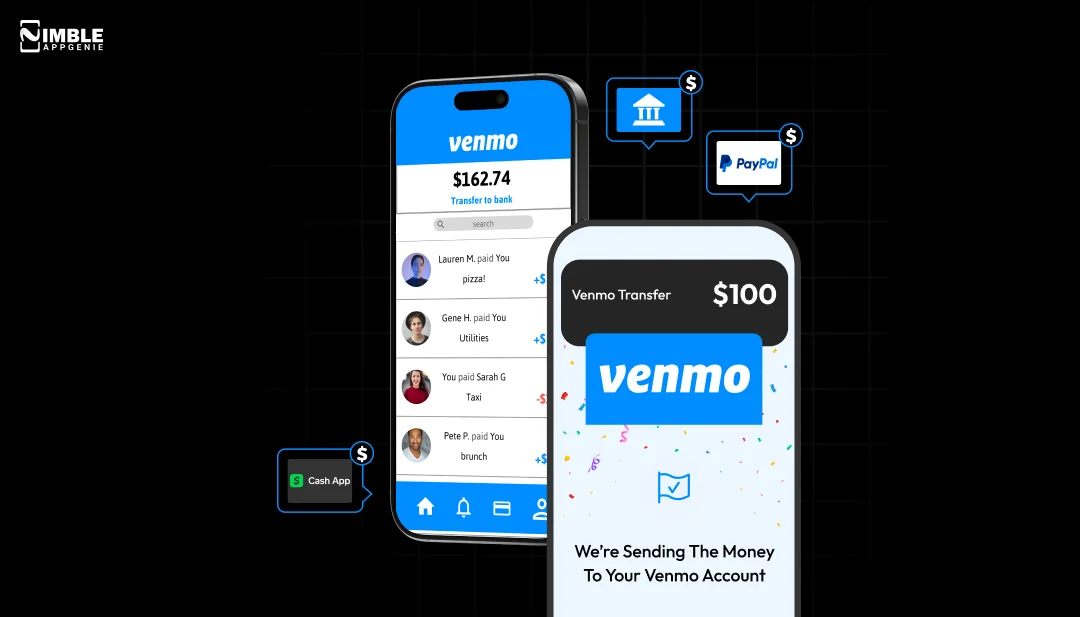
Venmo allows users to send and receive money between family, friends, and anyone with an account, wrapped in social features – a public feed, payment notes, and emoji-tagged payments that turned a utility into a habit.
| Two friends founded Venmo in 2009 and looked for an easier way to split expenses after a weekend trip to New York City. |
Since most “Venmo clone” cost guides were written, the figures behind it have grown considerably:
- Currently, Venmo has 100+ million total active accounts and 67 million monthly active accounts, up 7% annually as of late 2025.
- Total payment volume has recorded double-digit year-over-year growth for six straight quarters heading into 2026.
- In March 2026, Venmo launched its first major international expansion, allowing users to send and receive money with PayPal’s broader user base across 90 markets – a serious signal that “P2P payments” is no longer a domestic-only category.
That last point is crucial if you are benchmarking against Venmo particularly: multi-currency and cross-border support is rapidly becoming table stakes, not a future add-on. See our eWallet app statistics report for the wider market picture.
Features That Make Venmo Work
Any serious competitor should be accountable for the core feature set that makes Venmo sticky, not only functional.
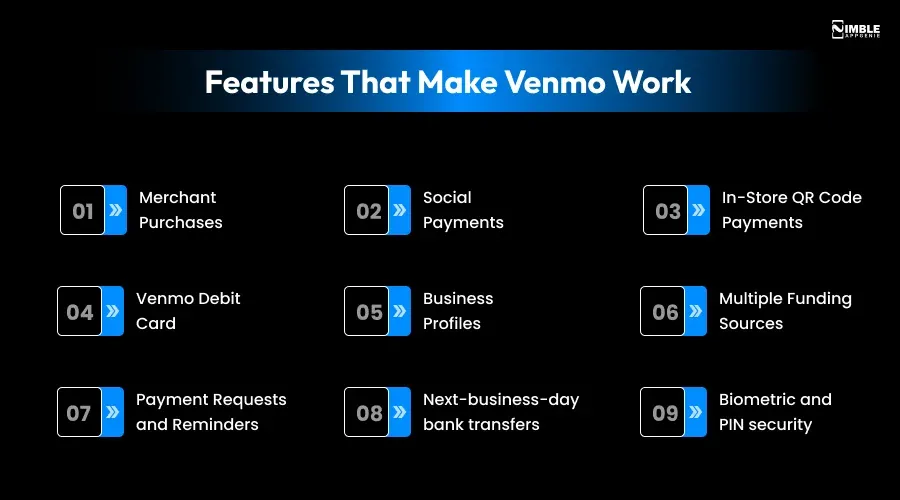
- Merchant Purchases: Paying at authorized retailers, in-store, and online.
- Social Payments: Splitting shared expenses and bills with a public or private feed.
- In-Store QR Code Payments: Contactless checkout without extra hardware.
- Venmo Debit Card: Spending wallet balance anywhere Mastercard is accepted.
- Business Profiles: Allowing merchants to accept payments through the same trusted app.
- Multiple Funding Sources: Linked bank accounts and cards.
- Payment Requests and Reminders: Eliminating the awkwardness of chasing owed money.
- Next-business-day bank transfers from wallet balance to a linked account.
- Biometric and PIN security, plus personalization through emojis, notes, and tags.
Each of these features adds engineering scope, which drives the cost ranges below.
Before the Cost Breakdown: Do You Need a Money Transmitter License?
Almost every “cost to build a Venmo clone” estimate you will see, including past versions of this one, focuses completely on development cost. That’s misleading on its own: an app that moves money between strangers is a regulated financial service, not only software.
In the US, that generally means either a state-by-state money transmitter license, or a partnership with a licensed Banking-as-a-Service (BaaS) provider that allows you to operate under their regulated coverage.
This decision impacts your timeline and budget as much as any technical choice on this page – we cover it in full, including a build-vs-partner comparison, in our guide to starting an eWallet business.
The cost figures below are development costs only. Treat licensing as a separate line item, not a rounding error.
How Much Does it Cost to Build?
The average cost to develop an app like Venmo ranges from $25,000 to $175,000, depending on platform, size, complexity, and tech stack.
For an accurate quote, consult directly with a fintech software development company – every payment app project is unique enough that a broad range will help you here.
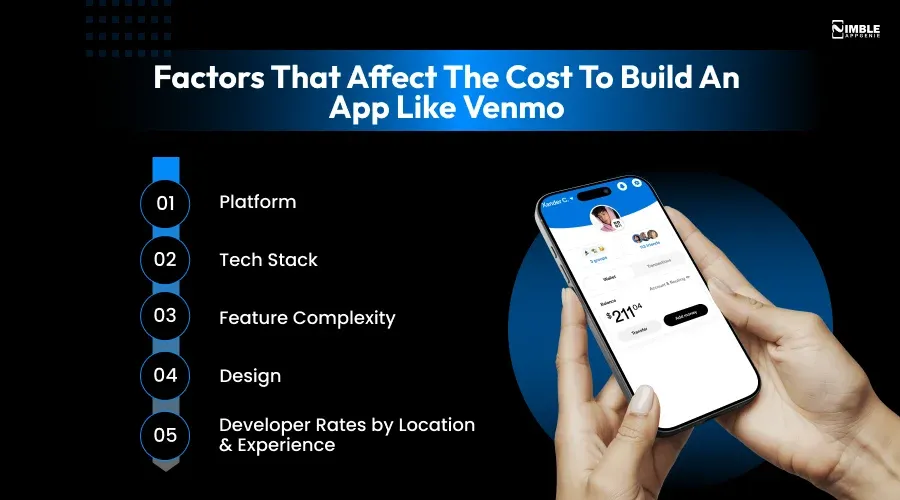
1. Platform
| Platform | Cost Range Impact |
| iOS Only | $20,000 – $100,000 |
| Android Only | $15,000 – $75,000 |
| Both iOS & Android | $35,000 – $175,000 |
| Add a Web App | +$20,000 – $50,000 on top of chosen platform(s) |
2. Tech Stack
The tech stack, including frameworks, languages, and tooling, shapes cost and long-term stability.
| Component | Typical Options | Cost Range |
| Frontend | React Native, Swift (iOS), Kotlin (Android) | $8,000 – $25,000 |
| Backend | Node.js, Django, Ruby on Rails | $10,000 – $40,000 |
| Database | PostgreSQL, MongoDB | $3,000 – $10,000 |
| Payment Gateway | Stripe, PayPal, Braintree | $5,000 – $20,000 |
| Security | OAuth, JWT, SSL/TLS | $5,000 – $15,000 |
| Cloud Hosting | AWS, Google Cloud, Azure | $2,000 – $10,000 |
| QA & Testing | JIRA, Selenium, Jest | $2,000 – $10,000 |
3. Feature Complexity
| Complexity | What’s Included | Cost Range |
| Basic | Registration/login, simple P2P transfers, basic security | $25,000 – $50,000 |
| Intermediate | + Social feed integration, transaction history, basic fraud detection | $50,000 – $90,000 |
| Advanced | + Biometric security, rewards program, customizable profiles | $90,000 – $130,000 |
| Highly Advanced | + AI/ML fraud detection, cross-border payments, third-party API integrations | $130,000 – $175,000 |
Cross-border payments now stay in the highly advanced tier, and, as reported, Venmo’s March 2026 international launch is a tier that a truly competitive app should consider.
4. Design
| Design Level | What’s Included | Cost Range |
| Basic | Simple UI, standard icons, minimal styling | $5,000 – $20,000 |
| Intermediate | Custom components, interactive elements, detailed prototypes | $20,000 – $40,000 |
| Advanced | High-fidelity design, animation, cohesive branding | $40,000 – $75,000 |
| Highly Advanced | 3D elements, personalized UX, A/B-tested flows | $75,000 – $100,000 |
5. Developer Rates by Location & Experience
| Region | Rate/Hour |
| North America | $100 – $200 |
| Western Europe | $70 – $150 |
| Eastern Europe | $40 – $100 |
| Asia | $20 – $70 |
| Latin America | $30 – $80 |
| Africa | $20 – $60 |
Security Layer Cost Estimates
A P2P app handles other users’ money in real time, making security architecture a cost center. At least budget for:
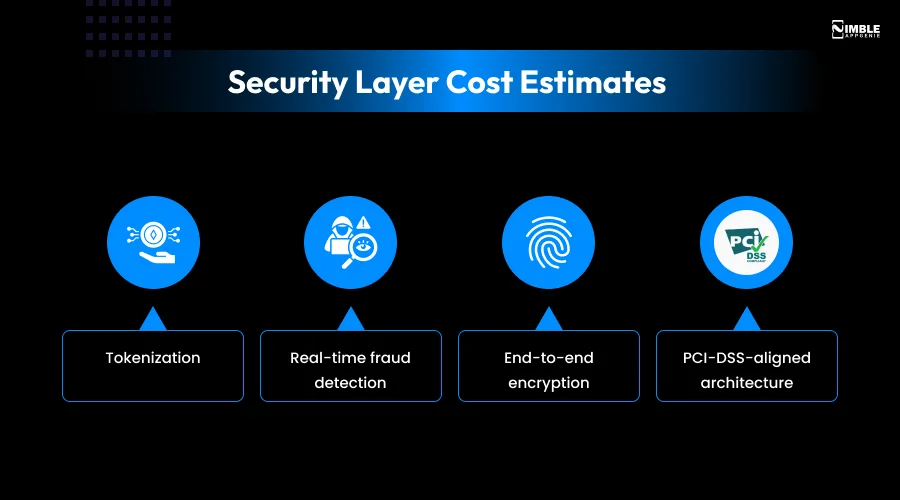
- Tokenization: So a database breach never exposes usable card or bank data.
- Real-time fraud detection, preferably AI-assisted rather than entirely rule-based.
- End-to-end encryption for every transaction in transit.
- PCI-DSS-aligned architecture from the first sprint, not a pre-launch audit fix.
Every payment app we ship goes through PCI-DSS, ISO 27001, and GDPR reviews built into the sprint cycle, not tacked on at the end.

How Long Does It Take to Build?
Average development time for a Venmo-style app is 6 to 9 months:
| Phase | Time | What Happens |
| Planning | 2–4 weeks | Requirements, feasibility, scope definition |
| Design | 4–6 weeks | UI/UX, wireframes, prototypes |
| Development | 12–24 weeks | Frontend/backend build, payment gateway and security integration |
| Testing | 4–8 weeks | Functional, security, and performance testing |
| Deployment | 1–2 weeks | App store submission and launch |
The app development timeline runs in parallel with whatever licensing or BaaS-partnership path you choose. Thus, the decision needs to be made early, not after development is already underway.
How Apps Like Venmo Make Money?
Common revenue paths include premium subscriptions, transaction fees, interest on stored balances, merchant fees, international transfer fees, and advertising.
For the complete breakdown of how Venmo specifically monetizes, see our dedicated guide on how P2P payment apps generate revenue.
Where Nimble AppGenie Fits In
It’s easy to close a feature list. But the challenging parts are getting security, licensing, and cross-border architecture right on the first attempt, where most “Venmo clone” projects run into problems.
We have built payment platforms, including SatPay, a versatile request-and-send wallet; CUT, a multicurrency wallet live in China and Myanmar; and Pay by Check, a US e-wallet supporting transfers and currency exchange – the kind of cross-border complexity a modern Venmo competitor increasingly needs.
If you are weighing the full technical build beyond only P2P transfers, our companion guide on how to create a digital wallet app covers broader architecture decisions.
Conclusion
Building an app like Venmo is a bigger project in 2026 than it was two years ago; not because the core P2P has changed, but because the bar Venmo set (deeper security expectations, 100M+ accounts, international reach) moved considerably higher.
Development cost is just one line item. Compliance, licensing, and security architecture are the ones that determine whether what you build can operate, not only demo well.
FAQs
Development typically costs $25,000 to $175,000, depending on platform, design complexity, tech stack, and feature scope. This figure covers app development only, not licensing or compliance costs.
Development typically takes 6 to 9 months, covering planning, design, development, testing, and deployment, run in parallel with any licensing path.
In most cases, yes, either your own state-by-state Money Transmitter License in the US, or a partnership with a licensed Banking-as-a-Service provider that lets you operate under their regulatory coverage.
Venmo has more than 100 million total active accounts and roughly 67 million monthly active accounts, with total payment volume posting double-digit year-over-year growth for six consecutive quarters heading into 2026.
Tokenization, end-to-end encryption, real-time fraud detection, and PCI-DSS-aligned architecture are all considered baseline requirements for any app handling peer-to-peer money transfers.
Yes. In March 2026, Venmo launched its first major international expansion, letting users send and receive money with PayPal’s broader user base across 90 markets.
Platform choice (iOS, Android, or both), tech stack, feature complexity, design level, and developer location and experience are the primary cost drivers.
Common monetization strategies include transaction fees, premium subscriptions, merchant fees, interest on stored balances, advertising, and international transfer fees.

Niketan Sharma, CTO, Nimble AppGenie, is a tech enthusiast with more than a decade of experience in delivering high-value solutions that allow a brand to penetrate the market easily. With a strong hold on mobile app development, he is actively working to help businesses identify the potential of digital transformation by sharing insightful statistics, guides & blogs.