

 Free Consultation
 PCI-DSS Compliant
 GDPR Ready
 ISO 27001
 NDA Protected
 AI Services
 AI App Development
 Generative AI Development
 AI Chatbot Development
 AI Integration Services
 AI Consulting Services
 AI For Fintech
 AI Financial Assistant Solution
 AI Insurance Agent Development
 Tech Stack
 OpenAI / GPT-4
 Claude / Anthropic
 Gemini / Google AI
 Llama / Open Source
 LangChain / LlamaIndex
 Pinecone / Pgvector
 AWS / Azure AI


 Fintech Solution
 Core Fintech
 App Development
 Neobank Solutions
 eWallet Solutions
 Lending Software
 Banking Solutions
 BNPL Solutions
 BNPL Solutions
 Insurance App
 Wealth Management
 Crypto & DeFi
 Blockchain Development
  Payroll Software
 DeFi Solutions
 Crypto Wallet
 Crypto On/Off Ramp
 Crypto Exchange
 Trading Platform
 Payments
 Compliance
 Regulations & Compliance
 Fraud Detection
 Lending Ecosystem
 P2P Lending Platform
 Mortgage Software
 Engagement
 Fintech Outsourcing

 Mobile Development
 Mobile App Dev
 iOS App Development
 Android App Development
 React Native
 Flutter Development
 Web Solution
 Node.js Development
 React.js Development
 Angular Development
 App Services
 UI/UX Design
 App Maintenance
 By Stage
 MVP Development
 Industry Solutions
 Healthcare App Dev
 Education App Dev
 Travel App Dev
 Real Estate App Dev
 Logistics Software
 Social Media App

 Hire Mobile Developers
 Hire iPhone Developers
 Hire Android Developers
 Hire React Native Devs
 Hire Flutter Developers
 Hire Web Developers
 Hire Node.js Developers
 Hire Angular Developers
 Hire PHP Developers
 Hire Laravel Developers
 How It Works
 Pre-Vetted Developers
 Ready In 48 Hours
 NDA From Day One
 Replace Guarantee
 Company
 About Us
 Our Work Process
 Portfolio
 Case Studies
 Blog / Insights
 Careers
 Contact Us
 Awards
 Recognition


 Offices


In a Nutshell:
- In 2026, AI is more of a co-pilot in a fantasy sports application than just a feature.
- One of the key aspects of implementing AI in fantasy sports apps is to include Explainable AI to ensure that users get insights on how AI has reached a certain conclusion in plain English.
- The legal landscape is tightening, and clear “skill-based” disclosures are essential for app survival.
- Realtime Adaptability, User Trust, Regulatory Hurdles, and Maintaining Fairness are some of the core challenges in implementing AI in fantasy sports apps.
- Nimble AppGenie can help you build a solid fantasy sports app powered by AI.
Do you have a fantasy sports app and want to update it?
Industry 4.0 has brought a revolution, and it has become essential to go with the current trend. Based on the current insights on technology, you should be bothered by adopting it into your app, right?
This is where AI and ML come into the picture. There are multiple benefits of using these updated technologies within the app. Let’s discuss it all in the given blog.
Here you will find market analysis, the reason behind using AI and ML in fantasy sports apps, their functions, and the cost of implementation.
Fantasy Sports App Market Analysis
Let’s start by discussing the current trend in the fantasy sports app market.
Here is the list you can go through:
- Based on the Fantasy sports statistics, the global market was USD 20.30 billion in the year 2022 which is expected to grow at a compound rate of 14.1% till 2030.

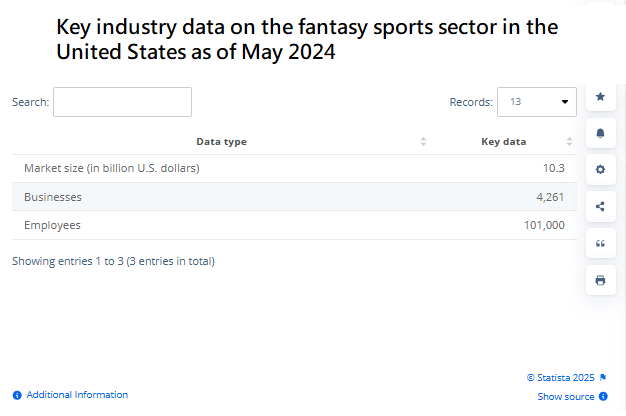
- However, in the U.S., the market size of the fantasy sports sector in the United States has reached 10.3 billion U.S. dollars in the year 2024.
- The Fantasy Sports Market is expected to grow from USD 37.62 billion in 2025 to USD 127.29 billion by 2034, which represents a compound annual growth rate (CAGR) of 14.50% in the period from 2025 to 2034.
- According to the survey by FSGA (Fantasy Sports & Gaming Association), it has been found that 64% of males and 35% females are engaged with fantasy sports apps.
Well, after learning about the market, let’s understand why it is essential to carry out AI and ML in fantasy sports apps.
Understanding AI & ML in Fantasy Sports and Its Evolution
In the early 2020s, the world was looking for ways to integrate AI in fantasy sports apps. Some users were optimistic about the use of AI in fantasy sports, some had mixed feelings, while some were worried about the way AI would impact these apps and games.
However, in 2026, the narrative has completely changed. Today, it is less about how AI is integrated and more about which AI is integrated into a platform.
If we talk about the timeline on how AI has made its way into fantasy sports, it can be classified into different eras that made these transitions from AI as features to complete apps being powered by AI.
- The Descriptive Era (2020-22): The initial days of AI in fantasy sports apps helped a user to fetch statistics and simplify that information for decision-making. AI worked as a descriptive model that simply offered statistics of what had happened in the game. The rest was to be done by the user. All the decisions, calculations, and more were the responsibility of the user.
- The Predictive Era (2023-25): After the successful implementation of descriptive AI, the next iteration came in the form of predictive AI in fantasy sports apps. This helped the solution to be more and more predictive about what might happen in a game or what the projected points that a user will end up with. This completely changed the way fantasy sports apps offered insights about the game.
- The Agentic Era (2025-Present): At the current stage, AI in fantasy sports apps is using AI as the core to generate insights based on the data available, along with dedicated descriptions on why it thinks so. The focus is on establishing transparency and logic behind its suggestion. It works as more of an agent that leverages computer vision and NLP to identify and handle real-time issues like player fatigue, strategy, and tactical approach.
The use of AI in fantasy sports has evolved significantly over the years. Not only do the solutions offer a better experience, but they are also continuously evolving for more and more progress.
With more and more focus on NLP, Generative UX, and optimization in real-time, implementation in AI is only going to be more and more advanced.
What Roles Does AI Play in the Fantasy Sports Apps? Key Applications
What makes the use of AI in fantasy sports more and more exciting in 2026 is the fact that it is now playing multiple roles in fantasy sports apps. As mentioned earlier, AI is no longer a feature, but the whole app.
The modern fantasy sports apps are all about offering deeper insights and an immersive experience. The use of AI has grown significantly over the years.
In case you are wondering what roles AI plays in fantasy sports apps, other than simply giving insights or automating the experience, check out the following applications of AI and the role they play in the apps.

► Strategy Assistant
For any fantasy sports app, the objective of any user is to make calculated decisions that lead to victory. Before AI, users had to gather all the information, run the numbers, and accordingly plan their moves in fantasy sports.
However, AI as an assistant can help in optimizing the lineup and do a lot more for a user, giving them the perfect experience to the best of its ability. The AI strategic planner takes care of the wins and risks while ensuring that all the mathematical calculations are accurate.
► Fantasy Sports Mentor
For years, fantasy sports have been compared to gambling and betting, as for many, it is a game of chance. However, with the implementation of explainable AI or XAI, you can easily create a digital sports mentor who not only gives a suggestion but also shows you the logic behind it.
One of the key roles of AI in fantasy sports apps is to explain every move that it makes. This not only creates transparency but also upgrades the skills of the users. The AI can work as a mentor to the players, helping them make the right decisions while keeping a human in charge.
► Measuring Player Performance
Another key role of AI in fantasy sports apps is to keep track of player performance based on their physical performance and numbers that they have yielded in a particular match, series, or season.
AI is implemented with computer vision and biometric data to fetch the most accurate details about player health and performance, making the decision completely based on how a player is performing. This way, the AI works as a digital scout, helping a user pick the right player in their team.
► Automated News Anchor
Thanks to Agentic AI, fantasy sports apps have easily become one of the most reliable sources of information for sports enthusiasts. Leveraging Natural Language Generation, these apps work as personal incident reporters and generate an automated report stating what the event was, how it happened, and how it will affect the game.
Agentic AI makes it easier to automate these reports while ensuring that the user is notified for preferred services. It is also the key entertainment section in the app, powered by AI in fantasy sports apps.
► Security & Human-in-Loop
Use of AI is generally preferred as it offers a more secure experience for the user. AI algorithms used in fantasy sports ensure that the game is running fairly and there is no malpractice involved, keeping you safe from bot players who may be manipulating the algorithm for their benefit.
Anomaly detection is one of the most impressive roles that has made investing in AI in fantasy sports app development worth every penny for businesses, as it eliminates issues associated with fairness issues.
These applications clearly demonstrate the different roles that AI plays in fantasy sports applications. It really is fascinating to see the way AI can uplift the experience of a user in an app that has direct connections with real-time events.
Why Use AI and Machine Learning in Fantasy Sports Apps? Benefits
Before identifying the role of AI and ML in fantasy sports apps, you should know the reasons to use them. From the market analysis, you probably have an idea about the worldwide market growth, right?
This can become an important reason to go with the implementation of the latest technology in fantasy sports apps.
Let’s discuss more about the reasons behind using fantasy sports apps:
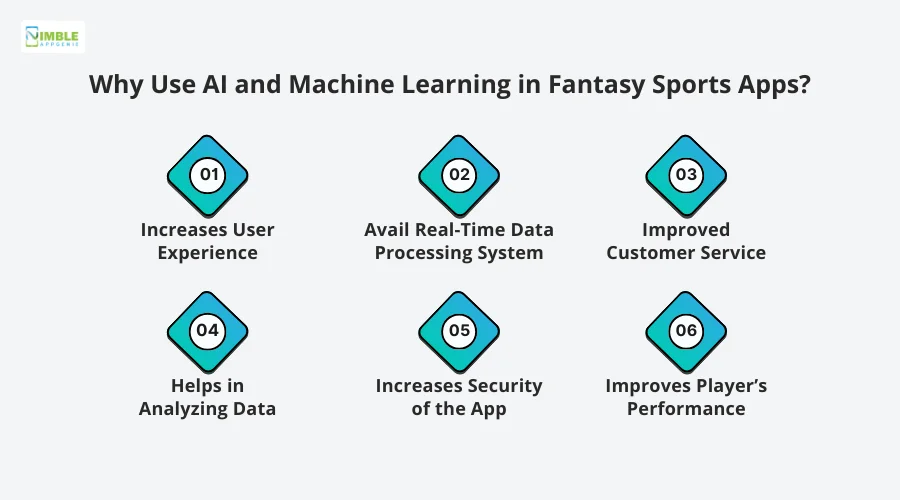
♦ Increases User Experience
AI in fantasy sports apps can help customize the user behavior as well as preferences. Here, AI can offer tailored recommendations and may provide personalized news feeds.
On the other hand, ML in fantasy sports apps can adjust the game’s difficulty level based on user skill level. This increases the engagement for both the seasoned and newcomers.
♦ Avail Real-Time Data Processing System
Fantasy sports apps are designed in the current era based on real-time data to inform users about current player stats, live game scores, and their present performance.
This data can be analyzed and used to ensure that they have the most up-to-date information that can be utilized for making practical decisions based on real-time facts.
♦ Improved Customer Service
The implementation of AI and ML in the fantasy sports app can be effective for increasing customer service operations by addressing users’ queries through AI. It will save time and cost for app users as well as help you in addressing their queries on time. This may result in user engagement and satisfaction.
♦ Helps in Analyzing Data
One of the important roles of AI and ML is to evaluate the vast amount of data accurately and quickly. It can help in providing insights into players’ performance, injury risks, and predicting game outcomes.
Within the fantasy sports apps, you can make use of AI-driven predictive analysis, which may help users to make smarter decisions.
♦ Increases Security of the App
Don’t you prefer an app that provides improved security to users’ data and enables them to avoid any kind of cyber threats?
Well, AI and ML can help in detecting and preventing fraudulent activities by identifying any kind of suspicious events. This helps in protecting users’ accounts and data through mobile app security.
♦ Improves Player’s Performance
The usage of AI and ML can help in predicting player performance and any future potential injuries by analyzing different factors such as the physical condition and past performance of the users.
This technology can be helpful to users in making more informed and strategic decisions, which may provide them with a competitive edge over other players. These were some of the reasons to use ML and AI in fantasy sports apps.

What are the Challenges in Implementing AI for Fantasy Sports Apps?
When implementing AI in any environment, there are some fundamental challenges, such as upgrading the skill sets of your employees, upgrading the resources, shifting from legacy to modern systems, and more.
However, when we talk about implementing AI in fantasy sports applications, the challenges are more severe as fantasy sports is already a controversial industry.
Some of the most prominent challenges that you should be worried about are –
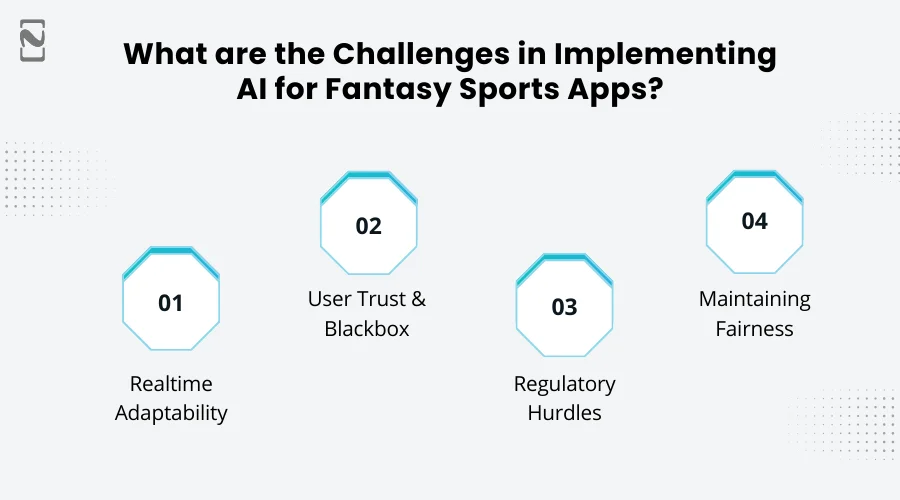
♦ Realtime Adaptability
When you implement AI into your fantasy sports apps, you need the efficiency to increase.
However, when the processing is real-time, it can become a challenge to make the app adapt to changes in real time. You see, when AI is implemented, the number of data points addressed and processed by the processing engine is so high that it brings latency in the process.
Deploying robust edge-computing and low-latency APIs is a way to overcome the challenges; however, that definitely requires experience and additional investment.
♦ User Trust & Blackbox
The functioning of AI in different models has always been questionable for the users.
There are times when suggestions made by AI can be questionable, for instance, AI asks you to bench your most in-form player for the next league game. Now, being an average user, it may surprise you as a surprise if the logic behind the suggestion is not clear.
It is crucial to implement Explainable AI to overcome this challenge as it creates user trust and resolves the Blackbox error completely.
♦ Regulatory Hurdles
Fantasy sports applications have always been under high scrutiny of regulations and compliance, making it difficult for AI to overcome the regulatory hurdles.
While it is already compared with gambling and betting solutions, a fantasy sports app may not be able to handle all the data shared by the user. This means, when the solution is always recording biometric data, it is already in the grey area with use of health data for generating predictions, which can trigger HIPAA-adjacent concerns for the users.
Working on the regulatory requirements and keeping a human in loop is a way to overcome this challenge while ensuring that the data is only used for fair assessment.
♦ Maintaining Fairness
AI-features in fantasy sports apps are generally a part of the paid subscription or an upgraded experience, which causes a conflict for the users.
You see, a paid user has access to advanced insights and AI solutions, while a casual user is managing without the same. When there are funds involved, the question arises here is how fair is it for the casual user to interact on the platform where people do have an additional edge.
This can question the ethical nature of the app. Reduced variety of winning strategies can reduce the issue.
The only upside to these challenges is that all of them can be overcome with the help of professional assistance. Building an AI-based fantasy sports app that gets the job done without getting stuck in any of the complications is a tough nut to crack.
It is only fair that you delegate this task to a fantasy sports app development company that knows how to manage these challenges without failure.
Case Studies Based on Using AI and ML in the Fantasy Sports Apps
Are you still confused about using AI and ML in your fantasy sports apps?
Here is the list of cases for the best fantasy sports apps that have used AI and ML technologies.
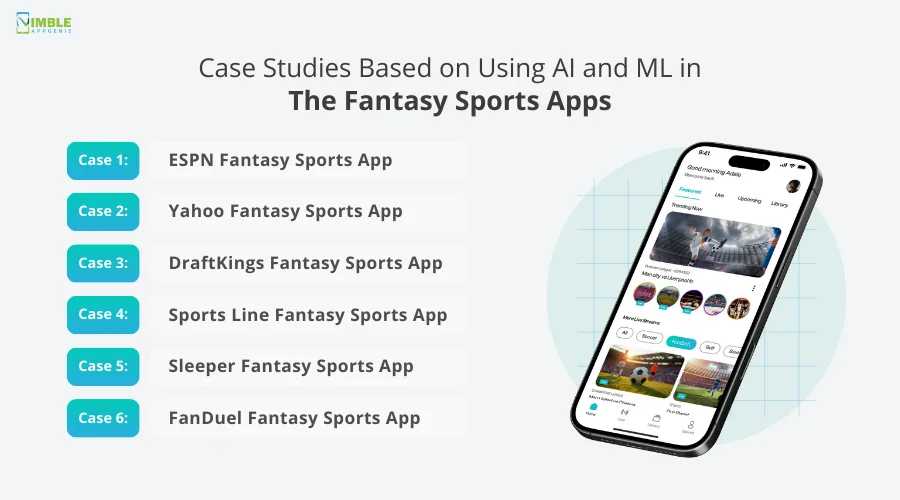
► ESPN Fantasy Sports App
The ESPN fantasy football app has already utilized AI-driven draft recommendations that assist users in making decisions based on the analyses made through the data.
Through AI, users can analyze players’ rankings, historical drafts, and trends to recommend picks that align with the user’s preferences and league context.
► Yahoo Fantasy Sports App
Yahoo Fantasy has used the power of AI to assist users with recommendations through algorithms that may provide configuration for upcoming matches.
Through AI and ML, the brand empowers users with data-driven insights after making their team selection procedure more informed and strategic.
Must-Read: How To Develop An App Like Yahoo Fantasy
► DraftKings Fantasy Sports App
DraftKings uses machine learning to create a more engaging and dynamic experience for the users. The brand is the leader in daily fantasy sports apps.
By providing multiple game options to the users, DraftKings increases player engagement by ensuring that the participants find their competitors based on their preferences and skill levels.
Explore More: How To Develop An App Like DraftKings
► Sports Line Fantasy Sports App
SportLine ensures that its users receive the best experience while playing games. The platform integrates with AI to deliver accurate projections as well as insightful analysis for fantasy sports enthusiasts.
The platform generates comprehensive recommendations and advises the users on why they need to make the decision. Thus, SportLine uses AI analysis to help users to understand game dynamics.
► Sleeper Fantasy Sports App
Sleeper fantasy sports app uses AI for generating in-depth player insights as well as analysis. They empower players to make well-rounded decisions.
They extract relevant information, then they consolidate the data by providing users with a comprehensive understanding of the player sentiments.
Don’t Miss: Cost To Develop An App Like Sleeper
► FanDuel Fantasy Sports App
Fanduel has implemented AI-powered scoring systems that are useful for providing real-time updates and a detailed performance analysis during live matches.
AI’s predictive capabilities of the FanDuel fantasy sports app are useful to offer insights into the potential game-changing moments that keep users engaged over the match.
Well, these were some of the cases, from which you can take inspiration for fantasy sports app design. Now, are you aware of the cost to implement it?
Similar Topic: How To Develop An App Like Fanduel
What is the Cost to Implement AI and ML in Fantasy Sports Apps?
AI and ML are the features that can incur additional costs when you implement them within your fantasy sports app. Now, if you are developing a new application from scratch, then it can be added to the total cost of creating a fantasy sports app.
Well, the additional cost to implement AI and ML in fantasy sports apps can vary from $15,000 to $70,000 or more.
We have provided you with a range because it depends on multiple factors, such as app complexity, design, features, and others. Are you ready to implement AI and ML in your fantasy sports app?
Who Can Help Me Integrate AI in Fantasy Sports App?
Nimble AppGenie is one of the leading names known for implementing AI in existing solutions and making them ready for tomorrow.
With more than 8 years of experience in the industry, we are a leading fantasy sports app development service that can help you implement AI in fantasy sports apps quite easily.
Our experts are highly professional and have hands-on experience on AI development which makes it the perfect companion for your business.
What makes Nimble AppGenie stand out from the competition is our extensive portfolio of fantasy sports applications that we have developed and deployed in the past.
Artificial intelligence is certainly a growing trend in fantasy sports as a concept, and the earlier you can grab the opportunity to offer advanced experiences to the user, the better you can thrive in your business.
Conclusion
The use of AI and ML is the current trend and is vital to adopt for several reasons, some of which are that it increases customer experience, helps in analyzing users’ data, increases app security, and provides real-time data processing systems.
The roles of AI and ML in fantasy sports apps are predictive analysis and automation, optimizing the app’s performance, increasing game dynamics and realism, and increasing user performance.
You can consider different case examples, such as ESPN and Yahoo fantasy sports apps, use them to analyze current users’ data, and then provide recommendations on this basis.
Similarly, Sleeper and DraftKing use it to help users with strategic decision-making procedures. The cost depends on multiple factors, and you need an experienced team to implement AI and ML in your next fantasy sports app.
FAQs

Niketan Sharma, CTO, Nimble AppGenie, is a tech enthusiast with more than a decade of experience in delivering high-value solutions that allow a brand to penetrate the market easily. With a strong hold on mobile app development, he is actively working to help businesses identify the potential of digital transformation by sharing insightful statistics, guides & blogs.
Table of Contents




No Comments
Comments are closed.