

 Free Consultation
 PCI-DSS Compliant
 GDPR Ready
 ISO 27001
 NDA Protected
 AI Services
 AI App Development
 Generative AI Development
 AI Chatbot Development
 AI Integration Services
 AI Consulting Services
 AI For Fintech
 AI Financial Assistant Solution
 AI Insurance Agent Development
 Tech Stack
 OpenAI / GPT-4
 Claude / Anthropic
 Gemini / Google AI
 Llama / Open Source
 LangChain / LlamaIndex
 Pinecone / Pgvector
 AWS / Azure AI


 Fintech Solution
 Core Fintech
 Fintech App Development
 Neobank App Development
 eWallet App Development
 Payment Integration
 Lending Software
 Banking Software Development
 BNPL Solution
 BNPL App Development
 Insurance App
 Investment App Dev
 Wealth Management App
 Crypto & DeFi
 DeFi App Development
 Crypto Wallet Dev
 Crypto Exchange Dev
 Trading Platform Dev
 Payments
 Compliance
 Fintech & Digital Regulations
 Fraud Detection
 Lending Ecosystem
 P2P Lending Platform
 Mortgage Software
 Engagement
 Outsourcing Dev

 Mobile Development
 Mobile App Dev
 iOS App Development
 Android App Development
 React Native
 Flutter Development
 Web Development
 Node.js Development
 React.js Development
 Angular Development
 PHP / Laravel
 App Services
 UI/UX Design
 App Maintenance
 By Stage
 MVP Development
 Industry Solutions
 Healthcare App Dev
 Education App Dev
 Travel App Dev
 Real Estate App Dev
 Logistics Software
 Social Media App

 Hire Mobile Developers
 Hire iPhone Developers
 Hire Android Developers
 Hire React Native Devs
 Hire Flutter Developers
 Hire Web Developers
 Hire Node.js Developers
 Hire Angular Developers
 Hire PHP Developers
 Hire Laravel Developers
 How It Works
 Pre-Vetted Developers
 Ready In 48 Hours
 NDA From Day One
 Replace Guarantee
 Company
 About Us
 Our Work Process
 Portfolio
 Case Studies
 Blog / Insights
 Careers
 Contact Us
 Awards
 Recognition


 Offices


Nimble AppGenie developed a loan management software called Debtica Core. It is made for lenders in Poland, and it helps them handle the whole journey in one place, from application and credit checks to repayments and collections. It also reports to KNF, Poland’s financial regulator, in the exact format they expect.
This is not a sales pitch. It is the real story of building Debtica Core. The decisions we made, the problems we ran into, and the lessons we picked up along the way. Building lending software for a regulated market like Poland is not simple.
There are strict compliance rules, local banking standards, and a regulator that expects things done a specific way. We learned a lot by doing it, sometimes the hard way.
If you are a fintech founder, a product manager, or anyone thinking about developing lending software for a regulated European market, this blog is for you. We are sharing what worked, what did not, and what we would change if we started over.
What is Debtica Core?
Debtica Core is a loan management software system built by Nimble AppGenie for a lending business operating in Poland. It manages loan applications, credit checks, repayments, and collections in one place, instead of spreading the work across spreadsheets and separate tools.
Before Debtica Core, the client was running parts of the loan process by hand. Staff tracked applications in spreadsheets. Compliance reports took days to put together.
There was no single system that could pull credit data, check a borrower, and move a loan through approval without someone copying information between tools. As the client’s loan volume grew, this way of working stopped scaling.
They needed custom loan management software and not an off-the-shelf solution built for a different market, and one that could grow with the business instead of adding more manual work at every stage.
What Features Did We Build for Debtica Core Loan Management Software?
Debtica Core has five core modules that we have built. They are the borrower panel, loan officer panel, a collective panel, a compliance and admin panel, and a credit bureau and payments layer that connects the whole system to the outside world.
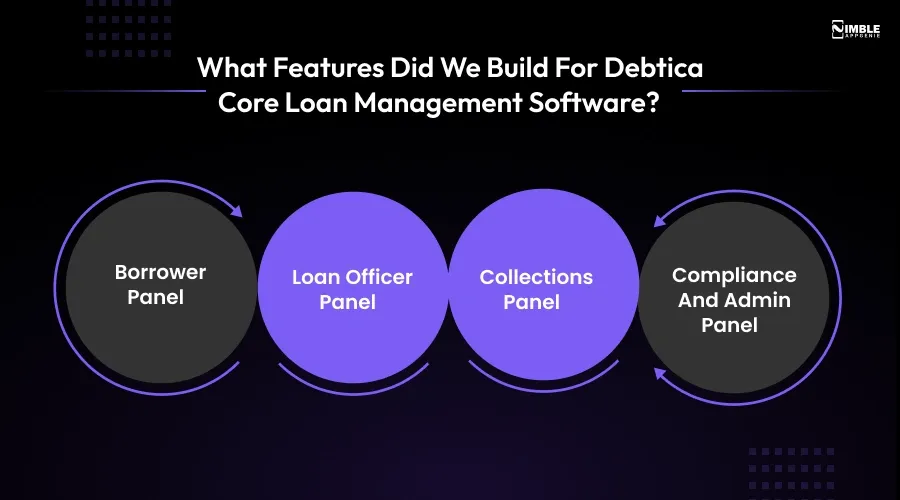
1] Borrower Panel
This is what the borrower sees. It had to work on a phone, in Polish, and get someone from application to a decision in one sitting.
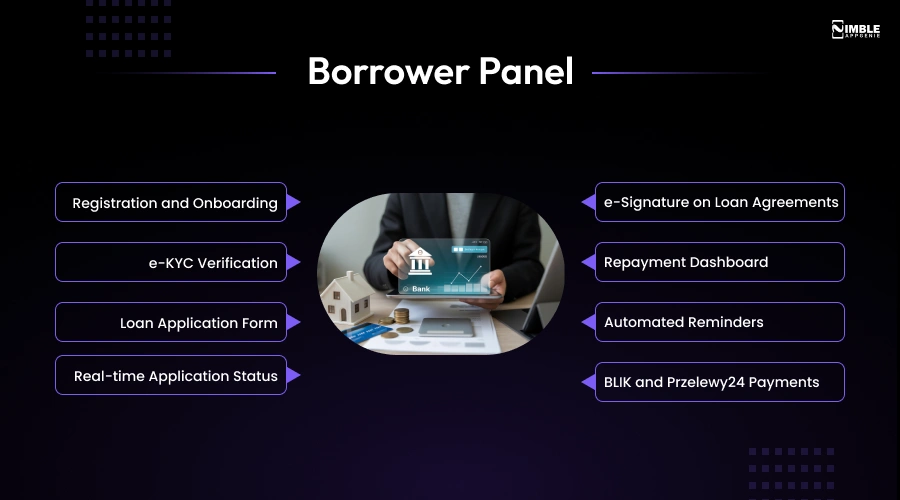
-
Registration and Onboarding
Borrowers can easily sign up with a phone number and email; no branch visit required.
-
e-KYC Verification
Borrowers upload an ID and a selfie, and the system checks the match automatically.
-
Loan Application Form
Income, employment, and a loan purpose are captured in a short, guided flow.
-
Real-time Application Status
Borrowers see exactly where their application sits, instead of calling to ask.
-
e-Signature on Loan Agreements
Borrowers can sign digitally. They do not need any printing or scanning for e-signature.
-
Repayment Dashboard
Borrowers can see the upcoming due dates, balances, and payment history in one screen.
-
Automated Reminders
SMS and email notify borrowers before a payment is due, and again if it is missed.
-
BLIK and Przelewy24 Payments
Borrowers repay using the payment methods they already use day to day.
2] Loan Officer Panel
Loan officers review applications, check flagged cases, and move loans through approval. The panel gives them one queue instead of five open tabs:
- Application queue with automatic ranking, so complete, low-risk applications surface first.
- Credit bureau data pulled directly into the applications view, no separate portal login.
- Automated credit scoring with a clear breakdown of why a score landed where it did.
- Manual override with a mandatory note, for the cases that need a human judgement call.
- Disbursement tracking, so officers can confirm funds actually reached the borrower.
3] Collections Panel
This module exists because a lender’s real risk is not the loan that gets approved; it is the one that goes unpaid, and nobody notices for weeks.
- Automatic flagging of overdue accounts, sorted by days past due.
- Structured follow-up workflows, so every overdue account gets a consistent next step.
- Payment plan builder, for borrowers who need restructured terms instead of a hard default.
- Call and contact logging, so every interaction with a borrower is on record.
4] Compliance and Admin Panel
Nimble AppGenie built Debtica Core for the compliance officer who has to answer to KNF, not just the loan officer who has to hit a monthly target.
- KNF-ready reporting, generated on demand instead of assembled by hand.
- Full audit trail like every login, every data access, every change to a loan record.
- Role-based access, so a loan officer, a compliance reviewer, and an admin see different parts of the system.
- AML and sanctions screening, run automatically at onboarding and again at key checkpoints.
How We Built Debtica Core Loan Management Software: Our Approach
We developed Debtica Core in four phases: discovery and architecture, core platform fintech software development, bureau and payment integrations, and testing before launch.
Every decision got tested against one question: does this hold up during a KNF audit? If a feature could not answer that clearly, it went back for rework.
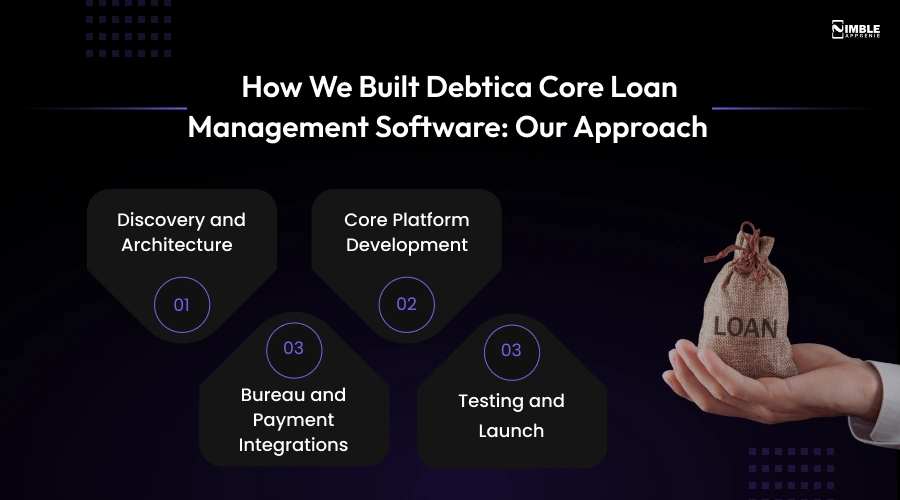
1. Discovery and Architecture
We started with three questions. What does the client’s current loan process actually look like? Which Polish regulations apply to this specific type of lending? Which credit bureaus and payment rails does the system need to talk to?
The answers shaped the build order. Originations came first, since every other module, from scoring to collections, depends on the data captured when someone applies.
2. Core Platform Development
Our dedicated development team built the origination and underwriting modules first, in short sprints, testing each one before moving to the next. Business analysts and a compliance reviewer sat in on every sprint review, not just the final one.
3. Bureau and Payment Integrations
Three integrations defined what the platform could actually do. BIK, KRD, and ERIF for credit and debt data, and BLIK and Przelewy24 for payments. Each one meant working against a different API, with its own data format and its own uptime quirks.
We built compliance into each module as it was developed, not as a review step at the end. Retrofitting KNF reporting onto a finished system would have meant reopening every module we had already closed.
4. Testing and Launch
Testing ran in two stages: internal QA against every workflow and edge case, then a pilot with a small group of real loan officers using live but limited data before full rollout.
The pilot caught things internal testing missed. Loan officers hesitated at a step we thought was obvious. A report we assumed was clear needed a second column. We fixed what came up, then ran the pilot again before going live.
Technology Stack Behind Debtica Core Loan Management Software
Debtica Core runs on a cloud-hosted, microservices setup, so origination, underwriting, payments, and reporting can each scale and update on their own.
| Category | Technologies or Services Used |
| Backend | Node.js, .NET Core |
| Frontend or Web Portal | React, TypeScript |
| Verification & Security | e-KYC provider for ID and selfie matching, AML and sanctions screening service |
| Credit Bureaus | BIK, KRD, ERIF |
| Payments | BLIK, Przelewy24 |
| Cloud & Infrastructure | AWS, with encrypted storage and role-based access control |
| Database | PostgreSQL |
Challenges We Faced During Loan Management Software Development
The main challenges were KNF compliance, connecting to three separate credit bureaus, automating AML and KYC checks, supporting local payment methods, and scaling collections without adding headcount.
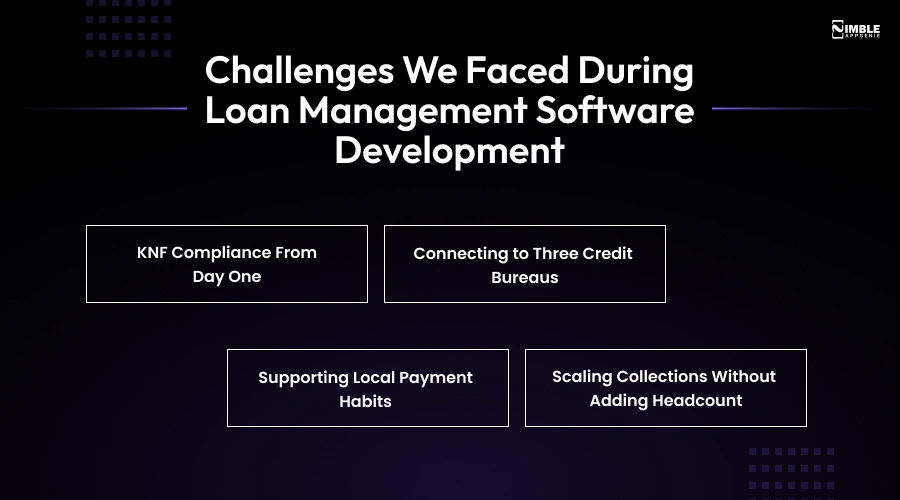
Challenge 1: KNF Compliance From Day One
KNF reporting is not a form you fill in once a year. It needs specific data, in a specific format, produced on a schedule.
What we did:
We mapped KNF’s reporting fields before writing a line of code for the origination module, so the data needed for compliance was captured at the point of application, not reconstructed later.
Challenge 2: Connecting to Three Credit Bureaus
BIK, KRD, and ERIF each have their own API, their own response format, and their own downtime windows. A credit decision that depends on all three has to handle any one of them being slow or unavailable.
What we did:
Our team used automated ID and selfie matching for standard cases, with a clear escalation path to a human reviewer for anything the system flags as uncertain.
| Key insights: Automation and compliance are not in conflict. The trick is deciding which checks can clear automatically and which ones genuinely need a person to look at them. |
Challenge 4: Supporting Local Payment Habits
Polish borrowers expect to pay with BLIK or Przelewy24, not a generic card form built for a different market.
What we did:
We integrated both payment methods directly into the repayment flow, so a borrower repays the same way they already pay for anything else online.
Challenge 5: Scaling Collections Without Adding Headcount
As loan volume grew, so did the number of overdue accounts, and the client could not keep adding collections staff at the same rate.
What we did:
We created automatic flagging and structured follow-up workflows, so every overdue account gets a consistent next step without a staff member manually checking each file.
Lessons We Learned Building Debtica Core Software
The biggest lessons were that compliance has to be built in from the start, credit bureau integration is core infrastructure and not an add-on, and automation only works where a wrong decision is cheap to reverse.
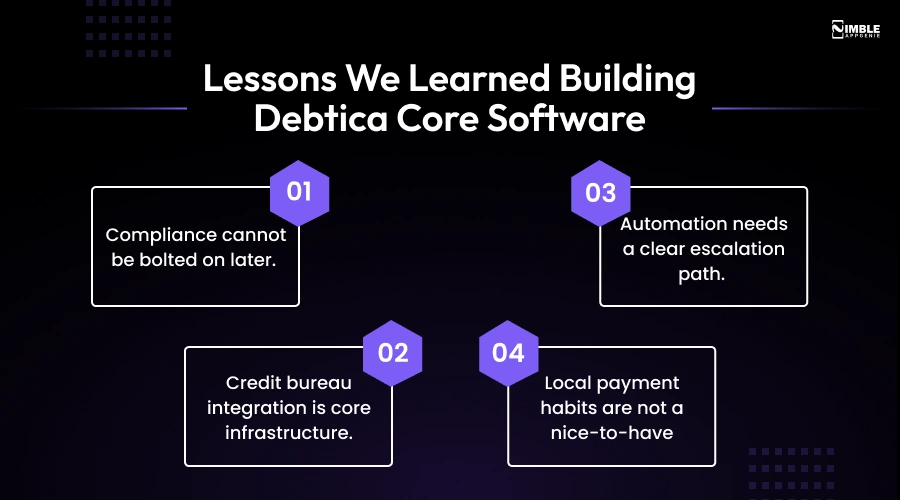
► Compliance cannot be bolted on later
If you build a loan lending platform and plan to add KNF reporting once it is finished, you will end up rebuilding multiple modules. Building it in from the first sprint costs more time upfront and saves far more later.
► Credit bureau integration is core infrastructure
BIK, KRD, and ERIF are not optional add-ons you connect once the platform is done. Underwriting does not work without them, so they belong in the first phase of development.
► Automation needs a clear escalation path
Full automation sounds efficient until an edge case slips through. The AML and KYC flow only works because certain cases go to a person, not because the system decides everything on its own.
► Local payment habits are not a nice-to-have
Borrowers repay more reliably when the payment method matches what they already use. BLIK and Przelewy24 support wasn’t a bonus feature; it was part of getting repayment rates to hold up.
The Outcome: What Debtica Core Delivers Today
Debtica Core is live and handles the client’s full loan process, from application to collections, in one platform. Compliance reports that used to take staff days to assemble now come out of the dashboard on demand.
Loan officers work from the queue instead of switching between a spreadsheet, a bureau portal, and an email inbox. Collections staff work from flagged accounts and structured workflows instead of manually checking every open loan for overdue payments.
It is all because of the loan lending app development solutions. The bigger shift is that the client can now handle more loan applications without adding amounts of manual work, since credit checks, reminders, and reporting run automatically instead of by hand.
FAQs
Loan management software handles loan applications, credit checks, repayments, and collections in one system. Lenders in Poland need it to meet KNF reporting rules and connect to local credit bureaus without doing it all by hand.
Yes. Debtica Core was made to meet KNF reporting requirements and GDPR and UODO data protection rules, with compliance built into each module during development rather than added afterwards.
Yes. Debtica Core connects to BIK, KRD, and ERIF through direct API integrations, so credit and debt checks run automatically during underwriting instead of through a separate manual lookup.
It depends on the features and integrations needed, but a platform like Debtica Core, covering origination, underwriting, and collections, typically takes several months of discovery, development, and testing before launch.

Madan is the Backend Solutions Architect at Nimble AppGenie, specializing in the design of secure, high-concurrency systems that power complex mobile ecosystems. With deep expertise in server-side logic and database management, he ensures every platform is built with enterprise-grade security. In his free time, he is an avid researcher of emerging technologies; he spends his time deconstructing the latest backend frameworks and reading technical papers to ensure our solutions remain at the absolute forefront of industry innovation.
Table of Contents


No Comments
Comments are closed.