

 Free Consultation
 PCI-DSS Compliant
 GDPR Ready
 ISO 27001
 NDA Protected
 AI Services
 AI App Development
 Generative AI Development
 AI Chatbot Development
 AI Integration Services
 AI Consulting Services
 AI For Fintech
 AI Financial Assistant Solution
 AI Insurance Agent Development
 Tech Stack
 OpenAI / GPT-4
 Claude / Anthropic
 Gemini / Google AI
 Llama / Open Source
 LangChain / LlamaIndex
 Pinecone / Pgvector
 AWS / Azure AI


 Fintech Solution
 Core Fintech
 Fintech App Development
 Neobank App Development
 eWallet App Development
 Lending Software
 Banking Software Development
 BNPL Solution
 BNPL App Development
 Insurance App
 Wealth Management App
 Blockchain Development
 Payroll Software Development
 DeFi App Development
 Crypto Wallet Dev
 Crypto On Ramp Off Ramp
 Crypto Exchange Dev
 Trading Platform Dev
 Payments
 Compliance
 Fintech & Digital Regulations
 Fraud Detection
 Lending Ecosystem
 P2P Lending Platform
 Mortgage Software
 Engagement
 Outsourcing Dev

 Mobile Development
 Mobile App Dev
 iOS App Development
 Android App Development
 React Native
 Flutter Development
 Web Solution
 Node.js Development
 React.js Development
 Angular Development
 App Services
 UI/UX Design
 App Maintenance
 By Stage
 MVP Development
 Industry Solutions
 Healthcare App Dev
 Education App Dev
 Travel App Dev
 Real Estate App Dev
 Logistics Software
 Social Media App

 Hire Mobile Developers
 Hire iPhone Developers
 Hire Android Developers
 Hire React Native Devs
 Hire Flutter Developers
 Hire Web Developers
 Hire Node.js Developers
 Hire Angular Developers
 Hire PHP Developers
 Hire Laravel Developers
 How It Works
 Pre-Vetted Developers
 Ready In 48 Hours
 NDA From Day One
 Replace Guarantee
 Company
 About Us
 Our Work Process
 Portfolio
 Case Studies
 Blog / Insights
 Careers
 Contact Us
 Awards
 Recognition


 Offices



Key Takeaways
- Fintech solutions for education comprise all the digital solutions related to finance provided to educational institutions, helping them to manage finances.
- The key pain points that fintech solutions for education address are institutional constraints, low financial literacy, family and student affordability, and teacher retention.
- Core Edufintech solutions for education are automated fee-collection, B2B lending, payroll and faculty compensation, BNPL lending, cross-border solutions, education savings, and gamified solutions.
- Key compliance requirements adopted by fintech in education are GDPR, PCI-DSS, and FERA.
- The cost to develop fintech solutions for education can vary from $20,000 to $150,000+ depending on different determinants, such as the complexity of features, type of app, and more.
- Partner with the right development partner, such as Nimble AppGenie, to create your own personalized fintech solutions for education.
The global fintech market was valued at USD 394.88 billion in 2025 and is expected to be worth USD 460.76 billion in 2026, and is expected to reach USD 1760.18 billion by 2034.
Here, education finance is the main factor fueling this curve as tuition costs keep outpacing traditional payment systems.
Hence, fintech solutions for education come in, shaping the education finance system and replacing manual fee collection and rigid loans with automated and student-first infrastructure.
For educational startups and entrepreneurs, fintech solutions for education are not a small feat. Hence, in this guide, we will walk you through the complete solutions, key financial pain points, compliance rules, tech stack, and a complete cost structure.
Without further ado, let’s begin.
What are the Fintech Solutions for Education?
Fintech solutions for education are digital tools that simplify school payments, fund learning costs, and teach money management.
Additionally, it simply means all the innovative financial solutions that are emerging to address the challenges associated with financing education.
The combination of finance and education is assisting in making learning more accessible but is also revolutionizing the way people invest in their education.
The intersection of finance and education not only makes learning more accessible and feasible, but it is also revolutionizing the way people invest in their education.
Here, the majority of the startups and businesses ask, “ What is the difference between EduFintech and Edtech?”
Well, EduFintech deals with the solutions of financial + technology services in education. However, Edtech focuses on all the technologies used for enhancing learning.
If you’re unfamiliar with the broader concept of financial technology, you may first want to understand what is fintech, before exploring how it applies to education.
For example, under EdTech, you will find learning management systems such as Canvas, Google Classroom, and online learning platforms such as Courera, Udemy.
While under EduFintech, you will find solutions for tuition and educational financing issues, making loans accessible to students; basically, it makes education financially accessible and manageable.
Bonus Read “ 50 Unique Educational App Ideas”
If you are wondering what the need for financial solutions for education is, then let’s check out the next section.
Key Financial Pain Points in Education Today
Whether you want to know the “reasons to opt for financial solutions for education” or key “financial pain points due to which financial services are adopted in education”, then this section resonates with you.
Here is the list of solutions to study:
-
Institutional Constraints and Resource Deficits
Educational institutions such as schools, colleges, and professional teaching institutions face challenges of rigid funding sources and skyrocketing prices.
Additionally, they face issues related to operational expenses such as maintaining and repairing the building utilities, along with compliance strain on baseline budgets.
This all leads to opt for financial solutions for educational institutions.
-
Low financial literacy among students
Educational institutions are facing challenges related to unawareness of financial literacy among students. This is the key pain point, which means a lack of basic skills and knowledge related to managing money, such as understanding debt and savings concepts.
This gap leaves students unequipped with the personal finance options they have to avail EduFintech Solutions.
This further results in helping students to opt for the EduFintech option.
-
Family and Student Affordability Pressures
This direct cost of learning forces many families into strict financial trade-offs or long-term debt cycles when trying to pay for college and basic living expenses.
This pressure occurs when the total cost of attending a university rises much higher than the typical family income.
Thus, EduFintech helps them with all the available solutions they can opt for as per their situations and demands.
-
Classroom Impact and Teacher Retention
Based on the perspectives of the educational institutions, one of the major challenges occur to manage the classrooms as per users’ facilities, along with teacher retention.
With the trend of smart classes, the budget to manage such classrooms and their staff directly compromises the overall quality of education.
Hence, EduFintech resolves this issue by directly paying for projectors, learning management systems, digital boards, and even helpful in managing apps.
EduFintech resolves the issue of teacher retention via stabilizing school cash flows and automating time-consuming administrative workflows.
Let’s learn all the fintech solutions for education by diversifying and distributing them under categories.
Core EduFintech Solution Categories
There are two types of categories under the educational system;
- B2B: Deals with the education institutions and their staff. (Institution-Facing)
- B2C: Deals with the student- and parent-facing issues. (Student/Family-Facing)
Let’s learn all the EduFintech solutions offered under these two categories:
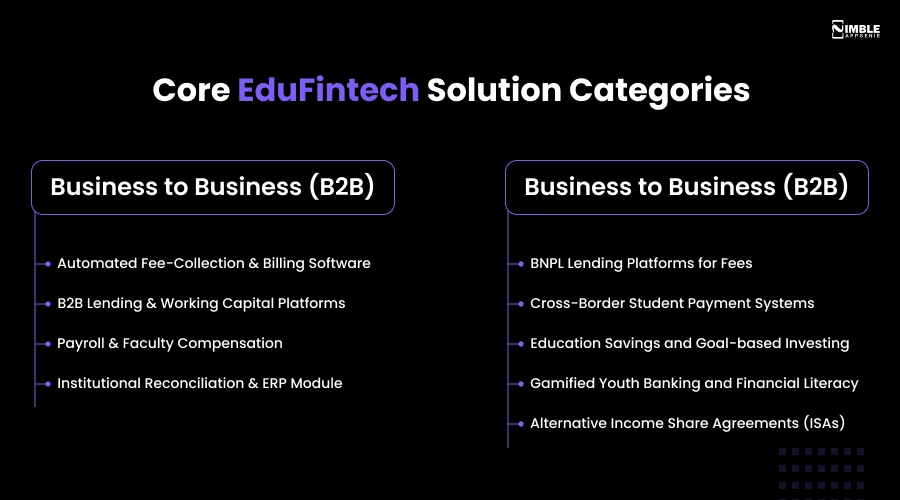
Category 1: Business to Business (B2B)
-
Automated Fee-Collection & Billing Software
The automated fee-collection and billing software streamlines financial solutions by handling online payments and automated reminders, along with digital receipt generation.
This system often offers institutions recurring invoicing, late-fee logic, and real-time dashboards by replacing spreadsheet-driven billing with a system that syncs directly to the institution’s finance stack.
Nimble AppGenie’s fintech software development services focus on offering complete fee-collection and billing software.
-
B2B Lending & Working Capital Platforms
Institutions sometimes need working capital to bridge the semester-gap cash flow, by funding the infrastructure, or covering the payroll before tuition payments land.
Lending software development empowers businesses to create B2B lending platforms, allowing educational institutions to secure short-term credit lines and invoice financing against predictable tuition receivables.
This offers education app security to the institutions and helps them to have a good cash flow during operations.
-
Payroll & Faculty Compensation
One of the important fintech solutions for education is offering payroll and faculty compensation services by automating salary calculations.
Different tax jurisdictions, compliance rules, and disbursement rails for faculty and staff are issues that multi-campus and multi-country institutions face.
Through payroll software development or integrating the payroll facility under fintech, educational institutions can handle direct deposits and tax compliance.
-
Institutional Reconciliation & ERP Module
An institutional reconciliation and ERP module resolves the chaotic problem of matching the thousands of students’ payments through different banks. For fintech companies serving the education sector, this module acts as a backbone that ensures financial accuracy.
Additionally, through an ERP system, you can close the gap between the money received and books updated by the educational institutions, as it helps to resolve the issues of payment mechanisms.
Nimble AppGenie’s fintech API integrations can be helpful here, assisting educational institutions to integrate prompt fintech solutions and ERP modules.
Category 2: Digital Tuition & Fee Payment Platforms
-
BNPL Lending Platforms for Fees
EdFintech helps educational institutions by providing them with instant fee disbursement. It protects families from paying lump-sum tuition fees through loans or delayed enrollments.
Here, BNPL app development or integrating with the BNPL app helps educational institutions to assist students by splitting fees into manageable installments with the underwriting logic built around academic calendars.
This offers relief not only to the parents and students, but also helps educational institutions to manage fees as the academic calendar rolls.
-
Cross-Border Student Payment Systems
Students studying abroad often face challenges with the high financial markups, slow settlement, and opaque fees, while paying tuition from abroad.
The cross-border payment structure used by educational institutions offers students a transparent a transparent conversion rates and same-day settlement fees.
The use of IBAN often helps educational institutions to connect students with diversified banks on an international scale.
Bonus Read “What is IBAN?”
-
Education Savings and Goal-based Investing
Fintech helps educational institutions in goal-based investing through automated savings, personalized calculators, and smart asset allocation. The majority of families do not have funds for children’s education, and even if they have, they are not able to track it.
Through Edfintech, parents and students can have access to goal-based investing that sets a target education fund and helps to track progress against tuition inflation.
It helps to create financial discipline that offers a clear focus and is even helpful in teaching early money management to the students.
-
Gamified Youth Banking and Financial Literacy
Sometimes, money management might seem a boring activity for both the parents and the students. Hence, fintech solutions for education help in making money management fun by offering a diversified solution to invest through a gamified panel.
As most of the students graduate with zero practical money-management experience. Here, gamified banking apps help them to save money for their education and help them to learn financial literacy.
Gamification in education turns saving and financial literacy into a habit rather than just a one-off course with the parents’ verified controls.
-
Alternative Income Share Agreements (ISAs)
Parents often get burdens to pay a complete fee for their children. Professional coaching or tuitions, colleges, and educational institutions often have high fees and a complicated payment structure.
Thus, with the help of ISA, students can pay a minimum amount at the beginning or can make an agreement to pay the complete fees after securing a job after the degree or their graduation.
This can be made possible online through the services offered by Edfintech apps. Hence, investing in such a solution can result in a positive outcome for the parents and students.
Many of the educational firms and institutions often struggle to find the exact benefits of fintech solutions for education.
Here is the summary table specifying the benefits of fintech solutions for parents and students, institutions, and investors:
| Factor | Students & Parents | Institutions | Investors & Lenders |
| Financial Access | Financing without rigid credit checks (ISAs, BNPL) | Working capital via B2B lending | New income-linked asset class (ISAs) |
| Cost & Efficiency | Lower FX costs; fees split into installments | Lower admin costs via automated billing & payroll | Lower overhead via automated underwriting |
| Risk Management | Income-aligned repayment, not fixed debt | Fewer reconciliation errors & defaults | Data-driven risk scoring beyond credit history |
| Transparency & Control | Real-time view of fees, savings & spending | Real-time dashboards for cash flow | Real-time portfolio performance tracking |
| Long-Term Value | Builds early financial literacy | Better financial planning & predictability | Scalable, recurring revenue stream |
Now, let’s get ahead with the diversified compliance and security considerations in the following section, as without complying with the regulations, you cannot consider growing your business outside the region.
What Compliance Rules Apply to Fintech in Education?
The compliance rules that are applied to fintech in education are FERPA, PCI-DSS, and GDPR. here, fintech in education firms should opt for the student privacy mandates.
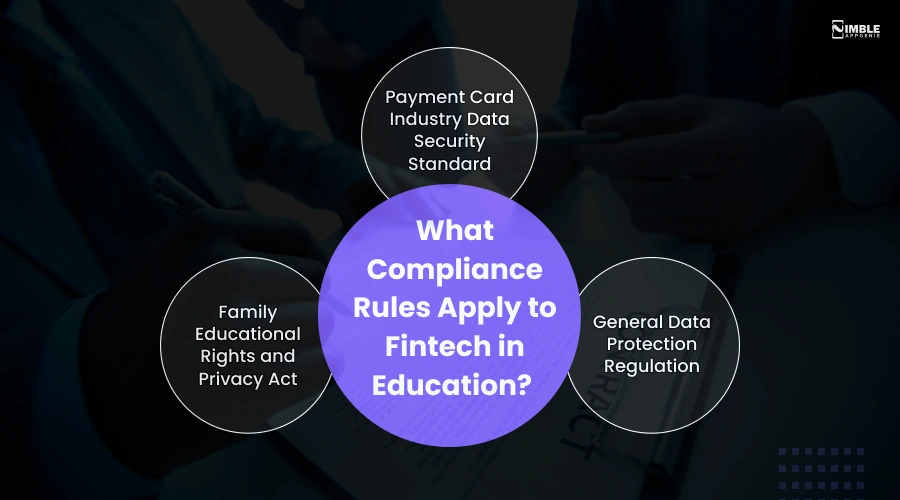
Here is the list of fintech and digital payments regulations and compliance to be followed:
- FERPA (Family Educational Rights and Privacy Act): This act should be complied with by educational institutions to protect the rights of students by protecting their records and financial aid certificates.
- PCI-DSS (Payment Card Industry Data Security Standard): It secures credit and debit card transactions by protecting tuition and fee payments from fraud and even data theft. It enforces 12 crore requirements grouped into 6 security goals.
- GDPR (General Data Protection Regulation): These regulations enforce strict global data protection with the data minimization rules, that helps the institutions safely handle international user data and avoid massive fines.
Complying with the regulations, let’s get ahead with the complete list of tech stack for creating the educational fintech solutions.
What is the Tech Stack for Building Education Fintech Solutions?
The key tech stack used for creating educational fintech solutions is React.js, Next.js, React Native, Node.js, Python, PostgreSQL, Stripe, Google Cloud, and much more.
Let’s get ahead with the finance tech stack that is implemented in educational apps to make them Edfintech:
| Layer | Technologies |
| Frontend | React.js, Next.js, React Native / Flutter (mobile) |
| Backend | Node.js, Python (Django/FastAPI), Java (Spring Boot) |
| Database | PostgreSQL, MongoDB, Redis (caching) |
| Payment Gateways | Stripe, Razorpay, PayPal, Plaid |
| Cloud & Hosting | AWS, Google Cloud, Microsoft Azure |
| APIs & Integrations | Open Banking APIs, KYC/AML APIs (Onfido, Jumio), ERP/LMS integration APIs |
| Security & Compliance | OAuth 2.0, SSL/TLS encryption, tokenization, AES-256 encryption |
| AI/ML (optional) | TensorFlow, PyTorch (for credit scoring, fraud detection, personalization) |
| DevOps & Monitoring | Docker, Kubernetes, CI/CD (Jenkins/GitHub Actions), Grafana/Prometheus |
While implementing fintech and adding fintech solutions for education, one of the important questions here is “How can edtech platforms add payment/fintech features?”
Well, they follow the complete process from adopting the integration methods such as payment gateways and SDKs to adding the core fintech features.
One of the important landscapes here is cost and timelines to create a fintech solution for education in the following section.
Cost and Timeline to Create a Fintech Solution for Education
Building the complete fintech solution for education can vary between $20,000 and $150,000+. Here, the key components that impact this cost are feature complexity, third-party integration, regulatory compliance, and MVPs.
Here is the complete table defining the fintech app development cost for education:
| Solution Tier | Cost Range | What’s Included |
| MVP / Basic | $20,000 – $40,000 | Single core feature (e.g., fee payment or digital wallet), basic UI, standard payment gateway integration, limited compliance setup |
| Mid-Range | $40,000 – $80,000 | Multiple features (fee collection + BNPL/lending + wallet), custom UI/UX, API integrations (KYC, payment gateways), basic reconciliation & reporting |
| Advanced | $80,000 – $120,000 | Full B2B + B2C modules, AI-driven features (fraud detection, personalization), multi-currency/cross-border support, advanced compliance (PCI-DSS, GDPR, FERPA) |
| Enterprise-Grade | $120,000 – $150,000+ | End-to-end platform (ERP integration, multi-country payroll, ISA/lending engine, real-time reconciliation), custom AI/ML models, dedicated security audits, scalable cloud infrastructure |
For the timeline to implement fintech solutions for education, let’s get ahead with the timeline:
| Phase | Timeline |
| Discovery & Planning | 1 – 2 weeks |
| UI/UX Design | 2 – 3 weeks |
| MVP Development | 6 – 10 weeks |
| API & Payment Gateway Integration | 2 – 4 weeks |
| Testing & Compliance Checks | 2 – 3 weeks |
| Deployment & Launch | 1 – 2 weeks |
| Total (MVP to Launch) | 3 – 5 months |
Bonus Read: ‘Development Time of a Fintech App”
Going forward to the integration or creating a complete solution for fintech, you need to connect with the right team.
How to Choose the Right Development Partner?
You can choose the right development partner by evaluating the three core areas: technical expertise, cultural and communication fit, and proven past results.
Identify whether the team offers relevant fintech app development services or not, as a niche is crucial as a niche firm can well understand your issues and requirements to connect you to the fintech ecosystem.
If you are wondering how to select the right development partner, you need not wander anywhere.
For integrating fintech solutions for education, you can connect with the top Education App Development Company, Nimble AppGenie.
Why?
- Niche in Fintech: Nimble AppGenie delivers secure, custom neobank architectures and regulatory-compliant digital wallet infrastructures.
- Proven Track Record: The team of engineers at Nimble AppGenie offers a proven track record, as we have completed 700 projects.
- AI-powered Compliance: The engineers of Nimble AppGenie, a leading AI app development company, offer generative AI and intelligent chatbot solutions, empowering educational institutions with personalized connectivity with students.
- Offers Advanced Security Measures: Many of the educational institutions are afraid to trust the latest and trending EdFintech solutions due to security concerns. But with the developers of Nimble AppGenie, you can take the risk. We understand the issue of our clients and ensure them by opting for bank-grade encryption, secure API architecture, and compliance-ready frameworks.
Conclusion
Fintech solutions for education offers distinction solutions, enabling educational institutions and students relief to enable finance + technology and to understand it well.
For educational institutions, fintech solutions help firms to enable automated fee collection, payroll solutions, and integrate B2B lending services. For parents and students, it offers a way to finance education through cross-border payments, BNPL lending payments, and gamified youth banking.
Educational institutions comply with the regulations, including PCI-DSS, GDPR, and FERA, which helps them to sustain the competition in the market and not be limited by regional or compliance risks.
The tech stack can vary depending on the requirements of the app. Similarly, the cost structure depends on whether you want an MVP or a complete integration. Partnering with a reliable partner can be helpful.
FAQs

Niketan Sharma, CTO, Nimble AppGenie, is a tech enthusiast with more than a decade of experience in delivering high-value solutions that allow a brand to penetrate the market easily. With a strong hold on mobile app development, he is actively working to help businesses identify the potential of digital transformation by sharing insightful statistics, guides & blogs.
Table of Contents




No Comments
Comments are closed.