

 Free Consultation
 PCI-DSS Compliant
 GDPR Ready
 ISO 27001
 NDA Protected
 AI Services
 AI App Development
 Generative AI Development
 AI Chatbot Development
 AI Integration Services
 AI Consulting Services
 AI For Fintech
 AI Financial Assistant Solution
 AI Insurance Agent Development
 Tech Stack
 OpenAI / GPT-4
 Claude / Anthropic
 Gemini / Google AI
 Llama / Open Source
 LangChain / LlamaIndex
 Pinecone / Pgvector
 AWS / Azure AI


 Fintech Solution
 Core Fintech
 Fintech App Development
 Neobank App Development
 eWallet App Development
 Payment Integration
 Lending Software
 Banking Software Development
 BNPL Solution
 BNPL App Development
 Insurance App
 Investment App Dev
 Wealth Management App
 Crypto & DeFi
 DeFi App Development
 Crypto Wallet Dev
 Crypto Exchange Dev
 Trading Platform Dev
 Payments
 Compliance
 Fintech & Digital Regulations
 Fraud Detection
 Lending Ecosystem
 P2P Lending Platform
 Mortgage Software
 Engagement
 Outsourcing Dev

 Mobile Development
 Mobile App Dev
 iOS App Development
 Android App Development
 React Native
 Flutter Development
 Web Development
 Node.js Development
 React.js Development
 Angular Development
 PHP / Laravel
 App Services
 UI/UX Design
 App Maintenance
 By Stage
 MVP Development
 Industry Solutions
 Healthcare App Dev
 Education App Dev
 Travel App Dev
 Real Estate App Dev
 Logistics Software
 Social Media App

 Hire Mobile Developers
 Hire iPhone Developers
 Hire Android Developers
 Hire React Native Devs
 Hire Flutter Developers
 Hire Web Developers
 Hire Node.js Developers
 Hire Angular Developers
 Hire PHP Developers
 Hire Laravel Developers
 How It Works
 Pre-Vetted Developers
 Ready In 48 Hours
 NDA From Day One
 Replace Guarantee
 Company
 About Us
 Our Work Process
 Portfolio
 Case Studies
 Blog / Insights
 Careers
 Contact Us
 Awards
 Recognition


 Offices


Key Takeaways:
- Fintech solutions for e-commerce make online payments faster, safer, and easier for both businesses and customers.
- The right fintech solutions for ecommerce can reduce failed payments, lower fraud, and help more customers complete their purchases.
- Features like digital wallets, BNPL, and one-click checkout improve the shopping experience and can increase sales.
- Every business should choose a fintech app development company that offers secure, flexible, and easy-to-scale solutions.
- The cost of fintech app development depends on the features, integrations, and level of customisation your business needs.
- Nimble AppGenie, a leading fintech app development company, can build the right solution to improve payments, manage cash flow, and support business growth.
Fintech solutions for e-commerce are digital tools that manage payments, lending, fraud checks, and money management for online stores. They connect your store, the customer’s bank, and your bank account, so money moves safely and on time.
If you run an online store, you already use some form of fintech, even if you do not call it that. Every payment, every BNPL button, every fraud check at checkout is a fintech solution at work.
Most store owners never think about this layer until something goes wrong. For example, a payment fails, a payout is late, or a chargeback eats into margin.
This guide breaks down what these solutions do, why they matter to the business side of e-commerce, how much they cost, and how to choose one without wasting money. It is written for people who run or manage an online store.
So, we will keep the technical terms to a minimum and focus on what actually affects the business.
What Are Fintech Solutions For E-commerce?
Fintech solutions for e-commerce are software tools built to move, manage, and protect money for online stores. This includes payment processing, digital wallets, lending, fraud detection, and accounting tools that connect directly to your store.
These solutions sit in the background of your store. A customer clicks pay, and in seconds, the fintech app checks the card, confirms the funds, screens for fraud, and sends money toward your bank account.
Without this layer, you would be back to manual bank transfers and cheques, which most online shoppers would not wait for. Fintech in ecommerce is not one product.
It is a category. Most stores use several of these at once, often from different providers, stitched together through the ecommerce platform.
Why E-commerce Businesses Need Fintech Solutions?
E-commerce businesses need fintech solutions because manual or outdated payment systems lead to lost sales, delayed payouts, and higher fraud risk. Fintech solutions close these gaps and allow a business to accept payments from more customers with less manual work.
A store that only accepts one card type or one currency loses customers who use something else. A store with slow payouts struggles to buy stock or pay suppliers on time. Also, a store with weak fraud checks eats chargebacks, which cost more than the lost sale itself once fees and penalties are added. Each of these is a fintech problem, and each has a fintech fix.
There’s also a competitive angle. Customers compare checkout experiences across stores without thinking about it. If a competitor offers one-click payment, saved cards, or a “pay in 4” option and you do not, some customers will simply go there instead.
This is not about having the flashiest checkout. It is about not losing a sale over something fixable. Cash flow is another reason fintech matters more as a business grows. A store doing a handful of orders a day can manage cash flow by instinct.
Types of Fintech Solutions for E-commerce
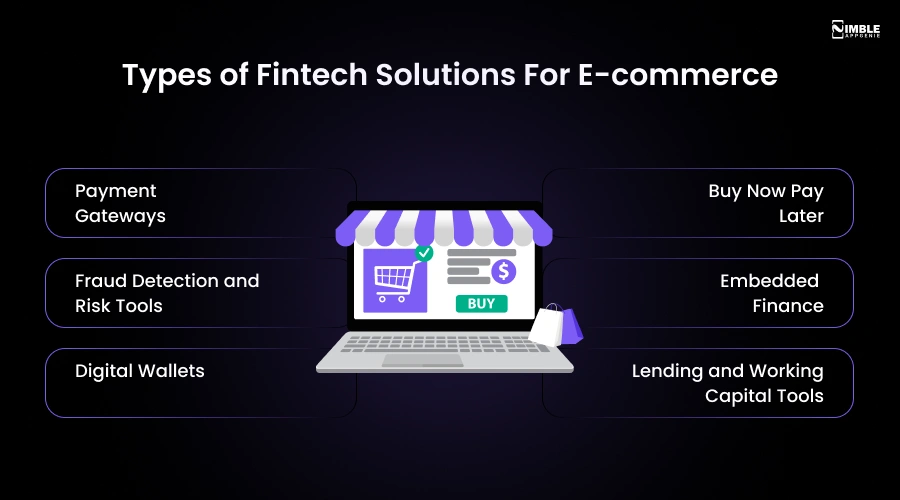
The main types of fintech solutions for e-commerce are payment gateways, digital wallets, BNPL, embedded finance, fraud detection tools, lending and working capital services.
Take a Look:
1. Payment Gateways
A payment gateway processes card and bank payments at checkout. It is the tool that actually talks to the customer’s bank and confirms whether a payment goes through. Stripe, Razorpay, and PayPal are common examples. This is the one fintech tool almost every ecommerce store needs from day one.
2. Fraud Detection and Risk Tools
These tools screen transactions in real time to catch stolen cards, bot orders, or unusual buying patterns. They score each transaction for risk and either approve it, block it, or flag it for manual review. This protects revenue that would otherwise be lost to chargebacks.
3. Digital Wallets
Digital wallets allow customers to pay using a stored balance or a linked card, without typing card details each time. Apple Pay and Google Pay are the most common examples. They speed up checkout, especially on mobile, where typing card numbers is slow and error-prone.
4. Buy Now Pay Later
BNPL apps like Klarna split a purchase into instalments, approved instantly at checkout. The customer pays a portion now and the rest over a few weeks or months. The BNPL provider pays the merchant upfront, minus a fee, and takes on the job of collecting from the customer.
5. Embedded Finance
Embedded finance means financial features, like lending, insurance, or business accounts, are built directly into the e-commerce platform the merchant already uses, instead of being a separate product from a separate provider. This is a newer category, and it is growing fast.
6. Lending and Working Capital Tools
These give store owners short-term funding based on sales history and transaction data, rather than a traditional credit score. This matters for ecommerce businesses that do not have years of financial history to show a bank, but do have strong recent sales data.
How Fintech Solutions Reduce Cart Abandonment?
Fintech solutions reduce cart abandonment by cutting the number of steps and the amount of friction at checkout. Saved cards, one-click payment, local payment methods, and BNPL all remove reasons a customer might quit before paying.
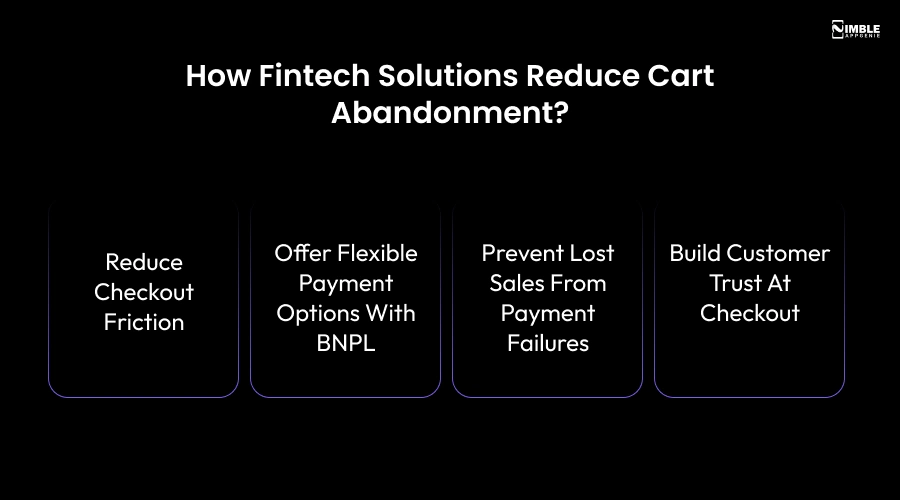
► Reduce Checkout Friction
Cart abandonment usually comes down to friction. A customer who has to re-enter card details, convert currency in their head, or get rejected by an unfamiliar payment method will often leave rather than troubleshoot.
Fintech tools remove these steps one-by-one, so the checkout asks for less and confirms faster.
► Offer Flexible Payment Options With BNPL
BNPL plays a specific role here. It allows a customer to buy a higher-value item without paying the full amount upfront, which can turn a hesitant browser into a buyer.
This works best on higher-ticket items, not on every product in a store, since the fee the merchant pays needs to be worth the extra conversions.
► Prevent Lost Sales From Payment Failures
Payment failures are another quiet cause of cart abandonment. A card can get declined for reasons that have nothing to do with the customer’s intent to buy.
A bank’s fraud filter, an expired card, or a temporary network issue. Good fintech apps retry failed payments automatically or prompt the customer to try a different method.
► Build Customer Trust at Checkout
Trust signals matter too. A checkout page that looks unfamiliar, redirects to a strange domain, or asks for unusual information will make some customers stop, even if nothing is actually wrong.
Established payment providers come with visual trust cues like recognised logos that reduce this hesitation.
Embedded Finance vs Traditional Payment Processing
Traditional payment processing manages a single job like moving money from customer to merchant. Embedded finance goes further and builds financial features like lending, insurance, or business accounts directly into the e-commerce platform itself.
| Aspect | Traditional Payment Processing | Embedded Finance |
| Main Purpose | Moves payments from the customer to the merchant. | Offers financial services like lending, insurance, business accounts, and payments within the ecommerce platform. |
| How It Works | Connects the store to a payment gateway to process transactions. | Financial services are built directly into the platform through licensed financial partners. |
| Services Offered | Payment processing only. | Payments, loans, insurance, business accounts, and other financial tools. |
| Best For | Every ecommerce business needs it as the basic payment system. | Growing businesses with enough sales data to benefit from additional financial services. |
| Role in Ecommerce | Acts as the foundation for accepting payments. | Builds on payment processing by adding financial products inside the platform. |
| Key Benefit | Reliable and simple way to accept payments. | Faster access to financial services without leaving the ecommerce platform. |
Security and Compliance in Ecommerce Fintech
Security and compliance in ecommerce fintech means meeting payment card industry standards, protecting customer data under regional privacy laws, and using tools like tokenisation and fraud scoring to keep transactions safe. These are the fintech security compliance considerations you have considered while building ecommerce solutions.
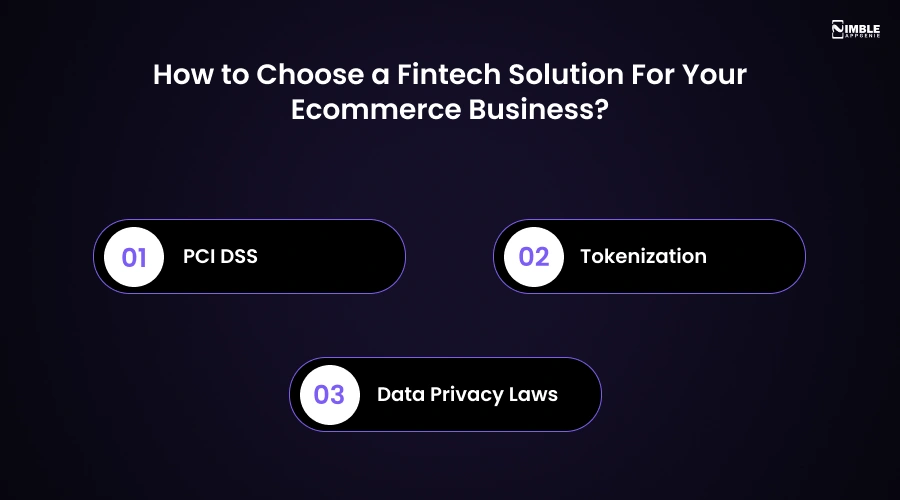
♦ PCI DSS
PCI DSS is the baseline requirement for any business handling card payments. It covers how card data is stored, transmitted, and protected.
Most ecommerce stores meet PCI DSS compliance by using a compliant payment gateway rather than storing card details themselves, which shifts most of the compliance burden to the provider.
♦ Tokenization
Tokenization is one of the main security compliance measures used to keep data safe. Instead of storing a customer’s actual card number, the system stores a token, a random string that means nothing outside that specific payment system. If a breach happens, the token is useless to an attacker.
♦ Data Privacy Laws
Fintech mobile app data privacy laws vary by region. A store selling into Europe needs to consider GDPR. A store selling in California needs to consider state privacy law.
Fintech providers that operate internationally usually build GDPR compliance with major frameworks into their product, but the merchant is still responsible for how customer data is used on their own site.
How to Choose a Fintech Solution For Your Ecommerce Business?
You can choose a fintech solution based on security and compliance, how well it fits your existing tech stack, its fee structure, payout speed, customer support, and whether it can scale with your order volume.
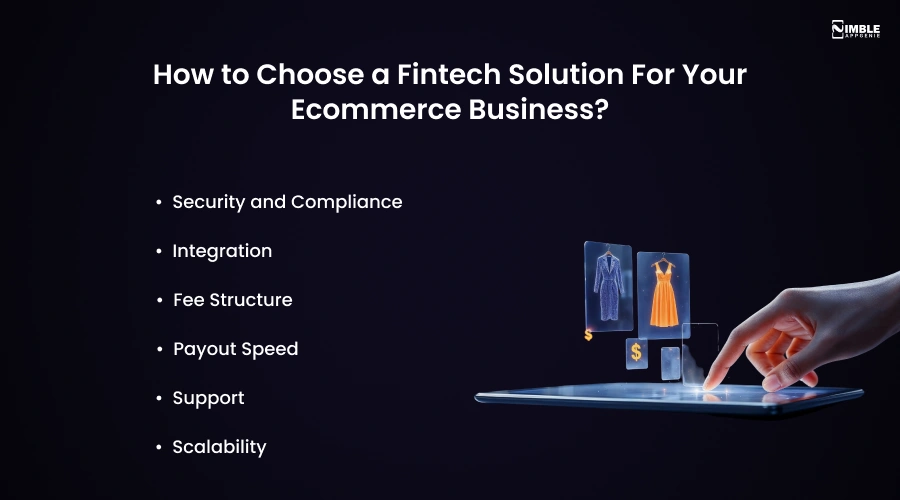
➤ Security and Compliance
The dedicated development team confirms PCI DSS compliance and asks how the provider handles fraud and chargebacks. A provider that cannot explain this clearly in an easier way is worth a second look.
➤ Integration
You can check it connects cleanly with your store platform, ERP, or accounting software without custom workarounds. A platform that needs heavy custom code to integrate will cost more long after the initial setup.
➤ Fee Structure
It is vital to thoroughly understand transaction fees, monthly costs, and any hidden charges for refunds, chargebacks, or currency conversion. Also, you must ask for the full fee schedule, not just the headline rate.
➤ Payout Speed
You must know how fast money reaches your bank account, since this affects cash flow directly. Some providers pay out in a day or two; others hold funds for a week or longer.
➤ Support
After that, you must confirm there is real support available if a payment fails or a dispute comes up. A provider with no live support can turn a small issue into a lost customer.
➤ Scalability
You have to make sure the solution can manage higher order volume, more countries, and more payment methods without a costly re-platform.
How Much Does It Cost to Integrate Fintech For Ecommerce?
The cost of fintech integration in ecommerce ranges between $25,000 and $200,000. It depends on whether you use an off-the-shelf gateway or build a custom fintech app solution, the number of payment methods you support, and how deeply it connects with your existing systems.
Off-the-shelf payment gateways are usually the cheapest way to start. You pay a percentage per transaction and sometimes a small fixed fee. This works well for most small to mid-size stores and is the right starting point for almost everyone.
Custom fintech app development costs more upfront because it involves developing specific features, connecting multiple providers, and managing your own compliance work.
The table below shows the different estimated cost breakdowns as per complexity.
| Complexity | Cost Breakdown |
| MVP Fintech Solution | $25,000 – $70,000 |
| Off-the-Shelf Fintech Solutions | $70,000 – $150,000 |
| Custom Fintech Solutions | $150,000 – $200,000 |
These are just the basic estimations. Some factors drive cost either way. For example, how many payment methods and currencies you support, whether you need custom fraud rules, and how deeply the tool needs to connect with your inventory.

Before committing to custom development, it is worth comparing the one-time build cost against what you would pay in fees over time through an off-the-shelf provider.
What Are the Common Challenges & Solutions When Adopting Fintech Solutions?
The most common challenges when adopting fintech solutions are compliance requirements, integration with older systems, cross-border payment complexity, fraud management, and vendor lock-in.
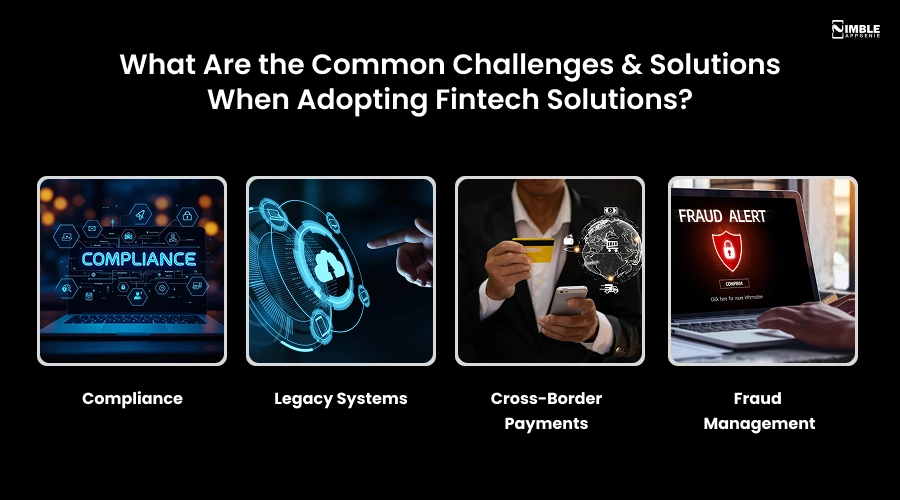
Let’s understand them in detail.
♦ Compliance
Payment data rules like PCI DSS, SEC, CCPA, and regional financial regulations add legal work most store owners do not expect.
Solution :
The practical fix is choosing providers that already carry these certifications, rather than trying to build compliance from scratch.
♦ Legacy Systems
Older ecommerce platforms or ERPs may not connect cleanly with newer fintech apps without custom work. This usually shows up as a bigger integration bill than expected.
Solution :
It is vital to get a clear scope from a developer before starting to avoid surprises.
♦ Cross-Border Payments
Currency conversion, local payment preferences, and regional regulations vary by country. A payment method that works well in one market can be almost unused in another.
Solution :
You must research local payment habits before assuming one setup will work everywhere.
♦ Fraud Management
More payment options can mean more ways for fraud to slip through if screening is not set up properly.
Solution :
You should regularly review fraud rules, not just set them once; this keeps it under control as fraud patterns change.
How Nimble AppGenie Helps Ecommerce Businesses with Fintech Solutions?
Nimble AppGenie develops custom fintech solutions for e-commerce businesses that have outgrown standard payment gateways tailored to a store’s specific setup.
As a trusted fintech app development company, we work with e-commerce businesses to assess what is actually needed before building anything, then develop and integrate the fintech features that fit the business.
This includes payment gateway integration, custom checkout flows, fraud detection systems, and embedded finance features built into an existing store or app.
The starting point is usually a conversation about where the business is losing money or time today, whether that is failed payments, slow payouts, manual reconciliation, or a checkout that does not fit local payment habits.
From there, the right scope of work becomes clear, instead of guessing at a solution first and finding the problem later. Book a free consultation if you are planning to integrate fintech into your e-commerce solution.

Conclusion
Fintech solutions for e-commerce are not optional. They are the layer that decides whether a customer completes a purchase, how money reaches your account, and how well your business is protected from fraud.
You can start with the basics: a solid payment gateway and fraud screening, then add BPL, embedded finance, or custom development as your order volumes and needs grow.
The right choice depends on where your business is today, not on what the biggest retailer in your industry is using. A store doing a few dozen orders a month has different needs than one processing thousands.
It is vital to consult with a fintech software development company that can match the solution to the stage, and revisit the choice as the business grows.
FAQs

Niketan Sharma, CTO, Nimble AppGenie, is a tech enthusiast with more than a decade of experience in delivering high-value solutions that allow a brand to penetrate the market easily. With a strong hold on mobile app development, he is actively working to help businesses identify the potential of digital transformation by sharing insightful statistics, guides & blogs.
Table of Contents


No Comments
Comments are closed.