

 Free Consultation
 PCI-DSS Compliant
 GDPR Ready
 ISO 27001
 NDA Protected
 AI Services
 AI App Development
 Generative AI Development
 AI Chatbot Development
 AI Integration Services
 AI Consulting Services
 AI For Fintech
 AI Financial Assistant Solution
 AI Insurance Agent Development
 Tech Stack
 OpenAI / GPT-4
 Claude / Anthropic
 Gemini / Google AI
 Llama / Open Source
 LangChain / LlamaIndex
 Pinecone / Pgvector
 AWS / Azure AI


 Fintech Solution
 Core Fintech
 App Development
 Neobank Solutions
 eWallet Solutions
 Lending Software
 Banking Solutions
 BNPL Solutions
 BNPL Solutions
 Insurance App
 Wealth Management
 Crypto & DeFi
 Blockchain Development
  Payroll Software
 DeFi Solutions
 Crypto Wallet
 Crypto On/Off Ramp
 Crypto Exchange
 Trading Platform
 Payments
 Compliance
 Regulations & Compliance
 Fraud Detection
 Lending Ecosystem
 P2P Lending Platform
 Mortgage Software
 Engagement
 Fintech Outsourcing

 Mobile Development
 Mobile App Dev
 iOS App Development
 Android App Development
 React Native
 Flutter Development
 Web Solution
 Node.js Development
 React.js Development
 Angular Development
 App Services
 UI/UX Design
 App Maintenance
 By Stage
 MVP Development
 Industry Solutions
 Healthcare App Dev
 Education App Dev
 Travel App Dev
 Real Estate App Dev
 Logistics Software
 Social Media App

 Hire Mobile Developers
 Hire iPhone Developers
 Hire Android Developers
 Hire React Native Devs
 Hire Flutter Developers
 Hire Web Developers
 Hire Node.js Developers
 Hire Angular Developers
 Hire PHP Developers
 Hire Laravel Developers
 How It Works
 Pre-Vetted Developers
 Ready In 48 Hours
 NDA From Day One
 Replace Guarantee
 Company
 About Us
 Our Work Process
 Portfolio
 Case Studies
 Blog / Insights
 Careers
 Contact Us
 Awards
 Recognition


 Offices



In a Nutshell:
- Fintech app development costs typically range from $20,000 to $300,000 based on complexity, features, security, and integrations.
- A basic fintech app with essential features can cost around $20,000 – $40,000, while an advanced fintech app with the latest technology can go up to $70,000 – $300,000+.
- Different fintech app types like eWallet apps, digital banking apps, and P2P lending platforms have varying costs to build a fintech app based on functionality.
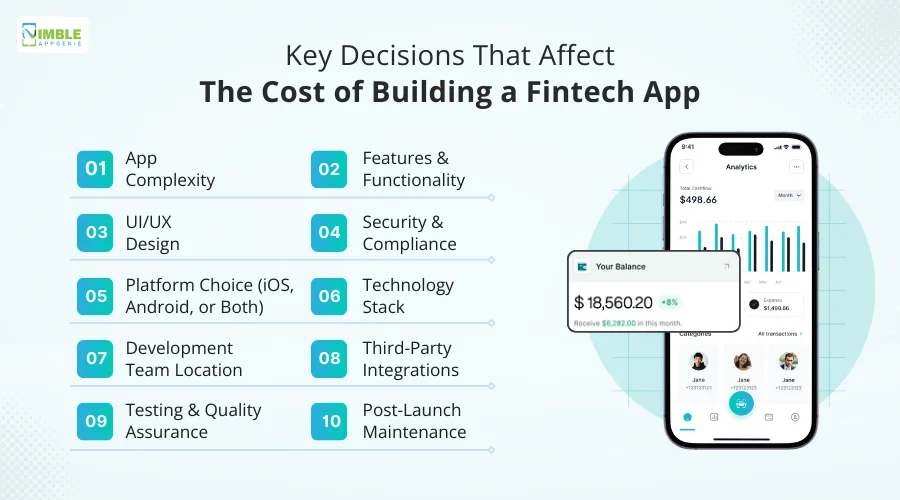
- The major factors affecting fintech app development pricing include app complexity, features & functionality, UI/UX design, security & compliance, platform choice, tech stack, development team location, and integrations.
- Nimble AppGenie helps you manage your budget better by prioritizing essential features, choosing cross-platform tools, and considering outsourcing to diminish overall fintech app development costs.
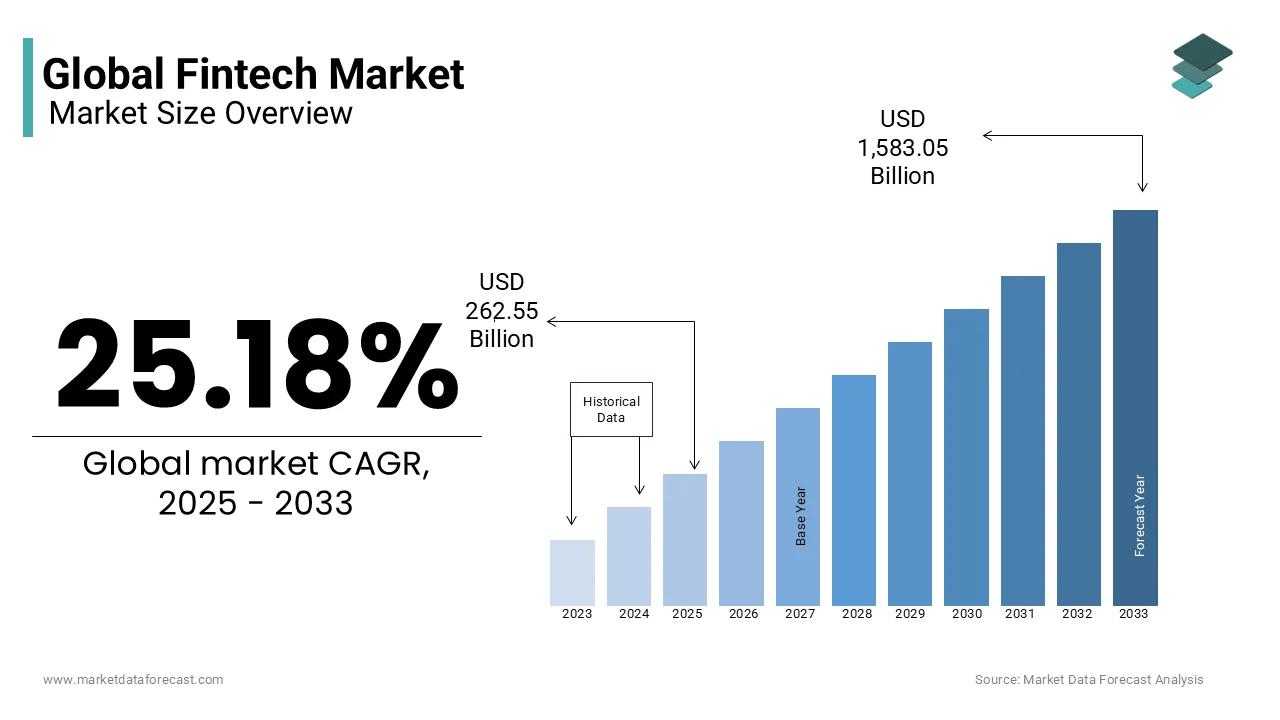
Did you know that the global fintech market is anticipated to grow by 2032 and reach $1,126.64 billion, up from $394.88 billion as recorded in 2025?
The figures indicate the surging use of financial services by consumers. To meet their demands and capitalize on the expanding fintech industry, financial institutions are increasingly planning to build a fintech app.
Besides other aspects, fintech firms should know the fintech app development cost with the required timeframe for successful project planning.
But how much does it cost to build a fintech app?
The fintech application development cost depends on numerous factors, incorporating required features, app complexity, regulatory compliance, and security standards.
We will discuss the complete breakdown of the fintech app cost estimation in the post per region, type, and development stages.
However, the average fintech app development pricing ranges from $20,000 to $300,000+. Other aspects like specialized features, AI integration, and more contribute to the cost, which we will discuss thoroughly in this post.
What is the Cost to Develop a Fintech App?
If you are looking to get a fintech app from an experienced app development company, it can cost you anywhere between $20,000 to $300,000.
The estimate is based on various factors such as current fintech trends, the development process, and other things involved in the process.
If you think the gap between an entry-level fintech app and a high-spec application is high.
You should understand that there are several factors to consider, features to choose from, and technologies to be integrated that result in varied costs of development.
You see, several stages in development cost differently, and hence everyone might have different needs.
For your reference –
- A basic fintech app that has decent security and supports online banking transactions can be built for around $30,000-40,000.
- A minimal app that gets the job done can be built at the basic mark of $20,000, and the add-ons can reach up to $80,000. Though there’s no stopping when it comes to adding features, something satisfactory can be achieved at $80,000.
- An advanced app with the latest technology, features, and improved fintech app will cost you on the higher side, taking your cost to range anywhere from $70,000-300,000.
Also, you need to understand that $300,000 is not a cap on expenses. There is no end to investing, as technology is always evolving. This is especially true in areas like fintech customer support, where constant innovation and adaptation are required to meet growing client expectations.
Fintech App Cost by Business Stage
The honest answer to “how much does it cost to build a fintech app” depends less on features and more on where your business is right now. A founder validating an idea has an entirely different budget than a funded startup preparing for a regulatory audit.
Here’s how the cost breaks down by stage.
| Business Stage | What You are Building | Estimated Cost | Timeline |
| Idea Validation (MVP) | One core transaction type, basic dashboard, single platform, minimal compliance | $20,000 – $60,000 | 3 – 5 months |
| Funded / Early Growth | Multi-feature app, full KYC/AML, payment gateway, cross-platform | $60,000 – $150,000 | 5 – 8 months |
| Regulated / Scaling Platform | Multi-jurisdiction compliance, AI fraud detection, real-time analytics, enterprise infrastructure | $150,000 – $300,000+ | 8 – 12 months |
A useful pattern here: Revolut launched with international cards and currency exchange for travelers, then added trading, crypto, and business banking only after its core product proved demand. Chime invested heavily upfront in banking partnerships and backend compliance before scaling its user base. Both approaches controlled early costs by staging the roadmap instead of building everything at once.
Fintech App Types & Their Development Costs
Talking about fintech app types, you should know that the development costs vary for every type based on their features and integrations.
Simple fintech app development costs start from around $20,000, while complex fintech solutions can cost $100,000 and more, again depending on backend requirements and functionality.
Let’s have an in-depth analysis of the most common fintech app types, their examples, features, and cost breakdown for banking or wallet apps.
1. Mobile Banking Apps
Mobile banking apps facilitate users to easily manage their bank accounts, money transfers, and bill payments through their smartphones.
Analysis of Cost to Build a Mobile Banking App
| Feature Complexity | Estimated Cost Range | Development Timeline |
|---|---|---|
| Basic | $30,000 – $50,000 | 3 – 4 months |
| Intermediate | $50,000 – $80,000 | 4 – 6 months |
| Advanced | $80,000 – $120,000 | 6 – 8 months |
Examples of Top Mobile Banking Apps: Bank of America and Emirates NBD Mobile Banking
As more financial institutions build AI apps, features like personalized financial insights, fraud detection, and AI-powered virtual assistants are becoming standard in modern mobile banking solutions.
Have a specific app in mind? You can explore more detailed cost breakdowns for popular fintech products, including the cost to build an app like Chase, which typically ranges from $100,000 to $500,000, the cost to build an app like Chime, which generally falls between $30,000 and $150,000, and the cost to build an app like N26, which usually starts around $40,000 and can exceed $100,000 depending on features, compliance requirements, and market coverage.
2. Digital Wallet & Payment Apps
Using these apps, users can digitally store funds and make payments in-store or online.
Analysis of Cost to Build a Digital Wallet App
| Feature Complexity | Estimated Cost Range | Development Timeline |
|---|---|---|
| Basic wallet app | $25,000 – $40,000 | 2 – 3 months |
| Medium complexity | $40,000 – $70,000 | 3 – 5 months |
| Advanced | $70,000 – $110,000 | 5 – 7 months |
Examples of Top Digital Wallets and Payment Apps: PayPal, Apple Pay, and Google Pay
If you are benchmarking against a specific digital wallet, you can refer to detailed cost breakdowns for similar platforms, including the cost to build an app like AliPay, which typically ranges from $150,000 to $400,000, and the cost to build an app like Apple Pay, which generally falls between $50,000 and $300,000, depending on feature complexity, security requirements, and regional compliance needs.
3. Peer-to-Peer (P2P) Lending Apps
P2P lending apps are useful for directly connecting borrowers and lenders, eliminating the need for traditional banks as intermediaries.
Analysis of the Complete Guide to P2P Lending App
| Feature Complexity | Estimated Cost Range | Development Timeline |
|---|---|---|
| Basic P2P lending platform | $40,000 – $60,000 | 3 – 4 months |
| Medium complexity | $60,000 – $90,000 | 4 – 6 months |
| Advanced | $90,000 – $150,000 | 6 – 8 months |
Examples of Top Peer-to-Peer Lending Apps: LendingClub and Zopa
4. Investment & Trading Apps
Users invest in stocks, cryptocurrencies, and ETFs using these apps with real-time trading capabilities.
Analysis of Investment App Development Guide
| Feature Complexity | Estimated Cost Range | Development Timeline |
|---|---|---|
| Basic investment tracking | $35,000 – $50,000 | 3 – 4 months |
| Medium complexity | $50,000 – $90,000 | 4 – 6 months |
| Advanced trading app | $90,000 – $180,000 | 6 – 9 months |
Examples of Top Investment & Trading Apps: Robinhood, eToro, and Zerodha
5. Insurtech Apps
Insurance-oriented apps ease users to directly buy, manage, and claim insurance from their devices.
Analysis of the Cost to Build an Insurtech App
| Feature Complexity | Estimated Cost Range | Development Timeline |
|---|---|---|
| Basic crypto wallet | $40,000 – $60,000 | 3 – 4 months |
| Medium complexity | $60,000 – $100,000 | 4 – 6 months |
| Advanced | $100,000 – $180,000 | 6 – 9 months |
Examples of Top Insurtech Apps: Lemonade, Hippo, Root, and Kin
6. Robo-Adviser Apps
Robo-adviser apps put forth automated investment management and AI-powered financial advice, permitting users to expand and manage their portfolios without manual intervention.
Analysis of the Robo-Advisor app development guide
| Feature Complexity | Estimated Cost Range | Development Timeline |
|---|---|---|
| Basic | $50,000 – $70,000 | 4 – 6 months |
| Medium | $70,000 – $110,000 | 5 – 7 months |
| Advanced | $110,000 – $150,000 | 6 – 9 months |
Examples of Top Robo-Adviser Apps: Betterment and Wealthfront
7. Cryptocurrency / Blockchain Apps
Cryptocurrency and blockchain apps facilitate users to trade, store, and manage digital assets securely, leveraging decentralized technology.
Analysis of Cost to Build a Cryptocurrency / Blockchain App
| Feature Complexity | Estimated Cost Range | Development Timeline |
|---|---|---|
| Basic crypto wallet app | $40,000 – $70,000 | 3 – 5 months |
| Medium complexity | $70,000 – $120,000 | 5 – 7 months |
| Advanced | $120,000 – $250,000+ | 7 – 10 months |
Examples of Top Cryptocurrency / Blockchain Apps: Coinbase, Binance, and Crypto.com
Now that you know the type of fintech app that majorly impacts fintech app development pricing and timeline. Above that, integrating features like AI analytics, advanced security, or blockchain, and the choice of platform notably raise budgets.
So, how much does a fintech app cost to develop?
Consult with an experienced fintech development company like Nimble AppGenie to get an accurate estimate tailored to your fintech idea.
Key Factors Affecting the Finance App Development Cost
Multiple factors impact the cost to develop a fintech app, like features, complexity, UI/UX design, functionality, third-party integrations, platform choice, security & compliance, and more.
The starting price of basic apps is around $10,000, while advanced, feature-rich solutions cost more.
Meticulous planning and perfect guidance from an experienced Fintech solutions provider company, like Nimble AppGenie, can help you optimize costs and ensure the creation of a scalable fintech app.
Let’s get deeper!
1. App Complexity
The very first decision you need to make is what type of app you want to build. What will be the extent of the complexity of your app?
The decision is taken based on what type of tech stack you choose, what type of development you want to execute, and how much time you have in mind.
Deciding how complex your app will be is going to help you carve out a basic budget for your fintech app.
The cost of developing a fintech app depends on how complex or tricky your project is.
An experienced development team can guide you through all the factors and allow you to choose the best app configuration.
A basic app is always less complex and comes at a comparatively low fintech app development cost.
2. Features & Functionality
Choosing all the fintech app features and functionalities that you need beforehand can be a little helpful. It is completely your decision whether you want advanced features or basic features.
The cost of your app will revolve around this decision. The correlation between the functionality and complexity of an app is uncanny.
Hence, make sure you do your research and choose only those features that matter as they will control the complexity of your app, indirectly affecting the fintech app development cost.
When it comes to building a fintech app, there are tiers of features based on what type of fintech application you want to develop.
For instance, if you plan to build a banking app that offers a basic user profile, balance fetching, and login logout features.
-
Cost Breakdown – Features & Functionality
| Feature Level | Inclusions | Estimated Cost Impact |
|---|---|---|
| Basic Features | User registration, profile management, dashboard, basic transactions | $10,000 – $25,000 |
| Intermediate Features | Payment gateway, KYC verification, notifications, transaction history | $20,000 – $50,000 |
| Advanced Features | AI fraud detection, real-time analytics, blockchain, multi-currency support | $40,000 – $100,000+ |
Note: Integrating advanced fintech features, like AI, automation, and trading engines, notably increases development complexity.
It will cost you less than an app with advanced features like real-time analytics, data fetching, AI bots, etc.
3. UI/UX Design
When crafting a solid user interface and user experience, there are several small decisions that you need to make.
These decisions include the nature of UI/UX, the approach you want to take, and the technologies you want to implement for the UI/UX.
Some prefer a minimal, fintech application design that is not too flashy and gets the job done. Some prefer making their app a bit loud and full of features.
-
Cost Breakdown – UI/UX Breakdown
| Design Level | Scope | Estimated Cost |
|---|---|---|
| Basic UI Design | Standard layouts, limited customization | $5,000 – $10,000 |
| Custom UI/UX | Wireframes, user journeys, interactive prototypes | $10,000 – $20,000 |
| Advanced UX & Branding | Custom animations, micro-interactions, usability testing | $20,000 – $35,000 |
Note: Good fintech UX fosters trust and user retention, especially in investment and banking apps.
Based on the type of approach you decide on, the cost of building a fintech app is determined. Investing in the user interface and experience is always a good decision, as it can help improve user engagement and boost user retention in fintech apps.
4. Security & Compliance
Choosing what type of security you want to deploy in your fintech application is another crucial decision that makes a difference.
While you may not have much control over what type of compliance you have to follow (as these are mandatory in almost every part of the world), you can choose the type of security measures you want to carry out in your fintech app.
The cost to develop a fintech app can increase when advanced security measures and added compliance requirements are introduced into the development.
-
Cost Breakdown – Security & Compliance
| Security Level | Inclusions | Estimated Cost Impact |
|---|---|---|
| Standard Security | SSL encryption, secure APIs, basic authentication | $8,000 – $20,000 |
| Regulatory Compliance | KYC, AML, GDPR, PCI-DSS implementation | $15,000 – $40,000 |
| Advanced Security | Biometric login, AI fraud detection, penetration testing | $25,000 – $60,000+ |
Note: Security and compliance are major cost drivers in fintech app development. Fintech regulations and compliance, for software such as AML, KYC, and others, can cost you a bit more than your basic security and compliance measures, like GDPR compliance, which includes data encryption and SSL.
5. Platform Choice (iOS, Android, or Both)
The next decision depends completely on your vision for your app. If you want to target a wider audience, you will have to start with your presence on both platforms, i.e., Android & iOS.
However, it will double the cost of building a fintech app as the entire process will be done separately for both platforms in native app development.
On the other hand, you can go for a cross-platform development approach, but it has its pros and cons.
Fintech apps are usually targeted at the majority of users, as everyone uses financial services online.
-
Compare Fintech App Development Costs by Platform
| Platform | Estimated Cost Range | Typical Development Timeline | Pros | Cons |
|---|---|---|---|---|
| iOS (iPhone/iPad) | $30,000 – $100,000 | 3 – 6 months | Smooth performance, high security, and loyal user base | Limited to Apple users and slightly higher hourly rates |
| Android | $25,000 – $90,000 | 3 – 6 months | Large user base, customizable and flexible devices | Fragmentation (many device types), more testing required |
| Cross-Platform | $40,000 – $120,000 | 4 – 7 months | Single codebase for iOS & Android, faster deployment | Slightly lower performance than native and some platform-specific issues |
Hence, going for cross-platform app development can help you reach a wider audience, but keep in mind that it will cost you more than a single native app development.
However, the investment is completely worth it as a wider presence means more downloads and active users, boosting your presence in the fintech market.
6. Technology Stack
Technology is the foundation of everything you build in a fintech app. Choosing the right fintech stack can help you build the best version of your app.
However, with technology evolving every day, you need to make the right decisions to ensure that the tech you choose is affordable and scalable in the long run.
Based on the type of technology you choose, the development cost of your fintech app will vary.
-
Cost Breakdown – Technology Stack
| Tech Choice | Scope | Estimated Cost Impact |
|---|---|---|
| Cross-Platform (Flutter/React Native) | Single codebase for iOS & Android | $30,000 – $80,000 |
| Native Development | Separate iOS & Android codebases | $50,000 – $150,000+ |
| Blockchain / Advanced Backend | Smart contracts and distributed architecture | $40,000 – $120,000+ |
Note: The tech stack directly affects scalability, performance, and long-term maintenance cost.
Technology is always changing, and hence, you cannot go for the lowest-hanging fruit or the cheapest tech stack, as it might become obsolete soon.
7. Development Team Location
Another crucial factor that can define the cost of developing a fintech app is the development team’s location.
The location of your app development team greatly affects service costs due to talent availability and currency differences. Hiring an app developer from Asia can be more affordable than hiring one from Europe.
It’s just how currency inflation affects the hiring cost of app developers. The hourly rates are usually highest in North America and the lowest in the Asian region. So choose your fintech developers wisely.
-
Development Team Location & Its Impact on Fintech App Cost
| Location | Hourly Rate | Estimated Cost |
| North America | $150 – $250/hour | $200,000+ |
| Eastern Europe | $50 – $100/hour | $100,000 – $150,000 |
| Asia | $20 – $50/hour | $20,000 – $100,000 |
-
In-House vs. Outsourced vs. Hybrid Team
Location is one part of the cost equation. The bigger decision is how you staff the project.
| Model | Best For | Cost Impact |
| In-house team | Long-term enterprise products with continuous, ongoing feature work | Highest upfront cost (salaries, benefits, and hiring time); offers the greatest level of control |
| Fully outsourced team | MVPs, time-boxed projects, and founders without a technical co-founder | Lowest upfront cost; typically 30–50% cheaper than building an in-house team from scratch |
| Hybrid (in-house lead + outsourced development team) | Funded startups that want product ownership but need to move quickly | Moderate cost; balances control, flexibility, and speed to market |
Most early-stage fintech founders choose outsourcing not just to save money, but to avoid the 2–3 month hiring cycle for specialized fintech engineers, compliance-aware developers, and QA familiar with financial regulations.
8. Third-Party Integrations
Integrations are a necessity when it comes to developing a fintech app. This is because these apps require dedicated payment gateways, analytics, financial data providers, creditworthiness data, and whatnot.
All these can be integrated into an app with the help of fintech API integration.
-
Cost Breakdown – Third-Party Integrations
| Integration Type | Examples | Estimated Cost |
|---|---|---|
| Payment Gateways | Stripe, PayPal, Razorpay | $5,000 – $15,000 |
| Banking & Financial APIs | Plaid, core banking APIs | $10,000 – $30,000 |
| KYC & Verification APIs | Onfido, Jumio | $8,000 – $20,000 |
| Data & Analytics APIs | Forex, stock market APIs | $10,000 – $25,000 |
Note: Third-party integrations vary based on licensing fees, API complexity, and customization requirements.
It affects the cost of building your fintech app, as these APIs have their own fees along with integration charges. Depending on the complexity of these APIs, you may be charged.
Hence, you should keep that in mind. Decide on the type of API you plan to integrate with, and you will have a rough estimate as to what it would cost to develop a fintech app.
Read also the comparison guide between the most usable payment gateways: Stripe, Braintree, and Adyen
9. Testing & Quality Assurance
Choosing the right testing and quality assurance measures is a must for a fintech app.
Having experienced quality assurance experts can help you get things sorted from the point of view of optimization and efficiency.
Testing financial applications can help you make the right decisions about the deployment of your services.
Since testing is done using all the possible test cases where the app might show a bug, it gives you enough confidence to push out your app and get it done.
Some developers include basic testing and quality assurance to make the app ready for the market, while some have dedicated services to ensure that there are no recurring bugs in the app and it is always covered.
10. Post-Launch Maintenance
Keep in mind that your job does not end once the app is deployed. It is just the beginning. You need proper post-launch maintenance.
It is your decision whether you want a dedicated post-launch maintenance team working for you, or you can manage it through an in-house tech team.
While your team can manage the app’s functionality, a dedicated team can take care of regular maintenance of the Fintech app, bug checking, feature updates, security patches, etc., making your app appear better optimized with every version upgrade.
These upgrades play a crucial role in your app’s performance, and hence, you should make this decision accordingly.
Your final estimate can be calculated based on everything you choose and decide, but it starts somewhere around $10,000.
These decisions can be difficult to make if you have never had experience with app development.
Many users choose to outsource the development of fintech apps to experienced professionals who can handle the job efficiently. Recognizing the factors that affect costs will help you set a more realistic budget.
Hidden Costs Most Founders Forget to Budget For
The development quote is rarely the complete picture. Most fintech founders underestimate what it costs to keep the app compliant and running after launch. Set aside $30,000 – $100,000+ per year for the following:
| Recurring Cost | What It Covers | Typical Annual Cost |
| Compliance recertification | PCI-DSS renewal, AML audits, regulatory filings | $10,000 – $30,000 |
| Third-party API fees | Plaid, Stripe, and KYC providers usually bill per transaction or per verification | $5,000 – $25,000+ |
| Cloud hosting & infrastructure | Scales with transaction volume and user count | $5,000 – $20,000 |
| Security monitoring & pen testing | Ongoing vulnerability scans, periodic penetration tests | $8,000 – $20,000 |
| Feature updates & bug fixes | OS updates, dependency upgrades, and new feature releases | $10,000 – $40,000 |
Why this matters: Regulatory compliance alone, including KYC/AML and security architecture, can account for 20% to 40% of your total fintech app budget, not as a one-time cost, but as an ongoing expense. Budgeting for this upfront helps avoid one of the most common reasons fintech apps stall after launch: running out of runway for compliance rather than for development.
A Quick Scan of Key Factors Affecting Finance App Development
| Key Factor | Impact on Cost | Estimated Cost Range |
|---|---|---|
| Features & Functionality | High | Basic apps: $10,000; Advanced apps: $70,000 – $300,000+ |
| UI/UX Design | Medium | Included within the above ranges; more advanced design increases cost |
| App Complexity / Backend Requirements | High | $10,000 – $100,000 depending on type and functionality |
| Platform Choice | Medium | Costs increase per additional platform |
| Third-Party Integrations | Medium | Adds $5,000 – $30,000, depending on the number and complexity |
| Security & Compliance | High | Included in advanced app costs; critical for fintech apps |
| Development Team Location & Expertise | Medium | Impacts the total project cost depending on the region and team size |
| Timeline & Project Scope | Medium | Can increase overall cost by 10 – 30% |
In the next section, we will break down the fintech app development cost associated with different types of apps, including eWallets, investment platforms, and more.
Real Numbers, Real Results: A Fintech App Built Within Budget
Here’s how these cost factors translate into a real-world project. A client approached Nimble AppGenie with the requirement for a multi-currency e-wallet application targeting the Middle East and Europe. The platform needed to support international payments, multi-currency storage, real-time forex conversion, and full KYC/AML verification without compromising performance.
We delivered the solution using cross-platform development, an integrated KYC/AML module, real-time forex API integration, and a scalable cloud-based backend architecture. Within three months of launch, the results included:
- 25,000+ user registrations
- 40% faster transaction processing compared to competitor benchmarks
- Zero security breaches post-launch
You can explore the full case study breakdown, including challenges and solutions, or connect with our team to discuss your app’s budget and requirements now.
Also Read: Fintech Super App: Here’s How To Build One
How Long Does It Take To Build A Fintech App?
On average, building a fintech app takes 4 to 9 months, depending on distinct factors. Let’s know more.
Now, as you know, fintech app development cost 2026, here we will dive deep into the estimated timeline for every fintech app you build and what impacts the duration.
When you plan to build a fintech app alongside budgeting, you should know the timeline estimation.
The development duration relies on factors like app type, complexity, team location, features, and platform.
Startups and enterprises looking for “fintech app development timeline” or “how long does it take to build a fintech app” usually need a transparent breakdown to effectively plan their project.
Below is a guide to average development timelines for distinct fintech app types.
Fintech App Development Timeline by Type
| Fintech App Type | Estimated Timeline | What Impacts the Duration |
|---|---|---|
| Mobile Banking App | 4 – 8 months | High security, compliance (KYC/AML), and multi-account integration |
| Digital Wallet / Payment App | 3 – 6 months | Payment gateway integration, security layers, and QR/NFC features |
| Peer-to-Peer (P2P) Lending App | 4 – 7 months | Credit scoring systems, borrower-lender workflow, and compliance |
| Investment & Stock Trading App | 5 – 9 months | Real-time data sync, trading engine, analytics, and security testing |
| Robo-Adviser App | 6 – 9 months | AI algorithms, risk profiling, and automated portfolio management |
| Insurtech App | 4 – 7 months | Policy management system, claims processing, document verification |
| Cryptocurrency / Blockchain App | 5 – 9 months | Blockchain integration, wallet security, smart contracts |
Additional Timeline Considerations
- MVP Version: 3 – 5 months
- Full-Feature Enterprise App: 6 – 12 months
- Native (Android + iOS separately) may add 1 – 2 extra months
- Cross-platform development can reduce time by 15 – 25%
- Strict fintech compliance and security testing may extend the timeline
How to Reduce the Cost of Developing a Fintech App?
By combining strategies such as MVP, cross-platform, and outsourcing, startups can help reduce fintech app development costs notably while still delivering a perfectly functioning product.
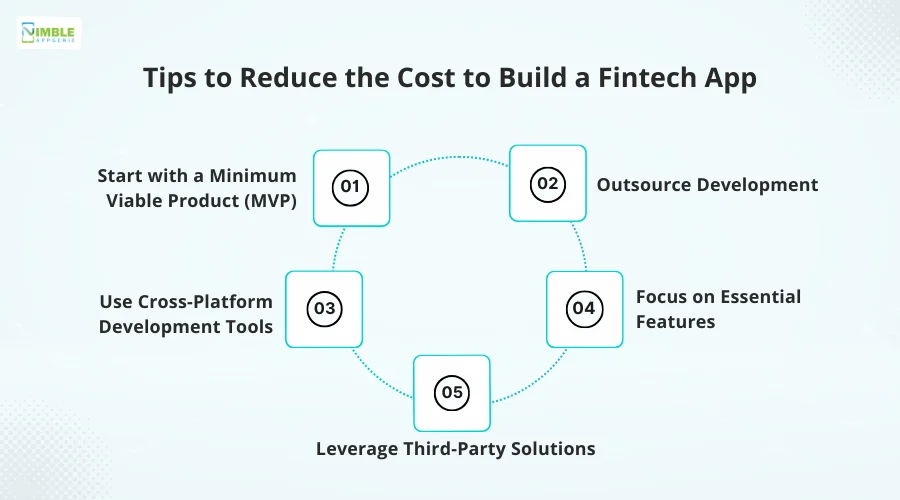
Here are a few things that could help you save some money and make better decisions while building a fintech app.
♦ Start with a Minimum Viable Product (MVP)
The first thing you should do is try to build an MVP of your idea. This way, you can get a glimpse of how your final product will look based on your requirements.
This will also help you identify if you need any changes in the chosen technology, design, or usability. With MVP, you can easily discard features that appear unnecessary, reducing your costs.
♦ Outsource Development
If you are looking to hire app developers to get the job done, it is always recommended that you outsource the entire process instead of hiring new resources permanently.
Onboarding a resource is going to cost you more than what it would take to hire a fintech app expert from another company. Outsourcing fintech development will be light on your pocket in the long run.
♦ Using Cross-Platform Development Tools
If you plan to build a fintech application, you might as well go for a cross-platform development strategy.
It helps you double your presence while spending on a single development process. Some of you may be thinking that using native app development can help you create a more optimized app that can use device resources to the best.
However, it will surely cost you more as you will have to finish the process twice, and it will take double the time.
♦ Focus on Essential Features
Every application today looks to create a wow factor in its features. While this approach works well to garner attention, these features are hardly usable, and they cost a lot of money to implement.
Focusing on essential features is more effective, easier to implement, and keeps your budget in check.
♦ Leverage Third-Party Solutions
Instead of building modules from scratch, you should start leveraging third-party solutions like fintech APIs.
Integrating them will save you time, effort, and money, reducing the cost of developing a fintech app.
Use services that are already being offered and thriving. In fintech, you need to create trust with your users. Existing solutions like payment gateway integration can help you gain the trust of your users.
A Quick Review of Strategies to Reduce the Cost of Developing a Fintech App
| Strategies to Reduce Cost | Description | Estimated Cost Reduction |
|---|---|---|
| Start with an MVP (Minimum Viable Product) | Build only the core features first to test the market before adding advanced features | 20% – 40% of the initial estimated cost |
| Using Cross-Platform Development | Develop for iOS and Android using frameworks like React Native or Flutter | 15% – 30% compared to developing separate native apps |
| Outsource to Experienced Development Teams | Hiring skilled offshore or nearshore teams can lower hourly rates | 10% – 35% depending on region |
| Prioritize Features | Focus on essential features first; delay or remove non-critical features | 10% – 25% |
| Leverage Third-Party Services | Use ready-made APIs for payments, notifications, and KYC instead of custom-built solutions | 5% – 20% |
| Agile Development & Iterative Releases | Avoid overbuilding; iterate based on user feedback to prevent wasted resources | 10% – 20% |
| Simplify Design & UX | Use standard UI components and templates for early versions | 5% – 15% |
Other than these tips, choosing the right service provider can help you build a fintech app within the budget you have decided on.
But how do you find an ideal team that can manage the cost and create an application for you?
How Can Nimble AppGenie Help in Fintech Development?
Collaborating with an experienced fintech app development company can be the difference between a delayed, costly project and a scalable solution.
Nimble AppGenie is a global giant offering custom solutions, assisting startups, financial institutions, and enterprises in bringing their ideas to life, turning them into innovative digital products with powerful security, features, and compliance.
Expertise in End-to-End Fintech App Development
Nimble AppGenie offers comprehensive fintech development solutions, from initial consulting and UI/UX design to development, deployment, and ongoing support. Their services are built around the core needs of modern fintech products such as mobile banking apps, e-wallets, robo-advisors, trading platforms, and DeFi solutions.
What Nimble AppGenie Offers:
- Fintech Strategy & Consulting
- UI/UX Design
- Custom Fintech Development
- Security & Compliance
- API & Third-Party Integrations
- Testing & Maintenance
Real-time Case Study by Nimble AppGenie – Multi-Currency E-Wallet Application
- Project Type: Cross-Border Digital Wallet
- Client: Confidential (Name withheld due to NDA)
- Region: Middle East & Europe
The Challenge:
The client wanted to launch a multi-currency fintech app that allows users to:
- Send and receive international payments
- Store multiple currencies in one wallet
- Access real-time currency conversion
- Complete secure KYC verification
- Monitor transactions instantly
The major challenge was to ensure regulatory compliance, real-time processing, and enterprise-grade security while keeping the app user-friendly and fast.
The Solution by Nimble AppGenie:
- Cross-platform development
- Secure payment gateway integration
- Real-time forex API integration
- Advanced encryption protocols
- Built-in KYC/AML verification module
- Admin dashboard with transaction analytics
- Scalable cloud backend infrastructure
Results Obtained:
- 25,000+ user registrations in the first 3 months
- 40% faster transaction processing compared to competitor benchmarks
- Zero security breaches post-launch
- Successfully managed high transaction volumes during peak periods
- Boosted customer retention due to seamless UX
The app is now successfully operating across various regions with consistent technical support and feature upgrades offered by our skilled fintech development team.
Why Choose Nimble AppGenie for Your Fintech Project?
- Over 8+ years of building fintech and e-wallet solutions for global clients.
- Security-First Development
- Full-Cycle Support
- Scalable Solutions
Pro Tip: By choosing Nimble AppGenie as your fintech development partner, you get a team that understands the intricacies of the financial technology ecosystem and delivers customized solutions that are aligned with market drivers.
Conclusion
Let’s wrap up, knowing the fintech app development cost ranges from $20,000 to $300,000 depending on varied factors like platform choice, integrations, security, features, and complexity.
Partner with a company to get a final price based on your specific project needs.
Remember to start with an MVP development, focusing on essential features and hiring a dedicated team of fintech app developers.
Plan wisely and harness the potential of the right technologies to launch a fintech solution that meets your business objectives and users’ expectations.
Ready to build your fintech app? Tell us your stage MVP, growth, or scaling, and get a cost estimate matched to it.
FAQ’s

Niketan Sharma, CTO, Nimble AppGenie, is a tech enthusiast with more than a decade of experience in delivering high-value solutions that allow a brand to penetrate the market easily. With a strong hold on mobile app development, he is actively working to help businesses identify the potential of digital transformation by sharing insightful statistics, guides & blogs.
Table of Contents




No Comments
Comments are closed.