

 Free Consultation
 PCI-DSS Compliant
 GDPR Ready
 ISO 27001
 NDA Protected
 AI Services
 AI App Development
 Generative AI Development
 AI Chatbot Development
 AI Integration Services
 AI Consulting Services
 AI For Fintech
 AI Financial Assistant Solution
 AI Insurance Agent Development
 Tech Stack
 OpenAI / GPT-4
 Claude / Anthropic
 Gemini / Google AI
 Llama / Open Source
 LangChain / LlamaIndex
 Pinecone / Pgvector
 AWS / Azure AI


 Fintech Solution
 Core Fintech
 App Development
 Neobank Solutions
 eWallet Solutions
 Lending Software
 Banking Solutions
 BNPL Solutions
 BNPL Solutions
 Insurance App
 Wealth Management
 Crypto & DeFi
 Blockchain Development
  Payroll Software
 DeFi Solutions
 Crypto Wallet
 Crypto On/Off Ramp
 Crypto Exchange
 Trading Platform
 Payments
 Compliance
 Regulations & Compliance
 Fraud Detection
 Lending Ecosystem
 P2P Lending Platform
 Mortgage Software
 Engagement
 Fintech Outsourcing

 Mobile Development
 Mobile App Dev
 iOS App Development
 Android App Development
 React Native
 Flutter Development
 Web Solution
 Node.js Development
 React.js Development
 Angular Development
 App Services
 UI/UX Design
 App Maintenance
 By Stage
 MVP Development
 Industry Solutions
 Healthcare App Dev
 Education App Dev
 Travel App Dev
 Real Estate App Dev
 Logistics Software
 Social Media App

 Hire Mobile Developers
 Hire iPhone Developers
 Hire Android Developers
 Hire React Native Devs
 Hire Flutter Developers
 Hire Web Developers
 Hire Node.js Developers
 Hire Angular Developers
 Hire PHP Developers
 Hire Laravel Developers
 How It Works
 Pre-Vetted Developers
 Ready In 48 Hours
 NDA From Day One
 Replace Guarantee
 Company
 About Us
 Our Work Process
 Portfolio
 Case Studies
 Blog / Insights
 Careers
 Contact Us
 Awards
 Recognition


 Offices


Key Takeaways:
- Digital rights management in music is not optional; it is the legal and technical foundation every music app needs before it goes live.
- DRM and music licensing are two different layers: licensing gives you the right to use music, and DRM enforces that right technically. You need both.
- The three major DRM systems, Widevine (Android/web), FairPlay (iOS/macOS), and PlayReady (Windows/Smart TVs), are not interchangeable. A cross-platform music app needs all three.
- Every stream in a DRM-protected app goes through an encryption layer, a license server check, and a real-time key exchange; no decrypted audio file ever touches device storage.
- Skipping DRM does not just risk piracy; it blocks you from App Store eligibility, major label deals, and platform API access entirely.
- Content fingerprinting (YouTube Content ID, TikTok MediaMatch, Meta Rights Manager) operates separately from DRM and must be set up independently to protect licensed content on social platforms.
- Blockchain-based rights management and smart contract royalty payouts are already live. Forward-thinking developers should build their rights layer to be provider-agnostic from day one.
- Nimble AppGenie has helped various music app teams navigate DRM architecture, licensing compliance, and full-stack development, so you do not have to figure it out alone.
You have got the idea, the team, and the roadmap. Then someone asks: “Have you sorted DRM yet?” – and the room goes quiet.
Building a music app is exciting until you encounter DRM, content protection requirements, and licensing agreements that nobody alerted you to.
What is DRM in music streaming apps, exactly? Digital rights management music is the technology that encrypts every audio stream, controls who can play it, on which device, and for how long.
That’s why, if you noticed, you can’t screen-record Spotify streams, your Apple Music downloads disappear when your subscription lapses, and YouTube automatically claims revenue on copyrighted audio within minutes of upload.
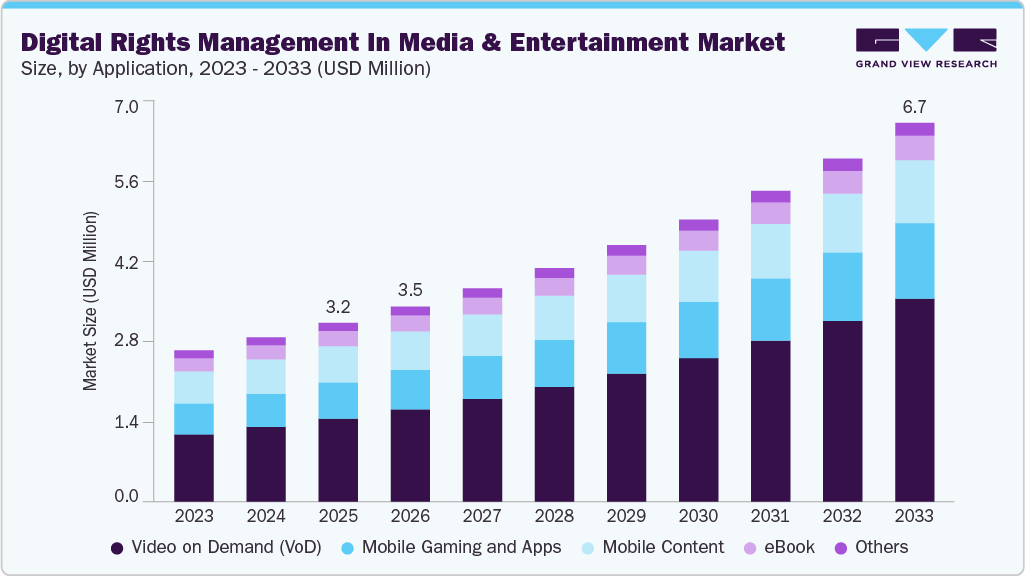
| The global digital rights management in media & entertainment market is anticipated to be valued at $6,742 million by 2033, growing at a CAGR of 10.0%. [Grand View Research] |
For startup founders, product managers, and developers planning music streaming app development, DRM is not a low-priority compliance checkbox.
It’s the difference between landing a label deal and receiving a cease-and-desist; between shipping on the App Store and getting rejected; and between creating something scalable and recreating everything six months later.
This guide breaks down how DRM in music streaming apps works, how to implement it sequentially, which technologies to use, and where the industry is headed in 2026, in plain language, without any legal jargon.
By the end, you will know exactly what to build, in what order, and why.
What is Digital Rights Management in Music?
Digital rights management in music refers to technologies that regulate how audio content is accessed, copied, played, and distributed. Think of DRM as a digital lock on every audio file or stream.
When a user taps play, the app checks whether that user owns a valid license to hear the content, and only then unlocks the audio. Without that verification, the content stays encrypted and unplayable.
The term ‘digital rights enforcement’ is more precise. DRM doesn’t grant rights; it enforces them. The real rights come from music licensing agreements with publishers, labels, and rights collectives. DRM ensures those agreements are enforced in practice.
► How DRM Differs From Music Licensing?
Music licensing is a legal agreement: you pay for the right that allows you to use a song in your app, in a particular territory, for a specific purpose. DRM is how you ensure that the arrangement is enforced technically.
A license without DRM is like a ‘No Copying’ sign on a filing cabinet with no lock. DRM without a license means you are imposing access to music you never had the right to use in the beginning.
► Real-World Examples
- Apple Music uses Apple’s FairPlay DRM to prevent downloaded tracks from playing on non-Apple devices or outside the subscription.
- YouTube Content ID music app constantly scans uploaded videos for matching audio fingerprints, then automatically blocks content or applies monetization rules.
- Spotify protects every stream using Widevine DRM encryption and verifies licenses server-side, making it impossible to record streams at scale.
Why DRM Matters When Building a Music App?
Digital Rights Management (DRM) is important when developing a music app because it serves as a technological “lock” that prevents illegal sharing, protects high-value audio content, and safeguards revenue streams.
Let’s get deeper to know.
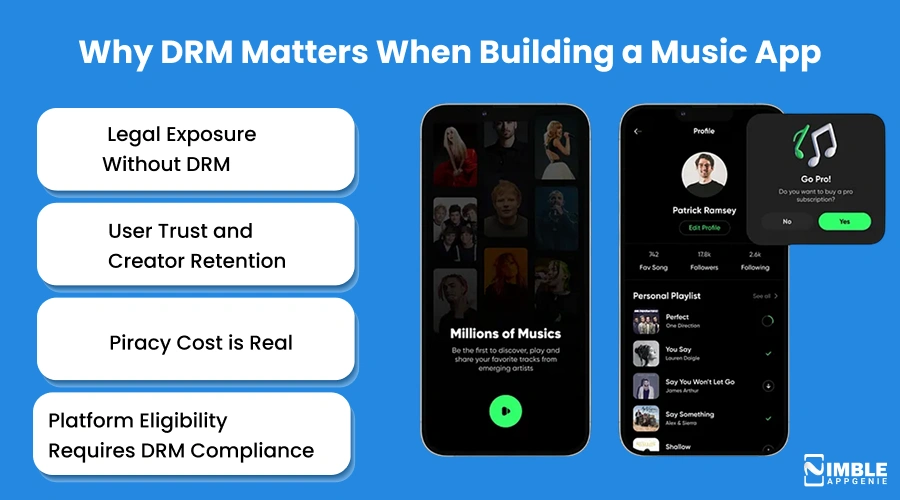
➤ Legal Exposure Without DRM
The Digital Millennium Copyright Act (DMCA) in the US and similar laws in the UK, EU, and India impose rigid liability on platforms that host infringing content.
Statutory damages can hit $150,000 every wilful breach in the US. Even a single complaint from a major label can prompt platform takedowns, reputational damage, and injunctions that startups fail to recover from quickly.
➤ User Trust and Creator Retention
Labels and artists evaluate platforms on how perfectly they protect content. A music app without auditable DRM will find it challenging to secure direct licensing deals with top labels and will find independent artists less interested in listing exclusives.
DRM compliance indicates professionalism and lasting viability to content partners.
➤ Piracy Cost is Real
Music piracy costs the global recording industry about $2.7 billion annually on average in lost revenue (IFPI 2023). Music app content protection goes beyond just encrypting streams.
It covers fingerprinting, access control, license auditing, and platform compliance, and every layer needs to be in place before you go live.
For app developers, the results are more direct; If your platform becomes a channel for unauthorized distribution, even unintentionally, you are legally and financially exposed.
➤ Platform Eligibility Requires DRM Compliance
If you want your app in the Apple App Store with audio streaming features, Apple needs FairPlay integration for any cached or downloaded content. Android TV and Google Play similarly mandate Widevine compliance for premium content.
Amazon’s Music distribution channel, Apple Music for Artists, and Spotify’s Partner Program all require evident DRM compliance before granting API access.
How DRM Works in a Music Streaming App?
Digital Rights Management (DRM) in music streaming apps acts as a digital lock, leveraging encryption and license verification to ensure only authorized users can play content.
Let’s take a closer look at how DRM works in music apps.
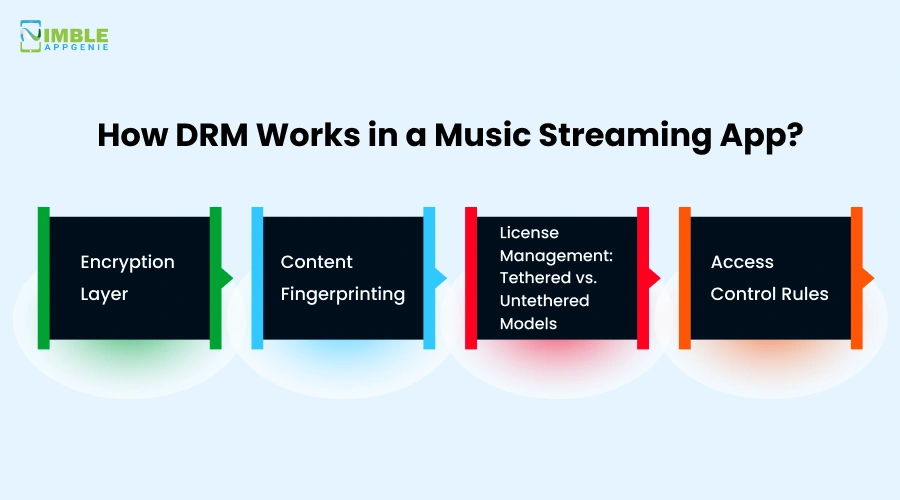
1. Encryption Layer
When a track is acquired from a distributor or uploaded to your platform, it is encrypted using a standard like AES-128 or AES-256 before storage. The encryption key is never stored with the content. Instead, it stays on a separate, secured license server.
When a user taps ‘Play’:
- The app requests a playback license from the license server.
- The server then verifies the user’s account, device, subscription status, and geographic rights.
- If everything checks out, the server issues a time-restricted decryption key to the app.
- The media player uses that key to decrypt and play the stream in real time, in memory only.
- No decrypted audio file ever lives in the device’s storage.
2. Content Fingerprinting
The working of fingerprints is different from encryption. Instead of locking content, it creates a unique acoustic signature of each track, like a sonic fingerprint. Platforms then scan incoming uploads against a database of fingerprints.
Spotify uses its proprietary system, YouTube’s Content ID is arguably the world’s largest music fingerprint database with 100+ million reference files (YouTube 2023), and SoundCloud uses Audible Magic.
3. License Management: Tethered vs. Untethered Models
When subscribers lapse, tethered licenses expire. On the contrary, untethered licenses allow permanent downloads (more common in e-learning and audiobooks, rare in music streaming).
Tethered licensing for the best music streaming apps is the industry norm with rolling 24-72 hour renewal windows. This ensures a cancelled subscription immediately avoids offline playback on the next license check.
4. Access Control Rules
DRM systems enforce rules ahead of simple play/don’t play. Common controls embrace device limits (restrict playback to 5 devices simultaneously), sharing limitations (block Bluetooth re-broadcasting to unauthenticated devices), geographic locks (content licensed only in specific countries), and offline playback windows (max 30 days downloaded before re-authentication).
Types of DRM Technologies Used in Music Apps
The target platform of your music app determines which DRM standards to use.
Here is an in-depth comparison of the six top systems related to music app development in 2026.
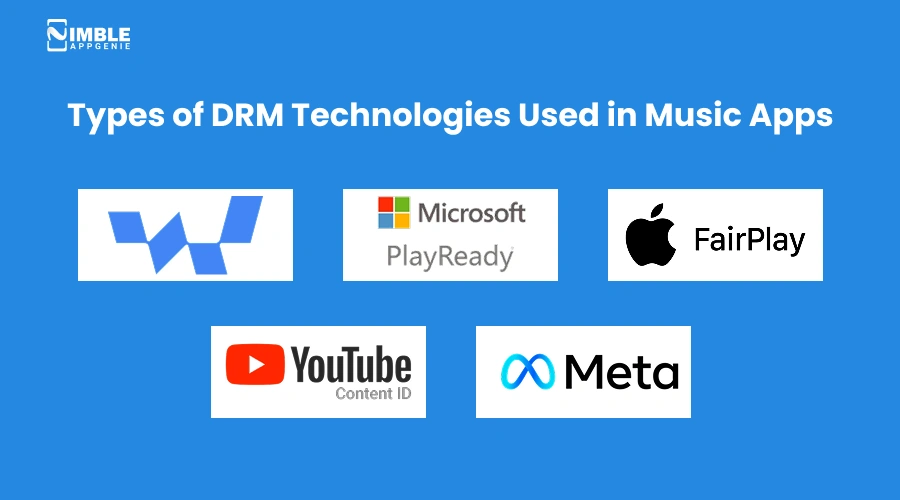
| DRM System | Owner | Platform Support | Best For |
| Widevine | Android, Chrome, web browsers | Android apps, web streaming | |
| PlayReady | Microsoft | Windows, Xbox, Smart TVs, web | Cross-platform, OTT services |
| FairPlay | Apple | iOS, macOS, Safari only | Apple ecosystem apps |
| Content ID | YouTube/Google | YouTube platform only | UGC content protection |
| Rights Manager | Meta | Facebook, Instagram | Social media content |
| MediaMatch | TikTok | The TikTok platform only | Short-form content |
♦ Widevine (Google)
Google’s DRM solution, Widevine, is the most deployed system in the world for Android and web. It operates in three security levels: L1 (hardware-level, highest security), L2, and L3 (software-level).
For music apps, Widevine L1 is recommended for offline playback and downloads. It’s built into Android, Chrome, most Smart TV platforms, and Chromecast.
♦ PlayReady (Microsoft)
Microsoft PlayReady is the ruling DRM for Windows applications, Xbox, and a broad range of Smart TVs (LG, Samsung, Hisense).
PlayReady supports domain-based license management (useful for family plans), adaptive bitrate streaming, and embedded licensing in MP4/CMAF formats. It is a perfect choice for apps targeting cross-platform OTT environments or Windows.
♦ FairPlay (Apple)
Apple FairPlay streaming (APS) is mandatory for any encrypted HTTP Live Streaming (HLS) content distributed through Apple devices. You can’t find it as an open SDK; developers need to apply for Apple’s FPS credentials through the Apple Developer portal.
Only clients running on Apple hardware with verified provisioning profiles can issue, making it the most hardware-locked of the three top systems.
♦ YouTube Content ID
Content ID is a platform-level rights management system created by YouTube, not a developer-facing DRM SDK. If your app embeds or aggregates YouTube content, Content ID works passively on your users’ uploads.
If a user uploads a track to YouTube that matches a reference file, the rightsholder’s policy applies automatically.
♦ Facebook/Instagram Rights Manager and TikTok MediaMatch
Meta’s Rights Manager and TikTok’s MediaMatch operate on the exact fingerprinting principle as Content ID. They are specifically relevant if your app integrates social sharing features.
If a user shares any track from your platform to these social networks, it may trigger automatic rights claims.
Proactively registering your licensed catalog with such systems can avoid false positives and safeguard your partners.
DRM vs Music Licensing For Apps – What’s the Difference
DRM and Music licensing for app developers are confusing at first. Well, they are not interchangeable; they operate at different layers and serve unique purposes.
Both of these are useful for music streaming app development.
| Aspect | DRM | Music Licensing | Both Needed? |
| What it is | Technical enforcement of access rules | Legal permission to use music | Yes – in most cases |
| Who issues it | Technology providers (Widevine, Apple) | Rightsholders, labels, publishers | Different parties |
| Scope | Device-level control and encryption | Legal use rights and territory | Complementary layers |
| Example | Encrypted audio stream with key server | License from ASCAP, BMI, or a label | Both protect your app |
| Without it | Streams can be ripped or shared | Lawsuits, takedowns, fines | Legal and technical risk |
| Developer action | Integrate SDK, configure license server | Sign agreements, pay royalties | Do both from day one |
► When You Need Both and Why?
If you are planning to build a music streaming app, a social app with music stickers, a fitness app with music sync, or any platform where users listen to or share copyrighted recordings, you need both.
A music license (from publishers, labels, PROs like ASCAP/BMI, or aggregators like DistroKid) offers you the legal right to use the music.
DRM technology offers you the technical power to enforce the scope of that license, who can listen, on which devices, for how long, and in which countries.
Overlooking either layer is a liability, not a risk management strategy.
How to Implement DRM in Music Apps (Step-by-Step)?
Implementing Digital Rights Management (DRM) in a music app involves encrypting audio content and ensuring that only authorized users with valid licenses can play it.
Let’s check out the steps to implement DRM in music apps, step-by-step:
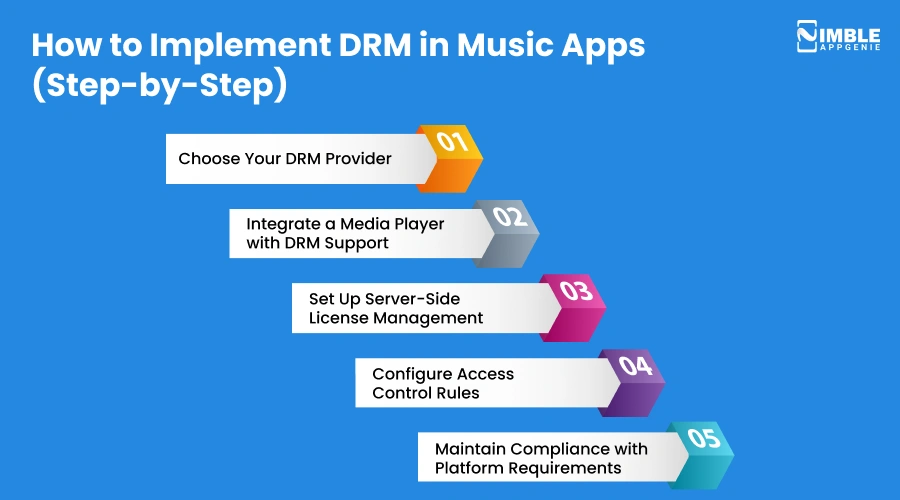
1. Choose Your DRM Provider
A multi-DRM solution provider for most cross-platform music apps is a realistic choice. Providers like EZDRM, Irdeto, Axinom, and BuyDRM offer unified APIs that abstract PlayReady, FairPlay, and Widevine into a single license management interface.
This avoids maintaining three separate integrations. Evaluate providers on pricing model (monthly vs. per-stream), geographic coverage, and SLA (aim for 99.9%+ uptime.
2. Integrate a Media Player with DRM Support
Ensure your media player supports Encrypted Media Extensions (EME) on web or platform-native DRM APIs on mobile.
Recommended players include:
- Android: ExoPlayer (Google’s open-source player with native Widevine support).
- iOS: AVPlayer with FairPlay Streaming integration via the AVContentKeySession API.
- Web: Shaka Player (open source, supports Widevine + PlayReady), THEOplayer, or Video.js with DRM plugins.
- React Native / Flutter: Use platform-specific bridges to ExoPlayer (Android) and AVPlayer (iOS).
3. Set Up Server-Side License Management
The most important infrastructure component is the license server. It receives license requests from client apps, checks entitlements (subscription status, geographic rights, and content availability), issues encrypted content keys, and validates user authentication tokens.
If using a multi-DRM provider, they host and operate this server. If developing in-house, use standards-compliant implementations like open-source solutions like Shaka Packager or Google’s Widevine Key Server for content preparation.
4. Configure Access Control Rules
DRM behavior significantly varies across OS versions, device manufacturers, and browser implementations. Create a test matrix that covers at a minimum.
Chrome on macOS, Android, and Windows; Safari on macOS and iOS 16+; Firefox on Windows; iOS 15–17 with FairPlay; and Android phones with Widevine L1 and L3 devices (test both).
Pay special attention to license renewal edge cases, like what happens when a user’s subscription lapses mid-download.
5. Maintain Compliance with Platform Requirements
DRM compliance is not a one-time job. Google Widevine’s L1 certification needs device-level hardware attestation that changes with Android versions.
Apple updates FairPlay certificate requirements annually. Label licensing agreements usually require audits of DRM implementation every year.
So, assign a dedicated engineer or utilize your multi-DRM provider’s compliance monitoring tools to track requirements changes.
If you are starting from scratch, our dedicated guide on how to build a DRM-protected music app covers the full architecture before you touch a single SDK.
DRM Challenges For Music App Developers With Solutions
Digital rights management is crucial for developers to protect music app intellectual property and handle licensing, but introduces notable technical and user-experience blockages.
| Challenge | Solution |
| High integration complexity across platforms | Use a multi-DRM provider (EZDRM, BuyDRM) with a unified API that handles FairPlay, Widevine, and PlayReady. Avoid building from scratch. |
| The license server latency is affecting the playback start | Pre-fetch licenses during app load. Cache license tokens client-side with a 30-second TTL to reduce perceived latency to under 200ms. |
| Widevine L3 on older Android devices | Implement adaptive quality: serve L3-encrypted lower bitrate streams to devices without L1 hardware. Do not block playback entirely. |
| FairPlay rejection during App Store review | Ensure FPS credentials are correctly embedded, and test with Apple’s TestFlight before submission. Read Apple’s HLS authoring spec in full. |
| Offline playback expiry confusion for users | Surface license expiry dates in the UI. Send push notifications 48 hours before offline licenses expire to prompt re-sync. |
| Content fingerprinting false positives | Register your licensed catalog with YouTube Content ID, Meta Rights Manager, and TikTok MediaMatch proactively. Maintain a catalog ID mapping internally. |
| Audit trail requirements for label deals | Log every license issuance event server-side with user ID, content ID, timestamp, and device hash. Retain for at least 3 years. |
Blockchain and the Future of DRM in Music
While discussing music streaming app trends, the role of Blockchain in music apps comes to mind.
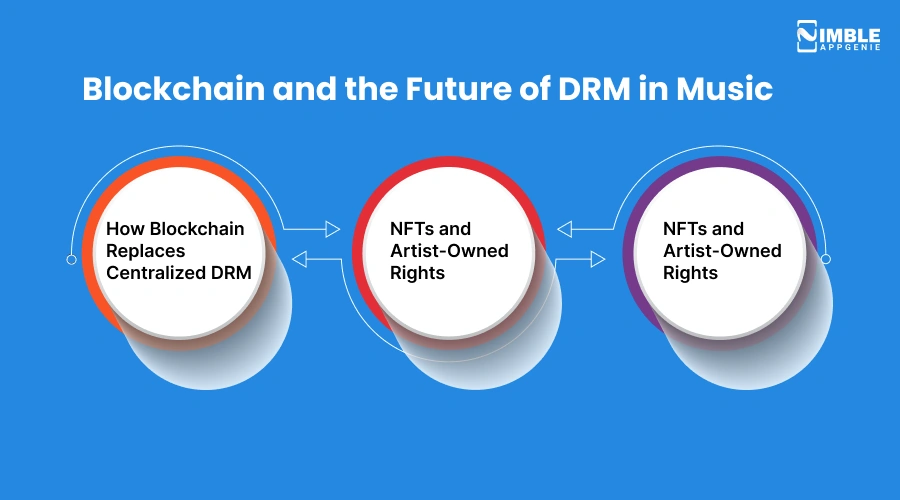
► How Blockchain Replaces Centralized DRM
Traditional DRM depends on centralized license servers, which are a single point of failure and control. Blockchain-based rights management allocates that control across a tamper-proof ledger.
Each right agreement, royalty payment, and license issuance is recorded as an immutable transaction.
Platforms like Opulous, Royal, and Audius are already live with blockchain-native rights management, eliminating label intermediaries for independent artists.
► NFTs and Artist-Owned Rights
Music NFTs showcase a basic shift in how intellectual property is structured. An NFT can encode particular usage rights, like remix rights, sync rights, and stream rights directly into its metadata.
Platforms like Catalog and Sound xyz allow artists to sell fractional ownership of a master recording. For music app developers, it means creating DRM logic that reads from an on-chain ownership registry despite a centralized rights database.
► Smart Contracts for Royalty Payouts
Smart contracts automate royalty distribution in real-time. When a stream arises, the contract executes: 35% to the primary artist, 5% to the publisher, 15% to the producer, and 45% to the label instantly, without a monthly settlement cycle.
For app developers, this means integrating with an on-chain payment rail (Polygon, Solana, or Ethereum are the leading music-focused chains) despite processing payments through a traditional royalty accounting system.
What Does This Mean for App Developers in 2026?
The practical implication is a hybrid model. The established catalog will stay behind traditional Widevine/FairPlay/PlayReady DRM for the foreseeable future.
Emerging and independent artist content is quickly moving on-chain. Forward-thinking music app developers should create their own management layer to be provider-agnostic from the start, so that integrating a blockchain rights check stays alongside.
Why Trust AppGenie For DRM-Protected Music Apps?
Creating a DRM-protected music app is a business-critical decision that shapes every licensing deal, partnership, and platform submission that follows.
Nimble AppGenie, a music streaming app development company, has helped 30+ startup founders, development teams, and product managers navigate this, from choosing the right DRM stack to protecting App Store approvals and structuring content licensing agreements that hold up with major labels.
Here is what working with Nimble AppGenie looks like in practice:
♦ DRM Architecture Consulting
We map the right combination of FairPlay, Widevine, and PlayReady for your platform, target devices, and content type before writing a single line of code.
♦ Full-Stack Music App Development
From license server setup to media player integration, our music app developers have shipped DRM-compliant music apps across Android, iOS, and the web.
♦ Music Licensing Guidance
We connect you with the appropriate rights collectives, label contacts, and distributors so your legal layer matches your technical one.
♦ Compliance Auditing
Before your App Store submission or label pitch, our experts audit your DRM implementation against current platform needs and flag gaps early.
♦ Ongoing Support
DRM requirements evolve, so Google revises Widevine certification, and Apple updates FairPlay specification. We stay updated so your team doesn’t have to.
If you are serious about building a music streaming app that labels trust, platforms approve, and users rely on, Nimble AppGenie is the team that has done it before.
Start Your DRM-Protected Music App with Nimble AppGenie.
Conclusion
Digital rights management in music is the infrastructure on top of which you create everything else; don’t confuse it with a music streaming app feature that you can add when you are ready.
Every label deal, every App Store approval, and every content creator partnership you need to start depends on one thing: a DRM implementation that works accurately, across each device, from the start.
This way, the music streaming industry actually operates. The good news is that digital rights management in music, which was once a black box, is no longer the same.
Technologies are mature, the integration paths are documented, and the providers are accessible even to early-stage teams. You should know the right sequence and execute it before problems hit you.
Digital rights management music done right protects content, your platform reputation, business model, and every artist who trusts you with their work.
Build it right from day one because retrofitting DRM into a live music app is an issue nobody wants.
FAQs

Niketan Sharma, CTO, Nimble AppGenie, is a tech enthusiast with more than a decade of experience in delivering high-value solutions that allow a brand to penetrate the market easily. With a strong hold on mobile app development, he is actively working to help businesses identify the potential of digital transformation by sharing insightful statistics, guides & blogs.
Table of Contents




No Comments
Comments are closed.