

 Free Consultation
 PCI-DSS Compliant
 GDPR Ready
 ISO 27001
 NDA Protected
 AI Services
 AI App Development
 Generative AI Development
 AI Chatbot Development
 AI Integration Services
 AI Consulting Services
 AI For Fintech
 AI Financial Assistant Solution
 AI Insurance Agent Development
 Tech Stack
 OpenAI / GPT-4
 Claude / Anthropic
 Gemini / Google AI
 Llama / Open Source
 LangChain / LlamaIndex
 Pinecone / Pgvector
 AWS / Azure AI


 Fintech Solution
 Core Fintech
 App Development
 Neobank Solutions
 eWallet Solutions
 Lending Software
 Banking Solutions
 BNPL Solutions
 BNPL Solutions
 Insurance App
 Wealth Management
 Crypto & DeFi
 Blockchain Development
  Payroll Software
 DeFi Solutions
 Crypto Wallet
 Crypto On/Off Ramp
 Crypto Exchange
 Trading Platform
 Payments
 Compliance
 Regulations & Compliance
 Fraud Detection
 Lending Ecosystem
 P2P Lending Platform
 Mortgage Software
 Engagement
 Fintech Outsourcing

 Mobile Development
 Mobile App Dev
 iOS App Development
 Android App Development
 React Native
 Flutter Development
 Web Solution
 Node.js Development
 React.js Development
 Angular Development
 App Services
 UI/UX Design
 App Maintenance
 By Stage
 MVP Development
 Industry Solutions
 Healthcare App Dev
 Education App Dev
 Travel App Dev
 Real Estate App Dev
 Logistics Software
 Social Media App

 Hire Mobile Developers
 Hire iPhone Developers
 Hire Android Developers
 Hire React Native Devs
 Hire Flutter Developers
 Hire Web Developers
 Hire Node.js Developers
 Hire Angular Developers
 Hire PHP Developers
 Hire Laravel Developers
 How It Works
 Pre-Vetted Developers
 Ready In 48 Hours
 NDA From Day One
 Replace Guarantee
 Company
 About Us
 Our Work Process
 Portfolio
 Case Studies
 Blog / Insights
 Careers
 Contact Us
 Awards
 Recognition


 Offices


TL;DR
- Basic Crypto exchange development cost for MVP starts around $15,000–$50,000; for mid-range platforms $50,000–$150,000; enterprise-grade exchanges cost $150,000–$500,000+.
- DEX builds are usually cheaper upfront than CEX builds since they skip fiat on-ramps and custodial wallets, but smart contract security spend goes up.
- Security, KYC/AML, and licensing alone can eat 25–35% of your total budget. Skipping them is the single biggest reason exchange launches fail or get shut down.
- Budget for after launch: maintenance, liquidity, and compliance renewals typically run 15–20% of your build cost every year.
- White-label cuts cost and time roughly in half versus custom development, but trades away long-term flexibility and full code ownership.
- Nimble AppGenie builds compliance-ready crypto exchange platforms for US and UK founders and can give you an itemized cost estimate based on your exact feature list, not a generic range.
“How much does it cost to build a crypto exchange?” is the first question almost every founder types into ChatGPT, Google, or a developer’s inbox when writing a single line of code, and it’s a fair one to ask before committing real money.
The honest answer: crypto exchange development cost in 2026 ranges from roughly $15,000 for an MVP to $500,000+ for an enterprise-grade platform, and the gap between those two numbers comes down to what you are building, not only who builds it.
Nimble AppGenie experts break the gap down in this guide by exchange type, by region, by feature, and by what your budget actually needs to look like after the launch day, when most cryptocurrency exchange development cost estimates handily stop.
What Actually Drives Crypto Exchange Development Cost
Before any numbers, it helps to know what is actually being priced. Six variables move the needle more than anything else:
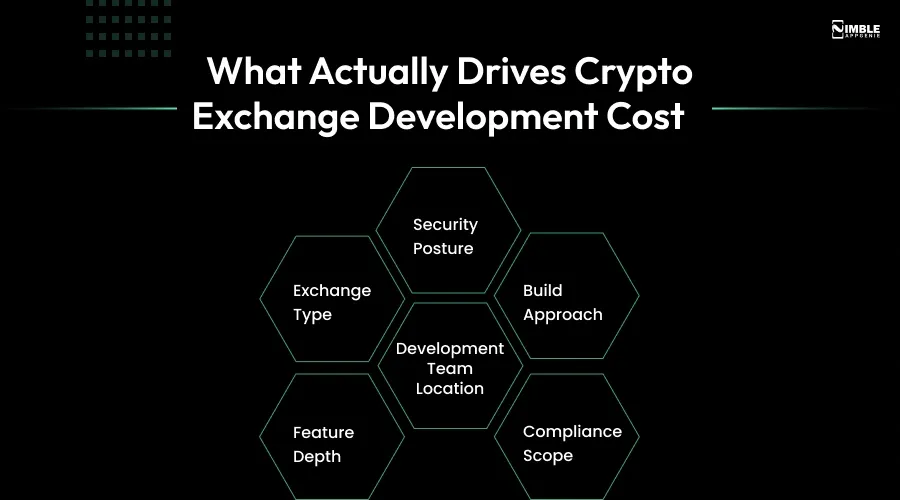
- Feature Depth: Spot trading only, or margin, staking, and derivatives too.
- Exchange Type: Centralized (CEX), decentralized (DEX), peer-to-peer (P2P), or hybrid.
- Security Posture: Multi-signature wallets, cold storage, audit frequency, and penetration testing.
- Build Approach: Custom-coded from scratch vs. a white-label or clone script.
- Compliance Scope: How many jurisdictions you need to be licensed in, and for what (see our breakdown of exchange licensing requirements in the US, UK, and EU)
- Development Team Location: US and UK teams bill more hours than Eastern Europe or South Asia, though hourly rate is not the whole story (more on that below).
Crypto Exchange Development Cost by Type: CEX vs. DEX vs. Hybrid vs. P2P
The type of exchange you choose sets the minimum and maximum limit for your entire budget before a single feature gets discussed.
Centralized crypto exchange development offers the broadest range because it includes fiat rails and compliance; hybrid crypto exchange development sits between the two, borrowing elements from both models.
| Exchange Type | Typical Cost Range | Best For |
| Centralized (CEX) | $50,000 – $500,000+ | Startups needing fiat on/off-ramps, deep liquidity, and mainstream user trust |
| Decentralized (DEX) | $25,000 – $200,000 | Teams prioritizing non-custodial trading and a lighter regulatory footprint |
| Hybrid | $60,000 – $250,000+ | Platforms wanting CEX-level speed with DEX-level asset control |
| P2P Exchange | $10,000 – $50,000 | Escrow-based, marketplace-style trading between users |
| White-label / Clone Script | $8,000 – $40,000 | Fast go-to-market with limited customization |
If you are deciding between models, Nimble AppGenie’s experts have written model-specific guides that go deeper into architecture and features: Binance-style high-volume exchange, Coinbase-style CEX, or Uniswap-style DEX. This article is the cost map; those are the build blueprints.
Cost by Development Tier: MVP, Mid-Range, and Enterprise
| Tier | Cost | What’s Included |
| MVP | $15,000 – $50,000 | User registration, basic wallet integration, simple order book, admin dashboard, single fiat/crypto pair |
| Mid-Range | $50,000 – $150,000 | KYC/AML, liquidity API integration, multiple trading pairs, margin trading, mobile apps |
| Enterprise | $150,000 – $500,000+ | Multi-jurisdiction compliance, institutional-grade security, staking, AI-driven analytics, high-frequency trading support |
Starting with an MVP is not a compromise – it’s a strategy. Launch with wallet functionality and core trading to prove demand, then add margin trading, staking, or derivatives once you have real user data telling you what is worth building next.
Feature-by-Feature Cost Breakdown
Here’s roughly where your budget goes once you get past the headline number:
| Component | Estimated Cost |
| UI/UX design (web + mobile) | $8,000 – $20,000 |
| Trading engine & order matching | $30,000 – $80,000 |
| Wallet & blockchain integration | $20,000 – $50,000 |
| KYC/AML & compliance systems | $10,000 – $40,000 |
| Security infrastructure & audits | $20,000 – $60,000 |
| Admin panel & analytics dashboard | $10,000 – $25,000 |
| Liquidity API integration | $5,000 – $20,000 |
| Legal & licensing | $10,000 – $100,000+ |
Legal and licensing costs swing the widest because it depends completely on jurisdiction – a single-state US money transmitter licence costs far less than FinCEN registration plus FCA authorization plus MiCA coverage across the EU. Get legal guidance before development starts, not after.
Regional Cost Comparison: Where You Build Matters Too
| Region | Typical Project Cost | Developer Rate |
| United States | $75,000 – $300,000+ | $80 – $150/hr |
| United Kingdom | $50,000 – $250,000 | $70 – $130/hr |
| Eastern Europe | $30,000 – $150,000 | $40 – $80/hr |
| South Asia (incl. India) | $20,000 – $100,000 | $25 – $50/hr |
A lower hourly rate is not automatically a lower total cost. A team without fintech-specific experience needs more hours relearning compliance and security requirements. Whereas a specialized fintech team already knows and reworks a financial product is costly in ways a simple app rebuild is not.
The Cost Nobody Puts in the Headline Number
Most cost guides stop at launch day. Your budget should not.
- Recurring Security Audits: $5,000 – $25,000 per audit – budget for at least one a year.
- Hosting & Infrastructure: $2,000 – $10,000/month depending on trading volume and uptime requirements.
- Compliance Renewals: Licensing fees and reporting obligations vary by jurisdiction but don’t stop after year one.
- Liquidity Provisioning: Market-making arrangements or liquidity API costs to keep order books usable from day one.
- Support & Operations: Fraud monitoring, customer support, and incident response staffing.
As a rule of thumb, budget 15-20% of your initial build cost every year for security, maintenance, and compliance. An exchange is not a one-time purchase – it’s a financial product you operate.
White-Label vs. Custom Development: Which Costs Less in the Long Run?
| White-Label / Clone | Custom-Built | |
| Upfront cost | Lower ($8K–$40K) | Higher ($50K–$500K+) |
| Time to launch | Weeks | 6–12 months |
| Customization | Limited to vendor’s framework | Fully flexible |
| Code ownership | Often licensed, not owned | You own it outright |
| Long-term scalability | Constrained by vendor roadmap | Scales on your terms |
White-label makes sense for quickly validating demand, or serving a narrow niche. Once you are planning to scale, add proprietary features, or raise institutional money, most founders migrate to a custom build – so factor that eventual switch into your long-term budget, not only your launch budget.
5 Ways to Cut Cost Without Cutting Corners
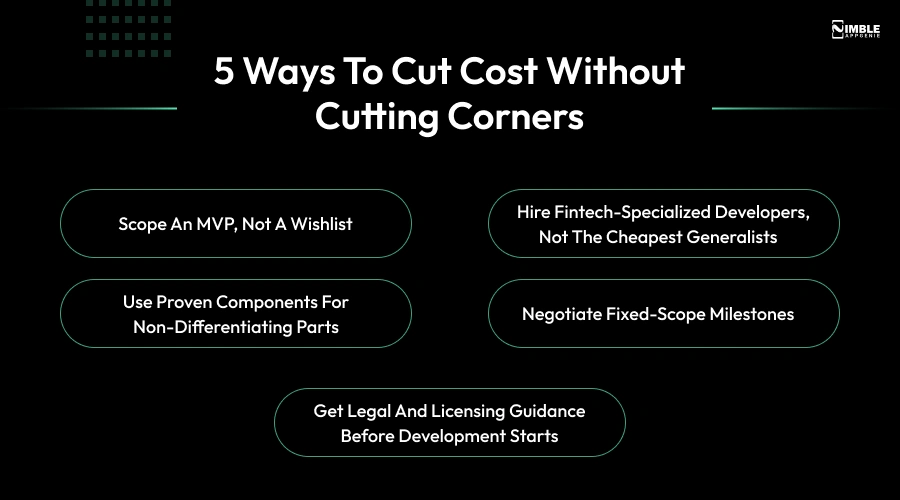
1. Scope an MVP, Not a Wishlist
Launch with core trading and wallet features; add staking, margin, or derivatives once user data tells you it’s worth the spend.
2. Hire Fintech-Specialized Developers, Not the Cheapest Generalists
Blockchain and compliance mistakes cost more to fix than they save to skip.
3. Use Proven Components for Non-differentiating Parts
But always security-audit anything you didn’t build in-house.
4. Negotiate Fixed-Scope Milestones
Instead of open-ended hourly billing, cost overruns are visible early, not at invoice time.
5. Get Legal and Licensing Guidance Before Development Starts
Redesigning an exchange around a license requirement discovered mid-build is far more costly than planning for it upfront.
Is it Worth It? Cost vs. ROI
The upfront number can look intimidating next to the size of the opportunity. The global cryptocurrency exchange platform market was valued at about $45.9 billion in 2023 and is projected to reach $264.3 billion by 2030, expanding at a compound annual rate of 28.4%.
Worldwide cryptocurrency market revenue is alone expected to hit $85.3 billion in 2026. North America alone accounts for around 35% of global exchange revenue, and established leaders like Coinbase are still growing fast – Coinbase’s Q3 2025 revenue rose 54% year over year to about $1.9 billion, per the same industry data.
| The market isn’t just large – it’s still expanding quickly. A well-scoped exchange with the right compliance foundation isn’t a speculative bet; it’s an entry into a category with a documented, multi-year growth curve.
Sources: Grand View Research, Statista, CoinLaw |
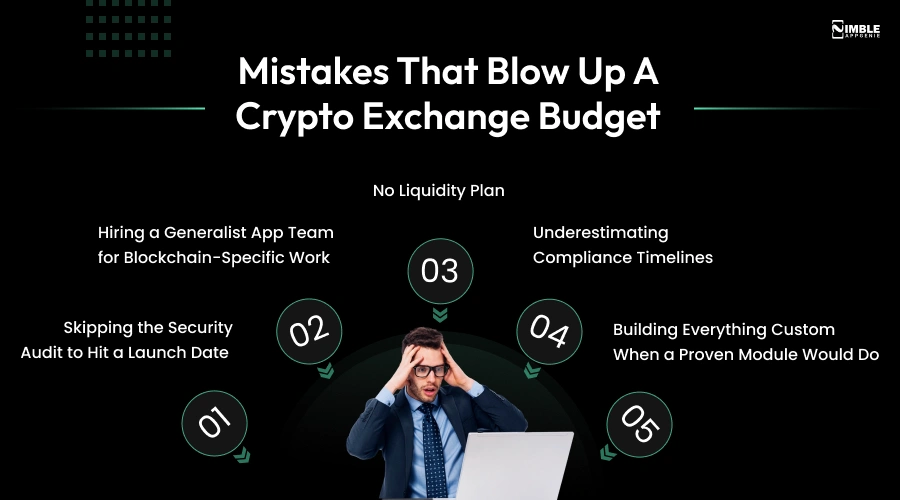
Mistakes That Blow Up a Crypto Exchange Budget
-
Skipping the Security Audit to Hit a Launch Date
A single exploit costs far more than the audit ever would.
-
Hiring a Generalist App Team for Blockchain-Specific Work
Order matching engines and smart contract security are not standard mobile app skills.
-
No Liquidity Plan
An exchange with no one to trade against falls regardless of how well it is built
-
Underestimating Compliance Timelines
Licensing can take 6-24 months depending on jurisdiction – start that process in parallel with development, not after
-
Building Everything Custom When a Proven Module Would Do
Not every part of your exchange needs to be a differentiator.
Which Exchange Should You Actually Build?
If you are still weighing models, here’s a quick decision path. Each row links to a build guide with architecture and feature specifics.
| If You Want | Build This | Deeper Guide |
| Mainstream users & fiat on-ramps | CEX | Coinbase-style guide |
| High trading volume & advanced order types | CEX | Binance-style guide |
| Non-custodial trading | DEX | Uniswap-style guide |
| Lending, staking, cross-chain | DeFi stack | DeFi app guide |
| A companion wallet | Wallet app | Wallet dev guide |
| Settlement, not trading | Stablecoin platform | Stablecoin Guide |
| A broader blockchain app, not just an exchange | Custom blockchain app | Blockchain cost guide |
Building a wallet too? Fintech experts at Nimble AppGenie also have dedicated walkthroughs for Trust Wallet-style and MetaMask-style builds.
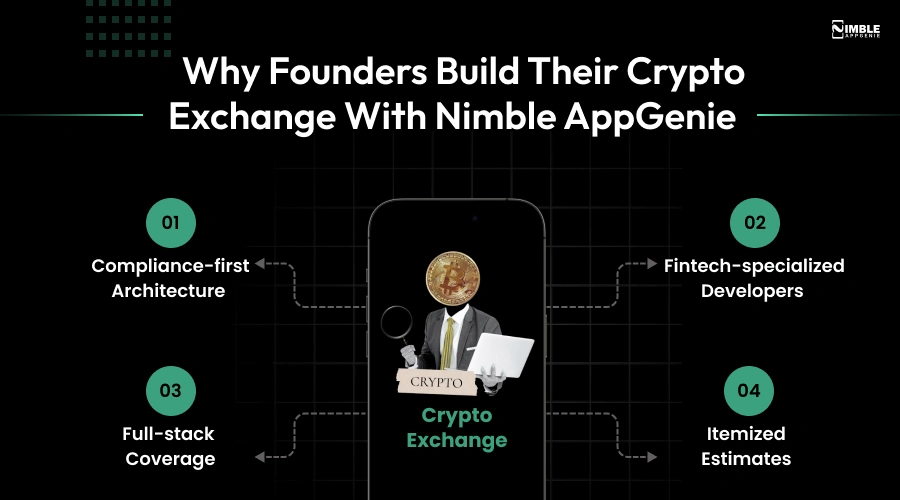
Why Founders Build Their Crypto Exchange With Nimble AppGenie
Crypto apps handle real money – the cost of getting it wrong far exceeds the cost of doing it right the first time.
Nimble AppGenie offers fintech solution services for fintech founders across the US and UK, with a portfolio spanning payment platforms, DeFi protocols, eWallet apps, and complete crypto exchange builds.
As a full-service crypto exchange software development company, we scope each project around your actual budget, not a one-size-fits-all package.
-
Compliance-First Architecture
KYC/AML, FCA, FinCEN, and MiCA considerations built from day one, not bolted on later.
-
Fintech-specialized Developers
Engineers who have shipped regulated financial products, not only mobile apps.
-
Full-stack Coverage
From blockchain infrastructure to wallet development to DeFi protocols.
-
Itemized Estimates
A cost breakdown built around your actual feature list, not a copy-pasted range
| Reviewed by the Nimble AppGenie Fintech Team – 8+ years building compliance-ready blockchain and crypto exchange platforms for founders in the US and UK. Figures in this guide are cross-checked against Grand View Research, Statista, and CoinLaw industry data, and reviewed each quarter as regulations and market rates shift. |

Conclusion

The cost to build a crypto exchange in 2026 depends far more on scope than on any single price tag – a $20,000 MVP and a $400,000 enterprise platform can both be the “right” choice, depending on your users, your growth plan, and your compliance obligations.
What consistency separates a successful launch from a stalled one is not the size of the budget; it’s whether compliance, security, and liquidity were planned for from day one, not added after a demo went well.
If you are ready to move from a rough range to an exact number for your project, that’s the conversation worth having next.
FAQs

Niketan Sharma, CTO, Nimble AppGenie, is a tech enthusiast with more than a decade of experience in delivering high-value solutions that allow a brand to penetrate the market easily. With a strong hold on mobile app development, he is actively working to help businesses identify the potential of digital transformation by sharing insightful statistics, guides & blogs.
Table of Contents




No Comments
Comments are closed.