

 Free Consultation
 PCI-DSS Compliant
 GDPR Ready
 ISO 27001
 NDA Protected
 AI Services
 AI App Development
 Generative AI Development
 AI Chatbot Development
 AI Integration Services
 AI Consulting Services
 AI For Fintech
 AI Financial Assistant Solution
 AI Insurance Agent Development
 Tech Stack
 OpenAI / GPT-4
 Claude / Anthropic
 Gemini / Google AI
 Llama / Open Source
 LangChain / LlamaIndex
 Pinecone / Pgvector
 AWS / Azure AI


 Fintech Solution
 Core Fintech
 App Development
 Neobank Solutions
 eWallet Solutions
 Lending Software
 Banking Solutions
 BNPL Solutions
 BNPL Solutions
 Insurance App
 Wealth Management
 Crypto & DeFi
 Blockchain Development
  Payroll Software
 DeFi Solutions
 Crypto Wallet
 Crypto On/Off Ramp
 Crypto Exchange
 Trading Platform
 Payments
 Compliance
 Regulations & Compliance
 Fraud Detection
 Lending Ecosystem
 P2P Lending Platform
 Mortgage Software
 Engagement
 Fintech Outsourcing

 Mobile Development
 Mobile App Dev
 iOS App Development
 Android App Development
 React Native
 Flutter Development
 Web Solution
 Node.js Development
 React.js Development
 Angular Development
 App Services
 UI/UX Design
 App Maintenance
 By Stage
 MVP Development
 Industry Solutions
 Healthcare App Dev
 Education App Dev
 Travel App Dev
 Real Estate App Dev
 Logistics Software
 Social Media App

 Hire Mobile Developers
 Hire iPhone Developers
 Hire Android Developers
 Hire React Native Devs
 Hire Flutter Developers
 Hire Web Developers
 Hire Node.js Developers
 Hire Angular Developers
 Hire PHP Developers
 Hire Laravel Developers
 How It Works
 Pre-Vetted Developers
 Ready In 48 Hours
 NDA From Day One
 Replace Guarantee
 Company
 About Us
 Our Work Process
 Portfolio
 Case Studies
 Blog / Insights
 Careers
 Contact Us
 Awards
 Recognition


 Offices



In a Nutshell:
- Cost to hire Node.js developer in 2026 ranges from $20/hr to $180+/hr, depending on location and experience.
- North American developers are the most expensive at $80 – $170+/hr; South Asian developers offer the most cost-effective rates at $15 – $55/hr.
- Dedicated developers from an agency offer the best balance of quality and cost for most businesses.
- Project complexity, security requirements, and tech stack all significantly impact the final cost.
- Freelancers are cheaper but come with reliability and consistency risks.
- Starting with an MVP and hiring offshore are the two most effective ways to reduce costs.
- Always evaluate a developer’s portfolio, communication skills, and past projects before hiring.
The cost to hire Node.js developers in 2026 ranges from $12/hour to over $180/hour, depending on experience and location.
Such variations make it important for startup founders, CTOs, business owners, and product managers to understand the hiring costs before starting development.
At Nimble AppGenie, we have worked with Node.js developers across 350+ projects, including fintech and SaaS platforms, and this guide shares real cost insights and hiring strategies.
What Does a Node.js Developer Do?
When you hire a Node.js developer, you don’t just hire someone who writes code; you hire the one who’s responsible for making the product secure, scalable, and fast.
Below is what a good Node.js developer should truly be doing on your project:
1. Building the backbone of your product
They set up the server, database connections, and APIs that strengthen everything users see and interact with – login, payments, data loading, notifications.
2. Making sure your app doesn’t break under pressure
With your growing user base, your backend should manage more requests while maintaining speed. A Node.js developer creates systems that expand with your business.
3. Keeping your data safe
From securing login systems to protecting sensitive user data, they implement security layers that keep your product compliant and trustworthy.
4. Connecting third-party tools
Payment gateways, CRMs, analytics platforms, cloud services – your Node.js developer integrates these so everything works together seamlessly.
5. Working with your whole team
A good Node.js developer doesn’t work in isolation. They collaborate with frontend developers, designers, QA engineers, and product managers to deliver on time.
Average Cost to Hire a Node.js Developer in 2026
How much does it cost to hire a Node.js developer in India, North America, Western Europe, and more?
Below, we will discuss the anticipated average cost to hire a Node.js developer in 2026 according to the recent data trends and expert predictions by categorizing them into region, expertise, engagement model, project type, and skill set.
► Cost by Region
The region from which you hire developers should also be given preference, as the Node.js developer hourly rate in USA / UK / Europe varies.
Let’s analyze Node.js developer rates by country and how a Node.js developer’s salary varies with the location.
| Region | Updated 2026 Rate |
| North America (USA & Canada) | $80 – $170+ |
| Western Europe | $60 – $130 |
| Eastern Europe | $30 – $75 |
| Latin America | $25 – $65 |
| Asia / South Asia | $15 – $55 |
| Africa | $20 – $50 |
Source: ZipRecruiter (March 2026) and Arc.dev Developer Rates.
► Cost by Expertise
The level of proficiency shifts the cost; that’s why senior developers charge more, being skilled in architecture, microservices, security, DevOps, and more.
| Expertise Level | Updated 2026 Rate |
| Junior (0–2 years) | $20 – $55 |
| Mid-Level (2–5 years) | $55 – $100 |
| Senior (5+ years) | $80 – $130+ |
| Expert / Lead / Architect | $100 – $200+ |
► Cost by Engagement Model
The more committed and structured the model is, the higher the price. Your choice of engagement model influences the cost.
| Hiring Model | Updated 2026 Rate |
| Freelancer (Hourly) | $20 – $100/hr |
| Full-Time / In-House (Monthly) | US: $10,000–$17,500/mo |
| Western Europe: $7,000–$12,000/mo | |
| Eastern Europe: $3,000–$8,000/mo | |
| Agency / Dedicated Team | $25 – $120/hr |
Source: Upwork Node.js Rates (March 2026), Arc.dev Developer Rates (2026)
► Cost by Project Type
Different project types demand different skills, which directly contribute to the cost to hire Node.js developer.
| Project Type | Updated Rate | Updated Total Cost |
| MVP Development | $20 – $50/hr | $10,000 – $55,000 |
| Full-Scale Product | $40 – $80/hr | $40,000 – $150,000 |
| Enterprise Software | $60 – $120/hr | $150,000 – $500,000+ |
► Cost by Skillset
Let’s make it clear how particular Node.js skills impact pricing.
| Skillset | Updated 2026 Rate |
| Express.js Developer | $20 – $65/hr |
| Nest.js Developer | $35 – $80/hr |
| MEAN / MERN Stack Developer | $40 – $100/hr |
| Microservices Developer | $55 – $110/hr |
| Cloud-Native Developer | $60 – $120/hr |
| DevOps-Integrated Node.js | $60 – $130/hr |
So, you should know that the actual Node.js developer hourly rates in 2026 (as in the tables) may fluctuate slightly, but consider it a realistic estimate.
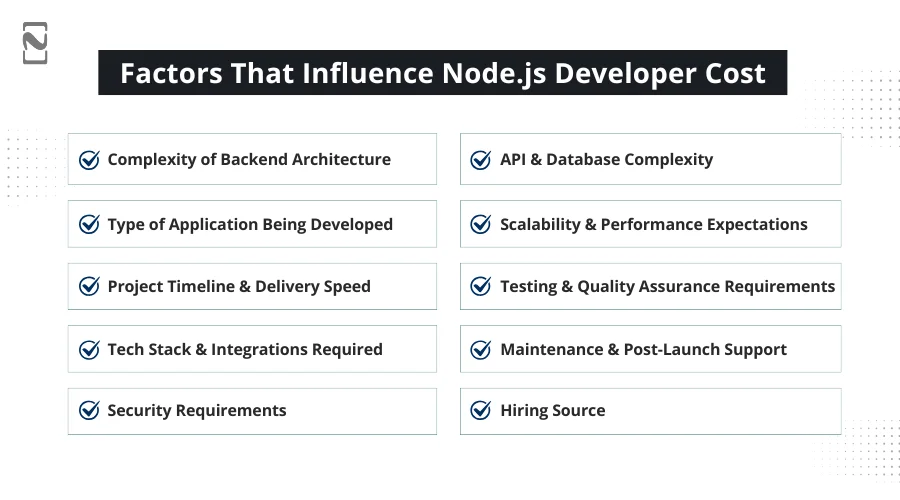
Factors That Influence Node.js Developer Cost
In 2026, hiring a Node.js developer doesn’t just rely on region or experience; numerous overlooked factors shape the final cost.
Here, we have put forth the major, technical, and business-focused factors that increase the cost to hire a Node.js developer.
1. Complexity of Backend Architecture
Your choice of backend architecture decides the Node.js development cost. The more complexity there is, the more engineering hours are required.
Let’s understand, considering the examples:
- Real-time communication (WebSockets, Socket.io)
- Queueing systems (RabbitMQ, Kafka)
- Event-driven architecture
- Multi-service orchestration
2. Type of Application Being Developed
The category of the application you are looking to create requires a different expertise level.
For instance, a fintech app development needs encryption, compliance, and safe transactions, while eCommerce apps require high concurrency, performance tuning, and caching.
Talking about AI/ML-driven apps, they need heavy data processing with model integration.
So, the top-performing and high-risk apps raise the cost.
3. Project Timeline & Delivery Speed
Most startups seek faster delivery, which directs adding more developers who can provide overtime hours.
Therefore, for faster turnaround, the rate increases. And, time-sensitive or you can say, urgent projects generally charge around 20 to 40% more.
4. Tech Stack & Integrations Required
If businesses approach with the demand for more integrations, it will lead to more heightened development costs.
Below, we will showcase the special integration demands responsible for the elevated Node.js development cost.
- Payment gateways
- Third-party identity systems
- CRM / ERP / Marketing tools
- Cloud-native services such as AWS Lambda, S3, Kubernetes, Cognito, and Firebase
For advanced stacks, you will require the assistance of senior Node.js talent, which will again lead to higher Node.js developer hourly rates.
5. Security Requirements
If you want robust security for your domain, expect the price to increase, like for JWT / OAuth 2.0 / SSO / MFA, OWASP compliance, data encryption, and role-based access control.
Why?
Well, security-heavy apps, such as healthcare, fintech, or government, demand experts who obviously charge more.
6. API & Database Complexity
While discussing this factor impacting the cost to hire Node.js developer, you should learn the edges that increase the pricing:
- Complex relational schemas,
- Multi-database setups,
- Heavy API orchestration,
- High-volume NoSQL architecture, and
- Real-time data syncing.
If your applications involve high-frequency data operations, you will likely require extended backend engineering time.
7. Scalability & Performance Expectations
With your growing business, your application should also scale. And for that, you need to support millions of requests, high traffic, load balancing, and a global user base.
With this requirement, the demand for skilled Node.js developers also comes to the surface, who should have proficiency in caching, clustering, horizontal scaling, and microservices.
And as you know, with the expertise, the Node.js developer cost also rises.
8. Testing & Quality Assurance Requirements
Undoubtedly, with the increased testing needs, the cost is also increasing.
Let’s highlight the special cases when you need:
- Unit, integration, E2E, and performance tests,
- Automated test coverage, and
- CI/CD infrastructure.
Besides, you should know that complex QA setups generally contribute about 15-20% to development cost.
9. Maintenance & Post-Launch Support
To ensure consistent and bug-free performance of your solution, you should opt for long-term support, the cost of which is based on:
- New feature rollouts
- Frequency of updates
- Bug fixing SLAs
- Server monitoring & logging
If you choose more frequent maintenance cycles, expect your overall budget to exceed.
10. Hiring Source
Your source of hiring makes the rates fluctuate significantly. Yes, whether you hire Node.js developers from verified agencies, in-house teams, or go for freelancers, the cost changes.
- The cost to hire a Node.js developer from verified agencies is expensive but reliable.
- Choosing freelancers can be cheaper, but you should be prepared for risks, too.
- An in-house team comes at a high fixed cost.
Remember that the selected hiring model can revise pricing by up to 3x. Continue reading for the cost comparison of hiring sources.

Freelancer vs In-House vs Dedicated Developers: Cost Comparison
At this point, you’re all mixed up about whether you should go for dedicated Node.js developers, in-house, or freelancers.
In this section, we will learn how the choice of the right hiring model affects accountability, productivity, cost, and long-term scalability.
► Freelance Node.js Developers
When you pick freelancers, you find it flexible and budget-friendly to manage short-term Node.js tasks. When you need immediate help, this model will be perfect for you with no need for long-term commitments.
Average Cost: $20 – $60/hour
Best for: Small tasks, MVP experiments, and short-term fixes.
Pros:
- The hourly rate is low.
- Freelancers have flexible availability.
- No long-term commitment.
Cons:
- Freelancers have limited reliability.
- No assured adherence to coding standards.
- They have communication delays.
- Freelancers are hard to scale.
► In-House Node.js Developers
In-house developers suit businesses that arrive with the need for comprehensive control, lasting product evolution, and consistent development.
When you hire in-house Node.js developers, you can expect them to work exclusively for your firm and be tightly aligned with your specified processes.
Average Cost: $90,000 – $160,000/year; $45 – $85/hour
Best for: Full control, extended product development, or ongoing iteration.
Pros:
- The in-house team has the highest level of involvement.
- You can experience better communication and cultural alignment by hiring in-house developers.
- They come up with full-time availability.
- Ideal for complex and evolving products
Cons:
- The most expensive hiring model is in-house.
- It demands extra expenses for office, tools, benefits, and taxes.
- You should also consider recruiting, onboarding, and retention costs.
► Dedicated Node.js Developers (via Agency)
Dedicated developers from agencies propose a balanced approach embracing predictable delivery, high skill, and no hiring overhead. The Node.js hiring model is perfect for startups and enterprises that need scalable Node.js development without handling full-time staff.
Average Cost: $25 – $80/hour; Monthly: $3,500 – $12,000, depending on expertise & region.
Best for: Startups & enterprises demanding high-quality development with no hiring overhead.
Pros:
- Dedicated developers you hire are pre-vetted experts.
- Project management is generally included in their responsibilities.
- You can experience faster onboarding by choosing developers from agencies.
- Dedicated developers are usually scalable teams.
- Lower risk of failure.
- You will get guaranteed delivery timelines.
Cons:
- Recurring monthly cost
- This hiring model offers less control than a full in-house team.
Cost Comparison Based on Hiring Model
Freelancer vs In-House vs Dedicated Node.js Developers, let’s have a quick review of the cost to hire Node.js developer to choose the best and most suitable.
| Hiring Model | Cost (Hourly) | Cost (Monthly) | Cost (Annual) | Best For | Key Limitations |
| Freelancer | $20-$60/hr | $1,500-$6,000 | — | Small tasks, bug fixes, and rapid MVP | Reliability & consistency |
| In-House Developer | $45-$85/hr (effective) | $8,000-$14,000 | $90,000-$160,000+ | Long-term products and teams | Highest total cost |
| Dedicated Developer (Agency) | $25-$80/hr | $3,500-$12,000 | $42,000-$144,000 | Full-scale development and scalable teams | Monthly retainer |
Tip: Dedicated Node.js developers from a leading Node.js development company offer a robust ROI and faster delivery than freelancers or in-house hiring.
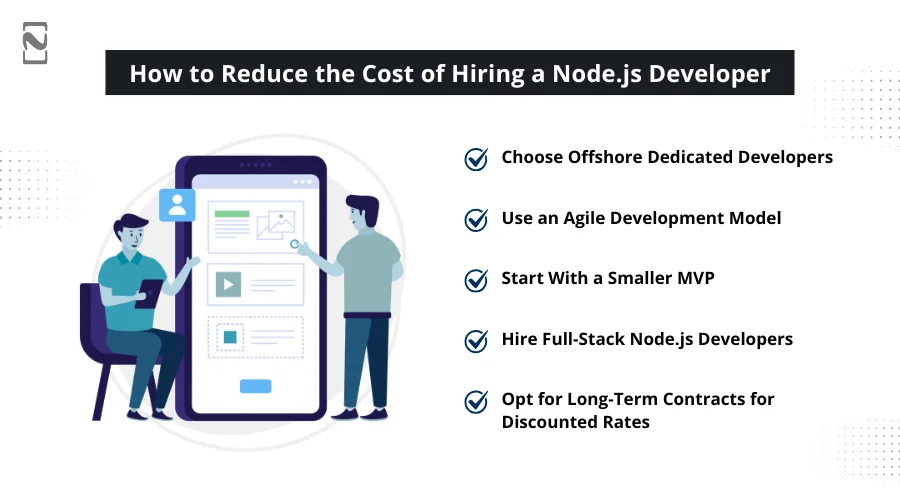
How to Reduce the Cost of Hiring a Node.js Developer?
You will be surprised to know that you can lower the Node.js development cost without hampering speed or quality.
➤ Choose Offshore Dedicated Developers
Hiring offshore developers from Eastern Europe, India, or Latin America greatly mitigates costs while offering access to talented Node.js developers.
Result: You get increased ROI with estimated monthly pricing and swift team scaling.
➤ Use an Agile Development Model
When you follow an Agile approach, you can control cost by dividing the project into shorter sprints, allowing you to pay just for what is delivered.
Result: It diminishes rework, boosts transparency and avoids budget overruns.
➤ Start With a Smaller MVP
A Minimum Viable Product launch enables businesses to validate their product idea without spending heavily initially.
Result: They can develop core features, accumulate feedback before scaling, and reduce development hours.
➤ Hire Full-Stack Node.js Developers
Full-stack developers who manage both frontend and backend reduce the requirement for various roles.
Result: It cuts down hiring costs, overall development time, and communication overhead.
➤ Opt for Long-Term Contracts for Discounted Rates
Agencies offer lower hourly or monthly rates for about 3 to 12-month commitments. Signing long-term contracts ensures fewer onboarding cycles, stable pricing, and better productivity.
Checklist to Evaluate & Hire the Best Node.js Developer
Opt for the below practical checklist when you hire Node.js developers to get a skilled team that’s reliable and project-ready.
The developer should:
- Have a strong knowledge of JavaScript and Node.js fundamentals
- Hands-on experience with databases like MongoDB, PostgreSQL, and Redis.
- Know how to work with Express.js, Nest.js, or similar frameworks
- Understand authentication & security, such as JWT, OAuth, and OWASP.
- Has proven mastery in building scalable, secure, and high-performance APIs.
- Have reliable debugging, testing, and problem-solving skills
- Be familiar with cloud services like AWS, GCP, and Azure.
- Must have good communication and the capability to work in Agile teams.
- Availability, time-zone alignment, and reliability.
- Have a portfolio of real-world Node.js projects.
- Offer clear pricing, contract transparency, and a defined scope.
How to Choose the Right Node.js Developer?
When you hire Node.js developers, it goes beyond evaluating their resume.
Below is a simple framework we use at Nimble AppGenie to check Node.js talent:
1. Check their portfolio
Look for real projects, besides tutorial apps. Ask if they have experience working with APIs, live products, and databases, similar to yours.
2. Ask these 3 simple questions
- Can you walk me through a backend project you built?
- How did you handle performance issues in a past project?
- How do you keep APIs secure?
You don’t have to understand all the technical answers, as you are only looking for confidence, real experience, and clarity.
3. Give a small paid test task
Give them a 2-3 hour task to assess how they code, communicate, and deliver. Avoid asking for free work.
4. Red flags to watch out for
- If they can’t explain their past projects clearly
- Show no portfolio or GitHub profile
- Don’t want to do even a small test task
- Quotes unusually low rates with no explanation
Green flags:
- Has worked on projects in your industry
- Communicates clearly and asks good questions
- Provides references from past clients
Tip: At Nimble AppGenie, every developer goes through a 3-stage vetting process before we put them on a client project: a technical test, a communication assessment, and a trial sprint.
Why Choose Nimble AppGenie to Hire Node.js Developers?
With 8+ years of experience and 350+ apps delivered, Nimble AppGenie is acknowledged as a trusted development partner for startups and enterprises across healthcare, SaaS, fintech, and eCommerce.
Here’s what sets us apart:
- 350+ projects delivered across industries worldwide
- 250+ clients served globally with a 97% client satisfaction rate
- 50+ experienced developers ready to work on your project
- 20M+ app downloads across the products we have built
- Recognised by Clutch, GoodFirms, AppFutura, and more
- Offices in the USA, UK, Canada, Dubai, Singapore, and India
Our Node.js developers work dedicatedly on your project, are fully vetted, and can be onboarded within a week. Contact us now!
What Our Clients Say About Our Node.js Development
Across 350+ projects delivered, here is what businesses constantly achieve when they hire Node.js developers through Nimble AppGenie:
- Faster delivery: Most projects are delivered within 1 week of onboarding.
- Cost savings: Clients save 30 to 40% compared to hiring an in-house team in the US or UK.
- Dedicated engagement: Your developer works exclusively on your project.
- 97% client satisfaction rate: Backed by reviews on Clutch and GoodFirms.
Let’s see what some of our clients have to say:
Nimble AppGenie delivered a standout website that has attracted significant traffic. Their collaborative and organized approach made the development process smooth.
- Francis Ejiegbu, CEO of StepbyStepFitness, UK
- Their team have great command of both client-side and server-side technology. We highly appreciate and recommend their services.
- Ryan Williams, CEO of GLU Learning, UAE

Conclusion
Understanding the cost to hire Node.js developers is the first step to making the right hiring decision, which can make or break your project.
Whether you are an enterprise scaling rapidly, a startup strictly budgeting and tracking expenses, you should pay for what you get.
At Nimble AppGenie, we have helped 250+ clients across fintech, SaaS, and healthcare build reliable Node.js-powered products, on time and within budget.
If you are ready to get started or just want a rough estimate for your project, our team is happy to help, no commitment required.
FAQs
The cost to hire a Node.js developer in 2026 ranges from $20/hr to over $180/hr, depending on experience, location, and hiring model. For a dedicated developer, expect $3,500-$12,000/month. Contact us for an exact quote based on your project needs.
Well, you can find freelancers to be cheaper to hire, but let’s just clear it up. Hiring dedicated developers may seem to be a little costlier, but trust us, they offer consistent delivery, higher reliability, and better lasting value to full-scale projects.
If you want to catch up with a competitive edge, go for dedicated Node.js developers for your next Node.js development project.
Look for experience with Express/Nest, database skills (MongoDB, PostgreSQL), API development, security practices, cloud knowledge (AWS, GCP, Azure), and good communication.
The cost estimation is pulled based on complexity, scope, hiring model, timeline, and the required expertise. Multiplying hourly rates by expected development hours gives you an average value.

Niketan Sharma, CTO, Nimble AppGenie, is a tech enthusiast with more than a decade of experience in delivering high-value solutions that allow a brand to penetrate the market easily. With a strong hold on mobile app development, he is actively working to help businesses identify the potential of digital transformation by sharing insightful statistics, guides & blogs.
Table of Contents




No Comments
Comments are closed.