

 Free Consultation
 PCI-DSS Compliant
 GDPR Ready
 ISO 27001
 NDA Protected
 AI Services
 AI App Development
 Generative AI Development
 AI Chatbot Development
 AI Integration Services
 AI Consulting Services
 AI For Fintech
 AI Financial Assistant Solution
 AI Insurance Agent Development
 Tech Stack
 OpenAI / GPT-4
 Claude / Anthropic
 Gemini / Google AI
 Llama / Open Source
 LangChain / LlamaIndex
 Pinecone / Pgvector
 AWS / Azure AI


 Fintech Solution
 Core Fintech
 App Development
 Neobank Solutions
 eWallet Solutions
 Lending Software
 Banking Solutions
 BNPL Solutions
 BNPL Solutions
 Insurance App
 Wealth Management
 Crypto & DeFi
 Blockchain Development
  Payroll Software
 DeFi Solutions
 Crypto Wallet
 Crypto On/Off Ramp
 Crypto Exchange
 Trading Platform
 Payments
 Compliance
 Regulations & Compliance
 Fraud Detection
 Lending Ecosystem
 P2P Lending Platform
 Mortgage Software
 Engagement
 Fintech Outsourcing

 Mobile Development
 Mobile App Dev
 iOS App Development
 Android App Development
 React Native
 Flutter Development
 Web Solution
 Node.js Development
 React.js Development
 Angular Development
 App Services
 UI/UX Design
 App Maintenance
 By Stage
 MVP Development
 Industry Solutions
 Healthcare App Dev
 Education App Dev
 Travel App Dev
 Real Estate App Dev
 Logistics Software
 Social Media App

 Hire Mobile Developers
 Hire iPhone Developers
 Hire Android Developers
 Hire React Native Devs
 Hire Flutter Developers
 Hire Web Developers
 Hire Node.js Developers
 Hire Angular Developers
 Hire PHP Developers
 Hire Laravel Developers
 How It Works
 Pre-Vetted Developers
 Ready In 48 Hours
 NDA From Day One
 Replace Guarantee
 Company
 About Us
 Our Work Process
 Portfolio
 Case Studies
 Blog / Insights
 Careers
 Contact Us
 Awards
 Recognition


 Offices


TL;DR
- The CFPB has dropped various enforcement actions, cut staff and funding, and is rewriting rules. Regulation E, the core fraud-liability rule for electronic transfers, stays in force.
- State attorneys general and private litigation are filling the gap.
- Unauthorized transfers (account takeover) are covered by Regulation E. Scams where the user sends the money are usually not, which is where most disputes now sit.
- Less federal enforcement doesn’t mean less risk for fintechs. Sponsor banks, state law, networks, and future administrations still apply pressure.
- Build for fraud prevention, clear dispute handling, and a written reimbursement policy now.
- Nimble AppGenie helps fintech businesses build secure payment apps with integrated fraud controls, dispute-resolution workflows, and risk monitoring to address evolving fraud-liability requirements.
The CFPB oversight rollback has made many fintech teams ask a risky question: if the federal oversight is stepping back, who is responsible when users lose money to fraud? The short answer: the rules on paper have not changed much, but enforcement is shifting to courts, states, and partner banks. This guide explains where fraud liability sits now and how to design payment apps around it.
What Is the CFPB Oversight Rollback?
The CFPB oversight rollback is the Consumer Financial Protection Bureau’s significant reduction in enforcement, supervision, and rulemaking since early 2025. It includes workforce cuts, dropped cases, funding disputes, and rewritten or narrowed rules; however, the underlying consumer finance laws remain on the books.
Key Terms to Know
| Term | Plain-English meaning |
| CFPB | Consumer Financial Protection Bureau, the federal agency created to oversee consumer financial products. |
| Regulation E | The rule implementing the Electronic Fund Transfer Act. It sets consumer protections and error-resolution duties for electronic transfers. |
| Unauthorized transfer | A transfer the account holder did not initiate or approve, such as account takeover or SIM-swap theft. |
| Authorized push payment (APP) fraud | A scam in which the victim is tricked into sending money themselves. |
| UDAAP | Unfair, deceptive, or abusive acts or practices, a core CFPB enforcement authority. |
| Section 1033 | The Dodd-Frank open banking provision on consumer data access. |
| Consent order | A settlement requiring a company to change conduct or pay redress. |
| Sponsor bank | The bank partner that holds funds or provides rails for a non-bank fintech app. |
What Has Changed? A Short Timeline
| When | What happened |
| Feb 2025 | Staff ordered to halt work, starting the bureau’s retreat |
| Mar 2025 | CFPB dropped its 2024 lawsuit against the Zelle operator and three large banks |
| Jul 4, 2025 | Budget law cut the bureau’s funding cap from 12% to 6.5% of a Federal Reserve expense baseline |
| Dec 2025 | A federal court ordered the bureau to request funding after it claimed it could not lawfully do so |
| Jan 2026 | GAO report documented reorganization, curtailed supervision, and consent-order terminations |
| Apr 22, 2026 | CFPB finalized a narrower fair lending (ECOA / Regulation B) rule, effective July 21, 2026 |
| Jul 20, 2026 | New York court let most of the state’s fraud case against the Zelle operator proceed |
| Aug 2026 | House Financial Services Committee circulated a CFPB reform bill (a proposal, not law) |
Reports recorded 22+ abandoned enforcement actions and around 20 modified or ended settlement orders. The bureau’s stated enforcement aim is now “actual fraud” with measurable consumer harm. Reorganization and funding litigation remained unsettled in the sources reviewed, so check the current status before relying on any of these developments.
Who is Liable for Fraud Now?
Liability depends on whether the transfer was authorized or unauthorized. Regulation E still safeguards consumers from unauthorized electronic transfers. Scams in which the user sends money are usually outside that rule, so reimbursement depends on provider policy, state law, and litigation.
Unauthorized vs Authorized Fraud
| Unauthorized (account takeover) | Authorized push payment scam | |
| Example | Hacker adds a recipient and sends funds | User pays a fake “bank security” caller |
| Regulation E applies? | Yes, with timely reporting | Generally no |
| Provider duty | Investigate, possibly credit provisionally | Depends on policy and state law |
| Main legal fight | Whether the consumer reported on time | Whether the transfer counts as “authorized” |
Regulation E Consumer Liability Limits
For unauthorized transfers, consumer liability under 12 CFR 1005.6 relies on how quickly the consumer reports.
| When the consumer reports | Maximum consumer liability |
| Within 2 business days of learning of the loss or theft | $50 |
| After 2 business days, within 60 days of the statement | Up to $500 |
| After 60 days from the statement | Potentially unlimited for later transfers, if the provider shows timely notice would have prevented them |
Providers usually must investigate within 10 business days, extendable to 45 days if they provisionally credit the account. Whether a non-bank wallet counts as a covered financial institution depends on how it holds consumer accounts, so confirm with counsel.
Why Is Fraud Liability Moving to States, Courts, and Banks
When a federal regulator withdraws, other parties act. State attorneys general, sponsor banks, and private plaintiffs all have their tools, and they use them. Fintechs encounter the risk without the predictability of a single federal rulebook.
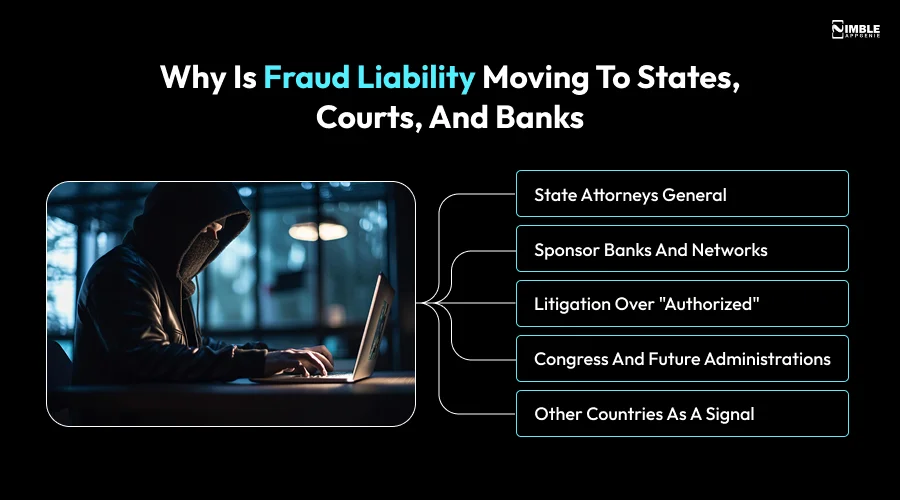
- State Attorneys General: New York sued the Zelle operator in August 2025, claiming its design enabled $1+ billion in fraud from 2017 to 2023. In July 2026, the court permitted most claims to proceed. Though it’s not a final ruling and doesn’t create new payment-network law, it keeps the issue alive. If one state’s case fails, other states may bring claims under their own statutes.
- Sponsor Banks and Networks: Partner banks answer to their own regulators and card or network rules, so they push fraud obligations down to fintech partners through contracts.
- Litigation Over “Authorized”: Courts keep testing whether a transfer induced by deception is actually “authorized” under the Electronic Fund Transfer Act.
- Congress and Future Administrations: Proposed reform bills would shift enforcement to prudential regulators for smaller institutions, while other proposals would restore funding floors. Policy can change again.
- Other Countries as a Signal: The UK has already legislated mandatory reimbursement for authorized push payment fraud, which shows where public pressure can lead.
What Does the Rollback Mean for Fintech Wallets and Payment Apps?
It means lower federal enforcement risk in the short term but higher uncertainty overall. Apps that move money should assume fraud liability will keep landing on them through state law, contracts, and reputation, regardless of CFPB activity.
- Open banking is unsettled. The Section 1033 rules remain on the books but are described as effectively unenforceable, so data-access contracts are more significant. Check current status before building on assumptions.
- Do not treat a quiet CFPB as a safe zone. Violations can still be followed later, and state or private actions are not connected to federal priorities.
- Instant rails raise the stakes. Payments that settle in minutes are challenging to reverse. This also applies to stablecoin transfers; our guide to stablecoin wallets under the GENIUS Act covers AML duties that sit with fraud controls.
- Multiple Rails Multiply Gaps. Scammers exploit the seams between systems, a theme in our article on wallet interoperability and fragmentation.
- Trust is a product feature. Users who lose money to scams blame the app they used, whatever the legal answer.
For a wider view of the rules in play, see our fintech regulations guide.
How Do You Build a Fraud-Resilient Payment App?
Combine detection, prevention, and clear dispute handling. The goal is fewer successful scams, rapid resolution when they happen, and a documented policy that partner banks, regulators, and users can all understand.
Fraud Liability Readiness Checklist
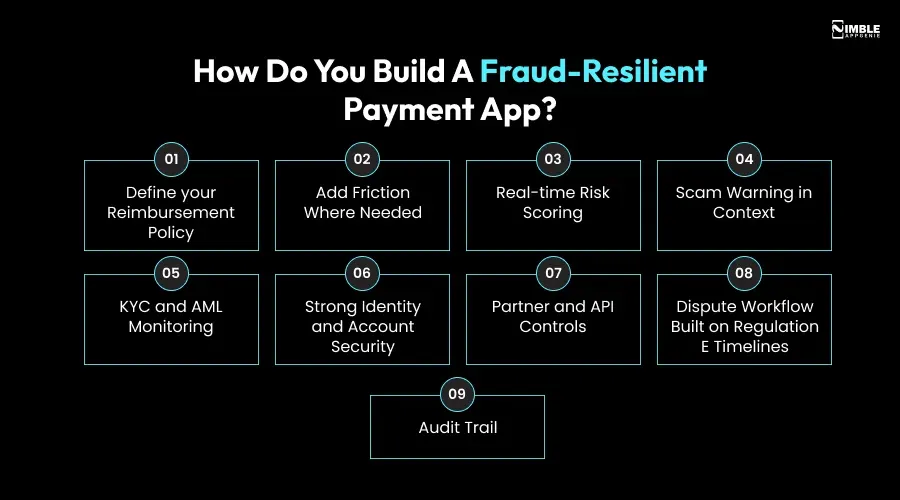
- Define your Reimbursement Policy: Define what you will cover beyond the legal minimum in writing with counsel.
- Add Friction Where Needed: Add confirmation steps, delays, or recipient-name checks for high-risk payments, and keep low-risk flows quick.
- Real-time Risk Scoring: Flag unusual amounts, new payees, rapid account changes, and device changes.
- Scam Warning in Context: Show specific alerts when patterns match known scams, such as bank-impersonation calls.
- KYC and AML Monitoring: Detect mule accounts and suspicious flows, as covered in our KYC and AML compliance guide.
- Strong Identity and Account Security: Implement step-up authentication and monitor SIM-swap activity and recovery changes, following our fintech security guidance.
- Partner and API Controls: Agree on fraud data sharing and responsibility with processors and banks through clean fintech API integration.
- Dispute Workflow Built on Regulation E Timelines: Log report times, track investigation deadlines, and automate provisional credit decisions where they apply.
- Audit Trail: Keep records of alerts, decisions, and communications for partner banks, regulators, and auditors.
If you are building the wallet, see our eWallet app development service. A lean MVP with fraud controls included is safer than adding them after launch, and our fintech app development cost guide helps you budget for them.
How Nimble AppGenie Helps Fintechs Build for Fraud Liability
Nimble AppGenie builds payment and wallet apps with fraud controls, dispute workflows, and audit trails, so teams don’t have to retrofit them after launch.
Our fintech team works on the parts of the stack that decide how fraud losses are prevented and resolved:
- Risk-scoring and payment-friction logic for new payees, large transfers, and device changes
- Dispute and error-resolution workflows that track Regulation E deadlines
- Secure partner and bank connections through fintech API integration
- Wallet and payment app builds through our eWallet app development service
We have delivered multi-country payment products, including MaxPay, which supports payments across 50+ countries. Legal conclusions on liability should come from your counsel, but the product architecture can be planned now. Talk to our team about a fraud-aware build plan.
Final Thoughts
The CFPB’s retreat has changed who enforces consumer protection, not whether partners and users expect it. The safest assumption is that fraud responsibility will keep flowing toward the apps that move the money. Build dispute handling and prevention into the product, document your policy, and revisit it as the rules settle.
| Sources (accessed October 2026): Consumer Reports: CFPB one year after shutdown order · Consumer Financial Services Law Monitor: GAO report on CFPB · Covington: The CFPB in 2026 · Consumer Finance Monitor: Regulation B final rule · Consumer Finance Monitor: New York v. Early Warning Services · Forbes: New York and Zelle fraud rules · CRS: CFPB budget background · House Financial Services Committee: CFPB reform bill summary · Consumer Finance Monitor: CFPB enforcement and open banking · eCFR: 12 CFR 1005.6. This article is informational and not legal advice. |

Madan is the Backend Solutions Architect at Nimble AppGenie, specializing in the design of secure, high-concurrency systems that power complex mobile ecosystems. With deep expertise in server-side logic and database management, he ensures every platform is built with enterprise-grade security. In his free time, he is an avid researcher of emerging technologies; he spends his time deconstructing the latest backend frameworks and reading technical papers to ensure our solutions remain at the absolute forefront of industry innovation.
Table of Contents




No Comments
Comments are closed.