

 Free Consultation
 PCI-DSS Compliant
 GDPR Ready
 ISO 27001
 NDA Protected
 AI Services
 AI App Development
 Generative AI Development
 AI Chatbot Development
 AI Integration Services
 AI Consulting Services
 AI For Fintech
 AI Financial Assistant Solution
 AI Insurance Agent Development
 Tech Stack
 OpenAI / GPT-4
 Claude / Anthropic
 Gemini / Google AI
 Llama / Open Source
 LangChain / LlamaIndex
 Pinecone / Pgvector
 AWS / Azure AI


 Fintech Solution
 Core Fintech
 App Development
 Neobank Solutions
 eWallet Solutions
 Lending Software
 Banking Solutions
 BNPL Solutions
 BNPL Solutions
 Insurance App
 Wealth Management
 Crypto & DeFi
 Blockchain Development
  Payroll Software
 DeFi Solutions
 Crypto Wallet
 Crypto On/Off Ramp
 Crypto Exchange
 Trading Platform
 Payments
 Compliance
 Regulations & Compliance
 Fraud Detection
 Lending Ecosystem
 P2P Lending Platform
 Mortgage Software
 Engagement
 Fintech Outsourcing

 Mobile Development
 Mobile App Dev
 iOS App Development
 Android App Development
 React Native
 Flutter Development
 Web Solution
 Node.js Development
 React.js Development
 Angular Development
 App Services
 UI/UX Design
 App Maintenance
 By Stage
 MVP Development
 Industry Solutions
 Healthcare App Dev
 Education App Dev
 Travel App Dev
 Real Estate App Dev
 Logistics Software
 Social Media App

 Hire Mobile Developers
 Hire iPhone Developers
 Hire Android Developers
 Hire React Native Devs
 Hire Flutter Developers
 Hire Web Developers
 Hire Node.js Developers
 Hire Angular Developers
 Hire PHP Developers
 Hire Laravel Developers
 How It Works
 Pre-Vetted Developers
 Ready In 48 Hours
 NDA From Day One
 Replace Guarantee
 Company
 About Us
 Our Work Process
 Portfolio
 Case Studies
 Blog / Insights
 Careers
 Contact Us
 Awards
 Recognition


 Offices



Key Takeaways:
- Shariah compliance in fintech follows Islamic law by avoiding interest and unethical investments.
- Fintech products must avoid riba, gharar, maysir, and include risk-sharing, asset-backing, ethical investing, and zakat.
- Murabaha, Ijarah, and Mudarabah contracts determine how ownership, risk, and profit are recorded.
- Shariah scholars, the Supervisory Board, and Shariah officers approve and monitor compliance, while developers implement the controls.
- Wallets, neobanks, BNPL, investments, crypto, takaful, and remittance services require different Shariah approaches.
- Effective implementation requires governance, contract-based workflows, screening and zakat tools, audits, and continuous monitoring.
- Connect with Nimble AppGenie to integrate Shariah compliance into the system from day one.
Allah has permitted trade and has forbidden interest (Quran 2:275). That single verse shapes how an entire financial system works, and now it shapes how modern apps are built.
As digital banking, wallets, and investing platforms reach Muslim users worldwide, Shariah compliance for fintech app development has moved from a niche requirement to a trust requirement.
Yet most teams discover too late that Islamic rules can’t be patched onto a finished product.
This guide explains the key principles, contracts, governance, and build steps behind Shariah compliance for fintech app products, so you can launch an ethical, auditable product that scales.
Without further ado, let’s get started.
What is Shariah Compliance In Fintech?
Shariah compliance in fintech simply means that digital financial services operate according to Islamic law, forbidding interest and unethical investments.
It is all about the integration of Islamic law (Shariah) into digital financial services to ensure that transactions are ethical, transparent, and free from prohibited elements.
Shariah-compliant fintech platform is a digital financial solution that follows the principles of Islamic finance while offering modern banking and financial services.
Unlike traditional fintech platforms that include interest-based lending, these fintech platforms operate as per Islamic rules. Shariah compliance means following Islamic law in business and finance to ensure that money management is fair, ethical, and even socially responsible.
Most of the fintech app startups often ask, “What is Shariah compliance in fintech?” and “Is fintech halal?”
Shariah compliance refers to the regulations made by Islamic religious governance and leaders to make a fintech app as per the Islamic laws. Shariah compliance is considered fintech halal because it strictly adheres to Islamic financial principles and is well vetted by qualified religious scholars.
If you are about to use fintech API integration services, one of the key compliance requirements that you can include is Shariah compliance.
Now, let’s look ahead to the key principles of Shariah compliance in Islamic financial products that you can include.
Key Principles of Shariah Compliance in Islamic Financial Products
Shariah compliance in Islamic financial products is governed by the core ethical and legal principles that are derived from Islamic law (Shariah), prioritizing risk-sharing, asset-backing, and even social responsibility over speculation or interest-based gains.
These principles are the foundation of shariah compliance in fintech.
Shariah compliance in Islamic financial products includes certain key principles:
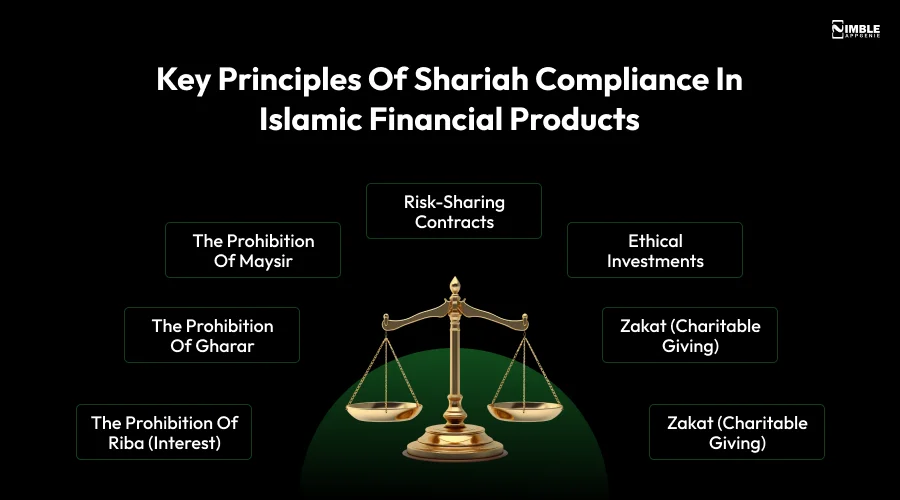
► The Prohibition of Riba (Interest)
The prohibition of Riba means the strict religious ban under Islamic law (Shariah) on charging or paying any predetermined, guaranteed extra payment or excess over the principal amount in a loan or exchange.
This principle aligns with risk-sharing, as financial institutions must actively participate in the risks of investments rather than earning guaranteed interest.
The core components included in Riba:
- No interest-based lending or borrowing.
- No predetermined fixed returns.
- Profit and loss sharing arrangements as alternatives to conventional laws.
► The Prohibition of Gharar (Excessive Uncertainty)
The rules of Islamic finance ban participation in contracts that are unverified. It says that all contracts should be transparent, with clearly defined terms and conditions for minimizing uncertainty.
The word gharar comes from an Arabic root meaning hazard or deception. This happens when the core details of a deal are unclear. So, this principle is entirely focused on preventing excessive uncertainty, deception, and even unfair risk in a transaction.
The core components of these principles:
- Uncertainty in the Subject Matter.
- Unclear price or consideration.
- Ambiguous contract terms.
► The Prohibition of Maysir (Gambling)
Maysir is strictly prohibited (haram) in Islam because it transfers wealth based on mere luck rather than productive effort or fair value exchange.
This is an Arabic word that is equivalent to gambling; it means getting something too easily and making a profit without working for it. Under this principle, any monetary gain that comes without legitimate effort is considered unlawful.
The core components of these principles:
- Lottery-style reward systems.
- Speculative investment products.
- High-frequency trading algorithms designed for quick profits.
► Risk-Sharing Contracts
Risk-sharing contracts are business agreement or where two or more parties divide financial, operational, or performance risks instead of one side carrying everything alone.
It is the heart of shariah-compliant finance, reflecting the core Islamic principle of equitable distribution of wealth and responsibility. This principle mandates that all parties to a financial transaction must equitably share both the profits and losses arising from an economic venture.
The core components of these principles:
- Allocation and distribution models.
- Linked compensation and margins.
- Control and operational accountability.
► Asset-Backed Financing
Asset-backed financing is where the transactions must be tied to a real, physical asset or genuine economic activity rather than pure monetary lending.
It is all about tying transactions to tangible assets and even services to avoid speculation and promote real economic activity.
The core components of this principle include:
- Contractual cash flows.
- Underlying the collateral/ Asset pool.
- Special purpose entity.
► Ethical Investments (Halal Financing)
Ethical investment in Shariah-compliant fintech centers on faith-based moral guidelines that forbid interest eliminates the excessive speculation.
It is the foundational pillar of Shariah compliance in fintech because Islamic law mandates that all financial transactions should be tied to economic value and social justice rather than pure speculation.
The core components of this principle include:
- Investment in lawful activities.
- Responsible risk-sharing, where the profits and losses should be allocated fairly.
- Responsible use of funds.
► Zakat (Charitable Giving)
Zakat as a core shariah compliance in fintech is all about the mandatory charitable contribution of 2.5% of one’s wealth, that are facilitate by financial institutions.
It is one of the important pillars of shariah compliance in fintech, which functions as a mandatory social impact mechanism rather than any optional charity.
Here are the core components included in Zakat:
- Wealth purification.
- Application to modern instruments.
- Implementation of Nisab and Rate standards.
Islamic Financial Contracts and How They Map To Digital Products
This section includes how contract-based finance is designed for Shariah compliance in fintech.
The Islamic financial contracts map to digital products by replacing interest-bearing logic with asset-backing, trade-based workflows, or profit-and-loss sharing that is built directly into the application logic and APIs.
Here is the complete list of Islamic financial contracts and how they map to the digital products:
| Contract | Meaning | Fintech product | App must enforce |
| Murabaha (cost-plus sale) | Provider buys the asset and sells it to the customer at a disclosed markup, paid in instalments | Purchase financing, BNPL | Fixed markup, never raised for late payment |
| Ijarah (lease) | Provider owns the asset and leases it for rent | Car and equipment leasing | Provider keeps ownership; rent starts after delivery |
| Diminishing Musharakah (shared ownership) | Customer and provider co-own an asset; the customer gradually buys the provider’s share | Home financing | Ownership-share ledger updated with each payment |
| Mudarabah (profit-sharing) | One party provides capital, the other provides work; profit is split by agreed ratio | Savings and investment accounts | Profit as a ratio, never a guaranteed return |
| Wakalah (agency) | One party acts for another for a fee | Investment wallets, takaful operator model | Fee kept separate from returns |
| Takaful (mutual risk-sharing) | Members pool contributions to cover each other’s losses | Insurance apps | Member pool separated from operator funds |
Also Read: “Fintech and Digital Payments Regulations”
Shariah Governance: Who Decides What is Compliant?
One of the questions that most of the startups and entrepreneurs ask is “”Who certifies a financial product as Shariah compliant?” and “What does a Shariah Supervisory Board do?”
The key decision-makers for Shariah governance for a fintech company are the Shariah Supervisory Board (SSB), its well-qualified jurists or Shariah scholars, and its Shariah officers.
Let’s have a look at them in brief:
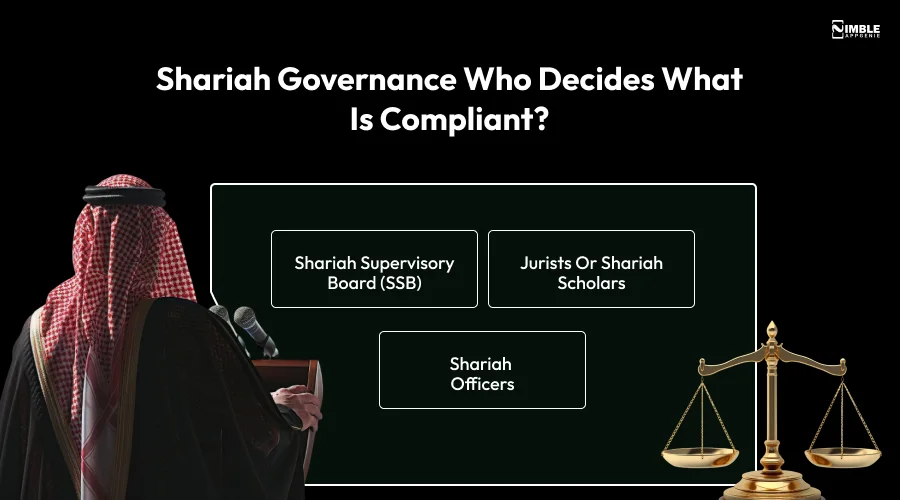
♦ Shariah Supervisory Board (SSB)
This is a board that is composed of at least three jurists. They are paid by the bank but act as independent consultants. The role of the SSB is both consultative and regulatory.
SSBs decide what is allowed (halal) or forbidden (haram) based on the two main sources of Islamic law, including the Quran and Sunnah, or what the Prophet Muhammad reportedly said and did during his time.
♦ Jurists or Shariah Scholars
Shariah governance is the set of institutional and organizational arrangements. Jurists are the specialists in Islamic jurisprudence, particularly commercial law.
These jurists interpret the Shariah principles and evaluate whether financial structures avoid the prohibited elements such as riba, Gharar, and Maysir, and then advise the institutions on compliance decisions.
♦ Shariah Officers
Shariah officers are the institution’s operational compliance professionals who effectively implement the SSB’s decisions and review daily transactions and documentation.
One of the key responsibilities of Shariah officers is to monitor products and technology, coordinate Shariah audits, and then report any type of non-compliance to the SSB and management.
Well, following complete Shariah compliance for fintech can sometimes be complicated; hence, if you are a fintech startup and want to proceed with Shariah-based fintech software, then understanding the key challenges will help you to mitigate them at a very early stage.
Why is Shariah-Compliant Fintech Software Hard To Build?
Shariah-compliant fintech software is hard to build because the compliance logic is product logic. This means that the Shariah rules cannot be changed or cannot be patched even after the core application is written.
Therefore, there can be the given reasons why Shariah-compliant fintech software is hard to build:
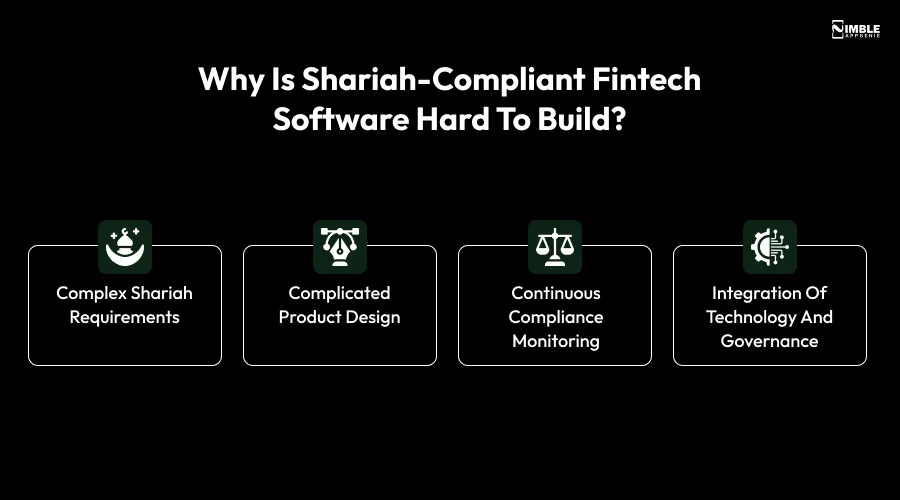
1. Complex Shariah Requirements
Shariah compliances are complicated, and once the app is built, molding it to meet Shariah compliance is difficult due to the complexity. These compliances are complex because Shariah compliances are unique, multi-step workflows.
2. Complicated Product Design
The Shariah compliance fintech app has a complex product design because the compliance logic is the core product architecture, rather than a feature layered on top of a standard banking interface.
Bonus Read: “Fintech App Design”
3. Continuous Compliance Monitoring
Continuous compliance monitoring is a critical challenge for Shariah compliance in fintech because digital transactions move at high speeds, operate across borders, and even involves the complicated complex structures that cannot be easily verified.
4. Integration of Technology and Governance
The integration of technology and governance is a key challenge because rapid digital automation outpaces traditional human-led Shariah review processes, creating friction between fast-paced tech deployment and strict religious ethical oversight.
To overcome these challenges, you can connect with a trusted fintech software development company such as Nimble AppGenie, which understands Shariah well and has a proven track record of delivering solutions with transparency and consistency.

Shariah Compliance Across Fintech Product Types
Shariah compliance across fintech product types varies due to different parameters such as the no-interest principle, disclosed price of the product, uncertainty, and speculation.
Here is the table defining the Shariah compliance across fintech product types:
| Fintech Product Type | Why Shariah Compliance Applies | Industry Type It Falls Under |
| Halal digital wallet | No interest on balances, no investment in prohibited sectors, and screening of haram merchants. | eWallet App Development |
| Islamic neobank | Accounts, cards, and financing need interest-free structures and Shariah board approval. | Neobank App Development |
| Islamic BNPL | Late fees can resemble interest, so a fixed, disclosed markup is used and penalty income is purified. | BNPL App Development, BNPL Trends |
| Halal investing / robo-advisory | Portfolios exclude prohibited industries and need ongoing screening as a stock’s status can change. | Wealth Management Software |
| Crypto and tokenization | Permissibility depends on real utility, asset backing, and speculation, and boards differ on each asset. | Crypto Wallet Development, DeFi App Development |
| Takaful (Islamic insurance) | Replaces uncertainty (gharar) with a mutual risk pool, with operator fees kept separate. | Insurance App Development |
| Remittance and zakat transfers | No interest-based or hidden fees, and zakat needs correct calculation and traceable delivery. | Money Transfer App Development |
Now, if you are ready to create the complete fintech product, let’s get ahead with the step-by-step process to create a Shariah-compliant fintech app in the following section.
How To Build A Shariah-Compliant Fintech App: Step By Step
You can build a Shariah-compliant fintech app by understanding the market, evaluating the right Shariah governance protocols, designing the complete app, selecting the right tech stack, testing the app, and then launching the app.
To build a Shariah-compliant fintech app, it is important to follow a complete step-by-step list:
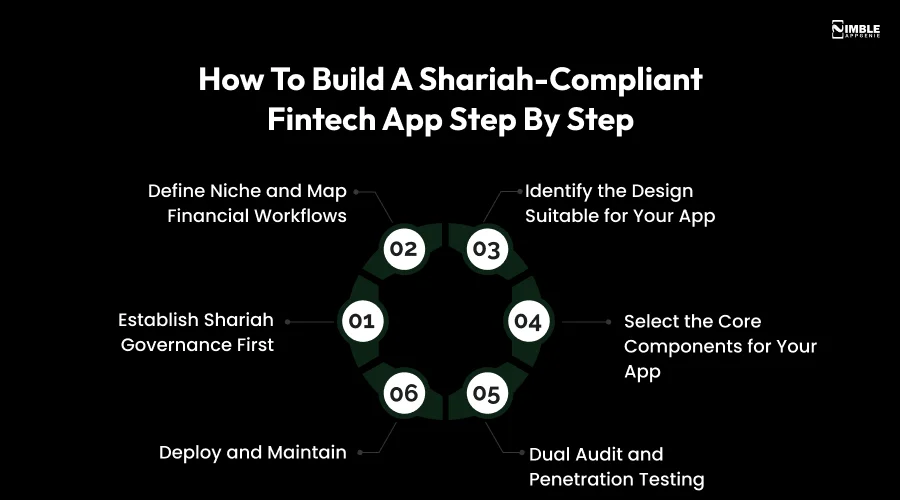
Step 1: Establish Shariah Governance First
For establishing the Shariah governance first, you need to create a structured system that guarantees compliance with Islamic law (Shariah), transparency, and independent oversight.
- Lock in the legal framework
- Identify the architectural logic
- Translate the law into business rules
Step 2: Define Niche and Map Financial Workflows
In this step, you should completely define your fintech niche, and then map the financial workflows for a Shariah-compliant fintech app that requires embedding Islamic legal contracts.
- A shift from Standard interest-based banking metrics to asset-backed
- Map the core Shariah- compliant financial workflows
- The savings workflows
Step 3: Identify the Design Suitable For Your App
In this step, you need to design the app as per the project requirements. Here are the three main parameters you need to check:
- Embed Islamic Jurisprudence directly into your product
- Dual audits and certification
- SSB credentials and Badges
Step 4: Select the Core Components for Your App
Now, under this step, you need to select the core components and tech stack that you need to include for building Shariah compliance in fintech.
- Halal screening engine
- Automated Zakat and purification engine
- Immutable audit trails
Step 5: Dual Audit and Penetration Testing
A dual audit and penetration testing is a phase where you combine religious verification with technical cybersecurity defense. Here’s what you need to know:
- All the Shariah compliance based app of fintech are audited by Shariah supervisory board (SSB) or certified Islamic finance scholars.
- Penetration testing is done by an independent, certified cybersecurity or penetration-testing firm.
- Perform the combined testing.
Step 6: Deploy and Maintain
In this step, you should deploy and maintain the app as per the goal of the project. This is what you need to opt:
- Engage the scholars first
- Build compliance as infrastructure
- Perform ongoing monitoring and purification
Startups and fintech entrepreneurs often ask, “How do I build a Shariah-compliant fintech app?” and “How long does Shariah board approval take?”
You can build a Shariah-compliant fintech app by identifying the market, evaluating the design of the app, considering the tech stack, testing the app, and then launching the app in the market. Board approval can take a few days to weeks to have an approval, based on the type of your app.
Which is the Right Company to Create a Shariah-Compliant Fintech App?
Nimble AppGenie is the top fintech app development company that helps to create a fintech app through specialized compliance that is totally dependent on custom architecture and Shariah-based compliance.
This is why connect with Nimble AppGenie:
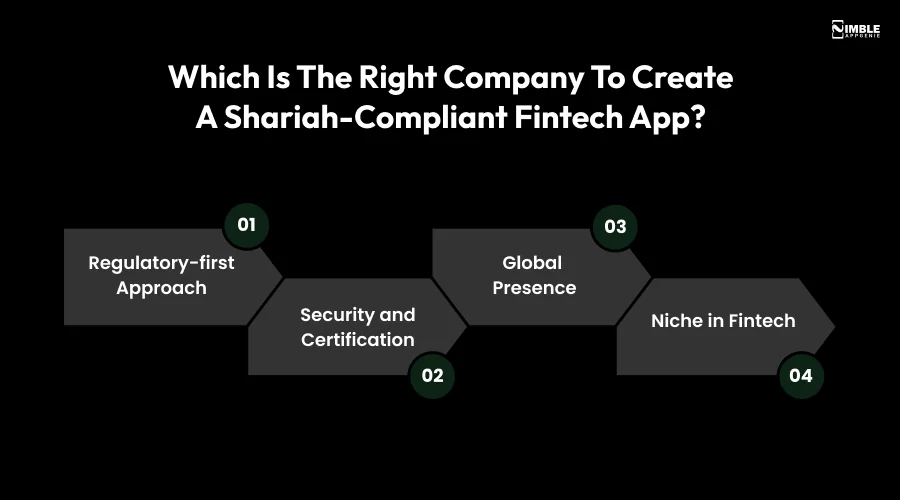
➤ Regulatory-First Approach
Nimble AppGenie is famous for delivering compliance-based fintech apps through embedding security and licensing checks directly into the pre-development and architectural design phases rather than treating them as an afterthought.
➤ Security and Certification
Nimble AppGenie ensures to include the security-based compliance requirements such as PCI DSS and, in the case of Shariah, the Shariah based compliances.
➤ Global Presence
The engineers at Nimble AppGenie have a widespread global presence and extensive fintech expertise to architect and scale regulatory-compliant and high-performance financial solutions.
➤ Niche in Fintech
Nimble AppGenie is the leading fintech company that offers all types of fintech-based solutions, including e-wallet apps, crypto wallets, and all other fintech apps.

Conclusion
Shariah compliance in fintech that you need to include is all about the key principles such as prohibition of Riba, prohibition of Gharar, prohibition of maysir, risk-sharing contracts, asset-based financing, ethical investments, and zakat.
These compliances are designed by key members such as jurists, officers, and SSBs. It is significant to follow the key compliances in fintech to effectively opt for the governance cycle.
You can connect with the right development partner to implement the right compliances as per Shariah.
FAQs

Niketan Sharma, CTO, Nimble AppGenie, is a tech enthusiast with more than a decade of experience in delivering high-value solutions that allow a brand to penetrate the market easily. With a strong hold on mobile app development, he is actively working to help businesses identify the potential of digital transformation by sharing insightful statistics, guides & blogs.
Table of Contents




No Comments
Comments are closed.