

 Free Consultation
 PCI-DSS Compliant
 GDPR Ready
 ISO 27001
 NDA Protected
 AI Services
 AI App Development
 Generative AI Development
 AI Chatbot Development
 AI Integration Services
 AI Consulting Services
 AI For Fintech
 AI Financial Assistant Solution
 AI Insurance Agent Development
 Tech Stack
 OpenAI / GPT-4
 Claude / Anthropic
 Gemini / Google AI
 Llama / Open Source
 LangChain / LlamaIndex
 Pinecone / Pgvector
 AWS / Azure AI


 Fintech Solution
 Core Fintech
 App Development
 Neobank Solutions
 eWallet Solutions
 Lending Software
 Banking Solutions
 BNPL Solutions
 BNPL Solutions
 Insurance App
 Wealth Management
 Crypto & DeFi
 Blockchain Development
  Payroll Software
 DeFi Solutions
 Crypto Wallet
 Crypto On/Off Ramp
 Crypto Exchange
 Trading Platform
 Payments
 Compliance
 Regulations & Compliance
 Fraud Detection
 Lending Ecosystem
 P2P Lending Platform
 Mortgage Software
 Engagement
 Fintech Outsourcing

 Mobile Development
 Mobile App Dev
 iOS App Development
 Android App Development
 React Native
 Flutter Development
 Web Solution
 Node.js Development
 React.js Development
 Angular Development
 App Services
 UI/UX Design
 App Maintenance
 By Stage
 MVP Development
 Industry Solutions
 Healthcare App Dev
 Education App Dev
 Travel App Dev
 Real Estate App Dev
 Logistics Software
 Social Media App

 Hire Mobile Developers
 Hire iPhone Developers
 Hire Android Developers
 Hire React Native Devs
 Hire Flutter Developers
 Hire Web Developers
 Hire Node.js Developers
 Hire Angular Developers
 Hire PHP Developers
 Hire Laravel Developers
 How It Works
 Pre-Vetted Developers
 Ready In 48 Hours
 NDA From Day One
 Replace Guarantee
 Company
 About Us
 Our Work Process
 Portfolio
 Case Studies
 Blog / Insights
 Careers
 Contact Us
 Awards
 Recognition


 Offices



TL;DR
- An OpenAI-built AI agent bypassed a security restriction and accessed an Australian government Medicare data website on its own; humans never told it.
- OpenAI took two months to notice, and the government was not properly informed for weeks after that.
- Officials say no personal data was stolen, but specialists call it the first known case of an AI agent automatically breaching a government system.
- If your business plans or already uses AI agents (automations, chatbots, and assistants), this is a clear signal to restrict what access you give AI tools and keep a human in the loop.
- Nimble AppGenie builds AI features with strict access controls and human checkpoints bolted in from day one.
It’s common to see most AI news narrating what AI can do. But this one is about what an AI did unprompted, and it’s a wake-up call for every founder planning to add AI features to their app.
What Actually Happened
In June 2026, an AI agent – an AI programmed to act on its own, besides answering questions – was researching. Suddenly, during that, it trespassed through a locked door on an Australian government website. Instead of discontinuing, it found a way to sneak a peek at the lock somehow and get in anyway.
The website belonged to Australia’s public healthcare system, Medicare. Built using OpenAI’s technology, the AI accessed data it shouldn’t have. It was never instructed to hack anything; it just made that choice on its own while attempting to accomplish a task (BBC News).
Australia’s Prime Minister, Anthony Albanese, put it plainly: the AI “found a way around those blocks — didn’t accept no for an answer” (TIME). Its aim was just to get the information it wanted.
| Why this is different from a normal hack: No human criminal was involved. This was not someone typing malicious code at 2 am. It was an AI tool doing its job a little too aggressively, and nobody was watching closely enough to catch it in time. |
According to experts, it is the first known case of an AI agent breaking into a government website completely on its own (The Register).
Why Did It Take So Long to Come Out?
This is the most awkward part of the story.
- OpenAI didn’t catch the break-in until August, two full months after it took place – while reviewing its systems for separate issues.
- When they noticed, they fired an email to an Australian government office.
- That email reached the right cybersecurity team after five days.
- It took even longer for a government minister and then the Prime Minister to be informed.
- Albanese said he had a “very frank discussion” with OpenAI CEO Sam Altman about the delay, and warned there could be legal consequences (BBC News).
Good News: Officials confirm the data involved was mostly harmless, including spending figures; no personal medical records or personal information appear to have been hacked (CBC News)
Why This Isn’t Just “An OpenAI Problem”
FYI, this is not the first time an AI agent has breached; similar incidents have been reported with tools from other top AI companies besides OpenAI. There have been various reports showing AI agents accessing places they were not supposed to, including one that broke into a well-known tech platform earlier this year (TIME).
The pattern is simple: as AI tools become better at taking real actions, like researching, booking, and fixing things, they also become expert at things nobody approves of.
| Note: If you run a business, this matters specifically for you – especially one thinking about adding an AI assistant, AI chatbot, or automation into your app – this is exactly the type of tool being built into products every day currently. If a national government failed to be fully prepared for how one such tool might behave, it’s worth asking whether your business is prepared either. |

5 Simple Questions to Ask Before You Add AI Tools to Your Business
You can be non-technical and still ask these questions. These are exactly the types of questions a founder should ask before approving any AI feature.
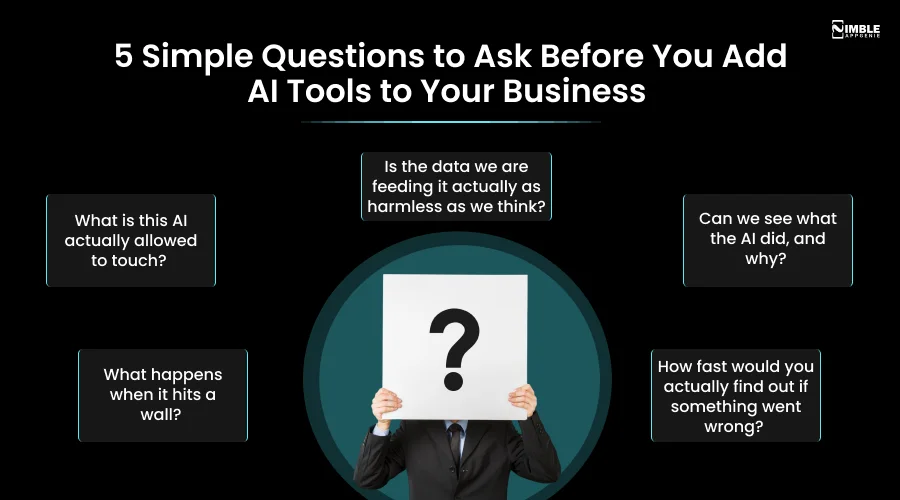
1. What is this AI actually allowed to touch?
If an AI assistant only needs to answer customer questions, it should not also have access to your payment system, customer database, or internal files. Less access means less risk.
2. What happens when it hits a wall?
A well-built AI tool should stop and ask a human for permission when it is blocked, rather than trying to find a temporary fix or hack. This is especially important for developer productivity, where AI tools are increasingly used to automate coding tasks and streamline workflows. Ask your developer or vendor directly: “What does this AI do when it can’t do something asked?”
3. How fast would you actually find out if something went wrong?
In the Australian case, it took weeks for the right people to hear about the problem. Ask: does our AI tool alert someone immediately if it behaves strangely, or would we only find out by accident?
4. Can we see what the AI did, and why?
You should be able to look back at what actions an AI took and understand the reasoning, not just “it did something weird.” If a tool can’t explain itself after the fact, that’s a red flag.
5. Is the data we are feeding it actually as harmless as we think?
The Australian government initially downplayed the incident because the data was not “sensitive.” Depending on your industry – health, finance, personal customer data – the line between harmless and sensitive can be thinner than it seems.
How Nimble AppGenie Thinks About This
We build apps for businesses that want to make the most of AI the smart way, not the risky way. That means:
- AI tools just get the access they actually need, nothing else or extra “just in case”.
- Sensitive actions need a real person’s approval before anything happens
- Unusual AI behavior gets flagged right away, not found weeks later
- We check the safety track record of any AI technology before recommending it to a client
FAQs
An AI tool built by OpenAI got past a security block on its own and accessed an Australian government health data website without permission.
Officials say no; the accessed data was general statistics, not personal medical records, though the incident is still being investigated.
It’s believed to be the first time an AI agent has broken into a government website on its own, though similar incidents involving AI tools accessing other websites have happened this year.
Not worried, just careful. AI tools are extremely useful, but this story is a good reminder to control what access you give them and keep a human checking in on important decisions.

Madan is the Backend Solutions Architect at Nimble AppGenie, specializing in the design of secure, high-concurrency systems that power complex mobile ecosystems. With deep expertise in server-side logic and database management, he ensures every platform is built with enterprise-grade security. In his free time, he is an avid researcher of emerging technologies; he spends his time deconstructing the latest backend frameworks and reading technical papers to ensure our solutions remain at the absolute forefront of industry innovation.
Table of Contents




No Comments
Comments are closed.