

 Free Consultation
 PCI-DSS Compliant
 GDPR Ready
 ISO 27001
 NDA Protected
 AI Services
 AI App Development
 Generative AI Development
 AI Chatbot Development
 AI Integration Services
 AI Consulting Services
 AI For Fintech
 AI Financial Assistant Solution
 AI Insurance Agent Development
 Tech Stack
 OpenAI / GPT-4
 Claude / Anthropic
 Gemini / Google AI
 Llama / Open Source
 LangChain / LlamaIndex
 Pinecone / Pgvector
 AWS / Azure AI


 Fintech Solution
 Core Fintech
 Fintech App Development
 Neobank App Development
 eWallet App Development
 Lending Software
 Banking Software Development
 BNPL Solution
 BNPL App Development
 Insurance App
 Wealth Management App
 Blockchain Development
 Payroll Software Development
 DeFi App Development
 Crypto Wallet Dev
 Crypto On Ramp Off Ramp
 Crypto Exchange Dev
 Trading Platform Dev
 Payments
 Compliance
 Fintech & Digital Regulations
 Fraud Detection
 Lending Ecosystem
 P2P Lending Platform
 Mortgage Software
 Engagement
 Outsourcing Dev

 Mobile Development
 Mobile App Dev
 iOS App Development
 Android App Development
 React Native
 Flutter Development
 Web Solution
 Node.js Development
 React.js Development
 Angular Development
 App Services
 UI/UX Design
 App Maintenance
 By Stage
 MVP Development
 Industry Solutions
 Healthcare App Dev
 Education App Dev
 Travel App Dev
 Real Estate App Dev
 Logistics Software
 Social Media App

 Hire Mobile Developers
 Hire iPhone Developers
 Hire Android Developers
 Hire React Native Devs
 Hire Flutter Developers
 Hire Web Developers
 Hire Node.js Developers
 Hire Angular Developers
 Hire PHP Developers
 Hire Laravel Developers
 How It Works
 Pre-Vetted Developers
 Ready In 48 Hours
 NDA From Day One
 Replace Guarantee
 Company
 About Us
 Our Work Process
 Portfolio
 Case Studies
 Blog / Insights
 Careers
 Contact Us
 Awards
 Recognition


 Offices



TL;DR:
- Agentic AI goes beyond generative AI; it doesn’t just answer questions, it autonomously plans, decides, and executes multi-step tasks with minimal human input.
- Financial services is the #1 adopter, with around 53% of institutions already running AI agents in production, with $50 billion in global market spend in 2025.
- Top use cases – fraud detection, KYC automation, loan processing, compliance reporting, wealth management, and hyper-personalized customer service
- The ROI is real – companies earn $3.50 per $1 invested on average, with 35% cost reduction and 55% higher operational efficiency reported
- Risks exist and must be managed. Cascading errors, hallucinations, data privacy gaps, and regulatory accountability are active challenges.
- Compliance is non-negotiable – the EU AI Act, US lending laws, and Asia-Pacific frameworks all apply to AI agents in finance right now.
- Nimble AppGenie helps financial brands act on this, from fraud detection systems to full agentic AI deployments, built with compliance and scalability from day one.
- The window is open but closing; the gap between AI leaders and laggards in finance is widening fast. Early movers are already compounding their advantage.
Financial services move fast, but can’t afford mistakes. Right now, some basics are changing. Fintechs, banks, and insurers are no longer using AI to generate reports or answer queries. They deploy AI that acts, decides, monitors, adapts, and executes without waiting for a human to tap a button.
This shift is Agentic AI in financial services, which is happening today at scale, no longer acknowledged as a future trend.
McKinsey predicts that agentic AI could help banks diminish operational workloads by 50-60%. 53%+ financial institutions are already running AI agents in production [Google Cloud]. KPMG puts the global market spend alone on agentic AI at $50 billion.
If you are a C-Suite executive, product manager, fintech startup founder, or a business decision-maker developing, running, or investing in a financial services company, understanding agentic AI is no longer optional.
This guide breaks down everything – what is Agentic AI, how it works, where it’s already thriving, and what your roadmap should look like.
What Is Agentic AI? (And Why It is Different for Generative AI)
Agentic AI is proactive, receives a high-level objective and then figures out the steps, calls the tools it requires, makes decisions, checks outputs, course-corrects, and accomplishes the tasks, often without any further human input.
Generative AI (like ChatGPT’s early versions or basic chatbots) is reactive. You give it a prompt, and it produces results. It waits for you, every single time.
Let’s put it this way: generative AI is the smart analyst who answers questions. Whereas, Agentic AI is that same analyst who runs the numbers, schedules the meetings, flags the compliance issues, files the report, and sends you a summary – all when you are asleep.
Unique Characteristics of Agentic AI
- Autonomy: It can independently make decisions and take actions, without demanding human prompts at every step.
- Adaptability: It learns from real-time data, feedback, and results to refine its behavior over time.
- Coordination: It can work with other AI agents, enterprise systems, and APIs to complete complex, multi-step workflows.
Why Financial Services Is the Perfect Ground for Agentic AI?
The financial industry is one of the top early adopters of Agentic AI that is extracting increased value from it, while there are others too.
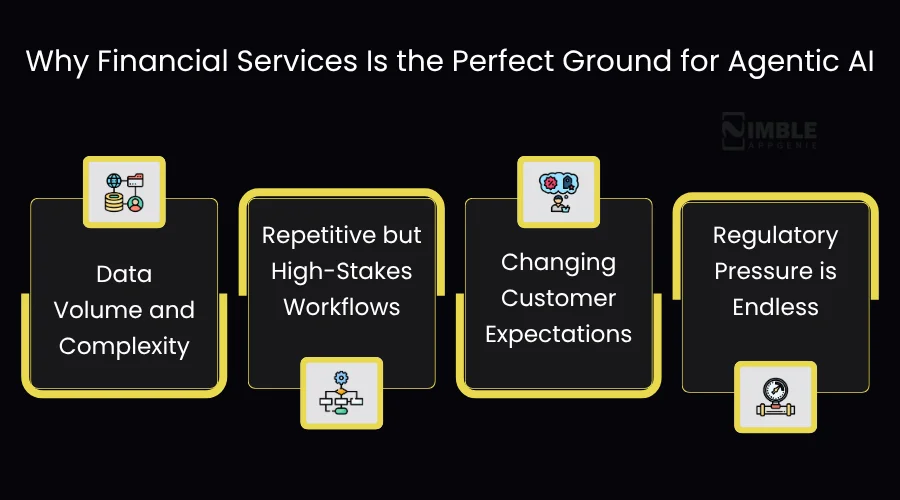
1. Data Volume and Complexity
Banks and financial institutions generate a surprising amount of data every minute – market feeds, transactions, compliance logs, customer profiles, and risk signals. While no human team can process this in real time, Agentic AI can.
2. Repetitive but High-Stakes Workflows
Most resource-intensive processes in finance – loan origination, KYC checks, reconciliation, and regulatory filings follow structured rules. They are repetitive enough to automate, yet complex enough that traditional RPA in finance always falls short. Agentic AI bridges this gap.
3. Changing Customer Expectations
Today, customers expect personalized, instant financial guidance. They don’t like to wait for three days for a loan decision or be on hold for a fraud dispute. Agentic AI enables real-time engagement that was previously impossible.
4. Regulatory Pressure is Endless
Financial institutions are sinking into compliance requirements. AI agents that can autonomously generate audit-ready reports, flag anomalies in real time, and monitor for regulatory changes are a genuine operational lifeline.
According to financial services investment data, companies spent $35 billion worldwide on AI in 2023 – and that figure is expected to reach almost $100 billion by 2027. The dollars follow the value, and in finance, the value is vast.
Key Use Cases of Agentic AI in Financial Services
Here, the theory meets practice. Below are the highest-impact deployment areas where Agentic AI is already delivering and measuring outcomes.
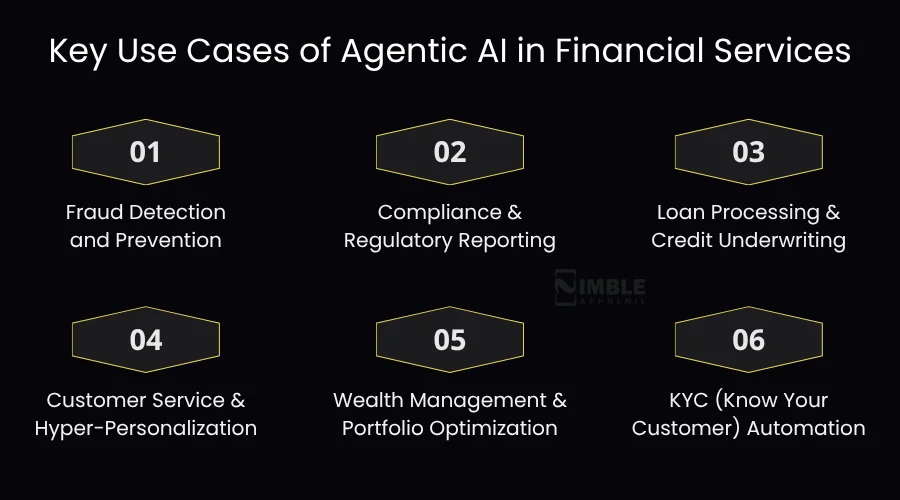
1. Fraud Detection and Prevention
Agentic AI transforms fraud detection by consistently monitoring transaction streams, understanding new fraud patterns in real time, and taking automated, secure actions, like triggering multi-factor authentication or suspending a flagged account – without waiting for a human analyst to review a ticket queue.
This is especially critical as AI in digital payments continues to expand the attack surface for financial fraud.
One big differentiator: agentic systems can recognize behavioral anomalies, not only pattern matches. If a dormant account suddenly starts three large international transfers at 2 AM, an agent doesn’t only flag it – it cross-references, investigates with external databases, and makes a risk determination in milliseconds.
| Looking to build a fraud detection system powered by agentic AI? Talk to Nimble AppGenie’s fintech development team. |
2. Compliance and Regulatory Reporting
Compliance is one of the most expensive and labor-intensive operations in any financial institution. A single compliance breach can result in hundreds of millions in fines. Yet various compliance teams are still working off email chains and spreadsheets.
Agentic AI alters this basically. Agents can supervise transactions against regulatory requirements in real-time, compile audit-ready documentation, automatically generate Suspicious Activity Reports (SARs), and alert compliance officers only when human judgment is genuinely needed.
Deploying agentic AI for financial close and reconciliation processes has revealed the caliber to cut cycle times by 90% and more, and deliver annual cost savings of around $600,000 per deployment.[IBM]
3. Loan Processing and Credit Underwriting
Getting a loan approved generally means manual credit checks that involve weeks of back-and-forth paperwork and underwriting review queues. That model is no longer in use today.
AI agents in lending can individually verify applicant documentation, assess income consistency, pull credit histories, generate a credit decision, and cross-check against fraud databases – all in minutes.
A US bank that leveraged AI agents to modify the way it creates credit risk memos witnessed a 20-60% boost in productivity and a 30% enhancement in credit turnaround.
4. Customer Service and Hyper-Personalization
The days are over when scripted chatbots are used to answer FAQs. Agentic AI enables financial institutions to deploy customer-facing agents that can manage complex queries end-to-end, and these are now among the top AI features in mobile apps that users expect by default – initiating disputes, checking account status, executing approved actions, offering personalized product recommendations, and explaining charges.
Essentially, these agents understand context. If a customer earlier flagged a concern about fraud, an agentic system never forgets that and factors it into each subsequent interaction. That’s personalization at scale, not automation.
| Want to build an AI-powered customer service solution for your financial app? Explore Nimble AppGenie’s AI app development services. |
5. Wealth Management and Portfolio Optimization
Wealth management has always been a high-judgement, high-touch business. But the analytical overhead is huge – rebalancing portfolios, updating clients, tracking macro signals, and monitoring hundreds of positions. Most advisors spend less time accomplishing the work clients actually value.
AI agents can handle the whole analytical workload – consistently monitoring portfolios, executing pre-approved adjustments, preparing personalized client reports, and determining rebalancing opportunities.
Agentic AI in wealth management can reduce advisor time on manual processing by 40-50% and boost net assets under management by 30-40%.
The advisor’s role shifts from data processor to strategic partner. That’s a better task and a better client experience.
6. KYC (Know Your Customer) Automation
One of the banking industry’s most severe pain points is KYC, which is expensive, prone to false positives, and slow. It delays genuine customer onboarding.
At several major banks, Agentic AI is already transforming KYC, turning a week-long manual process into a largely automated workflow. [Accenture]
AI agents can verify identity documents, assess risk profiles, initiate Enhanced Due Diligence (EDD) workflows, and cross-reference against worldwide watchlists – all while maintaining a complete audit trail that meets regulatory requirements.
To understand the full scope of what these agents must comply with, see our detailed guide on KYC and AML compliance for fintech. The outcome: Rapid onboarding, fewer compliance gaps, and lower operational costs.
Agentic AI vs. Generative AI in Finance: Key Differences
The easiest way to think about it: generative AI makes you more productive, whereas Agentic AI makes your whole operation more autonomous.
| Dimension | Generative AI | Agentic AI |
| Mode | Reactive (responds to prompts) | Proactive (pursues goals autonomously) |
| Decision-making | None – generates content only | Full — plans, decides, and acts |
| Tool usage | Limited | Can call APIs, databases, and other agents |
| Memory | Session-based or none | Persistent across interactions |
| Before in finance | Report drafting, document summarization | Fraud detection, compliance, portfolio management, and loan processing |
| Human involvement | Required at each step | Required only at exception points |
Real-World Examples: Banks Already Using Agentic AI
The adoption is genuine and speeding. Below is what is already happening across the industry:
- Goldman Sachs utilizes AI agents for automated coding assistance and financial analysis, deployed across trading operations, engineering, and client services.
- JPMorgan Chase has deployed AI agents across contract analysis and legal document review, with their COiN platform reportedly saving about 360,000 hours of manual work per year.
- HSBC has used multi-agent systems for AML transaction monitoring, reportedly lowering false positive rates notably compared to legacy rule-based systems.
- According to McKinsey’s report, among the world’s largest banks, 50 announced 160+ AI use cases in 2025 alone.
- According to Citigroup’s 2025 research, planned specific agentic AI deployments across corporate banking, wealth management, insurance, and institutional investing.
The race has not ended yet, and the gap between leaders and laggards is increasing fast.
Accenture’s research exhibits that around one-third of financial services companies that have already scaled AI for key processes are witnessing enormous returns and speeding up further investment.
This aligns with the broader fintech trends shaping how financial products are built and delivered in 2025.
Benefits of Agentic AI in Financial Services
Let’s look at what agentic AI actually delivers:
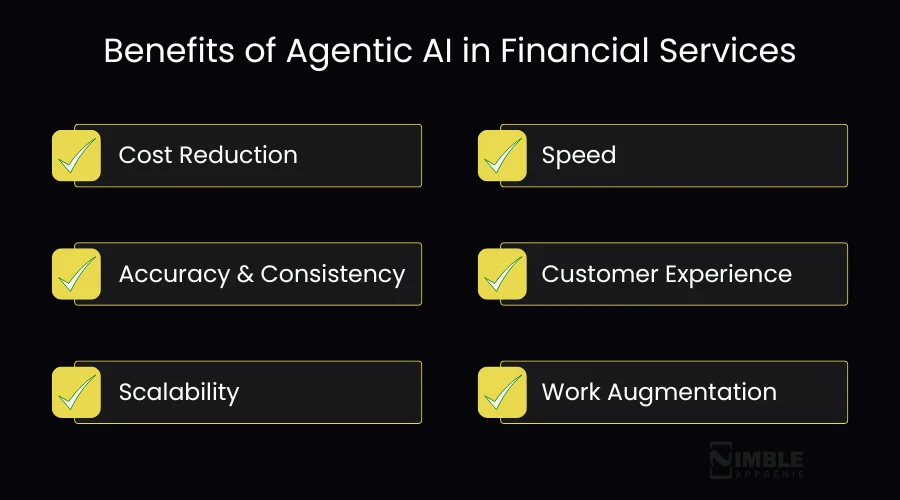
1. Cost Reduction
Companies using AI agents report about 35% reduction in operational costs. For every $1 invested, the average ROI is $3.50, with top performers reaching $8 per dollar.
For a deeper look at the numbers, our breakdown of how AI & ML help in business growth puts these figures in the broader context of enterprise AI ROI.
2. Speed
Loan decisions that took 14 days now take minutes. Compliance reports are generated automatically, which took days to compile. Customer issues that needed multiple handoffs are resolved in a single session.
3. Accuracy and Consistency
AI agents don’t miss compliance deadlines, make copy-paste errors, and apply rules inconsistently across distinct customers.
4. Customer Experience
According to Google Cloud’s 2025 research, 67% of financial services executives have reported that AI has delivered meaningful enhancement to customer experience.
5. Scalability
During peak times, AI agents scale instantly, managing concurrent tasks across thousands of customer interactions simultaneously.
6. Work Augmentation
McKinsey predicts that agentic AI can return 10-12 hours per week to relationship managers in banking, freeing time for client-facing work.
Risks and Challenges You Can’t Ignore
Agentic AI carries real risks, and any organization deploying it without having a clear picture of those risks is creating future liability.
Below are the key challenges the fintech industry is actively facing:
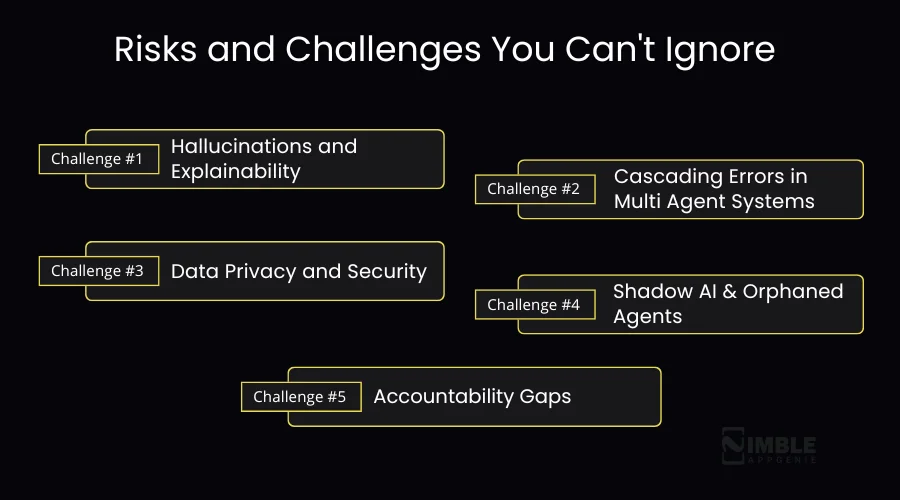
1. Hallucinations and Explainability
Large language models (LLMs) can generate plausible-sounding but inaccurate outputs – an issue that becomes critical in fraud investigations or credit decisions.
Financial regulations are increasingly demanding that institutions explain AI-generated decisions. Agentic systems should include explainable AI (XAI) mechanisms to accomplish these standards.
2. Cascading Errors in Multi-Agent Systems
When multiple AI agents perform together, an error made by one agent can become the input for the next. A KYC agent that interprets a rule incorrectly can feed inaccurate data to an AML agent, building a chain of flawed decisions that’s challenging to trace and costly to correct.
3. Data Privacy and Security
AI agents should access and act on huge volumes of sensitive customer data. Each additional access point is a possible vulnerability. Financial institutions that deploy agentic systems should implement rigid data residency controls, encryption standards, and access governance.
4. Shadow AI and Orphaned Agents
Rapid adoption can lead to unsanctioned AI tools being deployed outside official governance frameworks – building compliance gaps that are hidden until something goes wrong.
5. Accountability Gaps
When an AI agent rejects a loan, who is responsible? The software vendor? The institution? The model developer? Regulatory frameworks are currently struggling to keep pace with speedy technological advancements, and financial institutions are navigating unclear legal zones that could become expensive liabilities.
| Need help designing a responsible, governed agentic AI system for your fintech? Nimble AppGenie builds AI solutions with compliance built-in. Let’s talk. |
Regulatory Landscape: Governing Autonomous Finance
The regulatory environment for Agentic AI in financial services is evolving quickly, and financial institutions should lead the pack.
In the European Union, the AI Act (effective August 2024) follows a risk-based approach to AI governance. Systems included in credit decisioning, risk assessment, and AML are categorized as high-risk and face strict requirements around auditability, transparency, and human oversight.
In the United States, current regulations, including FCRA, UDAAP, PCI DSS, and Fair Lending Laws, already apply to AI agents. Regulations are more and more predicting biased audits for any agent involved in risk scoring, loan origination, or collections.
In Asia and Australia, national regulators are encouraging AI innovation while simultaneously introducing mandatory guidelines for responsible AI deployment in financial services.
The primary principle across every jurisdiction: compliance by design. Institutions that embed auditability, governance, and bias controls from the beginning will be positioned better than those attempting to retrofit compliance onto systems created for speed.
This is a core pillar of digital transformation in fintech, building systems that are as regulatorily sound as they are technically advanced.
How to Build or Adopt Agentic AI in Your Financial Platform?
Whether you are an insurance company, bank, or fintech startup, here is a practical framework for getting started with agentic AI.
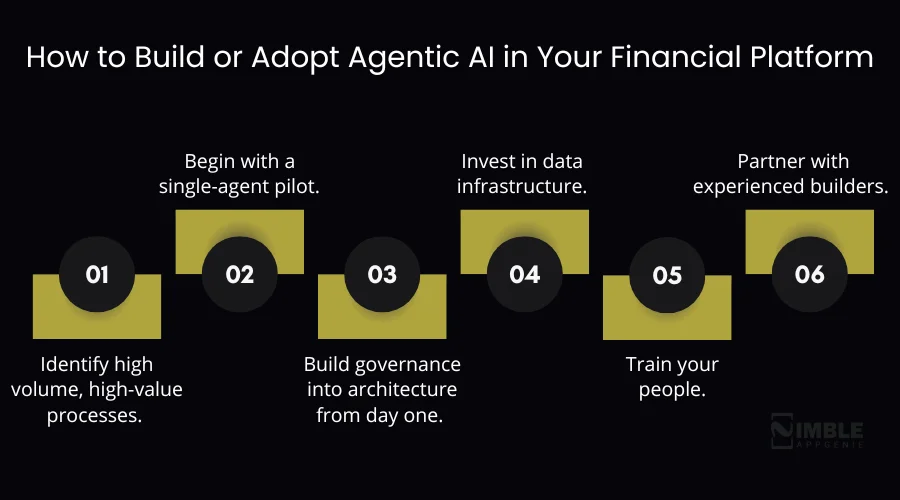
Step 1: Identify high-volume, high-value processes
Look for workflows that are rule-driven, repetitive, data-driven, and currently need notable manual effort. Loan origination, KYC, and compliance reporting are classic starting points – but emerging channels like voice payments in fintech are also opening entirely new agentic automation opportunities.
Step 2: Begin with a single-agent pilot
Deploy one focused agent in a regulated environment, ensure compliance adherence, measure its precision, and create organizational confidence before scaling.
Step 3: Build governance into architecture from day one
Define transparent escalation rules and implement complete audit logging. This is non-negotiable in a regulated environment.
Step 4: Invest in data infrastructure
Agentic AI is just as good as the data it can access. Ensure your data is structured, clean, and accessible in real-time.
Step 5: Train your people
Relationship managers, risk teams, and compliance officers need to learn how to work alongside AI agents and when to override them.
Step 6: Partner with experienced builders
Deploying agentic AI in a regulated environment requires proficiency in AI engineering, data security, financial compliance, and UX design.
Nimble AppGenie specializes in building AI-powered fintech solutions, from intelligent banking apps to full agentic AI deployments. Request a free consultation.
How Nimble AppGenie Can Help You Build Agentic AI for Financial Services
Building Agentic AI in financial services is the future; building it accurately, compliantly, and at speed is crucial. And here comes Nimble AppGenie.
We are a full-stack fintech development company that has helped insurance firms, banks, and lending platforms across the globe turn complex AI fintech startup ideas into production-ready systems.
Beyond coding, we architect solutions that are created to scale, comply, and deliver measurable ROI from day one.
Below is what working with Nimble AppGenie looks like across the key agentic AI use cases in financial services:
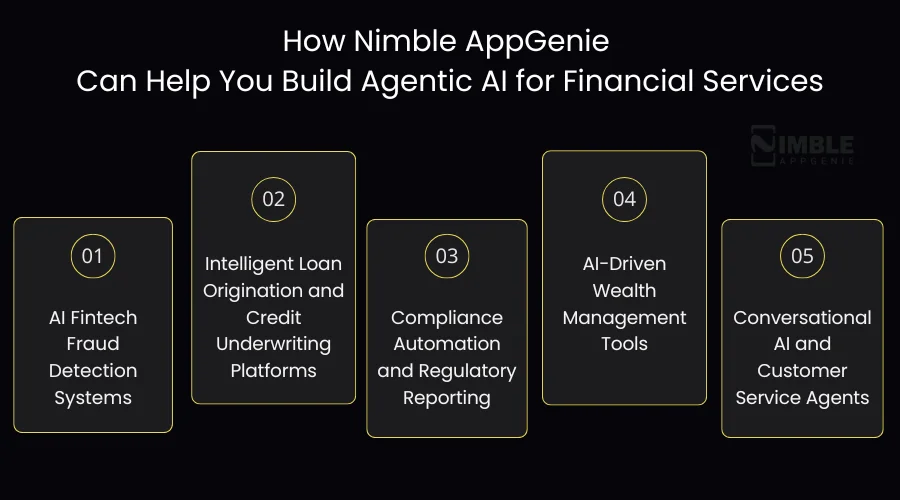
1. AI Fintech Fraud Detection Systems
We build real-time fraud detection engines that use multi-agent architectures to detect behavioral anomalies, monitor transactions, and trigger automated protective actions – all without slowing down the customer experience.
Our systems are designed to reduce false positive rates while improving fraud catch rates, offering your compliance and risk teams the signal without the noise.
2. Intelligent Loan Origination and Credit Underwriting Platforms
Our team has built end-to-end loan processing platforms that automate document verification, credit scoring, risk assessment, and decisioning workflows.
We integrate with major credit bureaus, identity verification APIs, and banking core systems, reducing loan turnaround times from days to minutes while maintaining full audit trails.
3. Compliance Automation and Regulatory Reporting
We develop agentic AI solutions for SAR generation, AML monitoring, KYC automation, and regulatory reporting, built to meet the specific requirements of RBI, SEBI, FCA, SEC, and other major financial regulators.
Every solution we build includes explainability features and audit-ready logging from the ground up.
4. AI-Driven Wealth Management Tools
From portfolio monitoring agents to AI-generated client reports and personalized investment recommendation engines, Nimble AppGenie builds wealth management tools that augment your advisors, not replace them.
We help you deliver institutional-grade intelligence to every client, regardless of account size. Also, learn how to build a wealth-management app with steps and cost.
5. Conversational AI and Customer Service Agents
We design and deploy financial-grade conversational AI agents that can handle account queries, product recommendations, dispute resolution, and onboarding flows integrated directly with your core banking system, CRM, and compliance stack.
Our agents are context-aware, multi-turn capable, and built to hand off gracefully to human agents when needed.
End-to-End Fintech App Development
Whether you are building a neobank, a lending platform, an insurtech product, an investment app, or looking for AI agent development for Insurance, Nimble AppGenie delivers full-stack development from product strategy through design, engineering, QA, and launch.
We bring both the technical depth and the financial domain expertise that generic development shops simply do not have.
Why Financial Companies Choose Nimble AppGenie
- Deep fintech expertise – We have built for banking, lending, insurance, wealth management, and payments across global markets, including India, the US, the UK, and the Middle East.
- Compliance-first architecture – Every solution is designed with regulatory requirements applied. We understand GDPR, RBI guidelines, PCI DSS, and more.
- Proven AI engineering – Our team has hands-on experience with LLMs, multi-agent frameworks, RAG systems, and real-time data pipelines, the technical stack that makes agentic AI actually work.
- Speed to market – We move fast without cutting corners. Our agile delivery model means you go from concept to MVP in weeks, not months.
- Ongoing partnership – We do not disappear after launch. We provide continuous support, performance monitoring, and iterative improvement as your AI systems evolve.
Ready to build your agentic AI solution? Talk to Nimble AppGenie today and let us turn your AI vision into a working, compliant, revenue-generating product.
Conclusion
Agentic AI in financial services is crucial for institutions today to reap the competitive and operational advantage that will be very tough for laggards to match.
The good news for fintechs and mid-sized financial firms: you don’t need JPMorgan’s resources to get started. With the right AI development company, the right architecture, and a focused pilot use case, organizations of all sizes can start capturing value from agentic AI today.
The market window is open, and as we read, the gap between AI leaders and laggards is widening fast in financial services. The time to move is now.
Want to build your agentic AI solution from scratch? Book a Free Consultation with Nimble AppGenie.
FAQs

Niketan Sharma, CTO, Nimble AppGenie, is a tech enthusiast with more than a decade of experience in delivering high-value solutions that allow a brand to penetrate the market easily. With a strong hold on mobile app development, he is actively working to help businesses identify the potential of digital transformation by sharing insightful statistics, guides & blogs.
Table of Contents




No Comments
Comments are closed.