

 Free Consultation
 PCI-DSS Compliant
 GDPR Ready
 ISO 27001
 NDA Protected
 AI Services
 AI App Development
 Generative AI Development
 AI Chatbot Development
 AI Integration Services
 AI Consulting Services
 AI For Fintech
 AI Financial Assistant Solution
 AI Insurance Agent Development
 Tech Stack
 OpenAI / GPT-4
 Claude / Anthropic
 Gemini / Google AI
 Llama / Open Source
 LangChain / LlamaIndex
 Pinecone / Pgvector
 AWS / Azure AI


 Fintech Solution
 Core Fintech
 App Development
 Neobank Solutions
 eWallet Solutions
 Lending Software
 Banking Solutions
 BNPL Solutions
 BNPL Solutions
 Insurance App
 Wealth Management
 Crypto & DeFi
 Blockchain Development
  Payroll Software
 DeFi Solutions
 Crypto Wallet
 Crypto On/Off Ramp
 Crypto Exchange
 Trading Platform
 Payments
 Compliance
 Regulations & Compliance
 Fraud Detection
 Lending Ecosystem
 P2P Lending Platform
 Mortgage Software
 Engagement
 Fintech Outsourcing

 Mobile Development
 Mobile App Dev
 iOS App Development
 Android App Development
 React Native
 Flutter Development
 Web Solution
 Node.js Development
 React.js Development
 Angular Development
 App Services
 UI/UX Design
 App Maintenance
 By Stage
 MVP Development
 Industry Solutions
 Healthcare App Dev
 Education App Dev
 Travel App Dev
 Real Estate App Dev
 Logistics Software
 Social Media App

 Hire Mobile Developers
 Hire iPhone Developers
 Hire Android Developers
 Hire React Native Devs
 Hire Flutter Developers
 Hire Web Developers
 Hire Node.js Developers
 Hire Angular Developers
 Hire PHP Developers
 Hire Laravel Developers
 How It Works
 Pre-Vetted Developers
 Ready In 48 Hours
 NDA From Day One
 Replace Guarantee
 Company
 About Us
 Our Work Process
 Portfolio
 Case Studies
 Blog / Insights
 Careers
 Contact Us
 Awards
 Recognition


 Offices



TL;DR
- Your license path full bank charter, EMI/PI, or sponsor-bank BaaS decides your cost, timeline, and what you are legally allowed to offer.
- A UK Authorised EMI needs £350,000 in capital; a full US bank charter has no fixed floor and can run from tens of millions to $210M+ depending on the business model.
- BaaS is the fastest route (weeks to months) but gives you the least control; a full charter is the slowest (12–24+ months) but gives you full banking powers.
- US regulators have opened up; the OCC received about 40 de novo charter applications in 18 months through mid-2026, up from historic lows, but the application quality bar has not dropped.
- Compliance ownership stays with you no matter who builds your tech; outsourcing infrastructure never outsources regulatory accountability.
- Most teams land on a hybrid: licensed core banking infrastructure plus custom product and UX, rather than pure build or pure BaaS.
If you are looking to figure out how to start a digital bank, the first thing to acknowledge is that this is not an app development decision. Rather, it’s a regulatory decision that comes by chance with an app. Most founders start by researching tech stacks and only later find that the license they choose decides almost everything else – what you can offer, how much capital you need, and how long it takes to make your business operational.
This guide is for founders, operators, and product leaders who already understand the fintech ecosystem and are beyond the “what is a neobank” stage. Whether you are deciding between a full bank charter, an EMI license, or just partnering with a bank through BaaS, either way, you want real numbers, not sales pitches, and you want to know what actually holds these launches up.
Quick Answer: How Do You Start a Digital Bank?
You start by picking a license path – full bank charter, a sponsor-bank/Banking-as-a-Service partnership, or an EMI/PI license because that pick sets your budget requirement, product ceiling, and timeline.
From there, you pick your target customers, set up a core banking system (built or licensed), add KYC/AML and card issuing, and launch your MVP. Your compliance team needs to be running by then, not still being hired.
Digital Bank vs. Neobank vs. BaaS Fintech: What’s the Difference?
Experts use these terms interchangeably; that’s why the planning stage is confusing.
Below are the practical differences:
| Term | What it actually means | Who holds the license |
| Digital bank | A deposit-taking institution that operates without physical branches, under its own or a partner charter | Itself (full charter) or a partner bank |
| Neobank | A brand and app layer offering banking-like features – usually the front end of a BaaS arrangement | A sponsor bank behind the scenes |
| BaaS fintech | A product built on top of a licensed bank’s infrastructure via APIs, no charter of its own | The BaaS provider’s partner bank |
If you are specifically preferring the neobank route, building the app and customer experience on top of someone else’s license – our guide to neobank app development covers the product and feature part of that decision in depth.
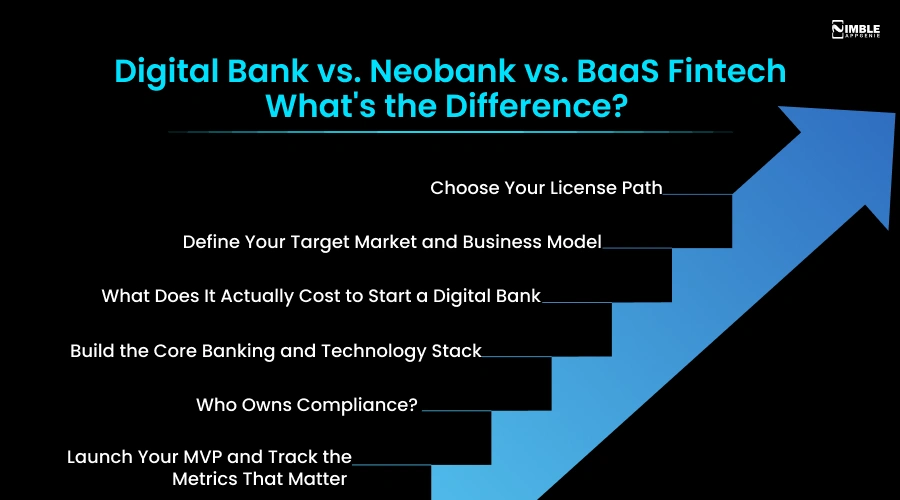
Step 1: Choose Your License Path
Your license path is the only decision that determines the cost, timeline, and what you are legally allowed to do. Three practical routes in 2026:
| License Path | Typical Capital | Timeline | What You Can Do |
| Full bank charter (US de novo, national) | Highly variable by business model – recent OCC approvals have ranged from tens of millions up to $210 million in initial paid-in capital for a full-service digital-asset-focused bank | Often 12–24+ months, including pre-opening requirements | Take deposits, lend from your own balance sheet, full banking powers |
| EMI or PI license (UK/EU) | £350,000 initial capital for a UK Authorised EMI under the Electronic Money Regulations 2011; lower or no fixed minimum for Small EMI/PI if you stay under £5M e-money and £3M/month in transactions | Roughly 6–12 months end-to-end | Issue e-money, hold safeguarded funds, provide payment services – no own-balance-sheet lending or deposit-taking |
| Sponsor-bank / BaaS partnership | No license capital of your own – you pay integration and revenue-share costs instead. | Weeks to a few months to integrate | Offer banking-like features under the sponsor’s charter, with less control over product terms. |
If you are aiming at a US charter, the regulatory factor shifts in your favor. The Office of the Comptroller of the Currency (OCC) received about 40 startup bank applications over 18 months through mid-2026, compared to fewer than four submitted between 2011 and 2014. Today, it’s deciding various complete applications within about 120 days. That’s the real change in requirements from the regulator side. But this doesn’t mean the count of complete, credible applications has dropped.
On the EMI side, ensure that the UK’s protection rules have also changed: the Financial Conduct Authority’s (FCA) Policy Statement PS25/12 introduced a complete interim framework – the Supplementary Regime – effective from May 7, 2026, tightening how payment and e-money institutions safeguard customer funds.
If you are building for a UK EMI, your safeguarding architecture design should follow the latest rule, not the pre-2026 version.
Step 2: Define Your Target Market and Business Model
Go for a narrow segment before picking features. A digital bank targeting freelancers has a distinct KYC friction tolerance, card program requirements, and unit economics than one developed for SMB payroll or migrant remittances. The license you opted for in Step 1 also restricts this ahead – an EMI can’t originate loans from its own balance sheet, so a lending-led model generally requires either a banking charter or a lending partner layered on top.
Be genuine about the revenue early. Interchange alone rarely covers customer acquisition costs for a card-led consumer product. Most digital banks that survive two years add another revenue stream – subscriptions, SME services, embedded lending, or FX spread where they are licensed to offer it.
Step 3: What Does It Actually Cost to Start a Digital Bank in 2026?
Cost splits into two parts that founders generally blend and should not: regulatory capital and everything else – compliance and legal staffing, operations, and technology.
-
Regulatory Capital
As illustrated above, this ranges from efficiently zero (BaaS) to £350,000 (UK EMI) to tens or hundreds of millions of dollars for a full US charter, depending on your business model and risk profile.
-
Technology Build
A custom core banking mobile/web app, system, or ledger generally runs from the low hundreds of thousands into seven figures, depending on how much you build versus license. Licensing an existing core banking platform compresses this notably compared to building a ledger from scratch.
-
Operational Runway
Preopening capital needs for a US charter usually include enough runway to cover the bank’s first 1-2 years of operating losses before it needs to prove profitability.
-
Compliance and Legal
Budget for a compliance officer or team from day one, ongoing KYC/AML tooling, and legal counsel through the application process. This is not a one-time expense – it’s a permanent line item.
If you want a closer look at how such technology costs break down by app type – digital banking, P2P lending, or eWallet – our fintech app development guide goes into the feature-by-feature pricing.
Step 4: Build the Core Banking and Technology Stack
Whichever license you choose, the technology layer looks extensively similar: a KYC/AML engine for onboarding and ongoing maintenance, a ledger that tracks each balance and transaction, a mobile or web front end customers actually use, and card issuing infrastructure if you are offered cards.
Here, the build-vs-buy decision matters more than most founders expect. A completely custom core banking system offers you lasting control, puts integration risk on your team, and adds months to your timeline. A licensed core banking platform gets you to MVP faster but partly ties your roadmap to a vendor’s release cycle. Most successful digital bank launches in 2026 land somewhere in the middle – licensed core infrastructure with custom product and UX on top.
Step 5: Who Owns Compliance? (You Do)
Outsourcing your technology stack doesn’t outsource your regulatory responsibility. This is the most common mistake founders make: they outsource infrastructure to a vendor and assume compliance comes bundled in. But it doesn’t. Your regulator holds you accountable for KYC/AML effectiveness, protection of customer funds, and fraud controls, regardless of who built the underlying system.
Recent OCC denial published as part of the agency’s new transparency initiative starting in 2026 aims at a consistent pattern: applicants who presumed they would finish compliance infrastructure after approval, despite having it substantially built before applying. Build your compliance function, real documented procedures, real staff, in parallel with your technology, not later.
Step 6: Launch Your MVP and Track the Metrics That Matter
Once you are live, the metrics that tell you whether your business works are distinct from the vanity metrics most product teams default to. Analyze:
- KYC Pass Rate: How many applicants clear onboarding without manual review
- Activation Rate: The share of signups who fund an account and transact
- Payment Success Rate: Failed transactions erode trust rapidly in a banking product
- Reconciliation Breaks: Mismatches between your partner bank’s records and your ledger, which point to integration issues before customers notice them.
- Fraud Loss Ratio: A leading indicator of whether your risk controls are working effectively.
- Compliance Rate: Often the earliest signal of UX or policy issues, well before it impacts churn figures.

Build In-House, Partner, or Buy? Where Nimble AppGenie Fits
None of these three paths – full custom build, pure BaaS integration, or licensed core banking platform – is universally right. A well-funded team chasing a full charter generally needs custom infrastructure they control end to end. A leaner team validating a niche segment is usually better served starting on BaaS and migrating to more control later, once the model is proven.
Nimble AppGenie works across all three models: custom core banking builds for teams pursuing their own charter, neobank app development for BaaS-based launches, and integration work for teams migrating between platforms as they scale. If you want a second opinion on which model fits your specific business plan for banking software development services, book a call with our fintech team before you lock in a technology direction.
FAQs
It depends entirely on your license path. A UK Authorised EMI requires £350,000 in initial capital. A full US bank charter has no fixed floor, but recently OCC approvals for full-service banks have required initial paid-in capital ranging from tens of millions of dollars up to $210 million, depending on the business model and risk profile. A BaaS partnership requires no license capital at all, though you’ll still need runway for technology and operations.
Yes. Most digital banks in the market today operate under an EMI/PI license or a sponsor-bank BaaS arrangement rather than a full charter. Both let you offer deposit-like accounts and payment services, but neither lets you lend from your own balance sheet or take true deposits the way a chartered bank can.
A BaaS-based launch can go live in a few months once integration is complete. A UK EMI application typically takes 6 to 12 months end to end. A full US bank charter is the longest path, commonly 12 to 24 months or more, including pre-opening requirements, even though the OCC has been deciding a growing share of complete applications within about 120 days in 2026.
An EMI can issue electronic money, hold customer funds in safeguarded accounts, and provide payment services, but it cannot take deposits in the legal sense or lend from its own balance sheet. A full banking charter allows both, at the cost of significantly higher capital requirements and a longer, more demanding application process.
Regulatory appetite has clearly increased: the OCC received around 40 de novo applications in the 18 months through mid-2026, compared with historic lows earlier in the decade, and has been approving a meaningful share of them. That said, the OCC has also signaled it’s scrutinizing application quality more closely, with published denials pointing to unfinished compliance and operational work as the main reason applications fail. Increased appetite doesn’t mean a lower bar for readiness.

Niketan Sharma, CTO, Nimble AppGenie, is a tech enthusiast with more than a decade of experience in delivering high-value solutions that allow a brand to penetrate the market easily. With a strong hold on mobile app development, he is actively working to help businesses identify the potential of digital transformation by sharing insightful statistics, guides & blogs.
Table of Contents




No Comments
Comments are closed.