

 Free Consultation
 PCI-DSS Compliant
 GDPR Ready
 ISO 27001
 NDA Protected
 AI Services
 AI App Development
 Generative AI Development
 AI Chatbot Development
 AI Integration Services
 AI Consulting Services
 AI For Fintech
 AI Financial Assistant Solution
 AI Insurance Agent Development
 Tech Stack
 OpenAI / GPT-4
 Claude / Anthropic
 Gemini / Google AI
 Llama / Open Source
 LangChain / LlamaIndex
 Pinecone / Pgvector
 AWS / Azure AI


 Fintech Solution
 Core Fintech
 App Development
 Neobank Solutions
 eWallet Solutions
 Lending Software
 Banking Solutions
 BNPL Solutions
 BNPL Solutions
 Insurance App
 Wealth Management
 Crypto & DeFi
 Blockchain Development
  Payroll Software
 DeFi Solutions
 Crypto Wallet
 Crypto On/Off Ramp
 Crypto Exchange
 Trading Platform
 Payments
 Compliance
 Regulations & Compliance
 Fraud Detection
 Lending Ecosystem
 P2P Lending Platform
 Mortgage Software
 Engagement
 Fintech Outsourcing

 Mobile Development
 Mobile App Dev
 iOS App Development
 Android App Development
 React Native
 Flutter Development
 Web Solution
 Node.js Development
 React.js Development
 Angular Development
 App Services
 UI/UX Design
 App Maintenance
 By Stage
 MVP Development
 Industry Solutions
 Healthcare App Dev
 Education App Dev
 Travel App Dev
 Real Estate App Dev
 Logistics Software
 Social Media App

 Hire Mobile Developers
 Hire iPhone Developers
 Hire Android Developers
 Hire React Native Devs
 Hire Flutter Developers
 Hire Web Developers
 Hire Node.js Developers
 Hire Angular Developers
 Hire PHP Developers
 Hire Laravel Developers
 How It Works
 Pre-Vetted Developers
 Ready In 48 Hours
 NDA From Day One
 Replace Guarantee
 Company
 About Us
 Our Work Process
 Portfolio
 Case Studies
 Blog / Insights
 Careers
 Contact Us
 Awards
 Recognition


 Offices



Key Takeaway:
- HSA/FSA payment integration means building or connecting the payment logic, eligibility checks, and compliance workflows that let a healthtech app accept tax-advantaged HSA and FSA funds; it’s a payments and compliance project, not a checkout button.
- Healthtech, telehealth, and wellness platforms add this capability to reduce payment friction and reach the tens of millions of Americans holding HSA/FSA funds, although it doesn’t guarantee higher revenue on its own.
- A real implementation touches eligibility logic (IIAS/SIGIS), payment processing, transaction records, refunds, and reconciliation; the right architecture depends heavily on your business model.
- Businesses generally choose between building custom infrastructure, integrating a processor with HSA/FSA support, partnering with a specialized HSA/FSA payments provider, or combining these approaches.
- Nimble AppGenie‘s fintech development team works with healthtech and payments companies on the underlying architecture, integrations, and compliance-aware engineering this kind of project requires.
Can a healthtech app actually accept HSA/FSA payments? Yes, but how you do it depends on what your healthtech business sells, how you process payments, and whether the products or services qualify under applicable HSA/FSA rules.
HSA/FSA payment integration involves connecting a healthtech app’s checkout and payment infrastructure to the systems and workflows required to accept eligible HSA/FSA transactions, apply appropriate eligibility rules, and maintain transaction records for reconciliation and compliance purposes.
For a telehealth platform charging for eligible medical services, the payment workflow may be relatively straightforward. A wellness platform selling supplements, non-clinical products, or fitness equipment can be more complex because eligibility may vary by product and circumstances, requiring additional eligibility logic or specialized payment infrastructure.
Fintech experts at Nimble AppGenie have created this guide to explain what actually goes into HSA/FSA payment integration, how healthtech businesses can accept HSA and FSA payments in the US, the key compliance and technical considerations, and when working with a fintech development partner makes more sense than building the payment infrastructure entirely in-house.
What HSA/FSA Payment Integration Means For a Healthtech App?
Technically, HSA/FSA cards run on standard Visa/Mastercard debit rails; the difference is what happens around the transaction, not the transaction itself.
A healthcare app needs to answer three questions before a charge goes through:
- Is this purchase eligible under IRS rules?
- Can the payment be verified as eligible at the point of sale (auto-substantiation), or does the customer need to submit documentation afterward?
- And if it’s not automatically eligible, is there a path, like a licensed provider’s letter of medical necessity, to make it eligible?
Depending on your business model, “integration” can mean anything from turning a setting on with your existing payment processor to building a full eligibility engine connected with your product catalog. That range is exactly why so many teams underestimate the scope until they are partially into the build.
Why Healthtech Businesses Are Adding HSA/FSA Payment Capabilities
HSA balances have increased considerably – assets held in HSAs reached $146 billion in 2024, an 18% boost from the previous year, according to Morningstar’s HSA Landscape Report. That’s a meaningful and growing pool of consumer healthcare spending that many healthtech and wellness platforms can’t reach at checkout nowadays because they are not set up to verify eligibility or process these transactions precisely.
Common business reasons healthtech companies pursue this:
- Expanding addressable spend for products or services that are reasonably HSA/FSA-eligible but currently only payable by regular card.
- Reducing payment friction for customers who already plan to use pre-tax health dollars but can’t at checkout today.
- Supporting existing workflows, like reimbursement claims, more smoothly through better transaction records.
- Matching competitors in wellness, telehealth, and healthcare marketplaces who already accept these cards.
These are possible benefits, not guarantees. Whether HSA/FSA acceptance moves revenue depends on your customer base, your product’s eligibility, and how well the eligibility experience is built into checkout, not on the payment method alone.
How HSA/FSA Payments Actually Work
Understanding the compliance mechanics is the difference between a real implementation and a checkout button that continuously declines. There are three main paths a transaction can take:
Common HSA/FSA eligibility paths for merchants.
| Path | How it works | Who typically uses it |
| IIAS (Inventory Information Approval System) | Each item in your catalog is flagged as eligible/ineligible; the system auto-verifies at checkout with no receipt needed. | Retailers and platforms selling a mix of eligible and non-eligible products. |
| Qualified MCC or the “90% Rule” | Businesses with a healthcare-related merchant category code, or where 90%+ of revenue is IRS-eligible, can accept cards without full IIAS certification. | Pharmacies, medical and dental practices, licensed providers. |
| Telehealth-backed medical necessity | A licensed provider reviews a short intake and can issue a letter of medical necessity, making otherwise-ineligible wellness products/services eligible. | Wellness, fitness, and consumer health brands selling borderline-eligible products. |
The IRS permits certain forms of automatic substantiation, which can reduce the need for customers to manually submit receipts for qualifying HSA/FSA transactions. Revenue Ruling 2003-43 established important guidance around electronic substantiation, while Notice 2006-69 provided additional guidance for systems such as the Inventory Information Approval System (IIAS) and recurring copay matching.
For healthtech businesses using an IIAS-based approach, eligible products can be identified at the SKU level, so the payment system can determine whether a transaction qualifies for HSA/FSA spending. Depending on the payment setup, businesses may also need to work with the relevant payment networks, processors, and IIAS-related standards and certification requirements.
This is one reason HSA/FSA payment integration can involve more than simply accepting an HSA or FSA card. If eligibility and substantiation workflows are not configured correctly, transactions may be declined, or customers may have to complete reimbursement or documentation steps outside the app. The exact requirements depend on the products or services being sold and the payment architecture being used.
What Actually Needs to Be Built or Integrated
Based on your business model, a real implementation may involve some or all of the following:
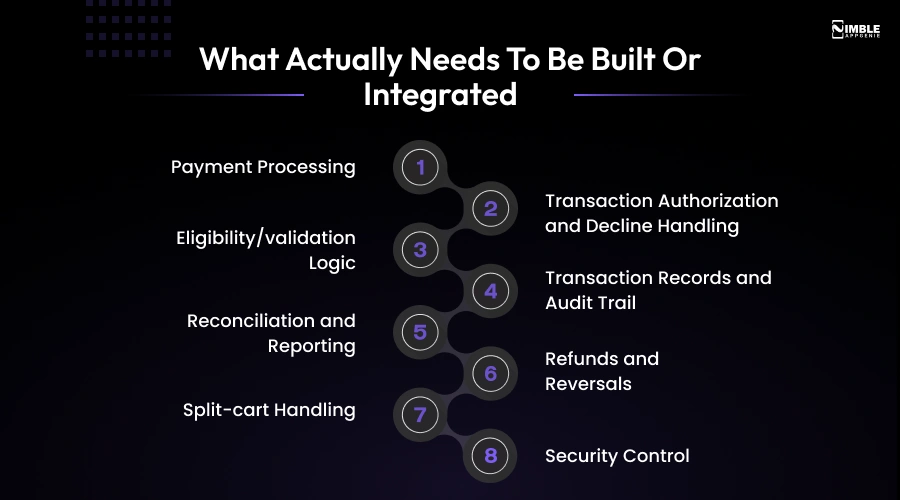
1. Payment Processing
A processor or acquirer that supports HSA/FSA card rails (Stripe and various others now support this – see Nimble AppGenie’s fintech API integration work)
2. Transaction Authorization and Decline Handling
HSA/FSA cards can still be declined for reasons irrelevant to funds, and your checkout UX needs to handle that smoothly.
3. Eligibility/validation Logic
IIAS-style product flagging, or MCC-based qualification, or healthcare intake-review flow.
4. Transaction Records and Audit Trail
Documentation that would meet a plan administrator or IRS inquiry, kept for as long as required.
5. Reconciliation and Reporting
Matching processor settlement data against your internal order and account records.
6. Refunds and Reversals
HSA/FSA transactions usually have more rigid reversal requirements than standard card refunds.
7. Split-Cart Handling
If a purchase mixes eligible and non-eligible items, the eligible portion is isolated.
8. Security Control
PCI-DSS compliance for card data, and appropriate handling of any health information used for eligibility review.
Not every healthtech app needs all of this. A telehealth platform billing exclusively for licensed clinical services has a much narrower build than a wellness marketplace selling a mix of eligible and ineligible physical products.
A Reference Architecture (Not a Universal One)
A general shape of this sort of integration looks like:
| User → Healthtech app checkout → Eligibility/validation layer → Payment processor or HSA/FSA infrastructure partner → Transaction result → Reconciliation and reporting |
The eligibility layer is where most of the custom engineering happens; it’s the part that decides, in real time, whether a given cart or service line is IRS-eligible, and needs to stay in sync with your product catalog as items change.
The right architecture shifts depending on whether you are processing directly, routing through a specialized HSA/FSA provider, or handling clinical billing where eligibility is closer to automatic.
There’s no single diagram here; the right one relies on your product mix and current payment stack.
HSA vs. FSA: What Builders Need to Know
HSAs and FSAs are both tax-advantaged, but they work differently in ways that can affect product and engineering decisions. HSA accounts are owned by the individual, and unused HSA funds generally remain available for future expenses.
For 2026, the IRS contribution limits are $4,400 for self-only coverage and $8,750 for family coverage under a qualifying HDHP. Health FSAs are employer-established benefit plans and generally follow a “use-it-or-lose-it” structure, although a plan may allow a limited carryover. For 2026, the health FSA salary-reduction contribution limit is $3,400, and plans that permit carryover can allow up to $680 to be carried into the following plan year.
For product teams, the practical difference emerges around timing: FSA holders may have urgency around plan-year deadlines that HSA holders don’t, which is worth considering when (and how) you surface HSA/FSA as a payment option in your app.
Compliance and Security Considerations
This is a financially sensitive, regulated area, and getting the compliance framing wrong surfaces real risks, such as disqualified eligibility claims, declined transactions, or audit exposure for your business or your customers.
- IRS Publication 502 defines what counts as a qualified medical expense; Publication 969 particularly covers HSA and FSA rules. Eligibility for HSA/FSA purposes doesn’t always match general medical-deduction eligibility, so these should be checked against each other, not assumed to be identical.
- PCI-DSS compliance applies to every part of your stack handling card data directly – see the payment compliance landscape overview on Nimble AppGenie’s fintech regulations blog.
- SIGIS/IIAS certification is needed for most non-medical merchants who want auto-substantiated eligibility at checkout.
If your eligibility workflow involves a licensed provider reviewing health information (as with telehealth-backed medical-necessity paths), that data needs to be handled with the same care as any other health information your platform deals with.
Note
This article is for general informational purposes and isn’t legal, tax, or compliance advice. Confirm specific requirements with a qualified attorney, tax advisor, or payments compliance professional before launch.
Common Implementation Challenges
Most HSA/FSA integration issues don’t surface in the initial build; they show up once the product catalog changes, reconciliation runs into real-world settlement data, or a customer requests a refund.
Here are the problems that usually come up, and how to avoid them:
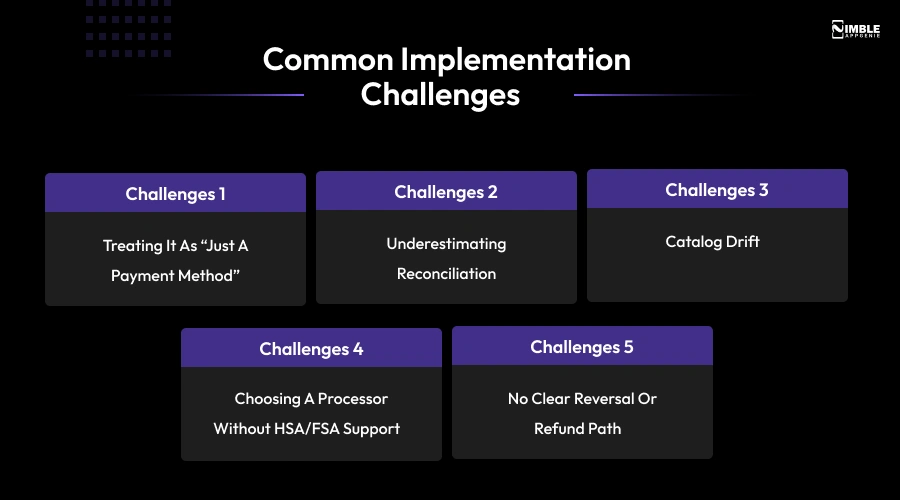
Challenge 1: Treating It as “Just a Payment Method”
Teams bolt on HSA/FSA as if it were another card type, skipping the compliance and eligibility layer underneath, leading to inconsistent acceptance.
Solution:
Scope the compliance/eligibility system before the checkout UI, and assign clear ownership to keep rules updated.
Challenge 2: Underestimating Reconciliation
HSA/FSA settlement data doesn’t always fit standard card processing timelines and formats, breaking assumptions built into existing reconciliation logic.
Solution:
Map your processor’s settlement timing and format upfront, and build reconciliation as a testing workstream, despite extending card-reconciliation code.
Challenge 3: Catalog Drift
Products change, but IIAS eligibility flags don’t get updated, so customers see incorrect eligibility at checkout.
Solution:
Connect eligibility flags to the product data model as a required field on SKU changes, and audit them quarterly.
Challenge 4: Choosing a Processor Without HSA/FSA Support
Teams pick a processor for other reasons and find the HSA/FSA gap mid-build, causing expensive rework.
Solution:
Confirm HSA/FSA support in writing during vendor selection, and validate it with a real test-card proof of concept before committing.
Challenge 5: No Clear Reversal or Refund Path
Standard card-refund flows don’t map cleanly onto HSA/FSA transactions, and it becomes a real issue the first time a customer disputes a charge.
Solution:
Design refunds to route back to the original eligibility-flagged transaction and preserve the audit trail, and test full, partial, and dispute scenarios before launch.
Build vs. Integrate vs. Partner
Most healthtech companies pick one of four approaches:
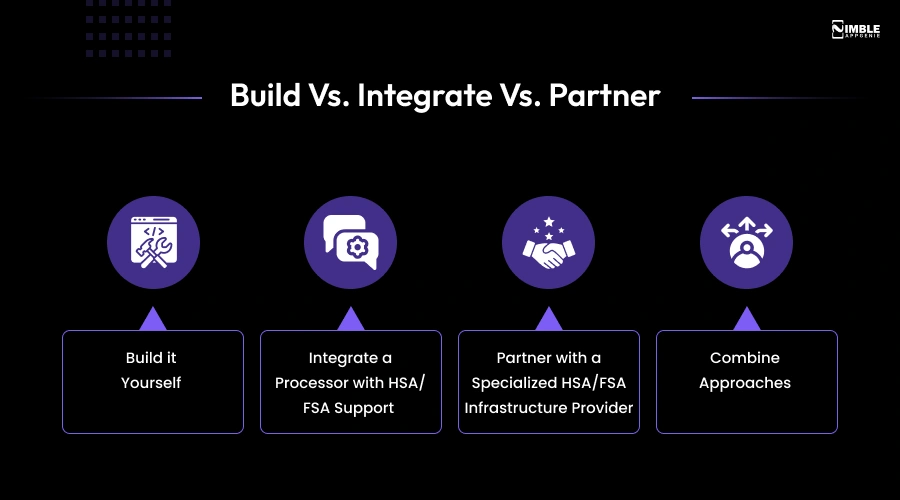
1. Build it Yourself
Complete control over the eligibility logic and checkout experience, but you own SIGIS registration, IIAS certification, and ongoing catalog maintenance. Makes sense for platforms where HSA/FSA acceptance is core to the product, not a bolt-on.
2. Integrate a Processor With HSA/FSA Support
Faster than building from the ground up, as the card-processing piece is managed, but you may still need to build the eligibility logic and product flagging yourself, depending on the processor.
3. Partner With a Specialized HSA/FSA Infrastructure Provider
Companies like Truemed, Flex, and Gale exist particularly to handle IIAS compliance and, in some cases, telehealth-backed eligibility review, in place of a transaction fee. Fast to launch, with less control over the cost structure and customer experience.
4. Combine Approaches
Many healthtech platforms use a specialized HSA/FSA provider or processor for the compliance-heavy parts while building custom integration into their own product catalog, checkout, and reconciliation systems, offering a native experience without bearing the full compliance load.
Not sure which of these fits your healthtech platform?
That’s a conversation worth having with a fintech development team before you commit engineering time to a particular path. Nimble AppGenie‘s team can walk through the trade-offs against your specific product and stack. If outsourcing part of the build is on the table, this overview of fintech development outsourcing is a useful starting point.
Development Cost and Timeline Factors
There’s no fixed cost for HSA/FSA integration; credible estimates depend completely on scope. What actually drives cost:
- The volatility and size of your product catalog (more SKUs and more frequency changes mean more IIAS maintenance).
- Whether you are building eligibility logic or integrating an existing provider.
- Reconciliation and reporting requirements, including any admin dashboards for the finance/ops team.
- Whether you need a telehealth-backed medical necessity workflow.
- Security and compliance review, testing, and ongoing maintenance as IRS eligibility rules and your catalog evolve.
- Existing payment infrastructure – integrating into a mature payment stack – is different from building checkout and HSA/FSA support at the same time.
- A narrow integration (e.g., adding HSA/FSA support to a telehealth platform’s current clinical billing) is a materially smaller project than building IIAS-certified eligibility logic across a multi-category wellness catalog.
How Nimble AppGenie Can Help
Nimble AppGenie is a fintech app development company that has been building payment and financial software since 2017, with dedicated practices in fintech API integrations and healthcare app development. The team is PCI-DSS compliant and ISO 27001 certified – related baseline credentials for any project touching card data or eligibility logic – and lists Stripe’s own HSA/FSA card processing support referenced earlier in this guide.
For a project like HSA/FSA payment integration specifically, that translates into help with: scoping which eligibility path (IIAS, qualifying MCC, or telehealth-backed medical necessity) fits your product; integrating the payment processor and eligibility layer into your existing checkout and product catalog; and building the reconciliation and reporting layer finance teams need once the feature is live. Nimble AppGenie has not published a case study specific to HSA/FSA payments – if this is a match for your project, that scoping conversation is the right next step rather than assuming a one-size answer.
Conclusion
HSA/FSA integration is a real infrastructural decision, not a checkout toggle. The businesses that get it right treat it as an eligibility and compliance system first and a payment method second – understanding IIAS, the 90% Rule, and how their specific product catalog maps to IRS-eligible expenses before writing a line of integration code.
Whether that means building custom logic, integrating a processor, partnering with a specialized provider, or some combination, the right path depends on your catalog, your product, and how central HSA/FSA acceptance is for your business.
A fintech development partner who understands both the compliance requirements and payments infrastructure can help you make that call with a clearer picture of the trade-offs than any single vendor’s sales page can.
FAQs

Niketan Sharma, CTO, Nimble AppGenie, is a tech enthusiast with more than a decade of experience in delivering high-value solutions that allow a brand to penetrate the market easily. With a strong hold on mobile app development, he is actively working to help businesses identify the potential of digital transformation by sharing insightful statistics, guides & blogs.
Table of Contents




No Comments
Comments are closed.