

 Free Consultation
 PCI-DSS Compliant
 GDPR Ready
 ISO 27001
 NDA Protected
 AI Services
 AI App Development
 Generative AI Development
 AI Chatbot Development
 AI Integration Services
 AI Consulting Services
 AI For Fintech
 AI Financial Assistant Solution
 AI Insurance Agent Development
 Tech Stack
 OpenAI / GPT-4
 Claude / Anthropic
 Gemini / Google AI
 Llama / Open Source
 LangChain / LlamaIndex
 Pinecone / Pgvector
 AWS / Azure AI


 Fintech Solution
 Core Fintech
 App Development
 Neobank Solutions
 eWallet Solutions
 Lending Software
 Banking Solutions
 BNPL Solutions
 BNPL Solutions
 Insurance App
 Wealth Management
 Crypto & DeFi
 Blockchain Development
  Payroll Software
 DeFi Solutions
 Crypto Wallet
 Crypto On/Off Ramp
 Crypto Exchange
 Trading Platform
 Payments
 Compliance
 Regulations & Compliance
 Fraud Detection
 Lending Ecosystem
 P2P Lending Platform
 Mortgage Software
 Engagement
 Fintech Outsourcing

 Mobile Development
 Mobile App Dev
 iOS App Development
 Android App Development
 React Native
 Flutter Development
 Web Solution
 Node.js Development
 React.js Development
 Angular Development
 App Services
 UI/UX Design
 App Maintenance
 By Stage
 MVP Development
 Industry Solutions
 Healthcare App Dev
 Education App Dev
 Travel App Dev
 Real Estate App Dev
 Logistics Software
 Social Media App

 Hire Mobile Developers
 Hire iPhone Developers
 Hire Android Developers
 Hire React Native Devs
 Hire Flutter Developers
 Hire Web Developers
 Hire Node.js Developers
 Hire Angular Developers
 Hire PHP Developers
 Hire Laravel Developers
 How It Works
 Pre-Vetted Developers
 Ready In 48 Hours
 NDA From Day One
 Replace Guarantee
 Company
 About Us
 Our Work Process
 Portfolio
 Case Studies
 Blog / Insights
 Careers
 Contact Us
 Awards
 Recognition


 Offices



Key Takeaways:
- The overall cost to create a policy administration system varies from $30,000 to $120,000, that varies depending on factors such as project management and documentation, contingency for changes, and lifecycle complexity.
- Different reasons to select a policy administration system are increased connectivity, faster launch speedm give feel of personalization, and help to save time on maintenance.
- Minimize the overall cost to build a policy administration system by using strategies such as starting with an MVP, selecting a single line of business, using an API-first approach, integrate instead of building non-core components.
- Connecting with Nimble AppGenie can help you build a complete policy administration system in 2026.
Do you know that the global insurtech market is projected to hit USD 23.54 billion in 2026 to 132.71 billion by 2034, while policy administration and management alone hold a 47.9% share of the market in 2025?
This surge in demand is pushing more startups and insurance businesses to ask the question, “How much does it cost to build a policy administration system in 2026?”.
This cost varies from $30,000 to $120,000, depending on different factors such as architectural design, project management and documentation, contingency for changes, and policy lifecycle complexity.
In this guide, we will walk you through the complete cost, factors impacting it, and the cost minimization strategies to opt for.
Let’s get started.
What is a Policy Administration System?
A policy administration system (PAS) is insurance policy administration software that is used for managing the entire lifecycle of an insurance policy. It is a definitive system of record for a carrier’s IT landscape.
This helps to distinguish it from other major systems. You can think of PAS as the insurance equivalent of a banking core system or an ERP system for manufacturers. This is the foundational application that enables the carrier to operate effectively.
Core functions include quote and underwriting management, policy issuance and management, billing and payments, along with compliance and reporting.
The key functions of a policy administration system comprise quoting and rating, underwriting, issuance, servicing, renewals, and cancellations.
Here, one of the important questions that arises is about the working process of a policy administration system.
How Does a Policy Administration System Work?
The insurance policy administration system is central to managing diverse life insurance policies. This is a system that serves as a hub for policy creation, premium collection, and policyholder data management.
Here is the complete set of steps stating how a policy administration system works:
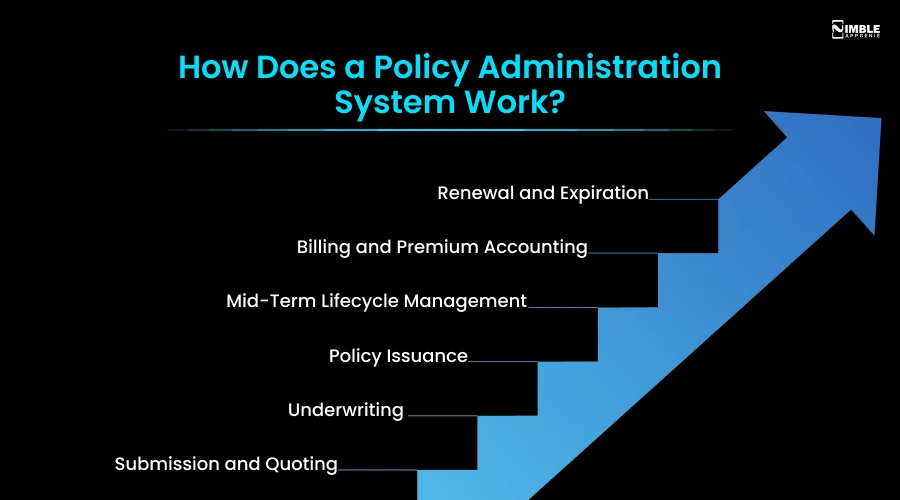
1. Submission and Quoting
This is the first step, where a prospect provides the data via an agent. The system uses a rating engine for analysing the data and generate a quote based on the company’s pricing models.
2. Underwriting
Underwriting is a critical process adopted by the insurance company, where the life insurance company evaluates the risk of insuring a person and even determines the terms of coverage.
3. Policy Issuance
Once the risk is accepted and the customer agrees to the price, the PAS creates the actual policy. It generates things such as a policy number, effective and expiry dates, premium, deductibles, and policy documents.
4. Mid-Term Lifecycle Management
Mid-term lifecycle management refers to the strategic phase for managing products, systems, and assets during their peak operational life. This is the step that handles modifications such as request processing, re-rating, and system updates.
5. Billing and Premium Accounting
PAS communicates constantly with the billing module to track financial health. It turns the bound insurance contract into active financial records and money collection. This system tracks the payment schedules and generates monthly or annual bills.
6. Renewal and Expiration
At the end of the policy term, the system is useful for determining automated review, where an existing insurance policy is either extended for a new term or officially ended. It is the step that recalculates the new premium cost for the upcoming term.
Even after understanding the working process of how a policy administration system works, let’s determine how to create it in the next step.
Why Create a Policy Administration System?
Different reasons to create a policy administration system are process automation, a single source of truth, error reduction, ensuring data accuracy, lowering operating costs, and improving the customer experience.
Here’s why you need to create a policy administration system:
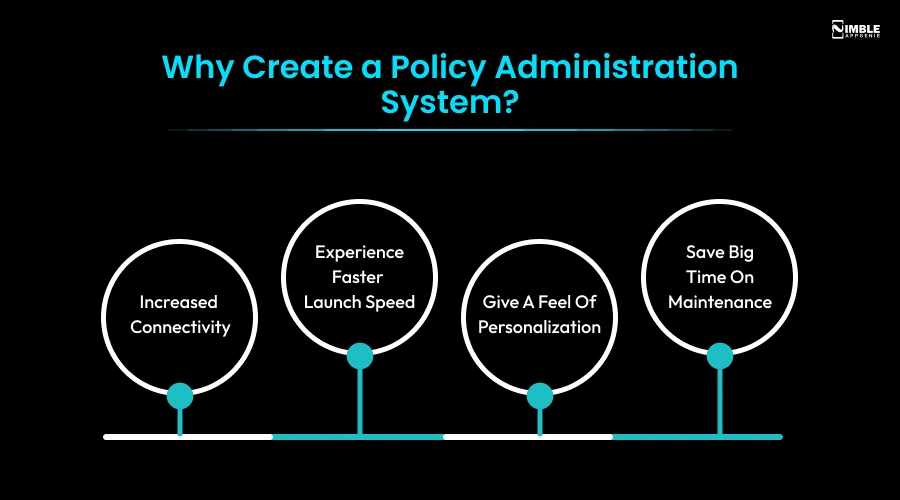
► Increased Connectivity
Building a modern policy administration system (PAS) with enhanced connectivity breaks down data silos and is essential for automating daily operations and reducing operating costs.
It increases connectivity by using open APIs and cloud architecture to act as a central digital bridge between an insurer’s core data and external systems.
► Experience Faster Launch Speed
A policy administration system offers fast launch speeds by replacing the rigid, hard-coded legacy software with low-code, table-driven configuration tools. It helps to shift from hard-coded legacy programming to low-code and pre-built API integrations.
► Give a Feel of Personalization
This system offers a sense of personalization by using data and flexible rules to tailor insurance products and user interfaces to individual customers.
The policy administration system offers personalization that saves time and effort, boosting operational efficiency. Furthermore, with the help of real-time data, the policy administration system uses customer data to shape every interaction.
► Save Big Time on Maintenance
A modern policy administration system (PAS) reduces IT maintenance time by replacing manual workflows with automation and centralizing data.
Furthermore, it reduces IT maintenance time by replacing legacy, hard-coded software with configurable and automated infrastructure.
Now, as you are ready to build a policy administration system, let’s find out the complete cost to build a policy administration system in the section below.

How Much Does It Cost to Create a Policy Administration System in 2026?
The complete cost of building a policy administration system varies from $30,000 to $120,000. This cost is impacted by different factors depending on whether you are building a focused MVP, licensing a commercial platform, or undertaking a full enterprise core replacement.
This is the system that is primarily needed by insurance and risk-management businesses that issue, manage, and service the contractual policies throughout their entire lifecycle.
Here, different types of businesses that need a PAS are property and casualty insurers, life, accident, and health insurers. Basically, an insurtech company should opt for a policy administration system in 2026.
The given table defines the overall cost breakdown of building a policy administration system:
| Cost category | Lean MVP | Standard system | Advanced system |
| Requirements and process analysis | $2,000 | $5,000 | $8,000 |
| Architecture and UX/UI design | $2,000 | $5,000 | $8,000 |
| Core development: products, policies, endorsements, renewals | $14,000 | $32,000 | $50,000 |
| Integrations: payments, CRM, accounting, claims, APIs | $3,000 | $10,000 | $15,000 |
| Testing and quality assurance | $3,000 | $7,000 | $12,000 |
| Security, access control, and audit trails | $1,000 | $3,000 | $5,000 |
| Cloud hosting, software tools, and environments | $1,000 | $3,000 | $5,000 |
| Deployment, data migration, and user training | $1,000 | $3,000 | $5,000 |
| Project management and documentation | $1,000 | $3,000 | $5,000 |
| Contingency for changes and unexpected work | $2,000 | $4,000 | $7,000 |
| Total estimated cost | $30,000 | $75,000 | $120,000 |
Also Read: Insurance App Development Cost
Now, for the factors, let’s determine the complete list in the following section.
What are the Different Factors Impacting the Complete Cost to Build a Policy Administration System in 2026?
Different factors affecting the overall cost to build a policy administration system are architecture and design, deployment, data migration, and user training, along with different types of integrations such as payments, accounting, and APIs.
Let’s learn the complete list of factors affecting the total cost to build a policy administration system:
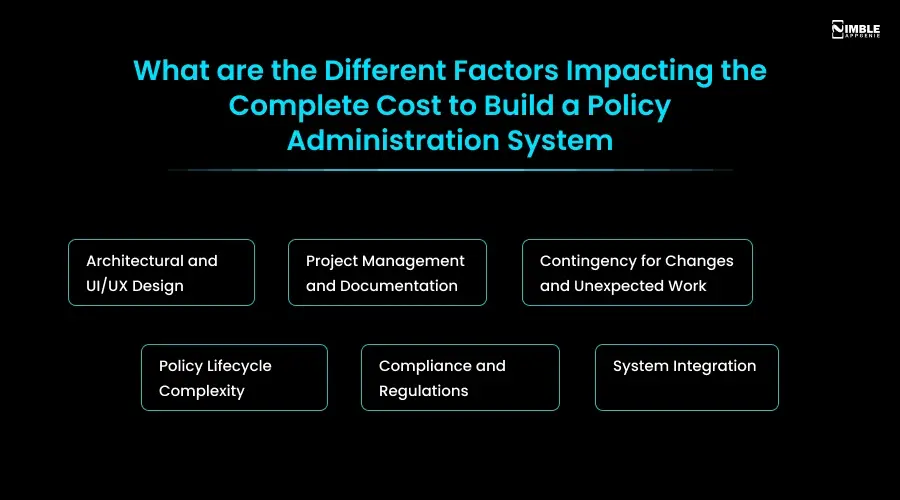
1] Architectural and UI/UX Design
The design of the complete administration system is one of the most critical factors that impacts overall policy administration by determining the complexity, integration effort, and long-term maintenance expenses.
Additionally, this design indicates how PAS functions, scales, and even adapts to market changes. High design complexity will result in an increase in the total cost to create a policy administration system.
2] Project Management and Documentation
Project management and documentation directly dictate the success, cost, and longevity of the policy administration system (PAS). Strong project management prevents scope creep, controls exploding costs, and secures executive buy-in.
While a clear documentation simplifies regulatory compliance, accelerates future updates, reduces maintenance bugs, and even speeds up user onboarding.
3] Contingency For Changes and Unexpected Work
A contingency budget directly impacts the final cost of PAS by acting as a financial buffer for unknown projects. The PAS projects involve many interconnected insurance rules and regulatory requirements.
This is the factor that acts as a financial buffer for project changes, hidden technical complexities, and scope creep.
4] Policy Lifecycle Complexity
The policy lifecycle complexity drives up the total cost because more rules and customer workflows require extra hours for software development, testing, and maintenance.
This complexity drives up the cost to build a policy administration system because of more business rules, mid-term changes, and regulatory updates.
5] Compliance and Regulations
Compliance and regulations increase the total cost to build a policy administration system because it adds 20% to 40% more expenses to the cost by securing data storage, complex legal rules, and constant software updates.
Here, companies invest heavily to secure data and to ensure customer privacy. If you ignore compliance and regulations, it will automatically add to your costs. As avoidance of compliances will lead to increasing penalties.
If you are building a fintech app, then checking the latest fintech and digital payments regulations can help.
6] System Integration
Different APIs and integrations have a large impact on the total cost to build a policy administration system in 2026.
It is a crucial factor because connecting legacy platforms, third-party data sources, and modern APIs requires extensive custom coding and maintenance.
These are the important factors impacting the total policy administration system cost. Now, let’s examine the overall strategies important to consider for minimizing the total cost in the following section.
How to Minimize the Cost to Create a Policy Administration System in 2026?
Sometimes even after evaluating the right factors, the total cost surges. Hence, learning about the right strategies can be helpful.
Here is the list of strategies to consider for minimizing the total cost to build a policy administration system:
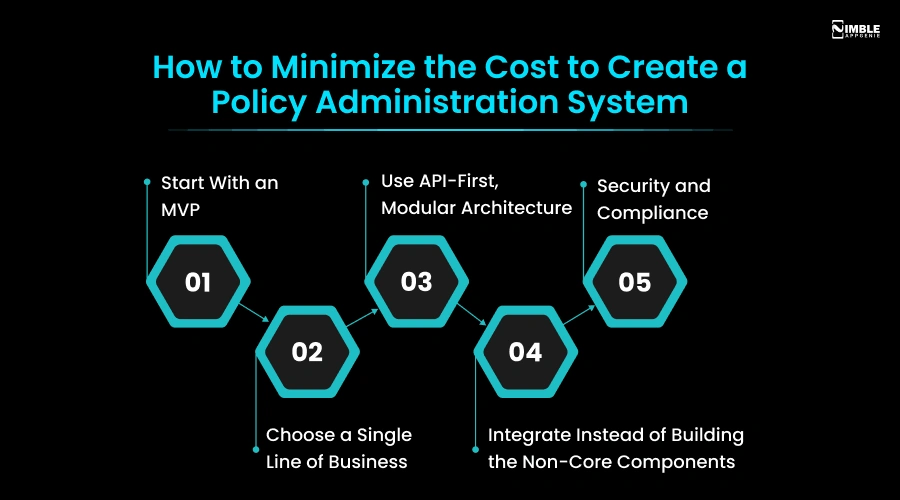
➤ Start With an MVP
Starting with a minimal viable product (MVP) focuses strictly on core rating, quoting, and basic policy issuance. It focuses your budget only on the essential features and is further helpful in identifying whether your product is validated by the target audience or not.
Also Read: “How to Build a Minimum Viable Product”
➤ Choose a Single Line of Business
Selecting a single line of business helps you to build a focused, fast, and scalable policy administration system by mastering one specific data model that simplifies the model and reduces total costs.
➤ Use API-First, Modular Architecture
Selecting an API-first and modular architecture reduces total cost by eliminating monolithic waste, accelerating time to market, and through minimizig the implementation cost. Connecting with the experts at Nimble AppGenie can help you with fintech API integration services and other related solutions.
➤ Integrate Instead of Building the Non-Core Components
While creating the complete policy administration system, it is important to segregate the tasks. If some of the components appear to be non-core, integrate these non-core components instead of building them from scratch. This will save the maximum time and cost for your project.
➤ Security and Compliance
Following the present security and compliance requirements will help build trust among users, which will be helpful in building a strong and long-term presence of your system. It prevents expensive software rework, avoids regulatory fines, and further stops data breaches.
You can proceed with fintech security that will be helpful in focusing on strict compliance, data encryption, and modern system architecture.
Which is the Best Company to Integrate a Policy Administration System?
Nimble AppGenie offers the best fintech software solutions, which help integrate a policy administration system into your insurance app or software. The engineers offer a wide range of services, along with creating a policy administration system, such as building a complete insurance app or adding any kind of integration services.
Here is the list of services offered by Nimble AppGenie:
♦ AI-Native Core Infrastructure
Nimble AppGenie offers AI-native core infrastructure by baking artificial intelligence directly into the base architectural layer of software like fintech, banking, and lending. The engineers at Nimble AppGenie are the best AI app developers, offering diversified AI solutions.
♦ Compliance-Ready Infrastructure
The developers of Nimble AppGenie offer compliance-ready infrastructure through embedding modular frameworks, automated audit logging, and aligning directly with application architecture from day one.
♦ Future-Ready Insurance Ecosystem
Nimble AppGenie offers a future-ready insurance ecosystem through building custom, AI-driven, and cloud-integrated software solutions that modernize legacy workflows.
Partnering with Nimble AppGenie will be helpful in integrating a policy administration system by streamlining complicated API connections and accelerating deployment.
♦ Niche in Insurance
Nimble AppGenie is a leading insurance app development company specializing in car, health, life, general liability, and logistics insurance solutions. Our expert developers help startups and enterprises build secure, scalable, and innovative insurance apps.

Conclusion
A policy administration system (PAS) is the core software platform that is used by insurance policy administration software that is used for managing the entire lifecycle of an insurance policy. Creating a policy administration system will be helpful in increasing connectivity, enabling faster launch, giving a feel of personalization, and saving big time on maintenance.
The total cost to create a policy administration system is impacted by different factors, including architecture, UI/UX design, contingency for change, policy lifecycle complexity, and helpful in system integration.
Furthermore, different strategies can be adopted to minimize the cost, such as starting with an MVP, selecting a single line of business, using an API-first, modular architecture, and ensuring security and compliance.
FAQs

Niketan Sharma, CTO, Nimble AppGenie, is a tech enthusiast with more than a decade of experience in delivering high-value solutions that allow a brand to penetrate the market easily. With a strong hold on mobile app development, he is actively working to help businesses identify the potential of digital transformation by sharing insightful statistics, guides & blogs.
Table of Contents




No Comments
Comments are closed.