

 Free Consultation
 PCI-DSS Compliant
 GDPR Ready
 ISO 27001
 NDA Protected
 AI Services
 AI App Development
 Generative AI Development
 AI Chatbot Development
 AI Integration Services
 AI Consulting Services
 AI For Fintech
 AI Financial Assistant Solution
 AI Insurance Agent Development
 Tech Stack
 OpenAI / GPT-4
 Claude / Anthropic
 Gemini / Google AI
 Llama / Open Source
 LangChain / LlamaIndex
 Pinecone / Pgvector
 AWS / Azure AI


 Fintech Solution
 Core Fintech
 App Development
 Neobank Solutions
 eWallet Solutions
 Lending Software
 Banking Solutions
 BNPL Solutions
 BNPL Solutions
 Insurance App
 Wealth Management
 Crypto & DeFi
 Blockchain Development
  Payroll Software
 DeFi Solutions
 Crypto Wallet
 Crypto On/Off Ramp
 Crypto Exchange
 Trading Platform
 Payments
 Compliance
 Regulations & Compliance
 Fraud Detection
 Lending Ecosystem
 P2P Lending Platform
 Mortgage Software
 Engagement
 Fintech Outsourcing

 Mobile Development
 Mobile App Dev
 iOS App Development
 Android App Development
 React Native
 Flutter Development
 Web Solution
 Node.js Development
 React.js Development
 Angular Development
 App Services
 UI/UX Design
 App Maintenance
 By Stage
 MVP Development
 Industry Solutions
 Healthcare App Dev
 Education App Dev
 Travel App Dev
 Real Estate App Dev
 Logistics Software
 Social Media App

 Hire Mobile Developers
 Hire iPhone Developers
 Hire Android Developers
 Hire React Native Devs
 Hire Flutter Developers
 Hire Web Developers
 Hire Node.js Developers
 Hire Angular Developers
 Hire PHP Developers
 Hire Laravel Developers
 How It Works
 Pre-Vetted Developers
 Ready In 48 Hours
 NDA From Day One
 Replace Guarantee
 Company
 About Us
 Our Work Process
 Portfolio
 Case Studies
 Blog / Insights
 Careers
 Contact Us
 Awards
 Recognition


 Offices



Key Takeaways:
- AI for SMEs: lowers the entry barriers, leveling the playing field, and driving productivity.
- A clear AI strategy matters more than the tools; without one, SMEs risk wasted spend, data risk, and poor build-vs-buy calls.
- SMEs compete using AI through automation, personalization, data-driven decisions, and 24/7 customer support.
- Building AI from scratch costs $20,000–$200,000+; integrating AI into existing systems ranges from $3,000–$100,000+.
- Before adopting AI, plan carefully, prioritize data security, specialize, and start with a small pilot.
- A partner like Nimble AppGenie helps SMEs move from strategy to execution with proven results.
Do you own an SME and bothered about its existence in this competitive landscape?
Then, it’s time for AI for SMEs. Artificial intelligence is not a trend; it’s a compulsion to improve your business and make it well recognized among your end customers.
Customers trust the brand that provides them a different and new perspective by solving their issues.
The global artificial intelligence market size was valued at USD 390.9 billion in 2025, and is projected to grow to USD 3,497.3 billion by 2033.
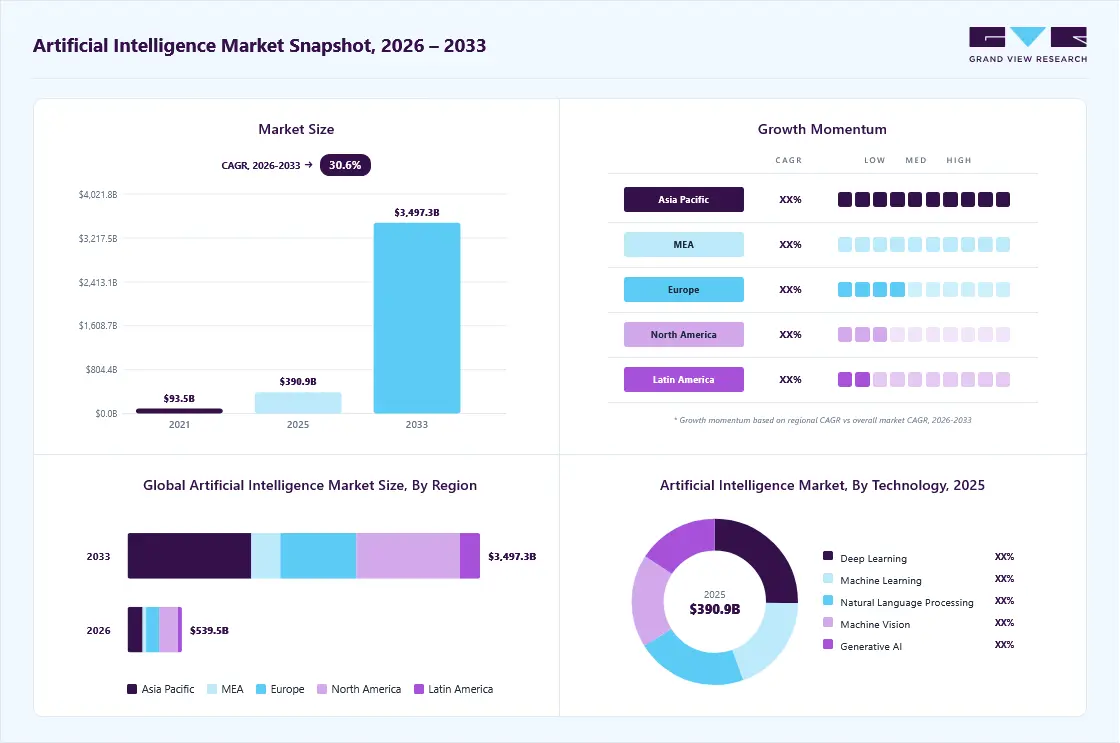
Proceeding with the market data, it creates an opportunity for your SMEs.
Now, many of the SMEs often ask, “How do small and mid-sized businesses compete with AI?”
Well, AI helps in automating repetitive tasks, making better decisions, delivering personalized customer service, optimizing operations, and empowering employees.
Here, we will walk you through why AI is important, why SMEs need an AI strategy, and cost factors.
Without any delay, let’s get started.
Who Are SMEs?
SME (Small and Medium Enterprises) are independent businesses that fall below specific limits for employee count, annual revenue, and even total assets. SMEs do account for about 99.9% of the complete business population, i.e 5.7 million businesses.
In developing countries like the US and UK, SMEs contribute 50% of employment and 40% of GDP. Here, the SME sector plays an extremely important part in the modern economy, proving to be the most attractive and tremendous innovative system.
With the growing trend and share of SMEs, they have become an eye-catching investment for various sectors and investors.
However, with the growing era of AI, it becomes important for SMEs to adopt it. If you are an SME or going to invest in an SME, you should be well aware of the reasons why AI is important in the following section.
Why Artificial Intelligence is Important for SMEs in 2026?
In 2026, AI has moved from a tool to a strategic asset for small businesses that are aiming to stay resilient. Additionally, the new competitive edge is upscaling AI literacy, which is emerging as a driving force for small businesses.
AI technology for automated mobile app development is lowering the barriers to entrepreneurship by motivating small businesses to automate repetitive tasks with AI and then manage the core strategy part by themselves.
Here’s why AI is important for SMEs in 2026:
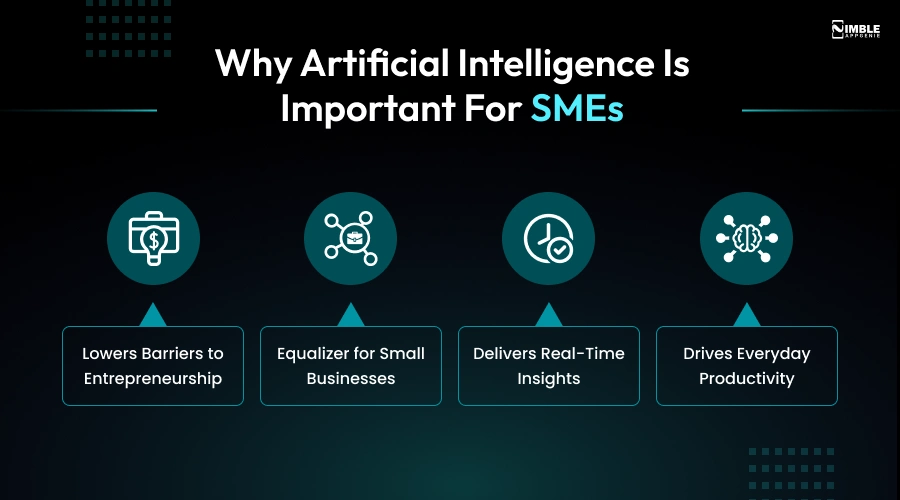
1. Lowers Barriers to Entrepreneurship
Implementation and adoption of AI for SMEs lowers the barriers for entrepreneurs. It automates tasks and provides time to startups and professionals to focus on creative work.
This shift for entrepreneurs makes the business more achievable and allows the founders to operate more leanly and smartly.
2. Equalizer for Small Businesses
AI acts as an equalizer for small businesses through automating routine tasks and providing enterprise-grade marketing, along with customer support.
The implementation and adoption of AI is democratizing enterprise-grade capabilities and supporting firms to automate tasks by scaling productivity.
3. Delivers Real-Time Insights
AI models help businesses to combine continuous data streaming, instant machine learning analysis, and automated action triggers.
Artificial intelligence delivers real-time insights for small and medium enterprises by automatically processing live operational streams and predicting cash flow shifts, along with tracking consumer behavior.
4. Drives Everyday Productivity
AI drives everyday productivity for SMEs by automating routine administrative tasks, enhancing customer service, and optimizing marketing efforts.
Here, AI for SMEs helps in driving productivity via task automation and improving collaboration through using NLP for communication and by using document and knowledge management systems.
If you are an SME and looking to add AI, you might be well known about the benefits of AI in SMEs; however, when it comes to forming the right AI strategy for SMEs, there can be a gap.
Many of the SMEs in 2026 are using AI, but still they are facing issues in succeeding.
The answer is due to a strong AI strategy. Let’s get ahead with the section stating an AI strategy for SMEs.
Why Do SMEs Need a Strategy Before Adopting AI Tools?
There are many reasons that an AI strategy is way more crucial than just using AI tools. Here, SMEs need an AI strategy to avoid money wastage and align tools with the purpose of the business.
Let’s consider the need for an AI strategy for SMEs:
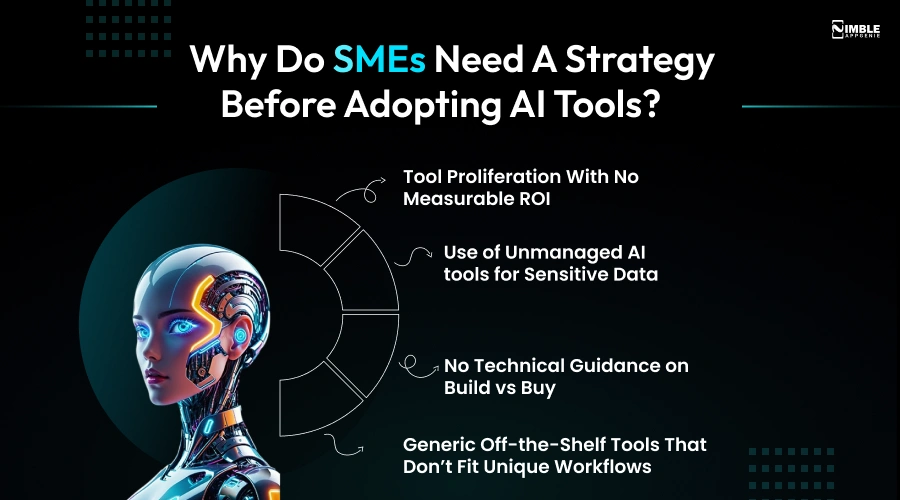
Pain Point: Tool Proliferation With No Measurable ROI
Tool proliferation with no measurable ROI is one of the major issues SMEs face, who are continuously buying new AI tools but cannot optimize them based on the purpose of the business.
Hence, the solution here is to connect with the AI strategists who know well what the right AI tool is and under what conditions.
Pain Point: Use of Unmanaged AI tools for Sensitive Data
Using AI is the new trend and helps to automate business tasks, but it comes with using unmanaged AI tools for sensitive data. Additionally, the use of unmanaged AI tools can harm sensitive data by causing leaks, breaking the privacy rules, and lacking security.
The right AI strategist, such as Nimble AppGenie, will help you to examine what are the most relevant AI tools for your business to manage sensitive data.
Pain Point: No Technical Guidance on Build vs Buy
Zero technical guidance on build vs buy will help companies to adapt AI tools via chaotic trial and error, rushed vendor choices, and even hidden costs. It is a major pain point for SMEs because it often lacks operational realism, a financial framework, and even risk assessment.
The relevant solution for this issue is appointing an AI strategist who can help in deciding on build vs buy depending on the requirements of your SMEs.
Pain Point: Generic Off-the-Shelf Tools That Don’t Fit Unique Workflows
The off-the-shelf software tools are designed for the average company. Here, many SMEs struggle to identify their requirements in the case of off-the-shelf tools and a unique AI fit.
Using off-the-shelf tools limits customization and restricts growth. The use of prebuilt tools offers limited options that create a cap for SMEs to switch to innovations.
Now, as you know the reasons to opt for the right strategy, let’s get ahead with steps to create an AI strategy for your SMEs.
But how can small and medium-sized enterprises compete with AI? Let’s learn them all in the following section.
How Can Small and Medium-Sized Enterprises Compete Using AI?
Small and medium-sized enterprises can compete with artificial intelligence by automating routine tasks and driving key strategies such as automation, personalization, and data-driven decisions.
Here is a complete list defining how SMEs can compete using AI:
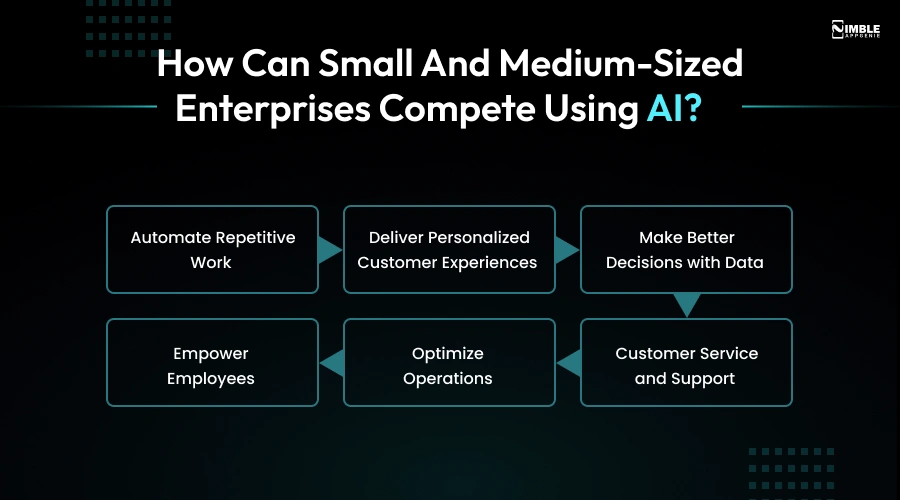
1. Automate Repetitive Work
SMEs can compete using AI by automating repetitive tasks. Here you can use AI to handle the routine tasks so the employees can focus on the higher-value work. Automating repetitive work with AI is one of the competitive factors because it saves time and reduces the redundancy of work.
Examples:
- Customer support chatbots
- Email summaries
- Meeting drafts
- Enhancing customer interaction through personalization
- Reducing human workload costs
Benefit: Lower operating costs and faster response times
2. Deliver Personalized Customer Experiences
SMEs deliver personalized customer experiences through leveraging customer data, utilizing affordable digital tools, and maintaining the direct, flexible relationship with their buyers. With AI, SMEs can analyze customer behavior and can tailor interactions.
Examples:
- Product recommendations
- Retargeting Campaigns
- Drip email campaigns based on customer journey stage
- A/B testing landing pages for different audiences
- Customizing Messages Based on Geolocation
Benefit: Better customer satisfaction and higher conversion rates.
3. Make Better Decisions with Data
Small and medium enterprises can deliver a personalized customer experience by leveraging customer data, using automation tools, and adopting an omnichannel approach. By utilizing accessible tools and tracking key metrics.
Examples:
- Sales forecasting
- Inventory optimization
- Demand prediction
- Fraud detection
- Finance and cash flow
Benefit: Makes better decisions through data analysis
4. Customer Service and Support
With the help of SMEs, you can deploy AI chatbots, provide round-the-clock support, resolve customer issues faster, improve retention, and even revolutionize marketing. What if your customer asks about your product at 3 AM? Will your representative be available to respond? Well, even if yes, that too at a higher cost. Hence, AI chatbots are effective.
Examples:
- Answering user questions via live chat
- Troubleshooting technical issues
- Providing self-service knowledge bases.
- Email and social media
- 24/7 customer support
Benefit: Higher customer satisfaction and retention
5. Optimize Operations
SMEs use AI to automate routine tasks, enhance overall customer service, and enhance decision-making. With the help of artificial intelligence, you can scale output by automating routine tasks, improving customer service, and making data-driven decisions.
Examples:
- Predictive maintenance
- Supply chain optimization
- Workforce scheduling
- Quality inspection
Benefit: Leads to smarter decision-making
6. Empower Employees
Artificial intelligence empowers employees in SMEs through automating routine tasks, increasing work autonomy, and providing personalized professional growth. AI can empower employees through automating routine tasks, enhancing work autonomy, and further improving skill development.
Examples:
- Offer flexible work schedules
- Provides professional development
- Provides Decision-making autonomy
- Open Feedback culture
Benefit: Empowering employees results in higher productivity and greater retention
Well, AI for SMEs helps the sector to outcompete in this competitive market. But at what cost?
Let’s evaluate the same in the next section.
What’s the Cost to Develop AI for SMEs from Scratch?
The overall cost to develop AI for SMEs from scratch means you are focusing on building the complete AI from $20,000 to $200,000+. Here is the cost based on project type and complexity of AI for SMEs.
Let’s understand the complete table on the cost to develop AI for SMEs from scratch:
| Development Phase | Estimated Cost | % of Total Budget | Cost Diversification |
| Discovery & AI Readiness Assessment | $2,000 – $12,000 | 6–8% | Data audit, use-case identification, feasibility study, ROI mapping |
| Strategy & Solution Design | $3,000 – $15,000 | 8–10% | AI architecture planning, platform/model selection (OpenAI, Claude, Gemini, custom), workflow mapping |
| Data Collection & Preparation | $3,000 – $20,000 | 10–12% | Data cleaning, structuring, labeling, integration with existing systems |
| Model Development / AI Engine Build | $8,000 – $70,000 | 30–35% | Custom model training/fine-tuning, LLM integration, algorithm development |
| UI/UX & Application Development | $5,000 – $40,000 | 15–20% | Dashboard/chatbot/interface design, front-end development, user experience flows |
| API & Systems Integration | $3,000 – $25,000 | 10–12% | CRM/ERP integration, third-party APIs, payment/data connectors |
| Testing, QA & Security Compliance | $2,000 – $18,000 | 8–10% | Functional testing, bias/accuracy checks, data security & compliance (GDPR, etc.) |
| Deployment & Post-Launch Support | $2,000 – $15,000 | 6–8% | Cloud deployment, monitoring setup, training, ongoing maintenance |
But what if you have an SME and want to integrate AI, not build it from scratch?
The experts of Nimble AppGenie have a solution for that too. Let’s learn it in the next section.
What’s the Cost to Integrate AI for SMEs?
The AI integration costs for SMEs range widely, from $ 3,000 for basic tools to $100,000+ depending on the type of AI tools.
Let’s consider the complete cost breakdown to integrate AI for SMEs below:
| Integration Type | Estimated Cost | What’s Included |
| Basic AI Tool Integration | $3,000 – $10,000 | Off-the-shelf AI tool setup (chatbot, AI writing/marketing tool), basic configuration |
| Workflow Automation Integration | $10,000 – $30,000 | AI-powered automation connected to existing CRM/ERP, single-workflow integration |
| Multi-System AI Integration | $30,000 – $60,000 | AI integrated across multiple business systems (sales, support, operations), custom APIs |
| Enterprise-Grade AI Integration | $60,000 – $100,000+ | Full-scale integration with custom model tuning, advanced security, multi-department rollout |
Well, while integrating AI for SMEs, you should be aware of the practices to consider before switching to AI.
Best Practices to Consider Before Switching to AI for SMEs
There are several practices to consider before switching to AI for SMEs, such as identifying your business, adopting comprehensive planning, prioritizing data and security, and competing through specialization.
Let’s consider the complete list of best practices:
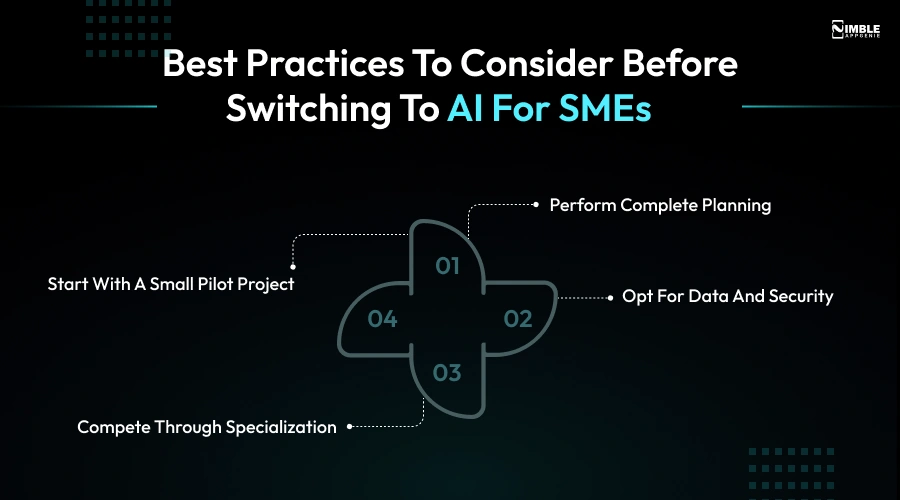
1. Perform Complete Planning
Before you opt for or completely rely on AI for small and medium enterprises, you should be well aware of:
- Your requirements related to business
- What different tools and techniques should be effective for you.
- Check if your current software will support AI or if you need to build a new one.
- Start small, with testing AI on simple and easy tasks.
2. Opt for Data and Security
Adopting data and security is one of the best practices to consider before you switch to AI because it will protect you from any kind of data leaks and against any fraud. It is the best practice because:
- It prevents your app from any cyber attacks.
- Offers data readiness and quality assurance
- Provides trust and risk control
- Helps in automated encryption and role-based access controls.
3. Compete Through Specialization
SMEs can compete via specialization by focusing on a specific niche while integrating AI or developing it from scratch. Here’s what you need to know for specialization:
- Niche domination
- Data advantage
- Workflow integration
- Deploy Efficiently
4. Start with a Small Pilot Project
If you are facing difficulties in handling a complete big project to start with, then you should begin with a small pilot project; it will help you assess:
- Identifying the skills of the engineers
- Helps you to evaluate the hidden risks with the project
- Provides you with awareness about technologies present in the market
- Helps you to take decision related to continuing with the large project or not.
How can Nimble AppGenie help in Integrating/building AI for SMEs?
Nimble AppGenie can help you in integrating and building AI for SMEs because, as a leading AI app development company, we offer:
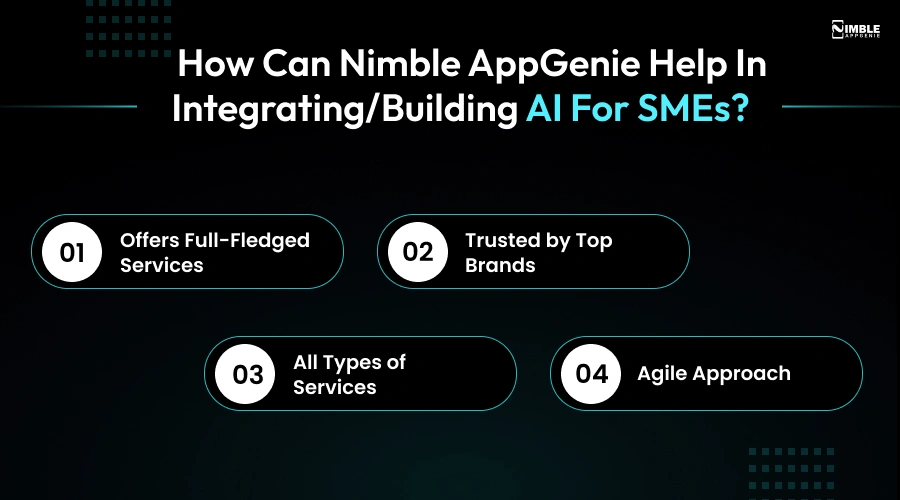
► Offers Full-Fledged Services
Nimble AppGenie offers a full-fledged service through handling the product discovery, custom engineering, and even post-launch support. Whether your SMEs deal in healthcare, eCommerce, manufacturing, finance, automotive, or education, our developers are here to help.
► Trusted by Top Brands
The engineers of Nimble AppGenie have helped many top brands such as Cut, DafriBank, Close2MI, drt, and Nujaxx to integrate AI. The experts at Nimble AppGenie have helped them to connect with their customers in real time.
► All Types of Services
Whether your SMEs deal in healthcare or education, or any other sector, Nimble AppGenie helps in offering AI app consulting services, API development, and integration services. Additionally, we offer AI app maintenance and support services.
► Agile Approach
Nimble AppGenie offers SMEs and financial institutions a custom digital solution using an agile methodology framework. Our engineers offer agile methodologies by focusing on collaboration, flexibility, and continuous enhancement.
Conclusion
With the help of AI for SMEs, you can unlock your opportunities to sustain in this competitive market. You need to understand the requirements of your business by evaluating the growth with AI.
The implementation of AI is helpful for SMEs because it lowers barriers to entrepreneurship, equalizes the playing field for small businesses, delivers real-time insights, and drives everyday productivity. SMEs can compete using AI by automating repetitive tasks, delivering personalized customer experiences, helping to make better decisions, and optimizing operational efficiency.
Diversified best practices that you should adopt before shifting to AI are planning for your business, opting for data and security practices, competing through specialization, and starting with a small pilot project.
FAQs
AI for SMEs refers to the use of artificial intelligence tools and automation by smaller businesses to cut costs, save time, and enhance customer service. It allows these companies to use ready-to-deploy digital systems without any large in-house tech teams.
In the current era, company size no longer matters because the market has shifted from rewards for economic scale to rewards for speed, data, and even adaptability.
Yes, small businesses can compete with the large companies using AI through lower operational costs increase speed, and scaled output. Small businesses can compete through speed, lower overhead costs, and operational agility.
No, AI adoption is not too expensive for SMEs; it hardly costs anything between $20,000 and $200,000+. This cost can further vary based on the complexity of features, project size, and the skills of the developers.
The most common mistakes that SMEs make when adopting AI include adopting tools without a clear goal, giving AI too many high-stakes responsibilities, and ignoring data quality and security.
The real ROI of using AI to compete varies based on the app, its features, and the size of your app. Other than this, the skills of the developers also impact the overall implementation and adoption of AI for SMEs.

Niketan Sharma, CTO, Nimble AppGenie, is a tech enthusiast with more than a decade of experience in delivering high-value solutions that allow a brand to penetrate the market easily. With a strong hold on mobile app development, he is actively working to help businesses identify the potential of digital transformation by sharing insightful statistics, guides & blogs.
Table of Contents




No Comments
Comments are closed.