

 Free Consultation
 PCI-DSS Compliant
 GDPR Ready
 ISO 27001
 NDA Protected
 AI Services
 AI App Development
 Generative AI Development
 AI Chatbot Development
 AI Integration Services
 AI Consulting Services
 AI For Fintech
 AI Financial Assistant Solution
 AI Insurance Agent Development
 Tech Stack
 OpenAI / GPT-4
 Claude / Anthropic
 Gemini / Google AI
 Llama / Open Source
 LangChain / LlamaIndex
 Pinecone / Pgvector
 AWS / Azure AI


 Fintech Solution
 Core Fintech
 App Development
 Neobank Solutions
 eWallet Solutions
 Lending Software
 Banking Solutions
 BNPL Solutions
 BNPL Solutions
 Insurance App
 Wealth Management
 Crypto & DeFi
 Blockchain Development
  Payroll Software
 DeFi Solutions
 Crypto Wallet
 Crypto On/Off Ramp
 Crypto Exchange
 Trading Platform
 Payments
 Compliance
 Regulations & Compliance
 Fraud Detection
 Lending Ecosystem
 P2P Lending Platform
 Mortgage Software
 Engagement
 Fintech Outsourcing

 Mobile Development
 Mobile App Dev
 iOS App Development
 Android App Development
 React Native
 Flutter Development
 Web Solution
 Node.js Development
 React.js Development
 Angular Development
 App Services
 UI/UX Design
 App Maintenance
 By Stage
 MVP Development
 Industry Solutions
 Healthcare App Dev
 Education App Dev
 Travel App Dev
 Real Estate App Dev
 Logistics Software
 Social Media App

 Hire Mobile Developers
 Hire iPhone Developers
 Hire Android Developers
 Hire React Native Devs
 Hire Flutter Developers
 Hire Web Developers
 Hire Node.js Developers
 Hire Angular Developers
 Hire PHP Developers
 Hire Laravel Developers
 How It Works
 Pre-Vetted Developers
 Ready In 48 Hours
 NDA From Day One
 Replace Guarantee
 Company
 About Us
 Our Work Process
 Portfolio
 Case Studies
 Blog / Insights
 Careers
 Contact Us
 Awards
 Recognition


 Offices



Key Takeaways:
- Web3 banking uses Web3 technologies such as blockchain, NFTs, cryptocurrency, and DAOs for performing banking-related operations.
- Web3 banking works when a user creates an account, builds a fiat-to-crypto bridge, verifies the smart contract, and then a transaction confirmation is sent.
- Key benefits of Web3 banking include no single point of control, offers transparency, helps in cost reduction, and provides security.
- The risks involved in adopting and implementing Web3 banking are regulatory uncertainty, smart contract vulnerabilities, and price volatility.
- You can start with Web3 technology integration through selecting the banking model, using key technologies, implementing security measures, and opting for integrated banking features.
- Partner with Nimble AppGenie and build your Web3 banking with the experts.
What is Web3 banking? How does it work, and how can one create it?
Web3 banking uses different technologies such as blockchain, NFTs, and DAOs for conducting the complete banking-related operations. It works when a user gets an account on the wallet, builds a fiat-to-crypto bridge, verifies the smart contracts, and near-instant settlement is performed.
One can create it after evaluating the banking model, using the appropriate technologies, executing the secured transactions, and then these transactions are verified.
Do you know that the Web3 financial services market is estimated at USD 6.52 billion in 2024, and is further projected to grow to USD 468.81 billion by 2035?
Yes, it is expected to grow at a CAGR of 47.5% during the period 2025 to 2035.
You can step into this growing market by understanding Web3 banking explained, its benefits, risks, and development/integrated process.
In this complete guide to Web3 banking, we will walk you through the concept, working process of Web3 technology in the banking industry, merits and demerits, and steps to integrate it in the banking industry.
Without further ado, let’s begin.
What is Web3 Banking?
Web3 Banking defines the use of web3 technology, including blockchain, cryptocurrency, smart contracts, NFTs, DAOs, and more, for conducting banking-related operations. It makes the most of blockchain technology that allows users to leverage cross-border payments.
This technology applies the decentralized blockchain-based principles to financial services. Web3 banking combines the decentralized internet with financial services to let you control your own assets.
Let’s understand it from the base:
Web1: Only read, where users cannot interact with the website. Here, websites are made with HTML and CSS.
Web2: Read and write; here, the internet offers users a platform for interaction. Here, modern platforms such as Facebook and Twitter allow you to connect with the end users.
Web3: Read, Write, Own. This is the new internet of value; here, the decentralized network is integrated.
Web3 banking technology explained: A simple breakdown
Web3 banking is the use of blockchain, smart contracts, and decentralized protocols for delivering banking services.
- Decentralization: Web3 banking technology drives decentralization by replacing financial intermediaries with blockchain technology. Here, the data is distributed across a network for resilience and user control.
- Blockchain Technology: Web3 banking replaces traditional, centralized databases with blockchain technology to offer financial services. This technology offers a transparent, immutable ledger by enabling trustless interactions.
- User Empowerment: The implementation of Web3 technology in banking offers decentralized financial services, which means it offers users the ability to control and manage their finances successfully.
How Does Web3 Technology Differ from Web2 Technology?
Web3 technology differs from Web2 technology through the way it offers decentralization. Web2, known as the interactive and social web, focuses on user-generated content and usability. Web2 technology is dominated by tech giants such as Google, Meta, and Amazon that act as intermediaries to store your data on centralized servers.
However, Web3 technology uses blockchain technology, distributes control across a peer-to-peer network, and allows you to own and control your digital assets.
Blockchain in banking allows banks to cut transaction costs and minimize the settlement times from days to minutes for cross-border transactions.
Before you opt for the Web3 banking system, are you aware of how it works?
Well, if not, then let’s evaluate it all in the following section.
How Does Web3 Banking Work?
Web3 banking replaces traditional banking intermediaries with decentralized networks. This all begins with creating a digital wallet, operating on a decentralized peer-to-peer (P2P) model rather than relying on central servers.
Let’s evaluate the complete working process of Web3 Banking below:
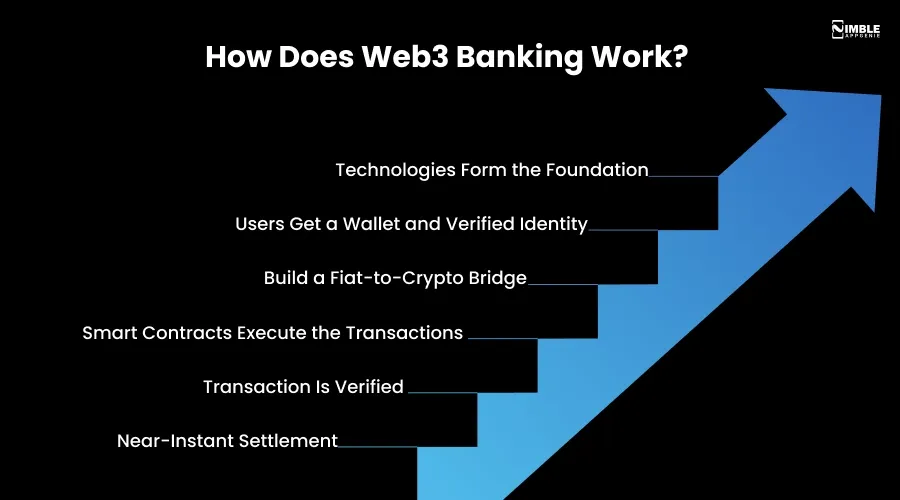
Step 1: Technologies Form the Foundation
This platform uses the latest technologies related to blockchain, smart contracts, crypto wallets, and decentralized protocols to form the foundation and replaces the centralized servers on which traditional banks depend.
Step 2: Users Get a Wallet and Verified Identity
Now, the users create their account or a crypto wallet that holds all the private keys, and then they complete the identity verification via DID. This is the step where the Web3 technology is reusable across platforms without any repeated KYC.
Step 3: Build a Fiat-to-Crypto Bridge
The user deposits fiat or crypto. On-ramp infrastructure converts it into stablecoins or tokenized assets so it can move on-chain while the app still functions like regular money.
Step 4: Smart Contracts Execute the Transactions
When the user sends money, borrows, or even invests, smart contracts automatically function effectively and carry out the actions based on the pre-set rules, with no manual approval and with no intermediary needed.
Step 5: Transaction Is Verified
Now the transaction is verified as the network validates the transaction and records it permanently on the blockchain. AI-powered monitoring simultaneously scans for fraud risks in real time.
Step 6: Near-Instant Settlement
Later, the funds are settled instantly in days, without any requirement os clearing house. This is the step under which confirmation related to the transaction is received. Here, the users retain full control of their funds.
Startups often ask “how to build a DeFi App?” when it comes to the development and integration of Web3 in banking.
But many of the fintech and banking startups often ask. “ What are the advantages of Web3 banking technology?” or “What’s the need for Web3 banking technology?”
Advantages of Web3 Banking Technology
The key advantages of Web3 banking technology are decentralization, security, transparency, cost reduction, and accessibility.
Now, let’s get into the details of Web3 banking technology benefits:
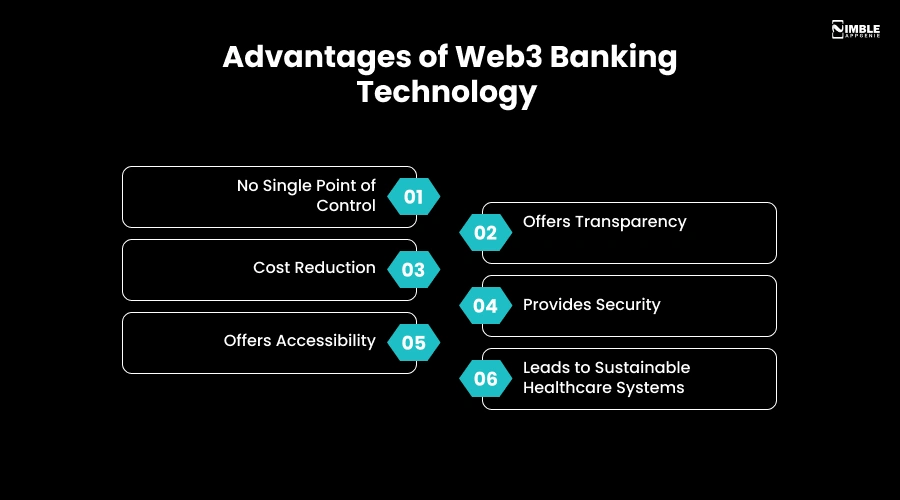
1] No Single Point of Control
Web3 banking technology offers decentralization of networks; hence, there is no single point of control.
This technology eliminates the need for any traditional financial intermediaries by using peer-to-peer networks. The decentralized nature allows direct transfer of funds without any intermediaries.
2] Offers Transparency
Web3 banking brings transparency to users by primarily moving away from centralized servers in favor of decentralized blockchains and open-source smart contracts.
This even means that every transaction and platform rule is permanently recorded on a public ledger, allowing users to independently verify each activity.
3] Cost Reduction
Web3 technology offers significant cost reduction by removing intermediaries, automating processes via self-executing code that further leads to lowering the payment processing fees.
Decentralization in Web3 technology saves customers from paying banks the processing fees and other platform charges. Tokenization in financial services converts the ownership of real-world assets into digital tokens and reduces intermediaries.
4] Provides Security
Web3 technology secures the internet by replacing central authorities with decentralized networks. This technology uses cryptographic and mathematical algorithms to protect data and ownership.
This technology comes with a distributed ledger system that ensures transaction details and important information are encrypted without any kind of intervention.
5] Offers Accessibility
The adoption of Web3 technology improves digital accessibility by dismantling centralized barriers. This technology ensures personalization, customization, languages, and visuals are taken care of to make the banking solutions inclusive and accessible.
Here, most of the banking startups and enterprises often ask, “How to overcome the challenges and risks of Web3 technology?”
Let’s get ahead with the risks and challenges in the following section.
What are the Risks and Challenges of Web3 Technology?
Challenges such as regulatory uncertainty, smart contract vulnerabilities, custody risk, price volatility, and scalability should be considered.
Let’s get ahead with the risks and challenges of Web3 technology:
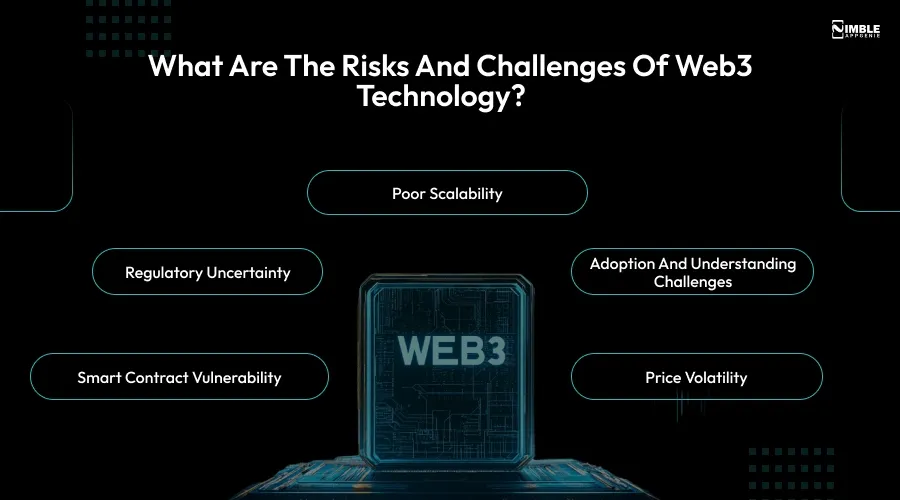
1. Regulatory Uncertainty
The lack of regulatory clarity around Web3 and its banking application is quite concerning. Since there are no central authorities governing Web3 technology, without clear guidelines, businesses struggle with compliance, securing the necessary licenses, and operating under different jurisdictions.
Bonus Read: “Neobank Banking License guide: country-by-country”
2. Smart Contract Vulnerability
The smart contract consists of transaction details that are more vulnerable to hackers if not properly encrypted. Along with this, the decentralized exchanges or DEXs are vulnerable to security breaches too.
3. Adoption and Understanding Challenges
Not all customers are educated to use Web3 banking technology. One of the most challenging aspects here is developing awareness and pushing customers to learn about the same. Additionally, without clear guidelines, businesses struggle to implement Web3 banking technology.
4. Price Volatility
Price volatility and extreme fluctuations in cryptocurrency introduce severe market, liquidity, and system risks to Web3 banking integrations. Here, the unpredictable price swings can erode the bank reserves and even threaten consumer trust.
5. Poor Scalability
Issues like limited network capacity, increased complexity, and even the lack of interoperability do make scalability one of the major challenges. Here, blockchain networks traditionally struggle to match instantaneous processing speeds, along with massive transaction costs.
Many banking startups often ask, “Have banking companies adopted Web3 banking technology?”
Well, yes, many growing banking enterprises have adopted Web3 banking technology.
Let’s evaluate the real-world use cases in the following section.
Real-World Use Cases of Web3 Banking
The real-world use cases of Web3 banking will help you to discover how the top banking companies are adopting and implementing this technology.
Here is a set of examples to look for the real-world use cases of Web3 banking:
1. JPMorgan
JPMorgan has approached Web3 banking by integrating institutional-grade blockchain solutions and digital identity into the traditional financial system. Through Web3 banking, the company has broadened their reach and gained access to robust token management tools.
2. Citi (Citi Token Services)
Citi has adopted Web3 solutions primarily by creating bridges between traditional finance and blockchain technology. The bank integrates Web3 banking services with 24/7 USD clearing for real-time cross-border payments and liquidity management.
3. Morgan Stanley
Morgan Stanley has embraced Web3 by integrating digital assets. Here, MSIM is the first bank in the U.S which is offering a cryptocurrency ETP, and reflects a continued focus on building digital assets to meet the evolving needs of users.
4. SWIFT
SWIFT has adopted Web3 technology by integrating a blockchain-based shared ledger into its infrastructure, allowing global banks to process cross-border payments 24/7 using tokenized deposits.
These examples show that even the backbone of global bank messaging is adapting to the Web3 rails.
Many of the banking startups and financial institutions often ask, “What is the difference between Web3 banking vs. neobank vs traditional digital banking?”
Well, the major difference lies in their core infrastructure, custody model, settlement speed, and even regulation.
Web3 Banking vs Neobank vs Traditional Digital Banking
Web3 banking makes use of decentralized blockchain networks, while traditional digital banking refers to the portals of brick-and-mortar legacy institutions. However, neobanks are independent, where branchless financial technology companies operate entirely online.
| Feature | Traditional Digital Banking | Neobank | Web3 Banking |
| Infrastructure | Legacy core banking systems | Cloud-native core banking | Blockchain + smart contracts |
| Intermediary | Bank-controlled | Bank-controlled (via BaaS partner) | Minimal/no intermediary |
| Asset Custody | Bank-held | Bank-held | User-held or hybrid |
| Settlement Speed | Slow (batch/SWIFT, 1–3 days) | Faster (real-time fiat rails) | Near-instant (on-chain) |
| Transparency | Limited/internal records | Limited/internal records | Public, immutable ledger |
| Regulation | Fully regulated bank | Licensed via BaaS partner | Evolving/hybrid frameworks |
| Best Suited For | Established institutions, risk-averse users | Digital-first startups, retail users | Crypto-native, cross-border, DeFi-focused businesses |
With this table and list of differences, you might be clear about how Web3 banking technology is way different than traditional banking and neobanks.
Now, the question is “how to build or integrate a Web3 banking solution?”
You can create and integrate a Web3 banking solution by selecting the banking model, using the key technology stack, adopting the security parameters, and then integrating the banking features.
In the next section, let’s learn it all in detail.
How to Get Started Building a Web3 Banking Solution?
You can integrate or build a Web3 banking solution into your app after evaluating your requirements, understanding the reasons to create it, identifying the right technologies to build and test it, and then launching your solution.
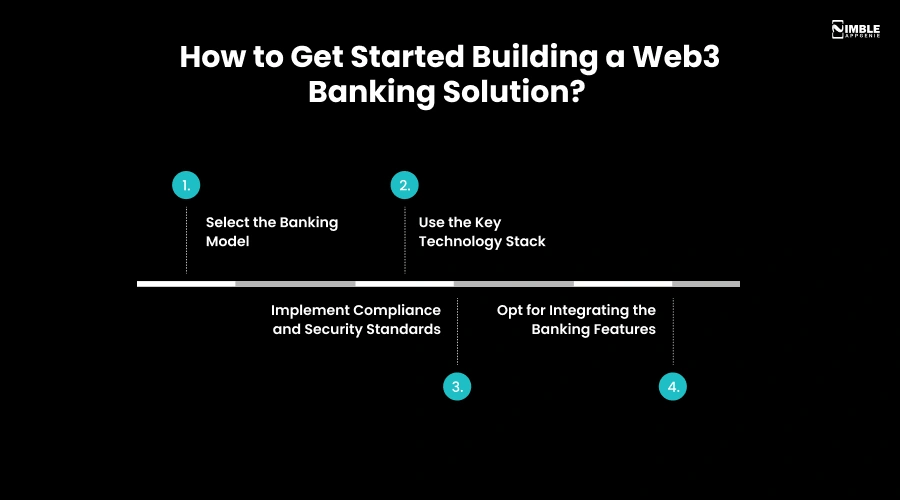
Let’s evaluate the steps to get started building a Web3 banking solution:
Step 1: Select the Banking Model
You should evaluate your app requirements and identify whether you need a Web3 banking solution or not. Identifying the requirements will help you to select the right banking model.
There are two types of models among which you can select:
- Custodial (DeFi-native): Under the custodial wallet banking model, you only offer the interface and routing.
- Custodial (Neobank): Here, your platform acts as a custodian that holds the private keys on behalf of the user.
Step 2: Use the Key Technology Stack
Now, as we move with the Web3 banking explained, one of the parameters to understand is the use of the key technology stack.
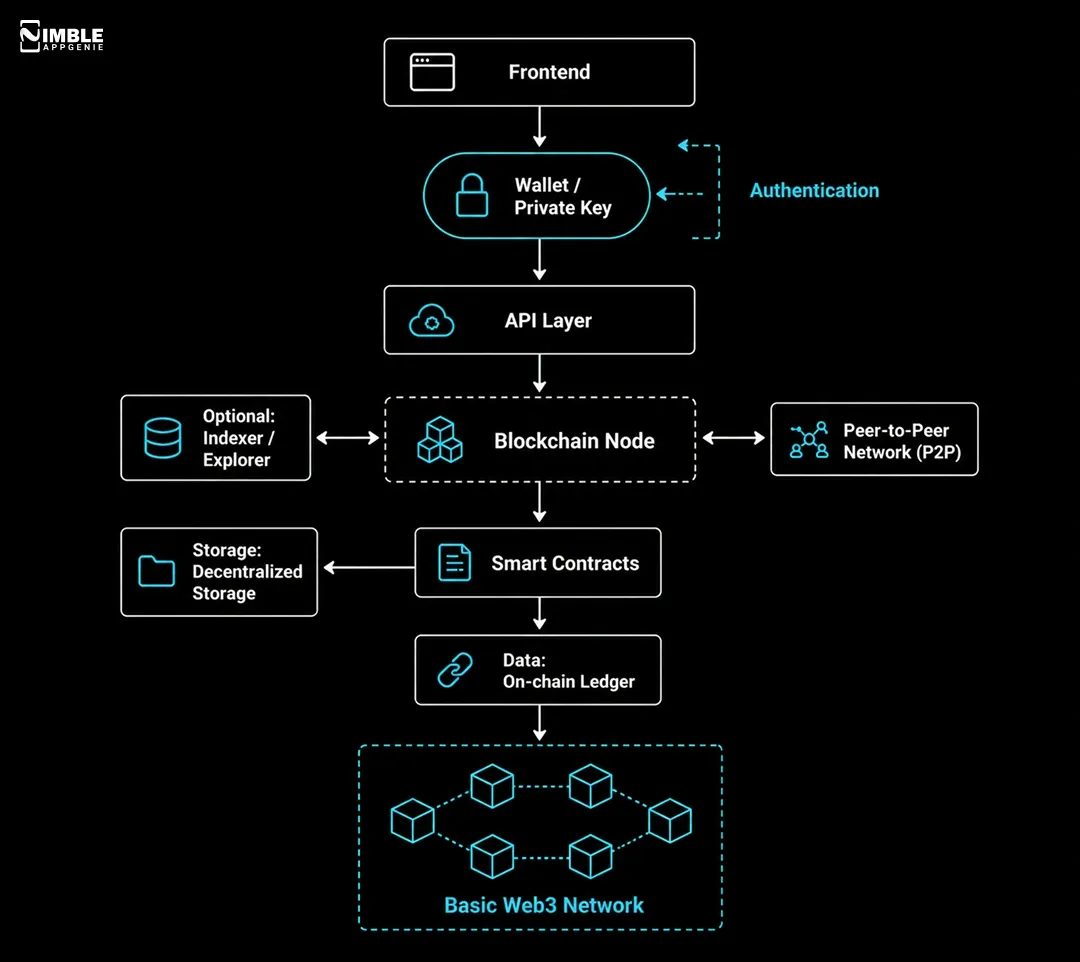
Under the Web3 technology network, we add the blockchain layer in the backend with wallet authentication and including the data APIs.
- Use of blockchain layer: Use Ethereum, Polygon, or Arbitrum along with languages such as Solidity or Vyper.
- Use of Wallet Authentication: Integrate tools such as Web3Auth or RainbowKit for seamless onboarding via email.
- Nodes and Data APIs: Use scalable nodes such as Quicknode and Alchemy instead of using or building your own Web3 banking nodes.
- Fiat to crypto Gateways: Implement the APIs in the Web3 banking from providers like MoonPay and Stripe, helpful banking apps to process the seamless transactions.
Here is the graphical representation of how Web3 architecture looks:
Step 3: Implement Compliance and Security Standards
In this step, you should integrate the compliance and security parameters that can drive an authenticated banking solution.
Here’s what you need to adopt:
- Identity Verification (KYC): Integrate with identity verification services to ensure that the data remains secure and encrypted.
- Smart Contract Audit: Have the smart contract audited professionally before handling the user funds.
Step 4: Opt for Integrating the Banking Features
Under this step, once the infrastructure is ready, you should offer core decentralized banking services such as DeFi yield farming, cross-chain transactions, along with stablecoin integration.
Here, you first secure the API access via your financial institution and with the help of the BaaS aggregator.
This is how one can integrate Web3 banking technology; the challenge is “cost”.
What’s the cost to integrate Web3 banking technology?
Well, it depends on different parameters, such as your business model and the type of architecture selected.
In the next section, let’s evaluate the cost of Web3 banking technology.
What’s the Cost to Integrate Web3 Banking Technology?
The overall cost to integrate Web3 banking technology varies from $20,000 to $80,000+ depending on the type of banking model, architecture selected, and the type of security measures or tools implemented for encryption.
Here is the complete cost breakdown table of Web3 banking technology:
| Cost Factor | What’s Included | Estimated Cost (USD) |
| Planning & Design | Requirement analysis, UI/UX, architecture | $3,000 – $10,000 |
| Frontend & Backend Development | Banking dashboard, APIs, user management | $10,000 – $30,000 |
| Smart Contracts & Blockchain | Smart contracts, blockchain and wallet integration | $7,000 – $20,000 |
| Security & Compliance | KYC/AML, encryption, smart contract audit | $5,000 – $15,000 |
| Testing & Deployment | QA, cloud setup, deployment | $3,000 – $8,000 |
| Maintenance & Support | Updates, monitoring, bug fixes | $2,000 – $10,000+ |
Also Read “Embedded Banking Platform Development Cost”
Now, if you’re looking to partner with an experienced company, connect with the leading enterprise.
Partner with Nimble AppGenie and Build a Web3 Banking Technology
Connect with Nimble AppGenie and build a Web3 banking solution with the top experts in the industry. The experts at Nimble AppGenie, as the best banking software development company, offer a range of services through integrating decentralized blockchain architecture with AI-driven compliance engines.
Here’s why you need to connect with Nimble AppGenie:
- Certified Experience in Blockchain: The experts at Nimble AppGenie have certified experience in integrating blockchain and crypto wallet solutions into the secure fintech ecosystem.
- Offers Hyper-Secure Infrastructure: Nimble AppGenie offers blockchain app development under which we provide hyper-secure infrastructure, including built-in KYC/AML workflows and regulatory compliance frameworks.
- Creates Cross-Platform UI/UX: Nimble AppGenie is a leading mobile app development company that offers integrated and user-friendly designs in every software.
- Delivers AI-Powered Apps: Nimble AppGenie is the leading AI development company that delivers AI-powered apps with real-time transaction processing and AI-driven insights to monitor and optimize financial workflows.
Conclusion
Web3 banking technology applies decentralized internet principles such as blockchain, smart contracts, NFTs, DAOs, and cryptocurrency to perform banking-related operations. Web3 technology uses the latest advancements in technology; it starts to work when the user creates a wallet, builds a fiat-to-crypto bridge, smart contracts are verified, and then funds get settled instantly.
This technology in banking leads to decentralization, offers transparency, provides security, and offers accessibility. The key risks and challenges include regulatory uncertainty, smart contract vulnerabilities, price volatility, and poor scalability.
Build a Web3 banking technology by selecting the banking model, using a key technology stack, implementing compliance, and adopting banking features.
FAQs

Niketan Sharma, CTO, Nimble AppGenie, is a tech enthusiast with more than a decade of experience in delivering high-value solutions that allow a brand to penetrate the market easily. With a strong hold on mobile app development, he is actively working to help businesses identify the potential of digital transformation by sharing insightful statistics, guides & blogs.
Table of Contents




No Comments
Comments are closed.