

 Free Consultation
 PCI-DSS Compliant
 GDPR Ready
 ISO 27001
 NDA Protected
 AI Services
 AI App Development
 Generative AI Development
 AI Chatbot Development
 AI Integration Services
 AI Consulting Services
 AI For Fintech
 AI Financial Assistant Solution
 AI Insurance Agent Development
 Tech Stack
 OpenAI / GPT-4
 Claude / Anthropic
 Gemini / Google AI
 Llama / Open Source
 LangChain / LlamaIndex
 Pinecone / Pgvector
 AWS / Azure AI


 Fintech Solution
 Core Fintech
 App Development
 Neobank Solutions
 eWallet Solutions
 Lending Software
 Banking Solutions
 BNPL Solutions
 BNPL Solutions
 Insurance App
 Wealth Management
 Crypto & DeFi
 Blockchain Development
  Payroll Software
 DeFi Solutions
 Crypto Wallet
 Crypto On/Off Ramp
 Crypto Exchange
 Trading Platform
 Payments
 Compliance
 Regulations & Compliance
 Fraud Detection
 Lending Ecosystem
 P2P Lending Platform
 Mortgage Software
 Engagement
 Fintech Outsourcing

 Mobile Development
 Mobile App Dev
 iOS App Development
 Android App Development
 React Native
 Flutter Development
 Web Solution
 Node.js Development
 React.js Development
 Angular Development
 App Services
 UI/UX Design
 App Maintenance
 By Stage
 MVP Development
 Industry Solutions
 Healthcare App Dev
 Education App Dev
 Travel App Dev
 Real Estate App Dev
 Logistics Software
 Social Media App

 Hire Mobile Developers
 Hire iPhone Developers
 Hire Android Developers
 Hire React Native Devs
 Hire Flutter Developers
 Hire Web Developers
 Hire Node.js Developers
 Hire Angular Developers
 Hire PHP Developers
 Hire Laravel Developers
 How It Works
 Pre-Vetted Developers
 Ready In 48 Hours
 NDA From Day One
 Replace Guarantee
 Company
 About Us
 Our Work Process
 Portfolio
 Case Studies
 Blog / Insights
 Careers
 Contact Us
 Awards
 Recognition


 Offices


Key Takeaways:
- Illicit crypto addresses received at least $154 billion in 2025, a 162% jump from the year before, and$17 billion of that came from scams alone.
- A crypto fraud detection platform is not the same build as a fintech fraud tool. It runs on public, immutable blockchain data, not private transaction feeds.
- AI here means graph neural networks and clustering algorithms working alongside anomaly detection, not only the classification models used for card fraud.
- The core modules are wallet clustering, AI risk scoring, cross-chain tracing entity attribution, and a case management layer for investigators.
- AI crypto fraud detection platform development cost ranges from $60,000 for a single-chain MVP to $700,000+ for an enterprise, multi-chain platform with legal-grade evidence export and case management.
- Nimble AppGenie builds custom blockchain analytics and AI fraud detection platforms for exchanges, wallets, and compliance teams, with the regulatory layer designed in from day one, not bolted on later.
“Is crypto actually traceable, or can criminals move stolen funds without a trace?” That’s one of the most common questions people type into Google instantly after a crypto scam headline breaks. The honest answer: Crypto is traceable, but only if the crypto fraud detection platform scanning it is built right. Get the architecture wrong, and a fraud ring can move funds through five blockchains before anyone notices.
That question is exactly why Chainalysis exists and why more exchanges, payment processors, wallets, and even law enforcement agencies want to know how to build something similar in-house, rather than pay recurring license fees forever.
This guide walks through what an AI crypto fraud detection platform is, how Chainalysis-style tools work under the hood, and what it takes, technically and financially, to build one.
- $154 billion illicit on-chain volume, 2025
- $17 billion lost to crypto scams, 2025
- 181,565 crypto fraud complaints filed with the FBI
- Sources: Chainalysis 2026 Crypto Crime Report, Federal Bureau of Investigation (FBI) Internet Crime Report 2025 & Chainalysis 2026 Crypto Crime Report.
Why Crypto Fraud Detection is Different from Fintech Fraud Detection?
If you have already read guides on building AI fraud detection for banking or lending apps, here’s the part that surprises people: fraud detection crypto systems don’t look like those at all.
A fintech fraud engine watches things it owns: your users, your transaction history, and your device logs. A crypto fraud detection platform watches something it doesn’t own: a public blockchain, and has to work out, from address behavior alone, who is behind a wallet and whether it’s connected to a hack, a scam, or a sanctioned entity.
| Fintech Fraud Detection | Crypto Fraud Detection |
| Reads private transaction and device data | Reads public, immutable blockchain data |
| Flags a user or a card | Flags a wallet address or entity cluster |
| Signals: device fingerprint, IP, behavior biometrics | Signals: address clustering, transaction graph, fund flow |
| Compliance anchor: KYC, AML, PCI-DSS | Compliance anchor: Travel Rule, OFAC sanctions lists, FATF crypto guidance |
| Stops a transaction before settlement | Traces funds after they’ve already moved, across chains |
If your business runs both a card/lending product and a crypto product, you likely need both systems – read our guide on building an AI fintech fraud detection system if the transaction-fraud side is what you are solving for. This guide is about the on-chain half of the problem.
How Does Chainalysis Actually Work?
Before building something “like Chainalysis,” it helps to know what Chainalysis is actually made of. It is not one tool; it’s a suite:
- Reactor: The investigation tool, which visualizes wallet networks, clusters addresses onto entities, and allows investigators to trace stolen funds across chains.
- Alterya: An AI layer (acquired by Chainalysis) that connects off-chain fraud signals – social media, chat, and web activity with on-chain wallet behavior to catch scams before funds even move.
- KYT (Know Your Transaction): A real-time API that screens transactions as they happen and flags exposure to sanctioned addresses, known illicit wallets, or darknet markets.
- Hexagate: Real-time on-chain security monitoring for smart contract exploits and wallet compromise.
The common thread across all four is that they turn a firehose of raw blockchain data into a short list of entities, wallets, and transactions worth a human’s attention.
| “When funds move from one system to another, such as from Zelle to a crypto wallet, there’s often no built-in mechanism to trace that movement across platforms. Investigators stuck within one domain rarely have the full picture.” – Caitlin Barnett, Director of Regulation & Compliance, Chainalysis |
Core Modules of an AI Crypto Fraud Detection Platform
Remove the branding, and every serious blockchain analytics platform is developed from the same six modules.
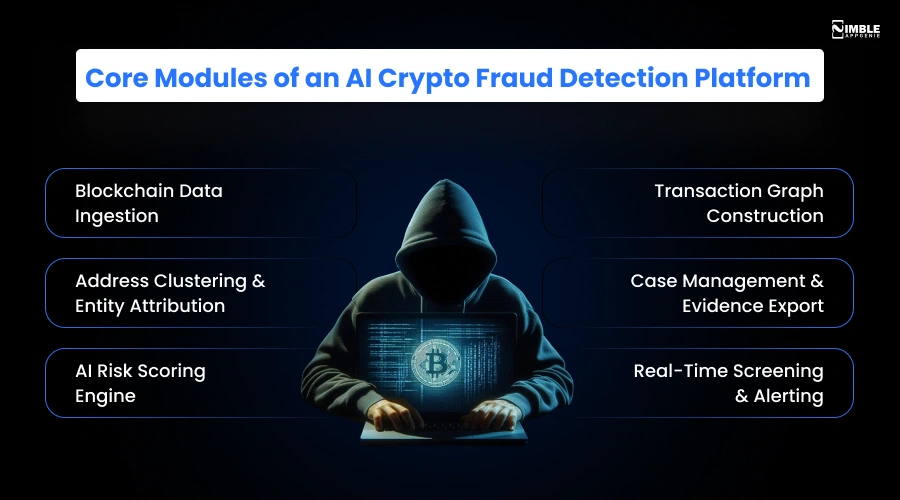
1. Blockchain Data Ingestion
You need full nodes or reliable indexers for every chain you plan to support – Ethereum, Bitcoin, and the higher-volume L2s and altcoins, at minimum. This is the raw material everything else depends on.
2. Address Clustering & Entity Attribution
Wallets don’t come labeled with names. Clustering heuristics, common-input-ownership, temporal pattern matching, and change-address detection group addresses that might belong to the same organization or person, then attribution data maps clusters to known real-world entities (darknet markets, mixers, and exchanges).
3. AI Risk Scoring Engine
This is the intelligent layer: whether a wallet or a transaction deserves human attention, and it is covered in detail in the next section.
4. Transaction Graph Construction
Funds don’t move in a straight line; they move through mixers, peel chains, and cross-chain bridges. A graph database structure is what allows you to actually query “ where did this money end up,” not only “who sent this transaction.”
5. Case Management & Evidence Export
Investigators need a workspace to build a case: annotate wallet networks, attach evidence, and export findings in a format that can survive scrutiny in court or from a regulator.
6. Real-Time Screening & Alerting
A KYT-style API that exchanges and payment platforms can call before permitting a withdrawal or deposit, returning a risk score in milliseconds.
How AI Actually Detects Crypto Fraud
Most “how to build fraud detection” guides skip this part because it’s genuinely different from standard fraud ML.
Here is what actually goes into the model layer of an AI crypto fraud detection platform:
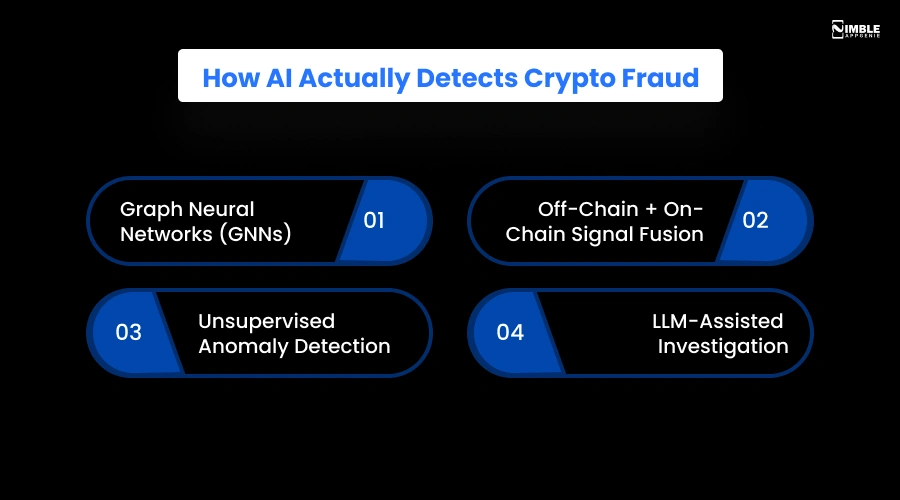
1. Graph Neural Networks (GNNs)
GNNs learn from the shape of a wallet’s connections, not just its transaction count, so they can flag entities that look structurally similar to known bad actors even from a brand-new address.
2. Off-Chain + On-Chain Signal Fusion
This is what Chainalysis’s Alterya acquisition was built around: connecting web and chat scam signals with wallet behavior to flag a scam before a victim sends funds, not just after. It is the difference between detection and prevention.
3. Unsupervised Anomaly Detection
These modules flag wallets that suddenly break pattern, like a dormant address that wakes up and fragments funds across dozens of new wallets within hours, the classic sign of a peel chain.
4. LLM-Assisted Investigation
Newer platforms use LLMs as an investigator’s copilot, summarizing a wallet’s history in plain language or answering questions like “has this cluster touched a sanctioned wallet in 90 days” without a manual query.
System Architecture: From Blockchain Nodes to Risk Alerts
A production-grade platform is layered, and each layer feeds the next:
- Node/Indexing Layer: Full nodes or third-party indexes per supported chain
- Clustering & Normalization Layer: Groups addresses into entities and applies known labels
- Parsing & Normalization Layer: Converts raw block data into a consistent transaction schema across chains.
- Graph Database Layer: Stores the transaction graph for fast multi-hop tracing.
- AI Risk Scoring Layer: Anomaly detection, GNNs, and rules work together to output a score.
- Case Management Layer: The investigator-facing workspace.
- API & Alerting Layer: Real-time screening endpoint for wallets and exchanges.

Tech Stack For an AI Crypto Fraud Detection Platform
At a top level, this stack combines a graph database for tracing, multi-chain node infrastructure, real-time streaming, and GNN-based ML frameworks – we generally work with Neo4j-class graph databases, Kafka for streaming, PyTorch Geometric for GNNs, and running on GCP or AWS for elastic scaling.
We also build in MLOps and explainability tooling from the start, since a model that can’t be retrained or explained is not compliance-ready.
Check out the full layer-by-layer stack breakdown:
| Layer | Common Choices |
| Node infrastructure | Geth, Erigon, Bitcoin Core, chain-specific full nodes |
| Indexing | The Graph, custom ETL pipelines |
| Graph database | Neo4j, TigerGraph, Amazon Neptune |
| ML/AI frameworks | PyTorch Geometric (for GNNs), TensorFlow, scikit-learn |
| Streaming | Apache Kafka, Apache Flink |
| LLM tooling | RAG pipelines over case data, fine-tuned summarization models |
| Cloud infrastructure | AWS, GCP (for elastic node and storage scaling) |
| API layer | REST/gRPC APIs for real-time screening |
Compliance Layer: Travel Rule, OFAC, and FATF
Crypto compliance runs on a different rulebook than fintech compliance. If you are building for exchanges or wallet providers, your platform needs to support:
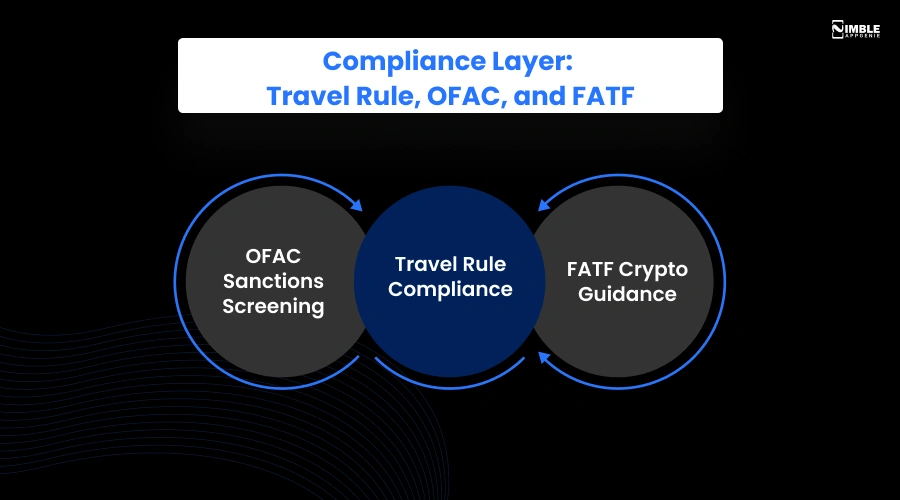
► OFAC Sanctions Screening
Checking wallet addresses against the US Treasury’s SDN list in real time, with AI-based fuzzy matching to catch obfuscated or near-match addresses that exact-match rules miss.
► Travel Rule Compliance
Sharing sender/receiver information for transactions above regulatory thresholds, a core requirement for any Virtual Asset Service Provider (VASP).
► FATF Crypto Guidance
The international framework most national regulators build their own crypto AML rules around.
Our AML transaction monitoring guide covers the fintech-side AML workflow if you need both layers integrated into one compliance program.
How Much Does It Cost to Build an AI Crypto Fraud Detection Platform?
An AI crypto fraud detection platform cost depends heavily on how many chains you support and whether you are licensing attribution data or building your own. Here is a realistic breakdown:
| Tier | Estimated Cost | Timeline | Includes |
| MVP
(single chain) |
$60,000 – $120,000 | 4 – 6 months | Single-chain node, basic clustering, a lightweight anomaly-detection model for wallet risk scoring, simple dashboard. |
| Mid-Tier
(multi-chain) |
$150,000 – $300,000 | 7 – 10 months | 3–5 chains, GNN-based clustering, KYT-style real-time API, case management. |
| Enterprise
(Chainalysis-like) |
$350,000 – $700,000+ | 12 – 18 months | 15+ chains, cross-chain tracing, LLM investigator copilot, legal-grade evidence export, multi-region deployment. |
► What Actually Drives Cost Here (And Makes This Costlier Than Typical Fintech Fraud Tooling)
- Running and maintaining full nodes across multiple blockchains
- Graph database infrastructure at scale
- Licensing or building entity-attribution datasets
- AI/ML development – training and retraining GNN and anomaly-detection models, plus ongoing MLOps, costs more than a rules-based engine and scales with the number of chains and the size of your labeled dataset.
- Legal review for multi-jurisdiction – Travel Rule and sanctions compliance
Build vs. Buy: Custom Platform vs. Licensing Chainalysis, TRM, or Elliptic
Once you know what platform needs to do, the next decision is who builds the AI and attribution layer – you or a vendor you license from. This is not only a budget question. It shapes how much control you have over your risk models, how quickly you can launch, and how much you depend on someone else’s data long-term.
Below is how the three paths stack up:
| Approach | Pros | Cons | Best For |
| License Chainalysis / TRM Labs / Elliptic data | Fast deployment, proven attribution accuracy | Ongoing license fees, limited customization, data dependency on a vendor | Exchanges needing compliance coverage fast |
| Build fully custom | Full ownership, tailored to your risk model, no recurring license cost long-term | Higher upfront cost, needs a specialized team, slower attribution-data maturity | Larger platforms planning to scale investigations as a core product |
| Hybrid | License attribution data, build your own AI layer and case management UI on top. | Still carries a data license cost | Most mid-size exchanges and compliance-first crypto platforms |
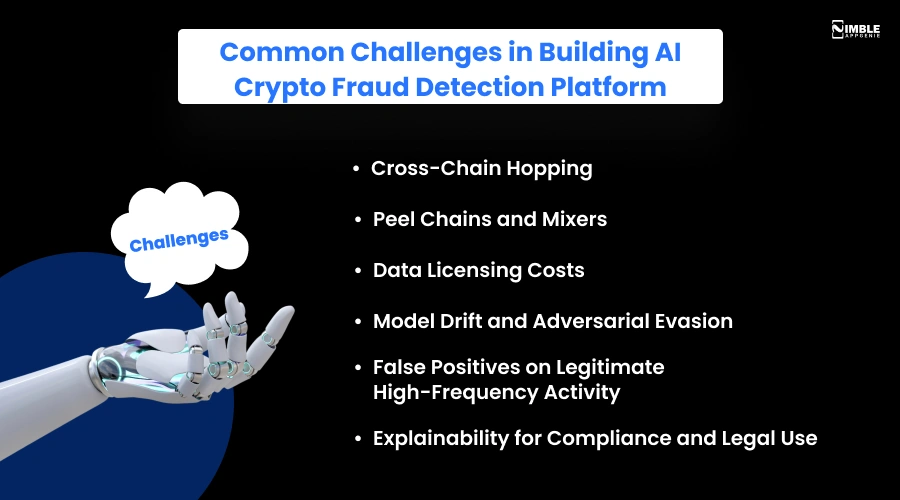
Common Challenges in Building AI Crypto Fraud Detection Platform
None of this is plug-and-play. Even with the right architecture and tech stack, teams building this in-house tend to run into the same six problems – some technical, some about the AI models themselves.
1. Cross-Chain Hopping
Funds moving through bridges and DEX swaps break the single-chain view. Cross-chain tracing has to be a first-class feature, not an afterthought.
Solution: Monitor bridge and DEX contracts directly and stitch wallet identities across chains at the data model level. So a single case view follows funds regardless of which chain they land on.
2. Peel Chains and Mixers
Criminals split funds across hundreds of small transfers to overwhelm tracing. Your graph engine needs to handle multi-hop queries fast enough to spot aggregation points before an investigator gives up.
Solution: Use a graph database purpose-built for multi-hop traversal (Neo4j, TigerGraph) and pre-compute clustering on known mixer patterns, so the engine flags an aggregation point in seconds rather than running a fresh trace each time.
3. Data Licensing Costs
Entity-attribution data (which wallet belongs to which exchange, known bad actor, or mixer) is costly to build and maintain; this is genuinely Chainalysis’s moat, not just their marketing.
Solution: Most teams don’t need to build this from zero – a hybrid approach that licenses a base attribution dataset while building proprietary labels on top keeps costs down without sacrificing coverage.
4. Model Drift and Adversarial Evasion
Laundering patterns shift as soon as bad actors learn what a model flags. GNNs and anomaly detectors need regular retraining on fresh labeled data, or accuracy quietly decays as fraud rings deliberately restructure transactions to slip under known thresholds.
Solution: Set up automated drift monitoring (via MLflow or Weights & Biases) that tracks model performance against fresh transaction data and triggers retraining on a schedule, not just when accuracy visibly drops.
5. False Positives on Legitimate High-Frequency Activity
Arbitrage bots and market makers can appear statistically similar to layering schemas. Tuning models to tell the two apart takes real transaction history, not only theory.
Solution: Feed the model a labeled dataset of known high-frequency wallets (market makers, exchanges) during training, and layer in behavioral rules, like constant counterparty patterns that catch what a purely statistical model misses.
6. Explainability For Compliance and Legal Use
A regulatory or court doesn’t accept “the model said so.” If a GNN flags a wallet, your platform needs to show the specific graph connections and behavior patterns that drove the score, not only a risk number, which means explainability has to be crafted into the model layer, not added after the fact.
Solution: Build explainability tooling (GNNExplainer, SHAP) into the risk-scoring layer from day one, so every flagged wallet comes with a plain-language trail of the connections and behavior that drove the score.
Why Build an AI Crypto Fraud Detection Platform Like Chainalysis With Nimble AppGenie
Building a crypto fraud detection platform touches blockchain infrastructure, AI/ML, and financial compliance at the same time – three specialists that rarely sit under one roof. That’s the gap Nimble AppGenie fills for fintech and crypto businesses.
- An in-house AI development team that builds the GNN and anomaly-detection models this platform actually needs, not generic fraud ML repurposed for crypto.
- Hands-on experience with on/off-ramp, exchange, and crypto wallet development, so we understand where fraud actually enters a crypto product.
- ISO 27001-certified delivery, with 350+ fintech and crypto solutions shipped across 50+ countries.
- Compliance built into the architecture from day one – OFAC screening, Travel Rule, and regional VASP requirements are not a phase-two conversion.
- Flexible engagement – MVP-first builds for startups, or full enterprise-grade platforms for exchanges and compliance vendors.
Conclusion
As we discussed, crypto fraud crossed $154 billion in illicit volume in 2025, and the platforms catching it – Chainalysis, Elliptic, and TRM Labs – all share the same underlying architecture: blockchain data ingestion, graph-based tracing, entity attribution, and AI risk scoring wrapped in a compliance layer.
Building your own version of that is not a weekend project, but it’s also not out of reach. Whether you are an exchange scoping MVP, a compliance vendor planning an enterprise build, or a fintech founder deciding whether to license data or build from scratch, the path forward starts with getting the architecture right before starting code.
If you want a second opinion on your scope, timeline, and cost before committing a budget, Nimble AppGenie’s team is happy to walk through it with you.
FAQs

Niketan Sharma, CTO, Nimble AppGenie, is a tech enthusiast with more than a decade of experience in delivering high-value solutions that allow a brand to penetrate the market easily. With a strong hold on mobile app development, he is actively working to help businesses identify the potential of digital transformation by sharing insightful statistics, guides & blogs.
Table of Contents




No Comments
Comments are closed.