

 Free Consultation
 PCI-DSS Compliant
 GDPR Ready
 ISO 27001
 NDA Protected
 AI Services
 AI App Development
 Generative AI Development
 AI Chatbot Development
 AI Integration Services
 AI Consulting Services
 AI For Fintech
 AI Financial Assistant Solution
 AI Insurance Agent Development
 Tech Stack
 OpenAI / GPT-4
 Claude / Anthropic
 Gemini / Google AI
 Llama / Open Source
 LangChain / LlamaIndex
 Pinecone / Pgvector
 AWS / Azure AI


 Fintech Solution
 Core Fintech
 App Development
 Neobank Solutions
 eWallet Solutions
 Lending Software
 Banking Solutions
 BNPL Solutions
 BNPL Solutions
 Insurance App
 Wealth Management
 Crypto & DeFi
 Blockchain Development
  Payroll Software
 DeFi Solutions
 Crypto Wallet
 Crypto On/Off Ramp
 Crypto Exchange
 Trading Platform
 Payments
 Compliance
 Regulations & Compliance
 Fraud Detection
 Lending Ecosystem
 P2P Lending Platform
 Mortgage Software
 Engagement
 Fintech Outsourcing

 Mobile Development
 Mobile App Dev
 iOS App Development
 Android App Development
 React Native
 Flutter Development
 Web Solution
 Node.js Development
 React.js Development
 Angular Development
 App Services
 UI/UX Design
 App Maintenance
 By Stage
 MVP Development
 Industry Solutions
 Healthcare App Dev
 Education App Dev
 Travel App Dev
 Real Estate App Dev
 Logistics Software
 Social Media App

 Hire Mobile Developers
 Hire iPhone Developers
 Hire Android Developers
 Hire React Native Devs
 Hire Flutter Developers
 Hire Web Developers
 Hire Node.js Developers
 Hire Angular Developers
 Hire PHP Developers
 Hire Laravel Developers
 How It Works
 Pre-Vetted Developers
 Ready In 48 Hours
 NDA From Day One
 Replace Guarantee
 Company
 About Us
 Our Work Process
 Portfolio
 Case Studies
 Blog / Insights
 Careers
 Contact Us
 Awards
 Recognition


 Offices



Key Takeaways:
- AI financial assistant apps like Cleo use AI-powered chatbots to help users manage budgets, track spending, and get personalized financial insights.
- The demand for AI financial assistant app development is growing fast because Gen Z and millennials prefer digital-first money management tools.
- Apps like Cleo, Dave, Albert, and Brigit are popular because they combine budgeting, cash advances, and smart financial planning in one app.
- To develop AI financial assistant apps like Cleo, businesses should focus on core features like expense tracking, budget planning, AI chat support, and bank account integration.
- Cash advance apps like Cleo are becoming popular alternatives to payday loans for users who need short-term financial support.
- AI fintech app development requires secure banking API integrations such as Plaid, along with strong encryption and compliance standards.
- The best tech stack for fintech app development includes React Native or Flutter, Node.js or Python, AI frameworks, and cloud infrastructure like AWS.
- The cost to build AI financial assistance apps like Cleo can range from $25,000 for an MVP to more than $300,000 for enterprise-level platforms.
- Fintech app security and compliance are critical and should include PCI DSS, GDPR, AES-256 encryption, and multi-factor authentication.
- A freemium subscription model, cash advance fees, affiliate partnerships, and premium financial tools are common ways to monetize AI budgeting apps like Cleo.
Why are millions of users turning to AI-powered finance apps instead of relying only on traditional banking platforms? Many people now expect instant spending insights, automated budgeting, and quick financial support without dealing with complex banking experiences or slow customer service systems.
This shift in user behavior has pushed many startups and fintech businesses to develop AI financial assistant apps like Cleo. This combines budgeting, expense tracking, AI chat support, and savings management into one mobile app.
The growing adoption of digital finance solutions is also creating huge business opportunities in the fintech sector. The US alone fintech market size is forecasted to cross $261.2 billion by 2032.
Thus, if you are planning to invest in AI financial assistant app development like Cleo, knowing the right features, tech stack, and process becomes important. Fret not! In this blog, we will discuss everything in detail to help you get started.
What is a Cleo App?
Cleo is an AI-powered financial assistance app that helps users to manage their finances through an interactive chat interface. It tracks users’ spending, helps them set budgets, and offers cash advances before payday.
Today, it is one of the most widely used money management apps among Gen Z and millennials in the United States. As of 2026, Cleo has more than 8 million users.
Here is how the Cleo AI app works:
- Users connect the bank account to Cleo through a secure API called Plaid.
- Cleo reads the transaction history in read-only mode.
- It uses AI to categorize users’ spending, like food, rent, etc.
- Then it gives them personalized tips, budgets, and insights through a fun chatbot interface.
- Premium users can also access cash advances of up to $100 and credit-building tools.
What makes Cleo stand out is not just what it does, but how it does it. The app uses humour, conversational language, and a roast mode that calls out users’ bad spending habits in a playful way. This approach makes budgeting feel less intimidating for younger users who are new to managing finances.
Why to Build AI Financial Assistant Apps like Cleo in 2026: Market Opportunity?
You might be thinking, the market already has apps like Dave, Albert, and dozens of other AI finance assistance apps. Is there still a gap for a new player? Well, yes of course. Here’s why:
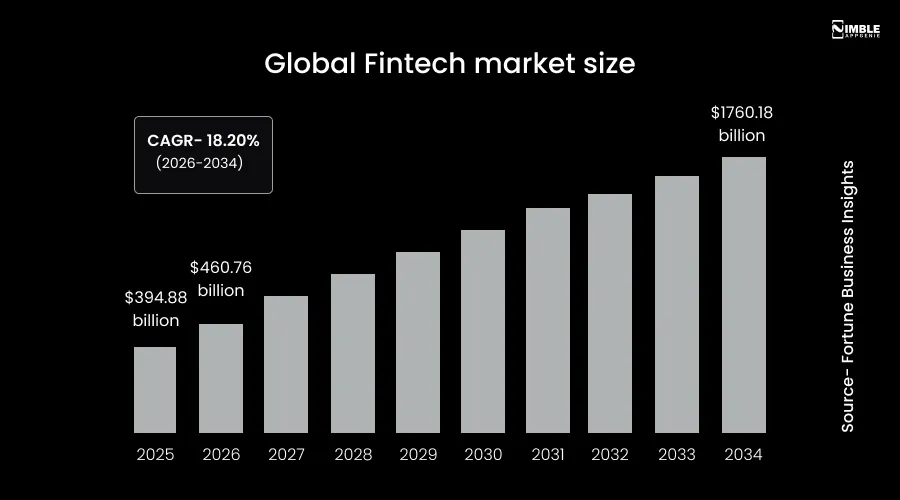
- The worldwide fintech market size is currently valued at $460.76 billion in 2026 and is forecasted to hit $1760.18 billion by 2034.
- Around 78% of financial firms have already implemented gen AI, which proves the demand is real and growing.
- More than 46% of Americans leverage AI tools like ChatGPT, particularly for budgeting and personal finance, and around 50% for financial advice.
- Millennials and Gen Z strongly prefer digital-first, AI-powered financial tools over traditional banking.
- Many users are still underserved. Loan apps like Cleo and other money apps are filling a real gap for people who want short-term financial assistance without high-interest payday loans.
2026 is being called an inflection point for AI in fintech. Early movers who build well-designed AI-driven personal finance apps now will have a major head start before the market becomes crowded.
Top AI Financial Assistant Apps like Cleo: What Sets Them Apart?
Understanding the competition is just as important as knowing what you want to build. Here is a quick look at the major cash advance apps like Cleo and Dave currently in the market. Let’s take a look at the table below:
| App Name | Main Purpose | Google Play Downloads | Ratings | What Makes It Unique |
| Dave | Cash advances and budgeting help | 10M+ | 4.6 | “Banking for Humans”, ExtraCash advances up to $500, no overdraft fees, and job board integration. |
| Albert | AI financial advice and saving tools | 5M+ | 4.5 | Automated savings, human financial advisors, Genius subscription, broader financial planning |
| Brigit | Budget tracking and instant cash advances | 5M+ | 4.8 | Predictive overdraft protection, credit monitoring, up to $250 advances, and it focuses on a financial safety net |
| Plum | AI savings and smart investing app | 1M+ | 5.0 | AI-driven micro-savings and investing, popular in the UK, is expanding globally |
| Oportun | Automatic savings and budgeting | 1M+ | 4.0 | Automated savings by analyzing spending patterns. |
| MoneyLion | Banking, investing, credit builder, and cash advances | 5M+ | 4.5 | All-in-one: banking, investing, borrowing, and financial content, super-app approach |
The key insights from studying other cash advance apps like cleo is this: the most successful ones do not try to do everything.
They choose a strong niche, no matter if it is a cash advance, automated savings, or credit building, and do it exceptionally well. When you develop AI financial assistant apps like Cleo, it is vital to identify your differentiator early.
Key Features of AI Financial Assistant App Development Like Cleo
Not all features are created equal. When you develop AI financial assistant apps like Cleo, you need to focus on features that users actually use and increase user retention. The table below showcases the crucial AI fintech app features that you must take into consideration.
| Feature | Description | Why It Matters |
| AI-Powered Chat Assistant | A smart chatbot that helps users manage money through simple conversations. | Makes financial management easy and more engaging for users. |
| Cash Advance | One of the biggest draws for a cash advance is the ability to get a small amount of money before payday. | This feature is incredibly popular among young users who occasionally need short-term financial support. |
| Expense Tracking | Automatically tracks and categorizes daily spending. | Helps users understand where their money goes and control unnecessary expenses. |
| Budget Planning | Allows users to create monthly or weekly budgets. | Helps users stay within spending limits and improve savings. |
| Bank Account Integration | Connects securely with bank accounts and cards. | Gives users a complete view of their financial activity in one place. |
| Bill Payment Reminders | Sends alerts for upcoming bills and due payments. | Prevents late payment fees and improves financial discipline. |
| AI-Based Spending Predictions | Predicts future expenses and spending trends using AI. | Helps users plan finances more effectively and avoid overspending. |
| Smart Notifications | Sends real-time alerts for unusual spending, low balance, or savings progress. | Keeps users informed and improves financial awareness. |
| Voice Assistant Support | Enables users to manage finances using voice commands. | Improves accessibility and makes the app easier to use. |
| Investment Tracking | Tracks stocks, crypto, mutual funds, and other investments. | Helps users monitor portfolio performance in real time. |
| Debt Management Tools | Helps users track loans, EMIs, and repayment schedules. | Makes it easier to manage debt and avoid missed payments. |
| Cashback & Rewards Tracking | Tracks rewards, cashback offers, and loyalty points. | Helps users maximize savings and benefits from spending. |
| Goal-Based Financial Recommendations | Suggests saving or investment plans based on user goals. | Makes financial planning more personalized and practical. |
How to Develop AI Financial Assistant Apps Like Cleo?
To create an AI financial Assistant application like Cleo, you have to follow the complete process from market analysis, plan features, choose tech stack, build API, to testing and launch. Are you ready to build? Below is the step-by-step process that top mobile app development companies follow:
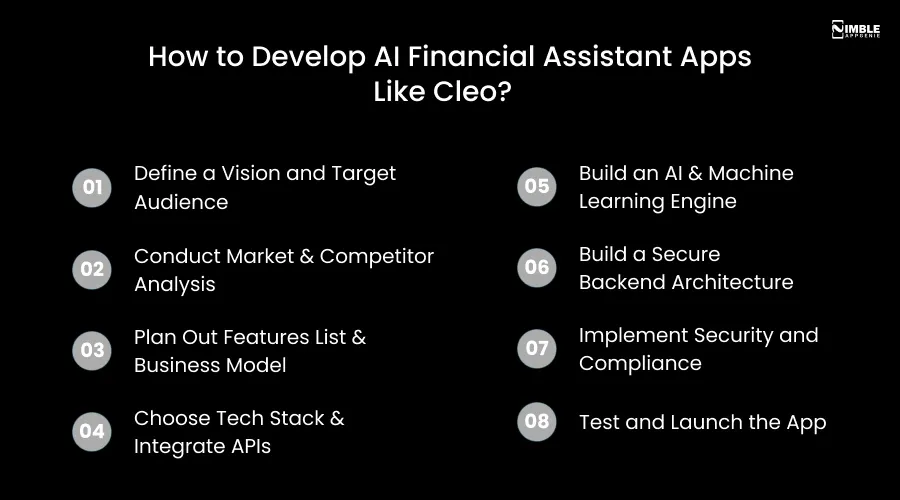
Step 1: Define a Vision and Target Audience
Firstly, you should start with the basics. Who is your app for? Gen Z users who need cash advances before payday? Small owners who want expense tracking? Working professionals who want investment guidance? The answer shapes every decision that follows.
Ask yourself whether you will focus on budgeting, savings, cash advances, credit building, or all of the above with an AI-powered personal financial assistant. A focused MVP is always better than a bloated first version.
Step 2: Conduct Market & Competitor Analysis
Now thoroughly do market research and analyze existing cash advance apps like Cleo, Dave, Albert, and Brigit. Check for the gaps in the market and grab the opportunity by building an AI-driven app that offers smarter money management and predictive spending alerts.
What are users complaining about in reviews? What features are missing that you could provide? You can use tools like Google Trends, App Store reviews, and Reddit communities to collect real user feedback.
Step 3: Plan Out Features List & Business Model
You have to list your must-have features for the MVP and full-fledged version. Also, decide your monetization strategy upfront. Will you use a freemium model, subscription tiers, affiliate partnerships, or a combination?
Most successful AI-driven and best budgeting apps use a freemium model, free core features with premium upgrades. This reduces the barrier to entry while creating a clear path to revenue.
Step 4: Choose Tech Stack & Integrate APIs
This is where the technical decisions get made. Your fintech app tech stack should be modern, scalable, and secure. We will cover the full recommended tech stack in the next section.
Additionally, the first major technical milestone is connecting your app to users’ bank accounts. You will need to integrate Fintech APIs. These APIs provide secure, real-time access to transaction data and support thousands of banks.
Your app should never store raw banking credentials. Besides. Use the API provider’s secure token system to keep user data safe. This is both a security requirement and a trust-building signal.
Step 5: Build an AI & Machine Learning Engine
This is where your app gets smart. The AI engine is responsible for:
- Categorizing transactions automatically
- Predicting future spending based on historical patterns
- Generating personalized financial insights and recommendations
- Powering the natural language chatbot interface
- Detecting unusual spending patterns and sending proactive alerts
You do ot need AI development models from scratch. You can use pre-trained models and frameworks for the prediction and categorization engines. This can reduce development time by 30-40%.
Step 6: Build a Secure Backend Architecture
Your backend is the engine that powers everything to develop AI financial assistant apps like Cleo. It needs to handle secure data storage, complex AI calculations, API calls to banking providers, and real-time push notifications, all simultaneously.
You can use cloud infrastructure from day one. Now design a microservices fintech app architecture so individual components can be updated or scaled independently as your user base grows.
Step 7: Implement Security and Compliance
This is non-negotiable in fintech. Your app must comply with financial regulations and mobile app data privacy compliance. This includes:
- PCI DSS compliance for handling payment data
- 256-bit AES encryption for data at rest and in transit
- Multi-factor authentication for user accounts
- GDPR compliance and CCPA compliance
- Regular third-party security audits and penetration testing
Step 8: Test and Launch the App
Before launch, your AI financial assistance app should go through functional testing, security testing, performance testing, and user acceptance testing.
Financial apps have zero tolerance for errors; a bug that incorrectly reports a balance or sends a wrong notification can destroy user trust instantly. Now, start with a soft launch or beta program to collect real-world feedback.
You can use analytics tools to monitor user behaviour, retention rates, and feature usage. The best fintech apps today got great through constant improvement, not by getting everything right on day one.
Tech Stack for Building a Cash Advance App Like Cleo
To build AI financial assistant apps like Cleo, you need a good fintech tech stack that supports AI-powered chatbots, secure banking integrations, real-time data processing, smooth mobile performance, and high-level financial security. We have created a table of the tech stack we use for an AI fintech project.
| Layer / Component | Recommended Technologies |
| Frontend (Mobile) | React Native or Flutter to build once, deploy on both iOS and Android |
| Frontend (Web Dashboard) | React.js or Vue.js for fast, component-based interfaces |
| Backend / API | Node.js or Python (Django/FastAPI) for fast, scalable, great ecosystem |
| AI & Machine Learning | TensorFlow, PyTorch, OpenAI GPT (for chatbot NLP) |
| Banking API / Open Banking | Plaid (primary), Yodlee (alternative) |
| Database | PostgreSQL (relational data), MongoDB (unstructured data), Redis (caching) |
| Cloud Infrastructure | AWS, Google Cloud Platform, or Microsoft Azure |
| Security & Authentication | OAuth 2.0, JWT tokens, AES-256 encryption, 2FA |
| DevOps / CI-CD | Docker, Kubernetes, GitHub Actions |
| Analytics | Mixpanel and Amplitude for tracking user behavior and feature adoption |
| Push Notifications | Firebase Cloud Messaging (FCM) |
| Credit API Integration | Equifax, Experian, or TransUnion APIs for credit score features |
How Much Does It Cost to Build AI Financial Assistance Apps Like Cleo?
The cost to develop AI financial assistant apps like Cleo can range between $25,000-$300,000. This cost is just the ballpark figure. It varies depending on app complexity, features, number of platforms, compliance requirements, and so on.
Basically, the cost to build a fintech app like Cleo depends on what you want to build. You can check out the table below that depicts the different app types and their estimated cost and timeline.
| App Type | Estimated Breakdown | Timeline Estimates |
| Basic MVP (core features only) | $25,000-$50,000 | 2-4 months |
| Mid-level App (chatbot + budgeting + cash advance) | $50,000-$120,000 | 4-7 months |
| Full-featured App (all Cleo features + more) | $120,000-200,000 | 7-9 months |
| Enterprise-grade Platform | $300,000+ | 9+ months |
Apart from these estimated costs, there are many other factors that can affect the final budget of an AI financial assistant app like Cleo. Take a look:
- Number of features in the MVP vs. the full version
- Complexity of the AI and ML models
- Number of platforms
- Level of UI/UX customization
- Compliance requirements
- Location of your development team
- Ongoing maintenance and updates after launch
To reduce the initial Cleo app development cost, you can start with an MVP version. Gradually add advanced features based on user feedback and market demand.
How to Monetize an AI Budgeting App like Cleo?
AI budgeting apps like Cleo can generate revenue through subscription plans, cash advance fees, affiliate partnerships, premium financial tools, etc. Let’s determine the most effective revenue models for financial assistance applications like Cleo:
| Revenue Model | How It Works |
| Freemium + Subscription | Free basic features; charge for premium, most common, and scalable |
| Cash Advance Fees or Tips | Optional tips on cash advances; small but adds up at scale |
| Affiliate & Partner Revenue | Recommend credit cards, insurance, or investment platforms; earn commission on sign-ups |
| Interchange Fees | Earn a small fee each time a user purchases with an in-app card |
| In-app Advertising | Relevant ads from financial partners it use sparingly to avoid damaging UX |
| Premium Financial Services | Credit building tools, high-yield savings accounts, financial coaching, recurring revenue |
Compliance & Security for Fintech App Development like Cleo
Fintech applications manage the most sensitive data in a person’s life, their money. This is why security and compliance are not optional.
If you skip or cut corners here, it will kill your app either through data breaches, regulatory fines, or simple loss of user trust. Below are the major fintech regulations and mobile app data privacy compliance that you must take into consideration.
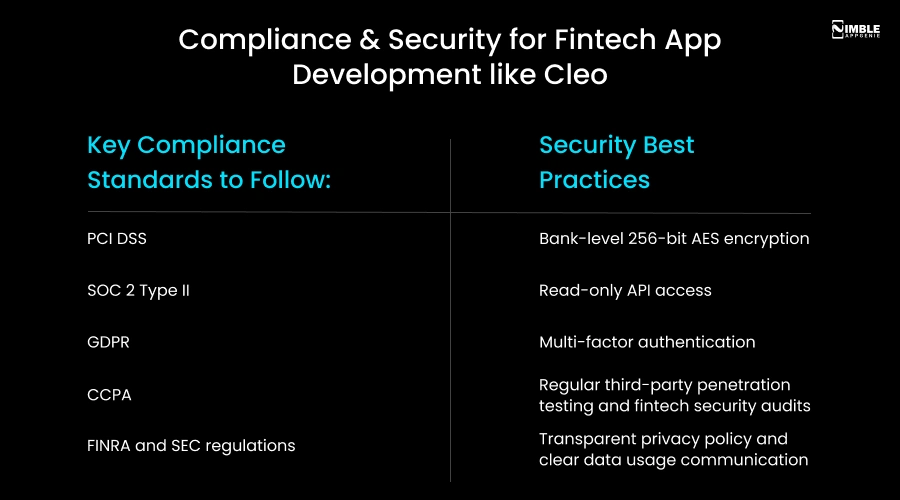
1. Key Compliance Standards to Follow:
- PCI DSS: It is required for handling card data.
- SOC 2 Type II: It demonstrates ongoing security controls.
- GDPR: If you serve users in the European Union, it is required.
- CCPA: If you collect data from California residents, it is mandatory.
- FINRA and SEC regulations: If your app offers investment features.
2. Security Best Practices:
- Bank-level 256-bit AES encryption for all data
- Read-only API access, the app can never initiate transactions
- Multi-factor authentication for all user accounts
- Regular third-party penetration testing and fintech security audits
- Transparent privacy policy and clear data usage communication to users
How Nimble AppGenie Can Help You Build a Cleo-like App?
Developing a fintech application is quite exciting, but it is also complex, technically challenging, and comes with real regulatory responsibilities. That is why Nimble AppGenie is the perfect choice.
As a top fintech app development company with deep expertise in fintech, AI, and custom solutions, we have helped startups, scaleups, and established businesses bring their app ideas to life, from initial concept to full-scale solutions.
Here’s how we help you at every stage:
- We help you define your app’s vision, features, target audience, and monetization model.
- Our designers create conversational, engaging interfaces that your users will love.
- We create smart chatbot engines, spending categorization models, predictive analytics in finance, and personalized recommendation systems.
- Our expert developers manage API integration and payment gateways, so your app connects to the real financial world.
- We implement bank-grade security, help you navigate PCI DSS and GDPR requirements, and make your app for audit readiness from day one.
- Our skilled developers design cloud-native, microservices-based backends that scale with your user base.
- We do not disappear after the app goes live. Our team offers ongoing maintenance, feature updates, and performance optimization.
Whether you are at the idea stage or start development tomorrow, Nimble AppGenie is your trusted technology partner for developing scalable AI personal financial assistance apps.
Conclusion
The success of Cleo, Dave, and other AI-powered financial apps proves one thing: people are desperate for smarter, friendlier ways to manage their money.
The traditional banking experience is replaced by conversational AI, automated savings, and on-demand cash access, and the market is far from saturated.
Thus, if you want to develop AI financial assistant apps like Cleo or a niche budgeting tool for a particular audience, the opportunity is enormous.
So, the key is to start with a clear vision, build on the right tech stack, prioritize security and compliance, and design an experience your users will genuinely love. With the right dedicated development team, you can go from idea to live app in a few months.
FAQs

Niketan Sharma, CTO, Nimble AppGenie, is a tech enthusiast with more than a decade of experience in delivering high-value solutions that allow a brand to penetrate the market easily. With a strong hold on mobile app development, he is actively working to help businesses identify the potential of digital transformation by sharing insightful statistics, guides & blogs.
Table of Contents




No Comments
Comments are closed.